
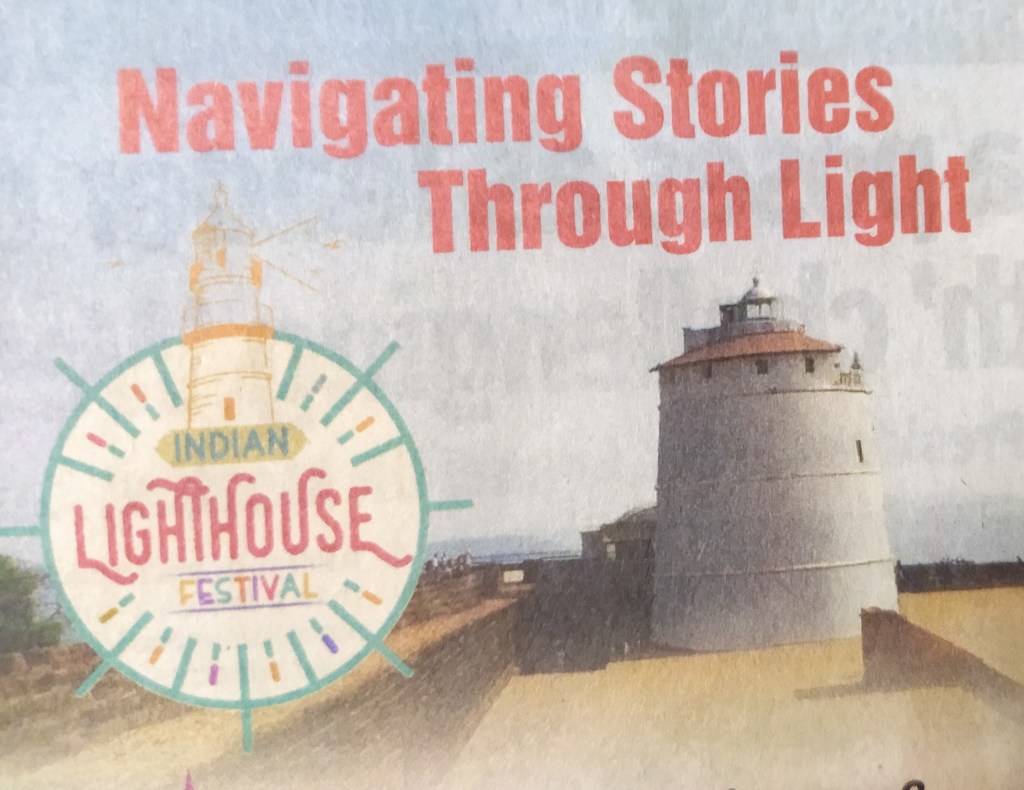
As the country gears up for Diwali, the Festival of Lights, India recently celebrated its first Lighthouse Festival. This is the first time that the spotlight is on lighthouses in India. The festival which was flagged off at Goa’s historic Fort Aguada, is aimed at rejuvenating the rich maritime history of 75 iconic lighthouses of the country, and promoting lighthouses as tourism destinations.
In a country which is so rich in the wide range of world-renowned monuments, spanning different eras and styles of architecture, there has not been much attention on lighthouses as heritage structures. Although there are nearly 200 lighthouses dotting the coast of India, not much is known about them, nor are they high on tourists’ itineraries. However the history of lighthouses in India is long and interesting.
The building of lighthouses in India is generally attributed to the colonial rule. The British, as well as the Portuguese and Dutch who ruled some of the coastal parts of the empire developed and constructed lighthouses at strategic points along the coastline. But India’s maritime history goes back much further, and where ships sailed, there must have been systems to guide them. There are sources that indicate that lighthouses also existed long before.
It is believed that lighthouses were built in India in the 3rd century BC by Emperor Asoka who was a contemporary of Ptolamy II, the Egyptian king who built the famous lighthouse—the Pharos of Alexandria which is the first known lighthouse, constructed between 300 and 280 BC. This was one of the Seven Wonders of the Ancient World.
The first known lighthouse in India was at Puhar Port in Kaveripatnam, an ancient South Indian port city. The famous Tamil writer Illango Adigal of 5-6 century AD in his book Silappadhikaram (one of Tamil literature’s Five Great Epics) had explained in detail about the beautiful lighthouse on the Bay of Bengal coast, and the numerous ships anchored at Puhar port, which was doing brisk business those days.
After the invasion of the Indian subcontinent by the Portuguese, Dutch and the English, trade and commerce through sea increased several folds, and over a period of time, lighthouses were built all along the coastline of the Indian subcontinent to guide the seagoing vessels as they approached the coast. These lights were maintained by the local rulers and port authorities.
As ports became busier, the need was felt for more navigation lights. At Colaba, the entrance to Bombay, the chief seaport of the time, the light was provided by a moored light vessel off the coast in 1842. In 1847, first lighthouse was constructed on Colaba point with a revolving light that gave a bright flash every two minutes. The next lighthouse to be constructed was at Karachi port in 1851. This was followed by a lighthouse on Piram Island in the Cambay Gulf, and then on the north mouth of the river Tapti, which was called the Hazira lighthouse. In 1856 a number of other lighthouses were constructed at important points along the western coastline of India. Among these was the lighthouse at Fort Aguada in Goa, which was the venue of the recent Lighthouse Festival.
The construction of lighthouses continued further south along the Malabar Coast through the nineteenth century. A similar exercise was also under way along the eastern coastline from Calcutta down to Madras. As the number of lighthouses increased, it became essential to establish an authority to control and maintain these lights. After detailed discussions and consultations, it was decided to constitute a Lighthouse Department in British India (with jurisdiction extending from Aden to Rangoon). The Governor General of British India gave approval to the Lighthouse Bill on September 21, 1927, and the Lighthouse Department was constituted. To commemorate this, every year 21 September is celebrated as Lighthouse Day in India.
Initially the department had control of 32 lighthouses. Today India has nearly 200 lighthouses, some of which are centuries old, which continue to be regulated by the Lighthouse Act of 1927. These range from the ancient now crumbling edifices; those painted with traditional red and white stripes, to imposing modern steel structures. Only a few of the original structures remain, some have been repaired as heritage structures, while several new automated towers have come up. Many are equipped with modern radar infrastructure, and equipment to collect weather data. The lighthouses are administered by the Directorate General of Lighthouses and Lightships, under the Ministry of Ports, Shipping and Waterways of the Government of India.
For many of us lighthouses are something that we associate with stories of smugglers, shipwrecks and rescues, or one of the many sights that we may take in as part of a seaside holiday. My own association with lighthouses stems back to the adventures of Enid Blyton’s Famous Five; and the rotating light that arched through the night sky on our summer holidays in Diu. But there is a serious global community of lighthouse lovers who study lighthouses. The scientific study of lighthouses and signal lights, their construction and illumination is called Pharology or pharonology. The term has its roots in the ancient Greek pharos (meaning lighthouse) and logos (discourse). Pharos was also the name of the famed lighthouse of Alexandria. These lighthouse enthusiasts or pharologists, not only study and document lighthouses around the world, they also work to promote the cause of lighthouses and light vessels. They are members of the World Lighthouse Association, and share their passion through the Lighthouse Digest.
D Hemachandra Rao, a retired engineer of Chennai turned his hobby into an ‘epic lighthouse yatra’ by journeying across India to visit and document every functional and non-functional lighthouse on the Indian coastline. Starting when he was in his mid-seventies, Rao travelled extensively along India’s coastline, sharing his descriptions and pictures of his findings through his Facebook Timeline. Known as the Lighthouse Man, Hemachandra Rao passed away in June 2022 at the age of 82, leaving behind a rich legacy in the form of a Maritime Heritage Museum that he set up in his house in Chennai. The museum includes hundreds of photographs of the lighthouses that he had visited.
Mr Rao believed that lighthouses had relevance even in the age of satellite technology. He said “the small light, coming from distance, still navigates the humble fishermen… even today we hear stories of fishermen coming to the shores safe led by the small light”.
There is no fog so dense, no night so dark, no gale so strong, no mariner so lost but what its beacon light can rescue. It beckons through the storms of life. It calls, ‘This way to safety; this way to home’. Thomas S Monson
–Mamata
 Millennial Matriarchs