
May 1 is marked as International Labour Day to commemorate the struggles of workers, and labour movements, and celebrate their role in society. In Gujarat the day has an added significance as Gujarat Foundation Day. May 1 marks the day that two new states–Gujarat and Maharashtra were carved out of the erstwhile Bombay state in 1960.
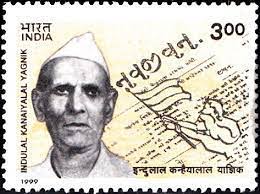
One name that it intrinsically linked with this historic moment is that of Indulal Yagnik who spearheaded the movement for a separate state of Gujarat. Indulal was the founder president of the Mahagujarat Janata Parishad that launched the movement which came to be known as the Mahagujarat Movement, in 1956. But Indulal’s activism well preceded this phase of his life which spanned many significant periods in Indian political life. A life that was not limited to public engagement, but also covered a wide range of interests, and contributions including to journalism, literature, and films.
Indulal was born in 1892 in Nadiad in Gujarat, and completed his higher education in Bombay, graduating with BA as well as LLB degrees. He chose the world of words rather than laws, and started his journey as a translator with Mumbai Samachar, a Gujarati daily, and as contributor to a well-known Gujarati monthly magazine. He began to associate with radical nationalists like Shankarlal Banker, and young lawyers like KM Munshi and BG Kher. He was also deeply influenced by Annie Besant and the Home Rule League, which advocated for self-government for India within the British Empire. In the meanwhile his own thinking was becoming more nonconformist in terms of social norms.
He was always a risk-taker. When Madam Bhikaji Cama became the first person to hoist the Indian tricolour on foreign soil at the International Socialist Conference at Stuttgart in Germany, on 22 August 1907, it was the young socialist Indulal Yagnik who smuggled that flag back to India.
Gandhi’s return to India from South Africa in 1914 drew Indulal into a new cause. By 1915, Indulal launched a Gujarati monthly along with his friends Shankarlal Banker, KM Munshi and Ranjitram Mehta. He contributed to the English magazine Young India and when Gandhi it took over, Indulal moved to Ahmedabad in 1915 to work for him.
When the British government decided to dispatch a team of eight editors—four English and four Indians to Mesopotamia (now Iraq) in 1917 to investigate allegations of mistreatment of Indian soldiers during World War I, Indulal was selected as one of them.
In 1917, he was involved in famine relief in the villages of Ahmedabad district. Indulal was an active participant in Gandhi’s 1918 Kheda Satyagraha, a resistance movement against oppressive land taxes for farmers. He was also, with Gandhi, a part of the move to establish Gujarat Vidyapith, an institution of higher learning. He made Ahmedabad the base for his public and political activities, even as he travelled widely, connecting with the most downtrodden and oppressed communities.
While he was close to Gandhi and Sardar Patel, and worked tirelessly for the ongoing satyagraha movement, Indulal was a much more vociferous advocate of the rights of the marginalized and oppressed communities. This often created clashes of opinion and approach. He also had a fiery and mercurial temperament which led him to act impulsively. While in 1923 he had shared a prison cell with Gandhiji, in 1924 Indulal completely withdrew from nationalist activities and relocated to Bombay where he became editor of a communist-published paper. His socialist-communist perspective led him to write a harsh critique of the 1928 Bardoli Satyagraha in this paper.
Subsequently, he distanced himself from both communism as well as the nationalist struggle and the Congress party, and forayed into films. He began in 1926, by translating the titles for the film The Light of Asia into Gujarati. He then began writing about films for different magazines and newspapers, and himself wrote short stories for a few silent films. He even produced a few films. However his stint as a producer was neither successful nor profitable.
Indulal returned to the nationalist movement. This time he took on the role of championing its cause abroad. He travelled to Britain and Germany where he wrote articles and pamphlets. He also got involved with revolutionaries in Ireland and activists in England. He was in England when Gandhiji was attending the Second Round Table Conference in 1931.
After five years abroad Indulal returned to India in 1935. Now he became an active advocate for famers’ rights, and in 1936 was instrumental in the formation of the All India Kisan Sabha, and led the Gujarat chapter of the Kisan Sabha. The world was in the throes of the Second World War. His anti-war activities were deemed disruptive to public order and he was imprisoned in 1940. Upon release in 1941, he dedicated himself to establishing ashrams and schools in areas where there were none. The ashram that he established on the banks of the Vatrak river became his own base, and it is here that he celebrated India’s Independence on 15 August 1947.
When the movement for a separate state of Gujarat was gaining momentum in 1956, the activist in Indulal surfaced again. ‘Indu Chacha’ became the mover and shaker of the Mahagujarat Movement. During this period he once again distanced himself from the Congress party, and established a political party called Mahagujarat Janata Parishad, which achieved significant electoral success. The party was dissolved after the formation of Gujarat state on 1 May 1960. Indulal then founded the Nutan Mahagujarat Janata Parishad.
Indu Chacha was very popular himself, appealing to working class and middle class voters alike. He was elected from the Ahmedabad constituency to the Lok Sabha for four consecutive terms starting from 1957 to 1971. He continued to maintain his almost spartan lifestyle until he passed away in 1972.
Indulal’s life story was closely linked to the political events of Gujarat and the world of that time. His six-volume autobiography Atmakatha, written in phases at different points of his life, is a valuable resource to understand the socio-cultural and political history of Gujarat. He dedicated the book to the “bright and fragrant flower-like people” of Gujarat. As a fellow Gujarati, Indu Chacha’s story gives a peep into the people and events that led to the creation of Gujarat.
On a more personal note, Indu Chacha was a friend of my parents, and I have memories of his dropping in to see them when we lived in Delhi in the late sixties, and relishing hot jalebis with milk! He must have been in his last term as member of the Lok Sabha then. As the state of Gujarat goes to the polls next week, Indu Chacha is still remembered.
–Mamata
 Millennial Matriarchs