

The last month has been unusual in that we have had more knocks on the door by our post lady than by couriers. In the last few years one had become so used to sending and receiving letters and parcels through courier services that we had almost forgotten what an important part post offices and postal services had played in our lives. In the days of ‘life in the slow lane’ the process of hand-writing letters, finding appropriate envelopes, going to the neighbourhood post office to get stamps, and slipping the letter in the post box afforded a great sense of satisfaction. Equally wonderful was the anticipation of receiving letters of response, and other exciting missives announcing results, admission notices, job interviews, and news from near and far. We didn’t consciously realize it then, but the postal service was an integral part of our life.
The history of the postal communication in India dates back to ancient times of kings who used to convey important messages, especially wartime news, through a relay of runners on foot. During the reign of Emperor Chandragupta Maurya, trained pigeons with small cachets of letters tied to their feet were used to send communications across the vast kingdom. This system of ‘pigeon post’ continued even during the time of Emperor Ashoka. The Mughals used a system of runner services which expanded to include horses. Horses were stationed at relay posts every few miles, and the messages were passed on from horseman to horseman. During the reign of Sher Shah Suri it is believed that there were 3400 horses with riders all along the Grand Trunk Road, for conveyance of news.
Post offices, as we know them, were first established in India by the East India Company. The Company opened its first post office in 1727 and the postal service was administered with the main aim to serve their own commercial interests. The post service was opened to the public in March 1774 with the establishment of the Calcutta GPO. This was followed by the opening of the Madras GPO in 1786, and then the Bombay GPO in 1794, and the Bangalore GPO in 1800. The Post Offices were manned by the respective District Collectors or military officers acting as ex-officio Postmasters.
In addition to managing the postal services of British India, the Post Office was involved in the transmission of correspondence between England and India. This was done by the sea route, and one way travel time was up to three months. In the 1820s Thomas Waghorn, then a naval officer with the East India Company, investigated a possible overland route between Alexandria and Suez, which could cut down the time to just over a month. It took ten years for the British Government and East India Company to be convinced of the viability of this route, which it subsequently took over.
Lord Dalhousie appointed a Post Office Commission in 1850 and the approved recommendations of Commission were framed as Post office Act XVII, 1854. Under this Lord Dalhousie recognized the Indian Post Offices as separate organization of national importance. 700 Post offices which included what were called 55 Receiving Houses were placed, for the first time, under the unitary control of a Director General, Henry Phillip Archibald Buchanan Riddell, on 1st October 1854. The Head Quarters was at Bengal, and was responsible to Home Department of the Government of India.
Roadways were at the time the main form of transporting post. The first line of postal communication by railway was opened from 18th September 1854. Mail service by steamer was introduced between Calcutta and Port Blair on 28 May 1859. And it was in India that the world’s first official “airmail” was operated on 21 February 1911 when Henri Pequet, a French pilot flew a biplane carrying 6500 pieces of mail from Allahabad to Nainital—a distance of six miles.
The Indian Postal Service has come a long way since then, to become the world’s largest postal network managing more than one-and-a-half lakh post offices. The postal department has met the challenges of India’s diverse geography, catering innovatively to remote areas. There is a floating post office in a houseboat on the Dal Lake in Kashmir; and the world’s highest post office in a small cottage in Hikkim district in Himachal Pradesh. The Nagpur Post Office is located in a large Victorian-style heritage building which accommodates the post master’s residence, a parcel hub, a postal depot, a recreation club, and a canteen. And there is a small metal post box among the tea plantations of Munnar in Kerala which has been used for a hundred years now. Known simply as Postal Number 9, the oldest postal number in the country, the post office continues to deliver mail to thousands of plantation workers.
The Indian Postal Service does much more than delivering mail. It offers a range of other services that help reach out to people and places which do not have access to variety of institutions like banks and other agencies. The post office remits money in the form of money orders (which is the only way of sending money for many Indians). The Postal Department also offers a variety of small savings schemes. It provides life insurance coverage under Postal Life Insurance and Rural Postal Life Insurance. It also plays an important role in discharging government services such as payment of pensions to senior and retired citizens. Wages under government welfare MGNREGA are also distributed through post offices. During the COVID lockdown the red postal vans were even used to deliver medical equipment like N95 masks, medicines, test kits and ventilators across states as part of their “essential services”.
My family has had pleasant experiences with India Post in the past few years. From efficient despatch and delivery of parcels both within the country, and even overseas (all the way to New Zealand!), to the Speed Post with its online Track and Trace (that is sometimes overzealous in informing about the journey of the post), it is indeed a service that calls for respect. This year we could also avail of the home visit by Postal Staff for taking biometrics of my 97 year-old father-in-law for his Jeevan Praman (Life Certificate for continuing pension).
No wonder then that the post office (dak khana) and the postman (dakiya) on his trusted bicycle were always a component of “village life” in stories and movies in the past. Even today, when we get message on our phone that Tinuben our post lady is on her way to deliver a speed post, we await her scooter and her knock on the door. From pigeon post to speed post, India Post has come a long way indeed!
–Mamata
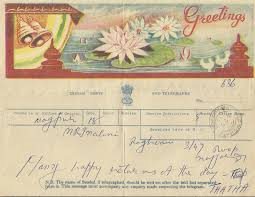 The last telegram in India was sent at 11.45 p.m. on the 14th of July, 2013. The telegram service in the country started in 1850 on an experimental basis, and was made available to the public in 1854. It connected us across the vast country, the harbinger of joys and sorrows. The arrival of a telegram definitely did give rise to butterflies in the stomach and a rise in blood pressure.
 Millennial Matriarchs