
Have you ever sat through a meeting where someone confidently proclaimed an idea that made you wonder if you were the only one who found it… well, questionable? Or listened to a neighbour explaining, with great authority, how to “fix the economy” or “end corruption,” in the time it takes for the traffic light to change?
Chances are, you’ve witnessed the Dunning–Kruger Effect in action — that quirk of human psychology where people with limited knowledge or skill in an area tend to overestimate their competence. Ironically, the more ignorant we are about something, the more certain we can feel about our opinions.
The term comes from two psychologists, David Dunning and Justin Kruger, who in 1999 published a study with the rather unexciting title “Unskilled and Unaware of It.” They were intrigued by a bizarre news story about a man who robbed banks after rubbing lemon juice on his face, believing it would make him invisible to security cameras. The man wasn’t joking — he genuinely thought he had found a clever loophole. Dunning and Kruger wondered how someone could be so wrong and yet so sure.
Their research showed that people who perform poorly on tests of logic, grammar, or humour not only make more mistakes — they also lack the skill to recognise those mistakes. In contrast, the truly competent often underestimate themselves, assuming that if something is easy for them, it must be easy for everyone.
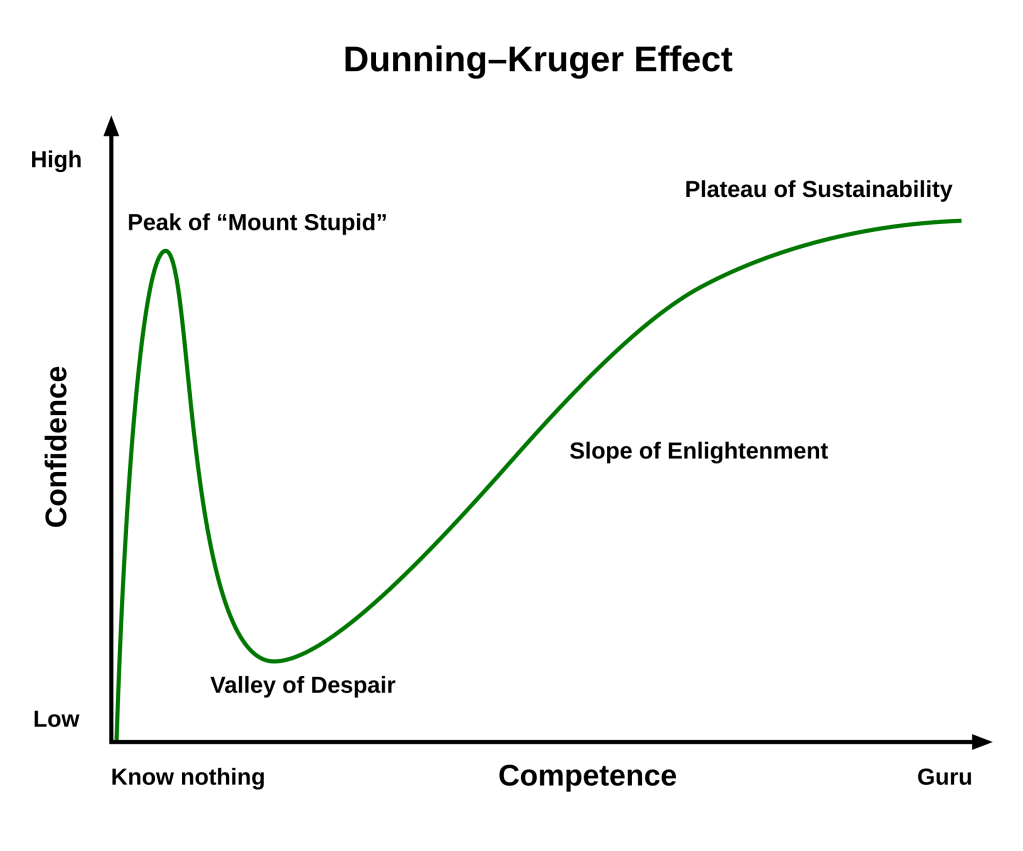
So we end up with a world divided between the confidently incompetent and the competently cautious.
If this sounds like a comment on social media, well……. Platforms like X (formerly Twitter) and Instagram stories are veritable festivals of the Dunning–Kruger Effect — where the loudest voices are often the least informed. Whether it’s miracle diets, “instant wealth” advice, or armchair experts diagnosing global issues, confidence is never in short supply. Accuracy, on the other hand, might need a search party.
But before we roll our eyes at others, it’s worth pausing. The uncomfortable truth is that we’ve all been there. Remember that time you confidently assembled a piece of IKEA furniture without reading the instructions — and then found one mysterious screw left over? Or when you tried to give a five-minute explanation of blockchain to someone who actually works in finance? Yes, that too is Dunning–Kruger territory.
What makes this effect particularly sneaky is that it feeds on self-assurance. It feels good to be certain. Admitting “I don’t know” can feel like weakness. Yet, as Socrates famously said, “The only true wisdom is in knowing you know nothing.” In other words, humility is intelligence in disguise.
The flip side of the effect is equally interesting. Those who genuinely know their stuff often hesitate to speak up. They second-guess themselves, feel like impostors, and worry that they might be wrong. This is where the Impostor Syndrome meets the Dunning–Kruger Effect — a perfect psychological storm that ensures the least qualified sometimes take charge, while the best-qualified stay silent.
So how do we guard against it? A few simple habits can help:
- Ask questions. Even if you think you know. Especially if you think you know.
- Seek feedback. It’s not always pleasant, but it’s the antidote to self-deception.
- Stay curious. The more you learn, the more you realise how much there is to learn.
- Listen before leaping. Sometimes the quietest voices in the room hold the deepest insight.
The Dunning–Kruger Effect may make for amusing anecdotes, but it also reminds us to pair confidence with curiosity. As we navigate workplaces, communities, and conversations — maybe even family and friends WhatsApp groups— it helps to remember that certainty is not the same as wisdom.
In the end, perhaps the best safeguard against foolish confidence is a dose of humble awareness — and a willingness to laugh at ourselves when we realise, as we often do, that we didn’t know as much as we thought.
–Meena
Graph: Wikimedia Commons
 Millennial Matriarchs