
The Jawaja Project

One of the criticisms against academic institutions is that they are far removed from every day realities and seldom contribute in solving real-life challenges.

The Jawaja project undertaken by IIM Ahmedabad in partnership with the National Institute of Design (NID), Ahmedabad is an early exception.

It was in 1975 that Ravi Mathai, IIM-A’s legendary first fulltime director, set out on a journey to see how corporate management principles could be used to solve the major problem facing India-poverty. Ravi had stepped down as Director and could now devote time to such a project.

The decision was taken to work in Jawaja, a drought-prone district of Rajasthan, consisting of about 200 villages and 80,000 population. There seemed very little scope for development there, given the arid landscape and lack of water and other physical resources. But Prof Ravi Matthai had a different perspective, because he saw people as the biggest resource.

As they understood the area better, they found that the area had a 300-year tradition of leather-craft. The communities there were also skilled at weaving. And so they decided to build on these skills to develop sustainable livelihoods for the communities there. Prof. Mathai roped in NID to join hands with IIM-A, to work on livelihoods and empowerment of the communities in Jawaja. He and Ashoke Chatterjee, his counterpart in NID, started the journey which involved many faculty from both institutes.

The idea was to connect artisans with contemporary disciplines of management and design, and knowledge institutions which had this knowhow. There were some important basic principles underpinning the effort. The first and foremost was that the relationship was one of mutual respect and learning—after all, even as the communities learnt new skills, the faculty of the institutions were learning how their knowledge could be put to use in solving social problems. Another important aspect was to see how much of the value chain could be controlled by the artisans and communities themselves, so that their incomes could be enhanced. The idea was to innovate and design new products which would have new markets, so that the traditional value chains could be broken and the craftspeople could play a greater role in more areas. The focus was also on working in groups, to give greater resilience and strength to the efforts.

Jawaja bag
A prized Jawaja bag

The process was by design a gradual one, moving from basic products which did not need very high quality—e.g, leather school bags and woven floor mats, to higher value ones like office supplies, more trendy bags, and high-end furnishings.

The challenges were of course many. Apart from the need to design new products which would use the old skills, technologies and equipment, another major concern was quality control.

With regard to production of new designs, a train-the trainer model was envisaged, which did not work quite as planned. With regard to quality control, the idea was that it would initially be done by external experts, and would then be taken over by the crafts groups themselves. This again went slower than foreseen. Funds and resources for developing new products and for procurement of raw material were always a constraint.

But the enduring success of the bold experiment is seen even today at several levels.

The first was the creation of self-reliant institution of crafts people– the Artisans’ Alliance of Jawaja and its associations. These started to manage all links of the value chain in Jawaja, from raw material procurement, finances, bank dealings, design and technology know how, and marketing processes. These are still active today and continue to innovate, produce and market these products which are highly valued.

The second is the impact of the project on the larger development scene. It was the learning from running this grassroots education and empowerment project that the idea of setting up a specialized institution for education in rural management came up, and the Institute of Rural Management (IRMA), Anand, was born. This was given shape by Prof Ravi Mathai and two other professors who had been with IIM-A—Dr.Kamala Chowdhary and Dr.Michael Halse.

The Jawaja experiment widespread legacy is that it influenced development sector thinking on how to approach community-based livelihood interventions in a spirit of mutual respect and learning.

It is an initiative which needs to be much more widely known, understood and discussed.

–Meena
Institutional Campuses: Biodiversity Havens

Those who sanctioned academic, scientific and other national institutions in the days of yore, were generous in their land allocation. So you have such organizations sitting on tens, and sometimes even hundreds of acres of land.

Some institutions have built up on much of the land. But in others, the land is either landscaped, or left wild. Or a witting or unwitting mix of the two. Any which way, a boon in today’s rush for land development. Often, because these institutions are under-funded, they are not able to maintain lawns etc. and let the land go wild, which is also a good thing. These campuses are like havens, where both green cover and biodiversity thrive.

To take just one example, I go back to the campus of IIM Ahmedabad (see also my blog of last week, ‘Living in a Louis Kahn’).

I had commented in that piece that there was no landscaping to speak about on the campus. I was mistaken, as comes out from this personal communication from Prof. Marti Subramaniam, eminent academic, in a comment on the piece:

‘The high point of my contact with Kahn’s work was when I spied him with Kasturbhai Lalbhai, early one morning, walking right outside the house where we lived as students.  I quickly followed them to overhear their conversation which went roughly along the following lines:

Kasturbhai: What trees should we plant here, Louis?

Kahn: Of course, in one line they should all be of the same species.  Otherwise, how would they talk to each other?’

So in fact it seems, a lot of thought had gone into the landscape! My ignorance indeed!

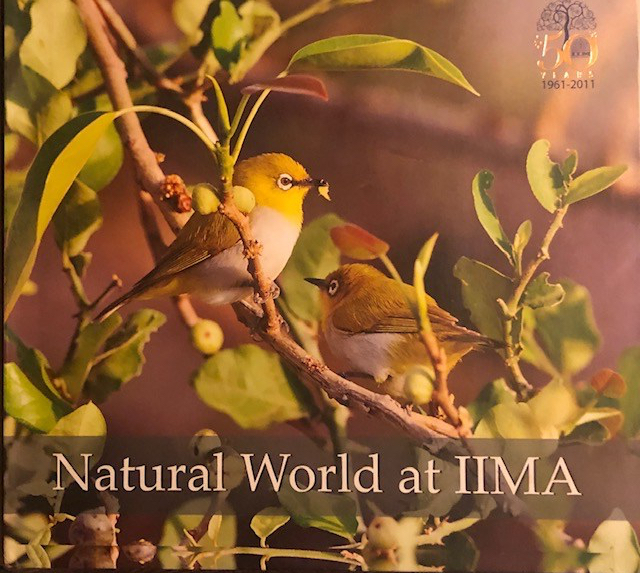
IIM A campus is a mix—from the manicured lawn of the Louis Kahn Plaza, to the utter wilderness on the edges. And this mix, it seems, has given rise to a good deal of biodiversity. And the great thing is, that as part of the Golden Jubilee celebrations of the Institute, these have been captured and documented in coffee table book called Natural World at IIMA.

725A7EA1-5F1C-4DD8-95C8-861F797A653B

A work of love and passion indeed! Close to 200 pages of colour plates, documenting the flora—trees, shrubs, climbers, sedges, grasses and herbs; as well as the fauna—birds, mammals, reptiles, insects, spiders, butterflies and moths.

One hears of pressures on several institutions to ‘not let the land go to waste, put it to use.’ Or worse, institutional lands being taken away for other uses, including commercial uses. We need to resist any such diversions. These are among the few remaining islands.

And documenting and disseminating these in the form of books, databases etc., helps to communicate the value of this diversity, and is the first step in making the campus itself an educational resource. And a matter of pride and joy for alumni.

Here is to large, unmaintained campuses, and books on them!

–Meena

Business as Usual

 “Business history gave me the opportunity to look at the experiences of individuals. Individuals who built organizations; individuals who built companies, individuals who responded to situations and responded to change. Then I began to have some kind of understanding of what Indian society is like. What are the forces in the Indian society that egg people on to certain things” said Prof Dwijendra Tripathi, Kasturbhai Lalbhai professor of Business History at IIM Ahmedabad, and the founder of the discipline in India.

Like any historian, he believed that studying the past led to a better understanding of the present. Today, India wants to ‘Make in India’. It wants every graduate and school dropout to be an entrepreneur, a job creator rather than a job seeker. There cannot be a time when it is more critical to study Indian business history.

India was fortunate to have a pioneer like Prof Tripathi who laid the foundations of this discipline way back in the ‘60s and ‘70s. But even today there are few Indian Business Schools which teach the subject. I wonder if there are any pure history departments which teach it at all!!!

His passing away on Sept 5 this year has led to a flurry of articles and pieces (including this one). Maybe it will also lead to serious debates on the place of the study of Business History for the development of Indian Business.

Some things change, some don’t! It is up to us to learn from the past to plan for the future.

‘Another disincentive to movement was a network of customs barriers. According to Moreland, these barriers–chowkies, as they were called-existed in 1600 and later. Most likely, they existed even earlier. As a result, the cost of transportation over a distance of 200 or 300 miles doubled the price of the commodity. The harassing and corrupt practices of the customs authorities added to the trials and tribulations of the situation’.

Indian Entrepreneurship in Historical Perspective: A Re-Interpretation Author(s): Dwijendra Tripathi Source: Economic and Political Weekly, Vol. 6, No. 22 (May 29, 1971)

–Meena

For me, Prof Tripathi was a gentle presence on the IIM-A campus, a ready smile for anyone he met.