
Last week saw the launch of India’s first Centre of Excellence for Hornbill Conservation. This is hosted by the Anamalai Tiger Reserve in Tamil Nadu, and will be dedicated to the long-term study and conservation of this threatened species.
What are hornbills, and why are they threatened?
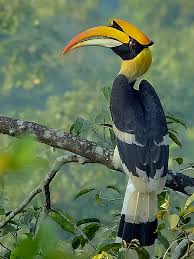
Hornbills get their name from the casque—a horn-like projection on the top of their long and downward-curving beak. While this is their defining feature, bright skin around their eyes and long eyelashes, and a brilliantly-coloured pouch of loose skin at their throat add to their striking appearance. They also have distinctive calls. Hornbills are giants among the forest birds in many ways.
There are 62 hornbill species worldwide, with 32 found in Asia and 30 in Africa. India is home to nine species. Among these: The Great Indian Hornbill or the Great Pied Hornbill is the largest among the hornbills found in India. The Malabar Pied Hornbill is endemic to tropical forests in India and Sri Lanka. The Rufous-necked Hornbill which is the most endangered, and the least studied of the nine hornbill species is found in the North-eastern parts of India. The Narcondam Hornbill is only found in a 12 sq. km stretch in the tropical forest of the Narcondam Island in the Andaman Sea. The Malabar Grey Hornbill is endemic to the Western Ghats. The Indian Grey Hornbill is the most commonly seen hornbill species in India, and is sometimes spotted even in cities.
Whatever the species, hornbills play a vital role in forest ecosystems as dispersers of seeds of forest plants, aiding the regeneration of forests. Hornbills are among the very few birds that can feed on fruits with large seeds. They digest only the fleshy parts of fruits that they swallow and then regurgitate the seeds, spitting them out, or defecating the seeds intact. As the hornbill flies from tree to tree, or during the nesting season flies back and forth over long distances to search for and carry food for its mate, the regurgitated cleaned seeds are dropped far and wide, enabling them to grow into trees far from the original trees from which they originated. The Namdapha National Park in Arunachal Pradesh has the highest density of hornbills across Asia. Studies have indicated that hornbills here disperse seeds at the rate of 11,000 seeds per day per sq. km!
Thus hornbills are critical in keeping the forest alive. If we lose hornbills, many forest trees that depend on them to spread their seeds may eventually disappear from the forest too. Hornbills symbolise not only the health of a forest, but also a key to their continued survival.
Hornbills in turn, depend on a healthy tree density in the forest for their own survival. All hornbills are cavity nesters. While they cannot build their own nests or dig cavities, they use existing holes in a variety of trees to make their nest. The process begins during a month-long courtship when the male presents the female with food. As they embark on playful behaviour the pair also check out tree cavities to select their nesting site. Having done this, the two prepare the nest by cleaning it, creating the wall lining, and undertaking repair work. Once the nest is ready, the female prepares to confine herself in the nest while the male continues to provide for her needs by bringing food and nesting material. The female then seals the nest entrance with her own faeces, food and bark fragments, and mud pellets brought by the male. Only her beak protrudes out from the sealed nest. This helps to protect the eggs and chicks from predators. She lays her clutch of between two and five eggs and incubates them for over 20 days. Throughout this period the male diligently flies back and forth, feeding his mate through her protruding beak. The mother emerges from the nest shortly before the chicks themselves are ready to fly, and the chicks once again seal the nest from the inside, even as they continue to be fed. Now both the parents share in providing food and caring for the chicks. One of Nature’s many marvellous examples of nurturing the young.
This unique nesting habit of hornbills has also, in recent times, become a threat to the very existence of these birds. The fact that they use the same nests over the years makes it important to protect their nesting trees, and the habitats where they grow. The destruction of forests by habitat fragmentation, deforestation and clearance of forest areas for agriculture and dams is depriving these birds of places to nest and breed. The loss of native trees also affects their diet, posing a significant threat to their survival. Adding to these human-made threats is the impact of climate change which disrupts flowering and fruiting patterns critical to hornbill feeding and breeding. Thus it is imperative that the trees that they use, and the trees and forests that that provide them food and shelter to breed be protected. Sadly these are being rapidly depleted, thus endangering the birds
The rapidly increasing threat to these magnificent birds calls for urgent action at all levels, from the government measures to people’s efforts.
The Hornbill has great cultural symbolism among many tribes of North East India, especially in Nagaland and Arunachal Pradesh. A unique community-based initiative to protect nesting trees of hornbills is the Hornbill Nest Adoption Programme spearheaded by the Nyishi tribe in the Pakke Tiger Reserve in Arunachal Pradesh. The tribe which traditionally hunted hornbills for their casque which were a symbol of their tribal identity have become active partners in protecting and conserving the hornbill nesting areas. The programme invites donors across the world to become ‘hornbill parents’ by adopting hornbill nests. The donations help pay salaries to the local community nest protectors who patrol the area, and ensure that the habitat continues to invite these birds. What an appropriate way to celebrate a bird that is, in its unique way, a diligent nest protector and parent.
A great People’s Science initiative is Hornbill Watch, a website where anybody can share details of a hornbill sighting from anywhere in India. This user-friendly website can be accessed by people from all backgrounds to share their hornbill sightings; being a wildlife conservationist or photographer, or even an avid birder, is not a necessity. The website has information on Asian hornbills in general, and detailed descriptions of the nine species found in India, as well as photographs submitted by contributors. Over time the data collected would help in identifying and prioritizing sites for hornbill conservation.
Now the setting up of a dedicated Centre of Excellence for Hornbill Conservation is another important step. The Centre will focus on the four species that are found in the Western Ghats which is a globally recognized Biodiversity Hotspot. The four are: the Great hornbill, Malabar grey hornbill, the Malabar pied hornbill, and the Indian grey hornbill. The great hornbill and Malabar grey hornbill are categorised as vulnerable, while the Malabar pied hornbill is near threatened as per IUCN. The Centre will monitor hornbill populations, study their breeding habits, map their nesting sites and food sources, and track their movements using GPS or satellite telemetry techniques. The Centre will also engage with the local communities to work for habitat restoration and nest protection.
The initiative looks beyond monitoring the species to protecting entire forest ecosystems upon which the hornbills depend for their survival, and which in turn are kept vibrant with help from their farmers—the Hornbills.
–Mamata
 Millennial Matriarchs