
2 October marks the birth anniversary of Mahatma Gandhi. On this day much is written and spoken about Gandhiji’s movements to free India from the shackles of British rule. The non-cooperation movement, the Swadeshi movement, the Salt Satyagraha and other non-violent movements were all part of the nationwide stir to lead India to become an independent, self-reliant nation. Amidst all this, not much is discussed about Gandhiji’s deep thinking and initiatives in the field of education.
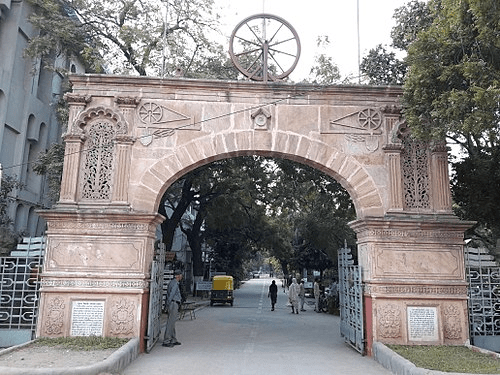
Gandhiji began experiments with education with younger children in the Kochrab and Sabarmati Ashrams during 1915-1920. In 1920, when he launched the non-cooperation movement, Gandhiji appealed to everyone to boycott schools and colleges imparting British colonial education propounded by Lord Macaulay. There was a huge response to this call, and thousands of students quit studies to join Gandhiji’s movement. But Gandhiji was equally concerned that the youth of the country were not deprived of education, but rather were offered an option that would provide an all-rounded education which could prepare them for the task of national reconstruction, and usher in Hind Swaraj, the India of his dream. The process towards this began with the formation of a National Education Committee which was chaired by Gandhiji. The committee felt that the path could be the establishment of what was envisioned as Rashtriya Vidyapiths (National Universities) which would promote educational institutions run by Indians for Indians outside the financial and governing control of British authorities. Five of these were established during this period. One of these, was Gujarat Vidyapith which was established by Gandhiji himself on 18 October 1920 (the only university set up by Gandhiji). Its foundation was an important event in the Satyagraha movement.
Gandhiji’s vision for the institution was to prepare a generation of dedicated, sincere, fearless, and honest students who contributed to a self-sufficient, non-violent, and egalitarian nation.
On 15 November 1920, Gandhiji launched Gujarat Mahavidyalaya, an affiliated college under the aegis of the Rashtriya Mahavidyalaya. The inaugural event was held in the compound of Dahyabhai Mehta’s bungalow in Kochrab village at 8.30 a.m. Dahyabhai had provided his bungalow for setting up the university. The historic photograph of the group present for this was taken by artist Ravishankar Raval who was the only one in Ahmedabad then who could operate a camera. Raval recalled the event in his memoirs. The proceedings began with a Punjabi song sung by Saraladevi Chowdhrani. It was followed by Bapu’s speech. After speeches of the registrar, and a few teachers, the event ended with the pledge “Bharat Hamara Desh Hai”. By 1923 more than 30,000 students were part of Gujarat Vidyapith.
Gandhiji was declared as the Chancellor of the University for life. Professor A T Gidwani was its founder Vice-Chancellor. After Gandhiji, the post of chancellor was held by Sardar Vallabhbhai Patel, Dr. Rajendra Prasad and Morarji Desai. Later, many more institutions, colleges and schools were affiliated to the Vidyapith.
Today Gujarat Vidyapith itself functions as a university dedicated to holistic Head, Hand, and Heart education based on Gandhian principles, whereas Gujarat Mahavidyalaya serves as a specific academic unit for students within that framework.
Up to 1930, the languages like Gujarati, Marathi, Bengali, Sanskrit, Persian and English and the subjects like History, Arithmetic, Philosophy, Economics, Accountancy, Music, Political Science, Pharmacy, Archaeology and Indian studies were taught in Gujarat Vidyapith at graduation level. The Vidyapith stopped functioning temporarily during the civil disobedience movements of 1930 to 1935, both the students and faculty members participated actively in the freedom struggle, many of them courting arrest. Again, during 1942 to 1945, during the Quit India movement the functioning of Vidyapith came to a standstill. After the year 1945, the Vidyapith started its activities once again.
Since then Gujarat Vidyapith, as it is called, has expanded considerably. But its main objective continues to be preparing workers of character, ability, culture and dedication for the conduct of movements connected with the regeneration of country in accordance with the ideals shared by Mahatma Gandhi. According to Gandhi, the aims of education are the holistic development of the individual, encompassing the physical, intellectual, emotional, and spiritual dimensions (hand, heart, and head). Education should lead to self-reliance, cultivating character, truth and non-violence. Participation in productive work with a sense of dignity of labour should foster self-reliance through practical skills; acceptance of equality of religions; priority for the need of village dwellers in all curricula should engage individuals in service to society have been guiding principles.
The emphasis is on more than the academics (through use of mother tongue as a medium of instruction); it is the cultivation of the heart and hands. This involves regular participation in community work, social service, community prayers, simple and self-reliant living, study tours and field studies, hand spinning and training in craft work, physical exercise and training in manual work.
For more than a century Gujarat Vidyapith has nurtured generations of learners who have been inspired by the life and teachings of Gandhiji to carry forward the legacy of truth, non-violence and social change, following the path of dialogue and understanding. The Vidyapith has strived to keep alive Gandhiji’s philosophy of education which prioritizes holistic development, self-reliance and service to humanity. Character, compassion and community, and inclusivity remain its cornerstones. Today more than ever before, we need such institutions, and our young people need to be reminded that education should encompass Head, Heart and Hands.
–Mamata
 Millennial Matriarchs