
I suppose in today’s world, children don’t often see teapots. Fortunately, the poem ‘I am a teapot’, one of the cutest action-songs, is still a part of the pre-school repertoire. As the poem tells us, typically teapots have an opening with a lid on top, through which the dry tea and hot water are added; a handle for holding the vessel: and a spout through which the tea is served. And there may be a small air hole in the lid, though the poem does not mention it.
A teapot is basically a vessel used for steeping tea leaves in boiling or very hot water, and then serving the resulting brew.
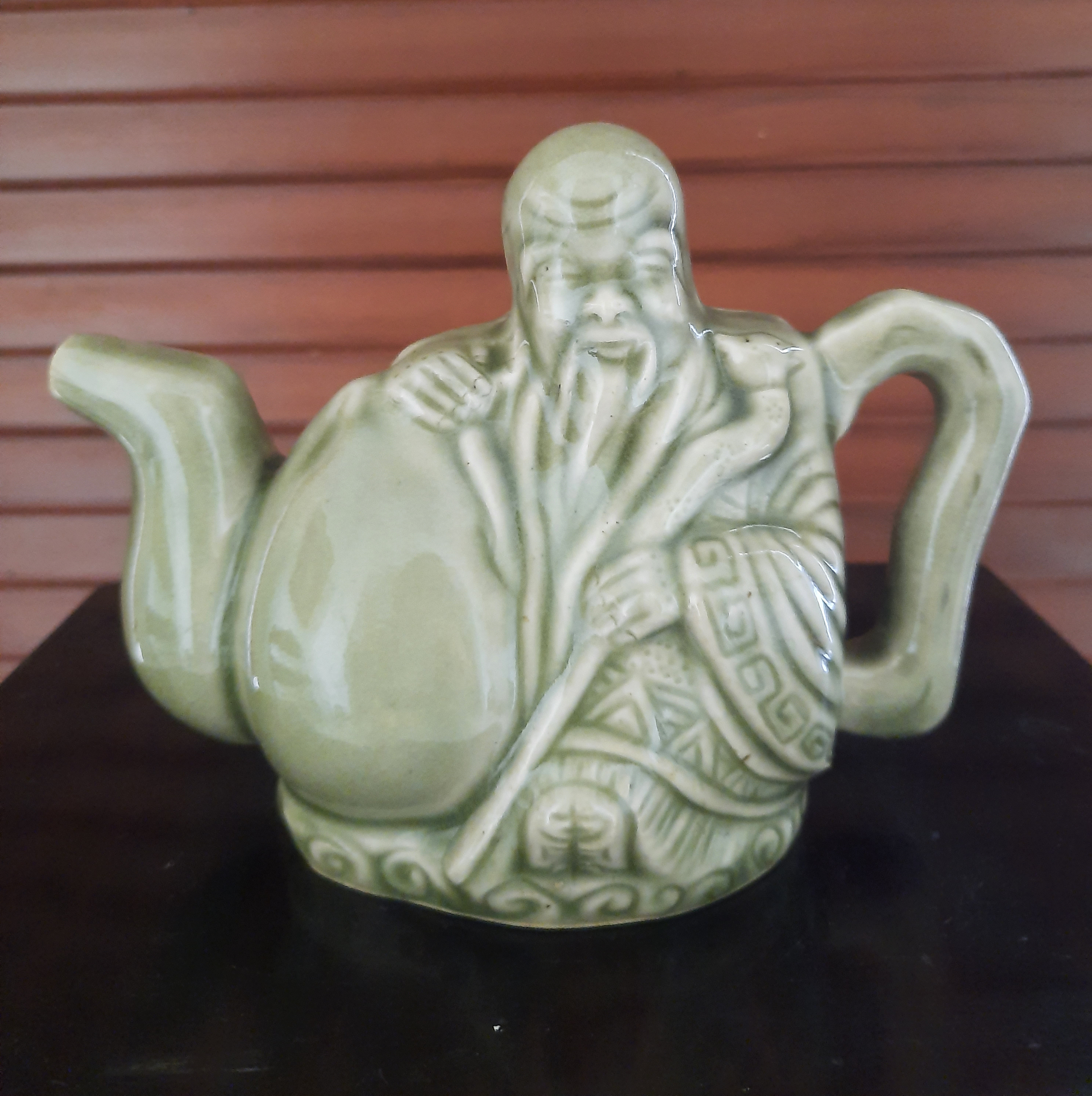
Assassin Teapot: Essential Kitsch from China!
The teapot has a hoary history. It originated in China—of course! The first recorded one goes back to the end of the Sung dynasty (1271-1368). These were Yixing teapots which were red or purple-colored earthen vessels. These containers made in the city of Yixing are still produced today and still very popular and are considered the epitome of teapots.
The idea of the teapot spread to Europe after the East India Company introduced tea and teapots in the late 17th century. In the early 18th century, the Company used to commission Chinese artisans to make teapots as the quality of porcelain in China was better there than in Europe. But slowly Germany and then France got into the game, and started perfecting the art and science. In the mid-1800s, an English pharmacist William Cookworthy, after several experiments, finally hit upon a way to make porcelain similar to that made in China and set up a factory in Plymouth. And from then on, English and tea and teapots became synonymous!
Many and fantastical are the shapes, sizes and colours in which teapots have been crafted down the centuries. It is a thing of beauty and elegance.
And it is this that the annual Sydney Teapot Show has been showcasing for over 30 years. This is an exhibition and competition where participants take up the challenge of making a unique teapot. Each year, there are specific themes, and this year’s categories are Australian Poets, Toy Story and The Natural World. There are also prizes for Best Pourer and Supreme Teapot – Best in Show. The Show celebrates craftsmanship at its best. As the organizers point out: ‘The skill of the clayworkers is employed in making a teapot – one of the more difficult tasks in ceramics – and their imagination and creativity is also evident in their response to the categories suggested’. The show started on 3 October, and is on for a month. Anyone lucky enough to be down under on these dates can catch the show.
Australia seems to particularly treasure teapots. The Bygone Beauties Museum there has over 5500 pieces! But it is not just in Australia that teapots are celebrated. The Victoria and Albert Museum has a good collection. The National Museum of Asian Art at the Smithsonian has some special beauties.
There are also several private collectors and collections. Sonny and Gloria Kamm of Los Angeles have been collecting teapots for over 35 years, and have about 17,000 pieces. Sue and Keith Blazye have 8,450 teapots in their home in Kent, plus around another thousand duplicates in the loft,.
Of special interest is the Chitra Collection. It is private museum of historic teawares. As the site explains, ‘In 2011 Nirmal Sethia, the Chairman of the luxury tea company, Newby Teas, set himself the task of acquiring the world’s greatest collection of teawares to record and preserve tea cultures of the past. Today, the collection, named in honour of his late wife, Chitra, totals almost 2000 objects and is already the world’s finest and most comprehensive of its kind.’ So if you are not able to make it to Sydney, check out https://chitracollection.com/collection/ for a teapot-treat!
As the weather turns balmy, it’s the perfect time to bring out your teapot and sip a refreshing cup, while reflecting on these teapot-related pieces of wisdom!
‘Disciples and devotees…what are most of them doing? Worshipping the teapot instead of drinking the tea!’ Wei Wu Wei (Theatre producer and philosopher)
‘A great idea should always be left to steep like loose tea leaves in a teapot for a while to make sure that the tea will be strong enough and that the idea truly is a great one.’ Phoebe Stone (Author and artist).
–Meena

 Millennial Matriarchs