
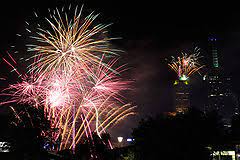
If bells are the traditional symbols that ring out the old, and ring in the new, perhaps the other thing that, across the world, opens the New Year with the dazzle of light and sound, is firecrackers. From the first display that lights up the sky in New Zealand, till 12 hours later, the sparkle that ushers in a new year in South America, firecrackers are almost a universal symbol of celebration of special occasions.
The history of fireworks goes back almost 2000 years ago, and the story of the first combination of crackle and bang, began almost as an accident. People in China used to throw bamboo stalks into the fire; the overheating of hollow air pockets in the bamboo would cause them to explode with a bang. The Chinese believed that this bang would ward off evil spirits. These are believed to be the first natural crackers. The human intervention began when, as the story goes, a Chinese alchemist mixed three common kitchen ingredients: sulfur, charcoal and potassium nitrate (saltpeter, a food preservative) and heated these over the fire, to make black flaky powder that ignited with a loud bang. The local people called this fascinating black powder huo yao (fire chemical). This was the first crude formulation of what came to be known to the rest of the world as ‘gunpowder’. People began to experiment further with the use of this powder. It was inserted into hollow bamboo tubes which were thrown into the fire. The ignited powder produced gases that caused so much pressure to build up in the tube that it blasted open with a loud bang. The first basic manmade ‘firecracker’ was born. In time the bamboo stalks were replaced with paper tubes, and instead of throwing the tubes into the fire, people added fuses made from tissue paper so that these could be lit from the outside.
Firecrackers became an integral part of all Chinese celebrations—festivals, weddings and religious rituals. In the meanwhile the Chinese also realized that the black powder could be put to other, less ceremonial, uses. They attached the firecrackers to arrows that they shot at their enemies. Thus began the use of gunpowder in warfare that continues, in more sophisticated forms, to this day.
The knowledge of fireworks using gunpowder began to travel westwards with traders and travelers. It is believed that Marco Polo, one on of his many trips to China brought back this invention to the Middle East, from where the European crusaders brought it to Europe. An English scholar Roger Bacon is believed to be the first European to have analyzed the black powder from China, as he was intrigued why the mixture of ingredients exploded rather than burned. He also recognized that this quality of the powder could potentially be very dangerous, so he wrote the formula in secret code, to keep it secret as long as possible. Despite Bacon’s best efforts, Europeans discovered the formula, and a variety of weapons using gunpowder were developed. By the sixteenth century gunpowder completely transformed the nature of medieval warfare where chain armour and castle moats could not withstand the power and penetration of muskets and cannons.
While firepower was being used to develop weapons for warfare, the sound of fireworks began to become part of celebrations and festivals in Europe by the fifteenth century. It is the Italians who added the spectacle of light and colour by developing aerial shells that launched upwards and exploded into a fountain of colour lighting up the night sky. For nearly 2000 years the early colours were produced were yellows and oranges. It was only in the nineteenth century that the technology was developed that could produce reds, greens and blues to firework displays. In the meanwhile European rulers widely used displays of fireworks to “enchant their subjects and illuminate their castles on important occasions.”
Early settlers to The New World carried with them their love of fireworks as they settled into what became the United States of America. Fireworks displays were part of the very first American Independence Day. Even today the Fourth of July fireworks tradition remains an integral part of the celebrations.
Today firework displays are a part of celebrations in almost every country and culture across the world. What appears to be a dazzle of colour, light and sound is in fact, a precise packaging of chemistry and engineering. Each modern firework consists of a tube that contains gunpowder (called an aerial shell), and dozens of small pods about 3-4 cm in diameter (each called a star). These stars hold a combination of fuel, an oxidizing agent, a binder, and metal salts or metal oxides for colour.
A firework also has a fuse that is lit to ignite the gunpowder. Each star makes one dot in the fireworks explosion. When the colorants are heated, their atoms absorb energy and then produce light as they lose excess energy. Different chemicals produce different amounts of energy, creating different colours. For example: Blues are made with copper-chloride compounds. Reds are made with strontium salts, strontium carbonate and lithium salts. Purple is made with a mix of blue-producing copper compounds and red-producing strontium compounds. Orange is created with calcium salts and calcium chloride. Green is made with barium chloride and other barium compounds.
From alchemy to chemistry, the dazzle and fascination of pyrotechnics has travelled across centuries and continents to become a symbol of celebration. In India, despite concerns of the adverse impacts of the noise and smoke on health and the environment, and in spite of legal restrictions, crackers are getting louder and smokier, even as the sparkling lights in the night sky take our breath away. As the reverberations of the New Year fireworks linger in the air, the wedding season lies ahead, and also cricket matches and other celebrations that ensure that the crackle never fades.
–Mamata
 Millennial Matriarchs