An uncommon name. But two people of this name, had a profound impact on India.
The first was Abel Joshua Higginbotham, who established the famous Higginbothams Bookshop in 1844–an institution which stands even today. The other was Samuel Evans Higginbottom who founded the Allahabad Agricultural Institute in 1904.
Abel Higginbotham was certainly an interesting character. He boarded a ship from England in the mid-1800s without a ticket or papers. The captain of the ship threw him out at Chennai when he was discovered. The stowaway was a trained librarian, and so could land a job at the city’s Wesleyan Book Shop run by Protestant missionaries. But the store suffered heavy losses and the missionaries who ran the business had to sell their shop at a low price. The enterprising Higginbotham bought the business, set up his own store in the year 1844 and called it “Higginbothams”—making it India’s first general bookstore. It gained a reputation for quality. The Guidebook to the Presidencies of Madras and Bombay by John Murray, which came out in 1859, describes Higginbothams as the “premier bookshop of Madras”. Higginbotham’s were appointed as the “official bookseller to His Royal Highness, the Prince of Wales” during the royal visit to India in 1875. The shop started stocking stationery too, and subsequently started printing its own books.
The second Higginbothams store came up in Bangalore in 1905 on MG Road making it the oldest bookstore in the city. In the 19th century, this was the largest chain of bookstores in the county. Even today, there are over 40 stores across the country.
To add to his achievements, during 1888 and 1889, Higginbotham served as the Sheriff of Madras!
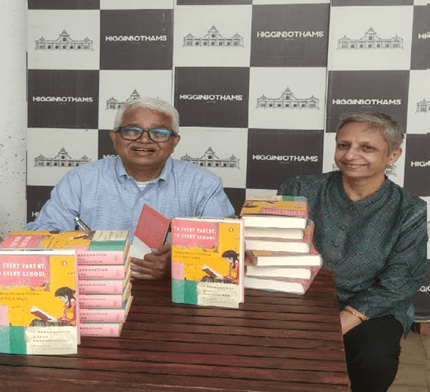
Our book-signing at Higginbothams, Bangalore
The other gentleman, Samuel Higginbottom was a missionary and agricultural reformer who arrived in India as part of the North India Mission of the Presbyterian Church, and landed up in Allahabad. He started as a teacher of economics but was deeply disturbed by the deep poverty of the farmers in the villages and districts around. The land here was not of the best, and agriculture was of very low productivity. He realized that modernization of agriculture was critical for the prosperity of the region, and returned to the United States and studied agriculture at Ohio State University for three years. He came back to Allahabad, to teach scientific methods of farming. But he was convinced that he had to take these efforts to the next level, and set about raising funds for an institution. His educational programs grew into the founding of Allahabad Agricultural Institute in 1919. Higginbotham developed close friendships with Mahatma Gandhi and Jawaharlal Nehru during the course of his work.The institute has done pioneering work for the advancement of agriculture, including introducing pest-resistant high yielding-seeds, improved farm implements and extension programs for farmers. In 2009, this was rechristened as Sam Higginbottom University of Agriculture, Technology and Sciences (SHUATS) in honour of the founder. He left India in 1945.
Sam Higginbottom wrote two books: a book about his work published in 1921 and an autobiography published in 1949.
As the sharp reader would have noticed, the name is spelt differently in the two cases. The two gentlemen were not related. Abel Higginbotham was Irish-born British, while Sam Higginbottam was American. The similarity in names is purely coincidental — different families, different geographies, different spellings, different national origins.
But we owe thanks in equal measure to both of them for their pioneering services!
–Meena
 Millennial Matriarchs