Teacher? Teacher!

In the run up to Teacher’s Day which is celebrated in India on 5 September every year, there will be numerous pieces about outstanding teachers, teachers who have changed the lives of students, and other inspiring stories.

Sadly, even as we felicitate and celebrate teachers such as these, there are also disturbing reports about teachers who, perhaps, could leave life-long scars on the children that they have the opportunity to mould and nurture. These belong to the mass of average teachers who are “teachers” in name but not in deed. What do they make of their job, which is really speaking a means of livelihood, and even that, which is insecure?

Take this piece, titled Confessions of a Teacher.  

I am a teacher. I saw an article entitled ‘Teacher’s Confessions’ and thought, why not pen down my own confessions?

I have been in teaching for years now. As a requirement to becoming a teacher, I had at that time, to study the science and principles of education. I have not learnt much more, since then.

I go to public libraries but rarely touch teaching related journals. A glance at the librarian’s issue book will show several books against my name, but none related to education.

I am certainly in the habit of reading. In the early years I was busy studying the textbooks and related material. But the textbooks don’t change often. I now need only to glance at the books. My reading list now includes dailies and monthlies and some assorted fiction.

After school hours I rarely discuss education-related topics. My discussion includes topics such as someone’s dismissal or promotion, forms and examinations, higher authorities or fellow teachers, booksellers, and so on.

During recess time, my colleagues gather for a cup of tea. We talk of many things. But never do we talk about how to teach, teaching aids, or students.

The school timings are fixed. The curriculum is set. The school bell heralds the passage of time, and students are prepared for the examinations. The systems are in place. I go to school. Teach the lessons for the day. I carry out my tasks and keep the order – partly by force, partly by wit, partly through my image, and largely through the set disciplinary systems of the school.

I don’t get into the depths of any subject. There is no time; just enough to complete what will be part of the exams. Students will take longer, and explanations will have to be made to the authorities.

I know the students by name, or those that know their lessons, and those that do not. I do not know anything about their family, their friends, their own personalities. We are not close. I know their minds, but not their hearts.

I see who comes first, and who is last. I do not know about their physical strengths and weaknesses. Those who finish their work and bring it to me, are clever; those I like. The rest are duds; I do not like them. Between us there is no affection. How can there be trust? They are afraid of me; and I exert my authority over them.

Once I leave the school, I scarcely think of them, save perhaps, one who might have been greatly disrespectful. Each to our own homes. Perhaps, as I lie down the thought may cross my mind that as the exams near, I will have to speed up the revision, for which I’d use the recess.

I haven’t seen the home of the children. Nor have I shown them my home. I do not have such a relationship with them.

I dream that I will be promoted till some day I become headmaster. I will complete my term of service, retire and enjoy my pension. I hope to save a little before I am too old. That is why I have to take tuitions.

I wish that I am well thought of in my community, that I can educate my children so that they get good jobs, and I can marry them off before I enjoy old age.

It is for this that I wish to work. Today the profession of teaching is, for me, an activity, a job. In all this, the ideals of education, the changing principles and practices of teaching, the desire to bring new changes in the field – all this is not in one, where will they come from?

I would like to explain clearly what my position is today. My state is like this; I presume my fellow teachers are in a similar situation.

If we think that this is a familiar scenario, it may come as a surprise that this was written in 1932 (nearly a hundred years ago). The author is Gijubhai Badheka an eminent educator who helped to introduce Montessori education methods to India. Disturbed by the dark educational system of that time, he embarked on his journey into the realms of education, and left behind a rich legacy of work and writing.

More about Gijubhai and his work on www.gijubhaibadheka.in.

Several generations later, the dilemmas about what makes a ‘good teacher’ continue to engage educators.

A hundred years after Gijubhai wrote some of his seminal works on education, Sir Ken Robinson one of the eminent contemporary thinkers on education propounded a critique of the school system. His TED talk Do Schools Kill Creativity? is one of the most watched talks. He urged schools to transform teaching and learning to an experience personalized for every student involved.

His words resonate closely with Gijubhai’s angst about the state of education, and his dream for a transformative educational system

Role of the Teacher    

The problem is that over time, all kinds of things have gotten in the way of it – testing regimes, league tables, unions’ bargaining rights, building codes, professional identities, the concerns of various pressure groups, ideology of various political parties. It’s very easy for people to spend all day discussing education without mentioning the students at all. But all of this is a complete waste of everybody’s time if we forget that our role is to help students to learn. Therefore, the question is: what should they learn and how do we best do that?

All the great education systems and schools know that. It’s why they invest so heavily on the selection of teachers, why they insist on getting people who don’t just have good degrees, or have them at all. They want people who know their material, but they also know that teaching depends upon a whole set of pedagogical skills and a love of the process. It’s more than the transmission of direct content. It’s about having a set of skills focused on facilitating learning. (Sir Ken Robinson)

A teacher’s work is like flowing water. The fulfilment of the work of education is not in teaching one or two subjects… Real education lies in making humans aware about their own unending strengths. (Gijubhai Badheka ‘Note to Teachers’ 1920)

Some food for thought.

–Mamata
How Montessori Came to India

The year was 1911. A young man set up practice as a District Pleader in Vadhwan Camp, in the erstwhile princely state of Bhavnagar in Saurashtra. His practice was doing well, he was gaining a name and earning too, but his heart was not in the machinations of legal matters.

In 1913, he became a father to a son. The advent of the child Narendra triggered the life mission which would launch him into a new role. The man was Gijubhai Badheka and his mission was to bring about a revolution in the field of child development and education.

Indian education during that time was a curious mixture of the Macaulayism as practised by the English rulers and the traditional “spare the rod and spoil the child” tenet. Narendra’s parents saw the sorry state of the local schools and were apprehensive about the kind of education their son would get. Gijubhai yearned for something different for his child, but was not able to visualise what this could be. So he started reading whatever he could find about education and educators. He also started sharing his anxiety and dilemmas with his friends.

One of these was friends was Darbarshri Gopaldas Desai, who visited Vadhwan Camp often. He told Gijubhai “If you want to read literature about children’s education, and see a new kind of school, go to Vaso and meet Motibhai Amin”. This was when the door opened for him. Gijubhai went to Vaso, met Motibhai and saw his school. He came back with many books; among which was a book describing the Montessori Method of education. This was Gijubhai’s introduction to the thinking of Maria Montessori, and her writing.

The more he read, the more deeply he started thinking about children and child development, and about putting the theory to practice. He also started experimenting with young Narendra, and sharing his observations with his friends, as also the ideas of Montessori. As his desire to spend more time and energy into this new challenge grew, the further he drifted from his legal practice.

IMG_20200826_100613.jpg
Dakshinamurti Balmandir

That is where serendipity stepped in. In 1915, Gijubhai helped to frame the constitution of an educational institution in Bhavnagar called Dakshinamurti. Its founders were kindred spirits, all grappling with dilemmas about education, as well as reading the works of Montessori. This was the turning point. In 1916, at the age of 32, Gijubhai quit his legal practice, and joined Dakshinamurti, initially as Assistant Warden of the student’s hostel, and teaching in the High School. His direct interactions with students reinforced his conviction that if real change had to happen it was critical to start from early childhood. He put forth a proposal to the Board to start an experimental pre-school (Balmandir). His wish was granted and in 1920 the Dakshinamurti Balmandir started. This became Gijubhai’s karmabhoomi (the land where one works). And this is where he applied the Montessori philosophy and method, drawing upon the core beliefs and tenets about child development, while adapting the methods and techniques to suit the local realities.

In 1925 Gijubhai took on three major initiatives that created a revolution in the thinking and practice of children’s education across Gujarat.

He set up a formal Adhyapan Mandir to train young people in the philosophy and practice of pre-school education.

To spread the thinking and to attract larger interest in children’s education, the first Montessori Sammelan (Conference) was held at Dakshinamurti. It was chaired by Saraladevi Sarabhai, who had personal experience in using the Montessori system in educating her own children, and who had tremendous belief in this philosophy. The Sammelan concluded with the setting up of the Nutan Bal Shikshan Sangh, headed by Saraladevi Sarabhai to take the work ahead.

Gijubhai invited all citizens interested in the new children’s education approach to join. The enthusiastic support of these members helped spread the new wave not only across Gujarat, but also other parts of the country. The Sangh became a platform to carry this forward. It was proposed to publish a monthly Shikshan Patrika to give voice to the movement.

In 1926, the second Montessori Sammelan was held at Ahmedabad, presided by Gijubhai. Educationists came from all parts of India and carried back the Montessori message.

In the short period from 1920 when he embarked on his mission, till his death in 1939 at the age of 54 years Gijubhai not only pursued his passion for, and practice of his vision of pre-school education, but wrote prolifically for children, teachers and parents.

He combined the scientific perspective of an experimenter, the desire to do something new, the insight to draw out some light from the doldrums that the educational system was in, and faith. This was supported by the revelations from the writing of Madame Montessori.

Sadly the two great like-minded people never met in person. Madam Montessori first came to India in 1939, the year that Gijubhai passed away, at the invitation of Theosophical Society of India. She was then 69 years old. She made Adayar, Chennai her home and lived there along with her son, Mario till 1946.

By then seeds that her writing had sown had already taken root and spread, and Gijubhai was the gardener that nurtured the early shoots, and encouraged the branches to spread far and wide.

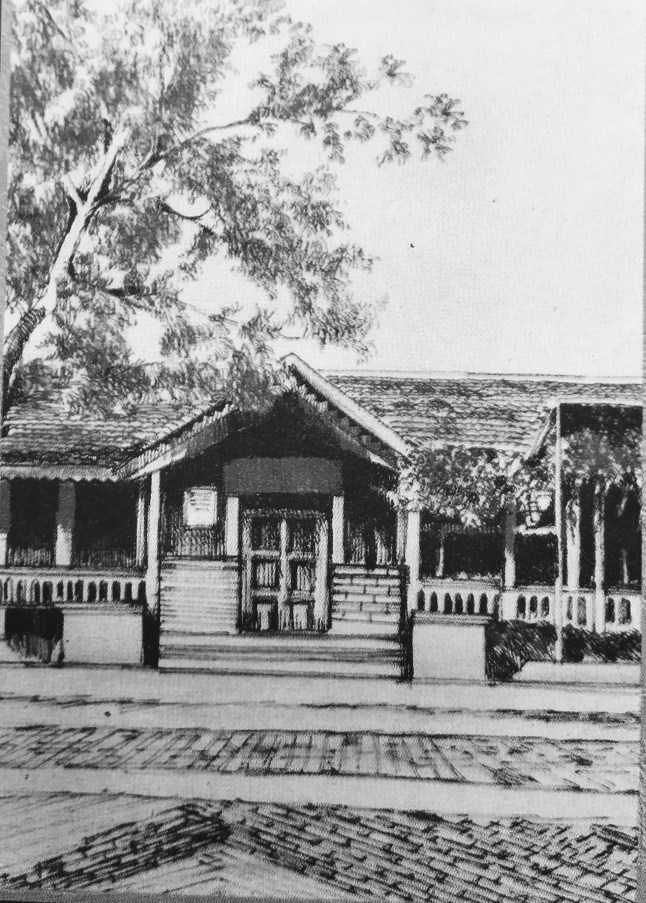
The Dakshinamurti Balmandir continues to function today, in its original building, one hundred years after it was first established.

It is necessary for the teacher to guide the child without letting him feel the pressure too much, so that she may be always ready to supply the desired help but may never be the obstacle between the child and his experience.

If we could say: “We are respectful and courteous in our dealings with children, we treat them as we would like to be treated ourselves” we should certainly have mastered a great educational principle and undoubtedly be setting an example for good education.

Dr. Montessori’s Own Handbook (1914)

A teacher’s work is like flowing water. …If we do not understand those who have to be educated; do not think about what they like and what they do not, then our work and theirs will go in vain. The fulfilment of the work of education is not in teaching one or two subjects nor preparing for a certain class, or passing matric or BA. Real education lies in making humans aware about their own unending strengths. It is to reveal the secret of how to animate these and how to use them. To do this requires that the strengths are respected. Their individual development needs to be given first place. Rather than being taught, they need to be guided onto the path of self-knowledge. This is the work of education today.

Gijubhai Badheka  Note to Teachers circa 1920.

–Mamata


How to be a Parent

The last three months of lockdowns across the world have, among other things, put the spotlight on parenting. With children and parents in continuous and close confinement, both have been tearing their hair out in frustration. The challenge of keeping children ‘occupied’; the careful negotiation of time and space that respects personal and physical boundaries; the sharing of responsibilities amidst the constantly looming uncertainty of when and where the virus could strike, has put everyone on tenterhooks.

This has led to a proliferation of Advice Columns. From counsellors to therapists, psychologists to agony aunts, there seems to be an overdose on ‘good parenting’ tips. In our zeal to do the best for our children we sometimes tend to forget the most basic and simple guidelines that are based on the fundamental premise of mutual respect.

These were offered almost a hundred years ago by Gijubhai Badheka one of the pioneers of the Montessori system of education in India, lifelong advocate of children and their rights, and creator of some of the best loved and popular children’s literature in Gujarati.  Gijubhai believed that every child has its own distinct personality. We as adults need to recognise and respect this. He urged parents to convert to the faith of trust, respect, freedom and love for children. Starting with these five fundamental tenets.

If You Really Want ToIMG_20200625_114247.jpg

If you would like to do just one thing for children…

What could you do?

Do not hit children.


If you would like to do two things; what could you do?

Do not scold children

Do not insult them.


If you would like to do three things; what could you do?

Do not scare children

Do not bribe them to do something

Do not overindulge them.


If you would like to do four things for children; what would these be?

Do not preach to children

Do not blow hot and cold

Do not keep finding fault

Do not exercise authority all the time.


If you are keen to do five things; what will you do?

Do not do whatever the child demands; teach it to do for itself.

Let the child do what it desires to do.

Do not take a child’s work lightly.

Do not interfere into a child’s work.

Do not take away a child’s work.

In a world that has changed dramatically in the last 100 years, these timeless tenets remain as, if not more, true today.

Gijubhai Badheka passed away on 23 June in 1939, at the early age of 54 years leaving behind a prodigious legacy of writing for children, parents and teachers.

Gijubhai was my grandfather. In my small way, I try to carry forward his legacy by sharing and translating his works from the original Gujarati into English.

–Mamata


Once Upon a Time…

These four words open up windows to entire universes—unexplored, or familiar. This is how many a story begins. Stories are a life force that have imbued human life with that something extra, since the dawn of civilization. Stories are a way to convey history, culture, language, spirituality, and identity. One way to keep stories alive is storytelling. Storytelling is one of the oldest forms of communication.

20 March is celebrated as World Storytelling Day–a day to remember and remind ourselves of the magic and power of stories. What began in Sweden, on this date in 1991, as All Storytellers Day has now become a global celebration of the art of oral storytelling. On World Storytelling Day, as many people as possible tell and listen to stories in as many languages and at as many places as possible, during the same day and night.

On this day I celebrate a storyteller who collected, recreated, and created a timeless repertoire of stories. Generations of children have grown up with these tales, told and retold by parents and grandparents over the last one hundred years. This was my grandfather Gijubhai Badeka, one of Gujarat’s foremost educationists and storytellers.

In Gujarati, as in most Indian languages, the child reader had remained somewhat neglected till the middle of the nineteenth century. There was hardly any specific literature for children; only stories retold from classical Indian literature, or heroic stories from Western literature, in not very satisfactory translations. Gijubhai pioneered the creation of special literature for children that also contributed to preserving the oral tradition of literature through exploring and compiling the rich legacy of folk literature. His search for folk tales crossed the boundaries of language and country. This journey of exploration he described thus, in his seminal work titled Vaarta nu Shastra (The Art and Craft of Stories) published in 1925. “So many stories have travelled in foreign lands, so many stories have changed their religion and form; it is an adventure to trace their journeys. If we become wandering travellers with the stories, we will discover that we find one story in Tibet and will see the same story in Africa; we will discover the same story wrapped in snow at the North Pole, and yet if we wander in the Arabian desert, there it will be, but uncovered and bare…but still we recognise the story. Some stories adapt to their land, taking on the form and language of their adopted home, while others retain their origins wherever they may settle. Some stories follow the creed of universal brotherhood, they see the world as their home and go wherever they get a chance to serve and please. Some settle firmly in different countries and come to be recognised as belonging to that place. They are then only translated to reach other countries.”

Many of Gijubhai’s stories are members of this travelling band. Gijubjai transformed and localised these stories, so that they are steeped in the sounds and colours of Gujarat, and have today become not only Gujarati, but uniquely ‘Gijubhai’s’ stories. They are simply told tales characterised by a mixture of prose and rhyme. The repetition of rhymes makes for lively storytelling which listeners join in. Gijubhai retold delightful tales of ordinary people, and familiar birds and animals. With equal panache he churned out stories of common folk with common trades—tailors, potters, barbers, shopkeepers, but also kings, queens and princesses. The characters reflect basic human traits—greed, envy, fear, desire for one-upmanship. Animal tales reflect a close and symbiotic relationship between animals and people. Many open with “once upon a time”… and end “happily ever after.” A hundred years after they were written these stories still touch a cord in the child, and also the child in each of us.

Stories are older than us, they are smarter than us, they keep going, and they are a part of us even though we do not realise this. But stories need human beings to reproduce, much as we need food… we need things to keep ourselves alive.

Hungarian-born American polymath Thomas Sebeok said “…what we can do, I think, is try and create stories that are interesting enough and important enough that our grandchildren might want to tell those stories to their grandchildren — because that’s the purpose of stories, that’s what they’re for: They make live worth living and, sometimes, they keep us alive.

In my own small way, I try to carry forward the legacy of my grandfather by translating and retelling these timeless tales.

–Mamata

It’s Not Easy…Being Parents

This piece is continuing Meena’s recent angst about parenting.

Indeed, parents need counselling more than the children. In many ways it seems that children today are more the receptacles of the parents’ own aspirations and, yes, peer pressures. How does the parent participate in conversations which centre around–What school does your child go to; what does she/he excel at; where did you go for your last family holiday; which are the different types of special coaching your child has… and so on. So the child has to live up to the expectations of not only the parents, but the social circles that they move in. And somewhere in all this circle of “well-meaning concern” the child begins to feel inadequate and undeserving, and there starts slow seeping of confidence, which sadly may end in extreme consequences.

At another level is the insidious guilt of the parents—for being so busy with their work and leisure; for delegating a lot of the traditional parenting tasks to external help; for not giving what they feel may be adequate time and attention; for not giving the child “the best that money can buy, after all what are we working so hard for?” This manifests in the over-concern, over indulgence and over coddling by parents; and a sense of birth right to privilege, self-centredness, and “my parents can set it right for me” on the part of the child. This too may have disastrous consequences should the well-planned map of “how we see our life” go awry.

Every generation of parents feels that the times that they live in are the most challenging, and that they require bespoke answers to child raising.

Interestingly, over 80 years ago, my grandfather Gijubhai Badheka, wrote several volumes on the challenges of parenting, with the apt title It Is Not Easy…Being Parents.  Gijubhai was not trained in child psychology; but his deep concern for the welfare of the child led him to observe, reflect, and note his thoughts. He described the dilemmas faced by both parents, as well as by children, and explored possibilities of how these could be handled.

For me, these simple yet profound notings are as fundamental and relevant even today. Sharing a few excerpts, translated by me from the original in Gujarati.

The young boy strenuously clambers up two rungs of the ladder. As he raises his foot to reach the third rung, the father says, “Come down; you are too young to climb ladders. If you fall you will break your bones.”

The young girl carefully wields a knife to chop vegetables or to sharpen a pencil. The mother scolds, “Put down that knife; you will cut yourself.”

The daughter wants to put the pan of dal on the gas stove. Mother says, “You will get scalded.”

The daughter says “Can I carry the glass of water for the guest?” Mother says, “You will spill it.”

The adults are trying to solve a problem. As they discuss the child offers some suggestions. All say, “Now you don’t try to act too big for your boots.”

Every day in innumerable situations we react in this fashion, unknowingly squashing the confidence of our children. Every time it takes up a task, it hears echoes of its parents’ cautionary warnings, and drops it forthwith, overcome by the fear that it will not be able to successfully accomplish the task. If someone asks it to climb up, carry something or use a tool, it may refuse, or if forced to do so, ends up falling or spilling or hurting itself. The child ends up even more ashamed at its own inadequacy to carry out the task.

By corroding our children’s confidence, we truly do make them unable to perform. In some ways our lack of confidence and trust in our children is a reflection of our own lack of confidence.

We need to have the strength to have confidence in our children. Encouraged by that trust, our children will prove themselves more than worthy of what we have bestowed. A child is human, a human striving to grow. We must enable this growth, the blossoming of its personality.

Removed from all the outer trappings of “success,” ultimately what do we, as parents, wish for our children? I think it should be “the confidence and courage to take on life!”

–Mamata