
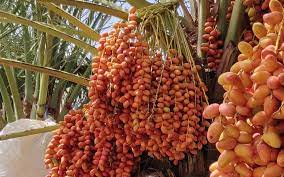
It is perhaps the most ancient cultivated tree in the world. Fossil evidence indicates that the date palm has been cultivated in the Middle East and North Africa for at least 5000 years. The tree has a place in mythology of several cultures. The Sumerians believed that the palm tree was the first tree ever created and that it was tended by a godly raven. In ancient Mesopotamia it was called the ‘road to the moon’ and associated with lunar worship. In Egyptian hieroglyphs the tree was used as symbol for year, and its frond as the symbol for a month. The Roman author and naturalist Pliny the Elder believed the tree to be the nesting site of the Phoenix, the self-resurrecting mythological bird.
There are several special botanical features that make the date palm unique among fruit trees. The height can exceed 20 m, and trees survive over a hundred years, and a tree can produce more than 70 kg of fruit a year. To grow and thrive, date palms require scorching dry summers, low humidity, no frost and ample sunshine. As a saying in the Middle East says: The date palm needs for its feet to be in running water and its head in the fires of the sky.
In practical terms, almost every part of the tree provided useful material for construction, roofing and ropes and baskets. Popularly referred to as the ‘tree of life’, ancient civilisations once looked to the date palm for life’s necessities.The soft wood, with its ability to withstand hot, dry conditions was useful for construction of houses, as well as certain parts of dhows, the traditional sailing vessels that carried out much of the maritime trade across the Indian Ocean. The fronds were used for roofing. The tree also inspired architectural elements. Capitals of columns were carved to resemble palm trees, the form features in artistic mosaics, weaves and embroideries in many ancient cultures.
And the fruit has long been recognized as a concentrated powerhouse of nutrients. The date has provided vital nourishment for generations living in the hot arid climes of the Middle East and North Africa. Dates are rich in vitamins, high in antioxidants and loaded with fibre. Dates are resilient to pests, do not rot when ripe and can be transported easily. Thus the old Arabic saying: The uses of dates are as many as the days of the year.
The date fruit itself gives the name to its parent tree the date palm—Phoenix dactylifera derived from the Phoenix (perhaps a reference to the mythical bird, as this tree can also regrow after a fire) and dactylifera meaning finger. The date’s English name comes from the Greek word dactulos meaning finger referring to its elongated shape and form.
Dates hold significance in major religions and cultures. In the Middle East and South Asia the fruits symbolize gratitude, generosity and good health and are served at weddings, religious ceremonies and festivals. The Jews considered dates as one of the seven holy fruits and paid special attention to it during their auspicious occasions and festivals. Dates are mentioned more than 50 times in the Bible. In the Holy Bible, palm trees are associated with symbols of prosperity and triumph. One legend says that the date palm was the tree of knowledge of good and evil and the date was the actual fruit (not the apple) that Eve offered to Adam in the Garden of Eden. In Islam the Prophet Muhammad considered dates to be a superior food and encouraged people to break their fasts with them. The date palm is mentioned 22 times in the Quran. Dates are considered a fruit, food, medicine, drink and sweetmeat. Their high sugar content makes them self-preserving and long-lasting. Dried dates can be stored for a long time, and transported easily across seas and deserts. They can be boiled and strained to produce a honey-like syrup, they can be fermented to make date wine. Desert nomads have used dates in traditional health remedies for thousands of years.
While not among the group of highest date growers, India grows 40-50 varieties of dates, both of the soft and dry type. One of the key date-producing regions in the country is Kuchchh in Gujarat. Date palms are believed to have been established in this region around 400-00 years ago. It is speculated that these grew from seeds thrown by pilgrims who visited the Middle East countries for Haj, and traders who also brought back these plants; or Arab gardeners working in the palaces of the local rulers who may have acquired and planted date seeds or shoots. Date varieties have been developed by thousands of years of selection of seedlings and only those possessing desirable characteristics have been propagated. Today there are believed to be around 1.7 million date palms in the area propagated from indigenous seedlings.
While the history of date cultivation here is not as old as that in other parts of the world,Kuchchh is probably the only place in the world where fresh dates are economically cultivated, marketed and consumed. The Kachchhi Kharek or Khalela as it is locally called is unique in that it is the fresh fruit that is eaten. While in most parts of the world dates are allowed to ripen until they become soft, and dark brown or black in colour, the Kuchchhi dates are harvested at the stage when the fruits have matured, accumulated sucrose, and have turned yellow or red, but are still crisp. This stage of harvesting is called the khalal stage. It is usually done just before the monsoon rains reach the region. The colour and crispness gives these dates a distinctive identity, and make for a delicious eating experience.
This identity has been formally recognized with the awarding of the GI Tag to this indigenous variety of dates—the Kuchchhi Kharek. The Geographical Indication Tag (GI Tag) is a sign assigned to products that have a specific geographical origin and possess intrinsic qualities due to said origin. This date is the second fruit from Gujarat to get a GI Tag, the first being the Gir Kesar mango grown in some districts of Saurashtra. The Kesar mango makes the intense heat of the summer bearable, while the Kuchchhi date adds energy and warmth to the nippy days of winter.
A special date indeed!
–Mamata
 Millennial Matriarchs