The Leaves Come Drifting Down

At the moment, leaves are the bane of my life.

They drift down in their tens through the day. The lawns, porch and verandahs are no sooner swept that they come drifting down to make a mess, yet again.

And Saturday, when Bangalore was hit with unexpected torrential rains, our house almost flooded because fallen leaves had covered the water outlets on our terrace and there was a good six inches accumulated before we realized it and cleared the outlets. A few more minutes and the water would have entered the house.

But in general of course, who doesn’t love leaves: the variety of the shades of green, their shapes and sizes, the shadows they cast, the way they rustle in the breeze or when birds and squirrels play among them.

There are some people who take this love and appreciation to aesthetic heights. They are the leaf-artists.

Some people of course consider the leaf itself as art.’ There is artistry to a leaf that I find hard to put into words. In looking at leaves, the colours and veining, the patterns and textures, I get a good feeling. Leaves are nature’s artistry on display’, says Hank Erdmann, a leaf-photographer.

Others use the leaf as the medium. These leaf-artists express themselves through various creative expressions using leaves. This spans leaf printing, leaf carving, leaf painting and leaf collage. All of these are based on highlighting the leaf’s natural colours, shapes and textures.

It is likely that leaf-art is as old as our cave-dwelling ancestors. One can easily imagine our grandnmother picking up a leaf and carving a design on it with a sharp stone. And from these projects must have emerged the use of leaves as a medium for writing on—palm leaves were used for writing since the 5th century BCE in India. The ephemeral nature of the medium however has not left much proof of art on leaves.

But two contemporary artists have taken leaf-art to a new level.

The first is the Colombo Ecuadorian photographer, Yinna Higuera. Her recent collection ‘Traces’ is a series of portraits of rural Ecuadorian women, made on banana, cocao, coffee and other leaves. The collectoin documents the lives of these women, and portrays their link with nature and its cycles. The exhibition has been shortlisted for a Sony World Photography award, 2025. This is based on the technique of ‘chlorophyll printing’. The images are printed leveraging the leaf’s photosensitivity, merging photography with nature. This is an alternative photographic process where photographic images are developed on natural leaves through the action of photosynthesis, and goes back to the 19th century.
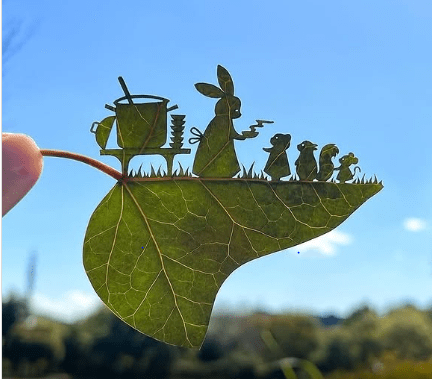
Another artist making waves (or gentle breezes) with his leaf art is Lito, a Japanese artist. He uses a completely different technique. He carefully selects a leaf, makes an intricate drawing on it, and painstaking carves it. The scenes often depict animals, birds and landscapes. Lito makes one leaf-carving every day! For him, this is not just a means of artistic expression, but also a way of managing his ADHD. It helps him focus, be calm–he sees it as a form of meditation. And importantly for him, leaf-carving is a means of earning a livelihood.

So I am going to re-calibrate. And appreciate each leaf as it drifts down to land on my verandah. Before muttering irritably at it!

And to end, here is a poem on leaves by Sarojini Naidu, whom Mamata wrote about a few weeks ago:

Like a joy on the heart of a sorrow,
   The sunset hangs on a cloud;
A golden storm of glittering sheaves,
Of fair and frail and fluttering leaves,
   The wild wind blows in a cloud.

Hark to a voice that is calling
   To my heart in the voice of the wind:
My heart is weary and sad and alone,
For its dreams like the fluttering leaves have gone,
   And why should I stay behind?

–Meena

PS: Today there are even Leaf Engraving Machines, ‘specialized for intricate leaf designs, perfect for crafting unique art pieces!’

The picture is from Lito’s Instagram page, art_dailydose
Private Gardens for Public Pleasure

Last week, we delved into the making of the Butchart Garden in Victoria, Canada—a private garden which is completely open to the public. This is not common. For the most part, public gardens are public, and private gardens are private—open only to the enjoyment of the owners, their families and friends.

A public garden is defined by the American Public Gardens Association as: “An institution that maintains collections of plants for the purposes of public education and enjoyment, in addition to research, conservation, and higher learning. It must be open to the public and the garden’s resources and accommodations must be made to all visitors. Public gardens are staffed by professionals trained in their given areas of expertise and maintain active plant records systems.”

On the other hand, a private garden is ‘a type of Urban Green Spaces Areas in immediate vicinity of private (privately owned or rented) houses, cultivated mainly for ornamental purposes and/or non-commercial food production’ and is not usually open to the public.

While Jennie Butchart, creator of the Butchart Gardens was clear right from the start that she wanted as many people as possible to see and enjoy her gardens, not all owners have been so open. Or even if they wanted to, didn’t know how to go about it. But that would be such a loss, because some of these private gardens are spectacular.

And hence, the various initiatives in many parts of the world which try to make private gardens accessible to the public.

For instance, in the US, the Garden Conservancy organizes Open Day programmes. This institution is a nationwide community of gardeners and garden enthusiasts who teach and learn about gardens. Believing that there is no better way to improve as a gardener than by seeing and experiencing firsthand a wide range of gardens, they organize these Open Days, which since 1995, have seen ‘more than 1.4 million visitors into thousands of inspired private landscapes—from urban rooftops to organic farms, historic estates, to innovative suburban lots—in 41 states’. These events are curated and ticketed and open up some of America’s best private gardens to the public for a few days. The organization even brings out an annual publication—‘The Garden Conservancy’s Open Days Directory’ This is a yearly guide to hundreds of private gardens across the United States. The directory includes information on the gardens’ types, such as organic, scenic, or historic, and how and when they can be visited.

In the UK,  London Parks & Gardens organizes the Open Gardens London event every year, helping visitors enjoy hallowed private London gardens including roof gardens, city farms, allotments, spaces steeped in history, and much more. A ticket to the event gives visitors access to every garden on display across the whole weekend, with children under 12 allowed in for free!

Under the Open Gardens South Australia programme, garden owners generously open their gardens for a weekend. The NGO helps owners plan and promote their opening. Some of the ticket money is usually donated to a charity of the owner’s choice

In Ireland, the Gardens Open initiative of Garden.ie lists around 300 gardens open for visiting, some year-round, others by appointment.

Mughal Gadens

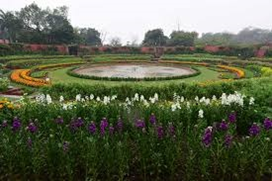
The Rashtrapati Bhavan gardens, previously known as the Mughal Gardens are not private. However, they are not open to the public all the time. Constructed by Sir Edwin Lutyens in 1917 in the traditional Persian Charbagh style the Gardens were renamed Amrit Udyan in 2023. The 12-acre beautifully cultivated gardens are open to visitors in Feb-March and Aug-Sept every year and a popular tourist spot in New Delhi.

India has some large public gardens, but no well-known large private gardens—certainly none open to the public. Maybe it is time for some people with the means and the green thumbs to create such green oasis in our crowded, polluted, frantic cities. That would be social responsibility indeed!

–Meena

Tippy-tippy Tap…

The last few weeks have been a time of looking closely at flowers, and marvelling at their variety. I observed about 12 types of pink flowers, about 8-10 types of orange flowers, about 5-6 red, a few yellow ones, a few white ones and two types each of purple flowers and blue flowers–all in my colony. 

So of course the question came to my mind: Was this the typical distribution of flower colours? Was pink the predominant colour, followed by orange and red? And so started my search to find out a little more about this.

First and foremost, what gives flowers their colours? Colours mainly come from the presence of pigments in the chromoplasts or cell vacuoles of floral tissues.  The most common pigments in flowers come in the form of anthocyanins which range in colour from white to red to blue to yellow to purple and to even black and brown. The other major group are the carotenoids, which provide the yellow colours, along with some oranges and reds. While many flowers get their colours from either anthocyanins or carotenoids, there are some that can get their colours from a combination of the two. Other classes of pigments, but of less importance in relation to flower pigmentation, are chlorophylls (greens), quinones (occasional reds and yellows), and betalain alkaloids (giving yellow, red and purple). 

Coming back to which is the most common flower colour, all my web- searching only told me that there was no definitive answer! To begin with, we don’t even know how many flowering plants there are. And of the flowers we know and have catalogued, colour data are seldom maintained. There is no repository of flower colour information. There is no database which documents flower colours, let alone rank them.

There are many good reasons that make it difficult to document these colours. There is no absolute measure. Colours look different in different lights, at different times of the day. Each person perceives colour differently—what looks orange to me look yellow to you. And we all describe them differently—I may say violet for a colour and you may say mauve.

Moreover, colours vary from genus to genus, and even within a species. A plant growing in one area (say, the plains) can have flowers  that are very different from the same plant growing elsewhere (say in higher altitudes). The colours of flowers depend very much on the growing conditions—soil, sunlight etc. So they may change somewhat with season too.

Recent research suggests that factors like ozone depletion and global warming have caused flowers to change their colours over time. For instance, of the 42 species studied in that research, UV-pigmentation in flowers increased at a rate of 2% per year from 1941 to 2017.

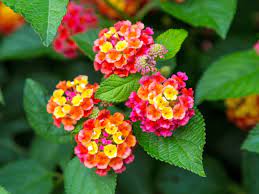
lantana
Lantana is one of the flowers which changes colour on pollination

Flowers also use colours as signalling mechanisms. Some flowers change their colour once they are pollinated, so that bees do not come back to them, but rather go to unpollinated flowers. (Eminent teacher, Prof. Mohan Ram, who developed a generation of botanists, ecologists and environmentalists, taught us this during a memorable nature walk.) Some flowers change their colour with age.

But here are some speculations about flower colours:

Counter-intuitively, some people believe green may actually be the most common flower colour–many plants, including most trees, bear flowers in various shades of green. This may be followed by white, yellow, blue and the reds in that order.  Brown is not uncommon either. But all scientists and naturalists emphasize that these are only guesses.

So don’t worry too much about how many. Just enjoy the flowers and their colours!

–Meena