Of the many women who dedicated themselves to Gandhiji’s thoughts and practices, the name of his English disciple Mirabehn (nee Madeleine Slade) is well known. Perhaps not as much written about, but no less inspiring, is the story of his other English follower who took the name Saralabehn.
Catherine Mary Heilman was born in Shepherd’s Bush, London on April 5 1901. Her mother was English and her father was of German origin, who had come to England via France. As a child living in a bi-national and bi-lingual liberal family, When she was in her teens, Catherine was rudely shocked when her German surname led her to be stigmatized during the World War and its aftermath. Her father was wrongly jailed as an enemy, and the young Catherine was not allowed to take part in school activities, and deprived of a scholarship. At sixteen she had to leave her studies and work in an office where the hostility continued.
It was while she was in a London boarding house in 1920 that she met a group of Indians who became her friends. This is when she began to learn and understand something about the nationalist struggle that was going on in India against the imperialist colonial rule. She realised that the way her history books had presented the colonies as the “white man’s burden” was quite different from the accounts she heard from her new friends. She also learnt about the non-violent nationalist struggle that was being led by Mahatma Gandhi. She started following news of the movement as it was evolving in India, and began to empathize with his thinking and practice. As she later wrote: “For the first time in my life, I was exposed to ideas that resonated with me. Every statement uttered and every word written by this individual, Gandhi, clad in just a small dhoti, held true meaning”. Even as her European friends warned and discouraged her from getting carried away by events that were happening in a country far away, Catherine was planning to go to India herself.
Catherine wrote to Gandhi to request permission to join his work but he was not very encouraging. She continued to explore ways of getting to India. She had no particular skills nor training, so she enrolled for a midwifery course which brought her in contact with English pacifist groups. Before she finished the course she received a letter inviting her to work at a school in Udaipur, so she transferred to a short programme in child education. In January 1932 Catherine finally reached India, and did not go back again.
She started work in Vidya Bhavan in Udaipur; work which along with teaching included manual work in fields, cleaning toilets, washing one’s own clothes and utensils. This gave her a sense of the typical chores that women did, as well as the dignity of labour. But she still did not feel that she had achieved what she had set out for—to participate in Gandhi’s Constructive Programme, which she considered to be “the true foundation of the freedom struggle”. She continued to write to Gandhiji, the man whose pull had brought her to India, but did not hear from him. In the meanwhile Catherine steeped herself in the life and culture of her new home, and at some point also took on the name Saralabehn.
In 1935 Saralabehn visited Mahila Ashram in Wardha. Gandhi was there at the time, and one morning the two finally met. Gandhiji asked her who she was and how long she was staying, and on being told ten days, he assigned her some work. Saralaben relocated to Wardha in 1936 and worked on the education of the girls in the Ashram based on the principles of Nai Talim. In 1941, when her health declined and Gandhi suggested that she move to cooler climes and concentrate on Nature Cure. There was a Gandhian Ashram in a village called Chanauda in the foothills of the Uttarakhand Himalaya and this is where she reached in August 1941.
As her physical health improved, Saralabehn began to get restless. She had her own routine which included learning how to spin Tibetan wool; she started travelling through the villages of the area and learning the local language. She also interacted with the villagers, especially the women, and began to discuss Gandhi’s ideas on Gram Swaraj or village self-reliance. She continued to be active in Gandhi’s nationwide civil disobedience movement.
The British placed her under house arrest for her involvement in the 1942 Quit India Movement. As soon as she was released, she again devoted herself to helping freedom fighters and to further preparations for the freedom movement. Hence in 1944 she was arrested and imprisoned again. After her release Saralabehn returned to her karma bhoomi. Having lived and work in the Kumaon villages she felt that the best way to carry forward Gandhiji’s constructive programme was to establish an educational institution for the local girls.
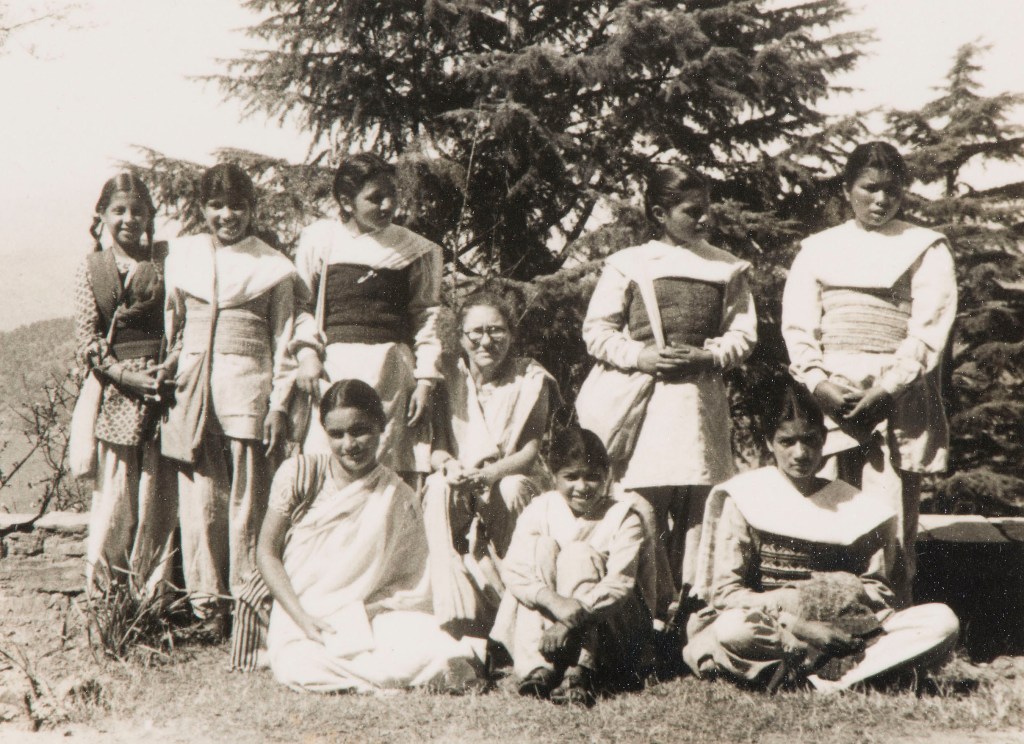
A local Indian Civil Service officer offered a cottage which he had named Lakshmi after his wife, for the new venture. Thus was founded the Lakshmi Ashram in 1946. Beginning with three students, Lakshmi Ashram began imparting education based on the principles of Nai Talim—education for economic self-reliance where Hands, Heart, and Head should all develop in Harmony.
As there was no local tradition of sending girls to residential schools, Saralabehn had first to gain the trust of the parents. Saralabehn designed her own syllabi and taught the first girls herself. Her curriculum included science, mathematics, Hindi, history and geography. In keeping with the applied-learning focus of Gandhian education, field work which involved close interaction with the local community and manual labour was an important component. This provided the opportunity of learning directly from villagers, especially women, as well as interactive settings for ashram students and teachers to share information about hygiene and health, as well as social, ecological, and political issues. Students also learned to spin, weave, and sew khadi.
An important step was to make the Ashram self-supporting. Saralabehn and her first students worked together to do all the chores of the Ashram. Milk and yogurt came from their own cows, and they collected fuel wood and fodder from the forest. They dined on vegetables, spices, and fruit that flourished in terraced gardens that they established on the ashram grounds, and prepared simple meals over a wood-burning hearth. They did their own housekeeping and ran a khadi shop and a homeopathic dispensary in a roadside bazaar. The aim of the all-round education and exposure was to teach girls to become self-reliant, self-confident community activists who could meaningfully contribute to the Gandhian ideal of Gram Swaraj.
Lakshmi Ashram grew to accommodate more students. Saralabehn continued to engage herself not only with its programme but also with other movements for similar causes. She journeyed to Bihar to join the Bhoodan movement, which Vinoba Bhave had initiated in 1951. In the early 1970s, she went to the Chambal Valley to work with families of surrendered bandits.
By then many of her early students had themselves taken on unconventional leadership roles, pioneering social and environmental movements especially in the Uttarakhand region. These include the famous Chipko Movement, protests against large dams and strip mining, campaigns against alcoholism, and protecting the forests and natural resources. The important role many of her students played demonstrates how a different type of education can have a powerful impact.
Saralabehn continued to live and work in her adopted country until she passed away on 8 July 1982. She was cremated at Lakshmi Ashram where she lived and worked not just as an educator but as a visionary who helped change lives of Himalayan women, and equally fought for the cause of the environment.
–Mamata


 Millennial Matriarchs