
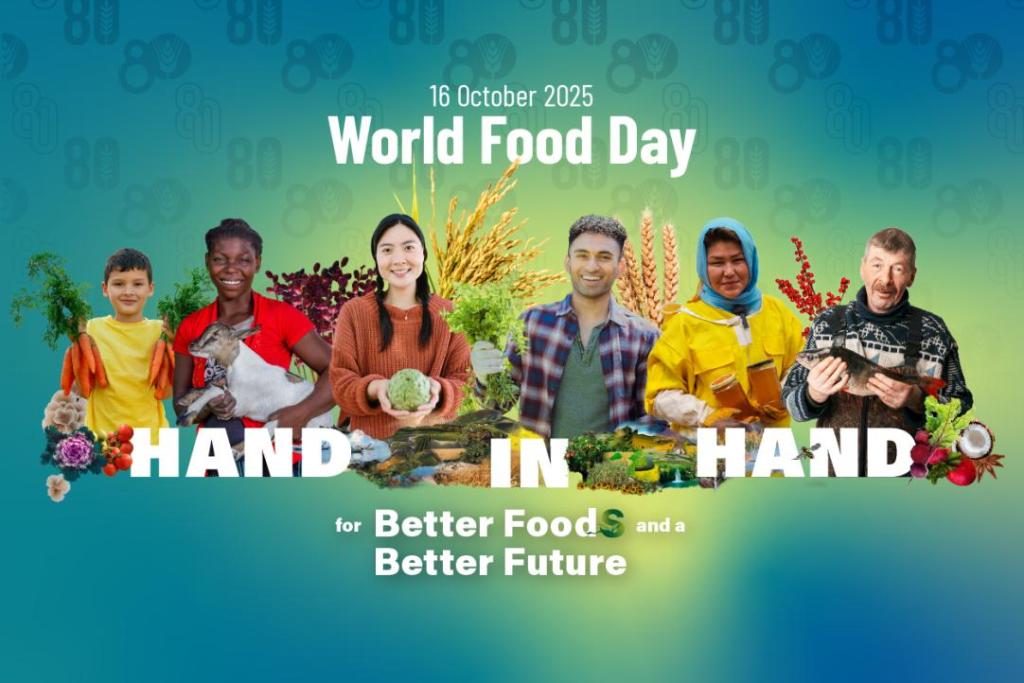
October 16 marks World Food Day—the day in 1945 that the Food and Agriculture Organization (FAO) was set up. FAO is a specialized agency of the United Nations that leads international efforts to defeat hunger. FAO’s goal is to achieve ‘food security for all and make sure that people have regular access to enough high-quality food to lead active, healthy lives.’ 194 countries and the European Union constitute its membership and FAO works in over 130 countries worldwide.
World Food Day aims to raise global awareness about food security and hunger, promoting actions to eradicate hunger and malnourishment. The day focuses on sustainable food systems, healthy diets, and equitable food distribution to ensure a better future for all. The theme for World Food Day 2025 is “Hand in Hand for Better Foods and a Better Future”.
One would hope that with world attention on this critical issue, things would have gotten better in the decades since the establishment of FAO. Well, in fact measures of world hunger over time do show a general decline from that time. But the bad news is that progress has stagnated and reversed in recent years due to factors like conflict, climate change, and the pandemic.
Food Sufficiency
One area of concern in this turbulent world of conflicts and tariff wars is a country’s food self-sufficiency. The alarming fact is that as per a study reported in Science Alert, carried out by researchers from the University of Göttingen in Germany and the University of Edinburgh, only ONE country in the world can is self-sufficient in all seven key food groups (Fruits, Vegetables, Dairy, Fish, Meat, Plant-based protein, and Starchy staples).
And is Guyana! China and Vietnam were the runners-up, producing enough food to meet their populations’ needs in six out of the seven categories. Less than 15% of countries are self-sufficient in five or more food groups. Half a dozen countries– Afghanistan, the United Arab Emirates, Iraq, Macau, Qatar, and Yemen – are unable to meet self-sufficiency in any food group.
This is bad news in a world which cannot count on peace and fair trade across borders. Governments have to urgently re-think their agricultural policies.
India
India’s agriculture has come a long way from the days of ‘ship to spoon’ when we dependent on the largesse of developed countries. Today, we are net strong in staples (cereals including rice, wheat and coarse grains) and dairy.
But we have our vulnerabilities. The weakest points are pulses and oils.
We depend on pulse imports because production fluctuates.We produced around 24-25 million tonnes of pulses in 2024-25 and imported about 4.65 million tonnes. Domestic production fluctuates due to weather etc.
India meets only ~ 40-45% of its edible oil demand through domestic production. The rest is imported (for oils or oilseeds). In 2023-24, imports we imported approximately16 million tonnes of edible oils. Domestic production is increasing but yield gaps, land use, and competition with other crops are constraints.
The issue is not just the macro-numbers. The context of persistent malnutrition and food insecurity due to rising food prices, food wastage, farmer distress and the increasing impact of climate change on agricultural production must be kept in mind.
Respect Food and Farmers
While we hope our governments and institutions will sharply focus on this, as individuals, this World Food Day is an opportunity to think about where our food comes from; how we can eat healthy without imposing enormous costs on the earth; how we can bring food-waste down to zero. And renew our respect for the farmers who feed us, often without due return.
–Meena
 Millennial Matriarchs