
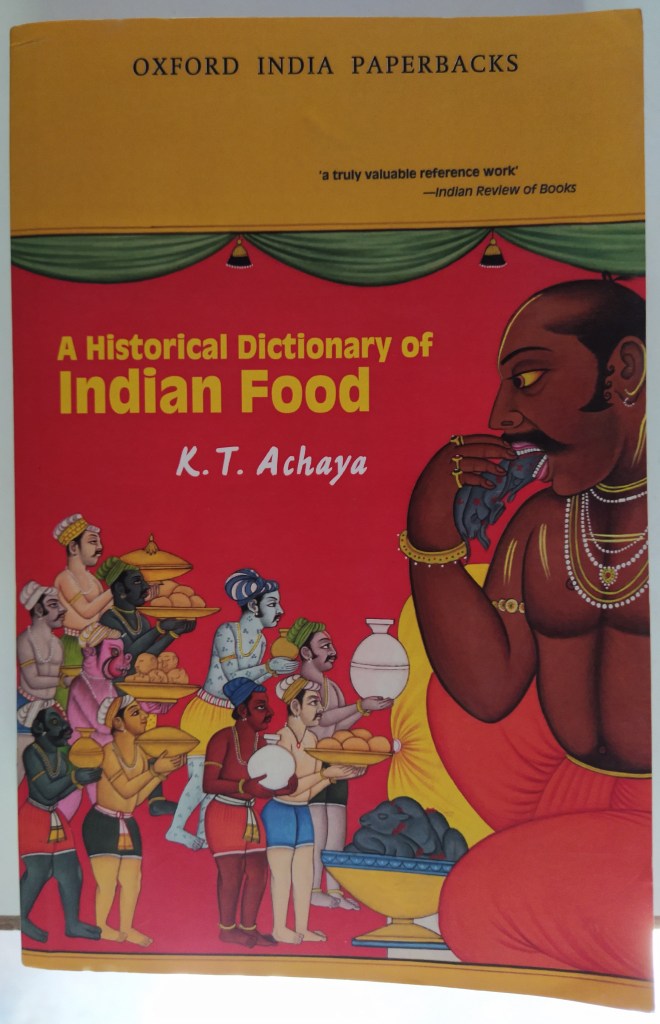
Several years ago, a dear friend gifted me a book on food. Not because I am a great foodie myself, but because I love probing into the ‘why’ and ‘how’ of things, and this book did the same. Whenever I write a piece about food, I invariably dip into this trusty resource. This is a book called A Historical Dictionary of Indian Food by KT Achaya.
The painstaking and well-researched book traces the origins and pathways of food, and food ingredients that are so much a part of our cuisines. KT Achaya was a scientist with deep interest in the humanities as well the fine arts. He was also fluent in a number of Indian languages which gave him access to diverse original sources. From ancient Sanskrit manuscripts, archaeological evidence, to a wide range of scientific as well as historical documents, KT Achaya compiled facts about countless ingredients as well as dishes that threw up fascinating nuggets of information, and sometimes also ruffled feathers (e.g. idlis did not originate in India!)
Recently I read another book which talked about Achaya the man himself. That was an interesting story in itself, and gave life to the name that I had only associated with my food dictionary. I discovered that Achaya spent his entire professional life as highly respected scientist working with compounds and formulae, before his avatar as a food historian.
KT Achaya was born on 6 October 1923 at Kollegal in Karnataka. His father was a sericulturist who managed a silk farm run by the government of India. Achaya graduated from Madras University with chemistry honours. He also got his MSc degree from the same after pursuing his research at the Indian Institute of Science in Bangalore. A government scholarship took him to the University of Liverpool for his doctoral studies. His research focused on the chemistry of cow and buffalo ghee, and was academically well received. In 1948 he published his first book, Indian Dairy Products co-authored with K. S. Rangappa. This is still considered one of the most important books in the field.
Achaya returned to India in 1949. In 1950 he was selected to help establish an institute under the auspices of the Indian Council of Scientific and Industrial Research (CSIR). Originally named Regional Research Laboratory, this is now the Indian Institute of Chemical Technology, Hyderabad. Achaya went on to spend 22 years at the Institute, engaged in ground-breaking research and publishing academic papers that garnered international recognition.
In 1971, Achaya became the executive director of the Protein Foods and Nutrition Development Association of India in Mumbai. Here he hoped to develop products that were high in nutrition, easy to consume, and inexpensive. The project did not succeed commercially, but the book on nutrition that he wrote during this period, Your Food and You, became popular and was translated into several Indian languages. Subsequently Achaya moved to Mysore to be close to Coorg where his origins lay.
He retired in 1983. It is during this period that Achaya began to write articles on the history of Indian food for the Science Age journal. It is these that grew in scope and range, ultimately being published as books, the first of which was Indian Food: A Historical Companion described as an ‘incomparable classic on Indian food’. He went on to publish several other books including A Historical Dictionary of Indian Food and The Food Industries of British India.
Achaya described himself as a “cowboy” because he had worked so long in the chemistry of dairy products and milk production. His later research later turned to oils and oil production, nutrition, and food technology. In fact Achaya was much more–a Renaissance man in an age of specialisation. He was not only interested in, but knowledgeable about western and Indian classical music, photography, art, cinema, books, sports, and of course food. He was an innovative cook himself; experimenting with different kinds of cuisine, and equally interested in understanding more about the ingredients he used for the different dishes, and leading him on the trails to track their origins and history.
First published in 1994, Indian Food: A Historical Companion marked a new phase in food writing in English in India. There were, at the time, books on food in Indian languages. S. Meenakshi Ammal’s Samaithu Paar in Tamil (the English translation of which was also gifted to me by the same friend!) was a classic that was passed down through generations. The early English language books were by people like Tarla Dalal. But these were simply ‘recipe’ books. Achaya’s was a totally different genre. These were the first compendiums of their kind. They were scholarly, encyclopaedic, and often not relieved by photographs, and even, recipes.
The years that followed saw a spurt in interest in food history. Today there are many books which trace the history of food in different ways. Many of these document traditional family recipes and place these in a social, historical and geographical context. Some of these combine history, anecdotes and photographs, along with interesting layouts and illustrations. Then came the internet where recipes from the local to the global, from the simplest to the gourmet are available at ones fingertips.
Be that as it may, for a pre-internet generation there is something special about browsing through a recipe book. I myself have a kitchen shelf with a variety of recipe books, collected over the years; some of which I dip into to refresh a memory, or to explore a change in the regular menu. Achaya’s books evoke not only a sense of exploration and discovery, but also a deep respect for the scholarship and passion of a single man.
–Mamata
 Millennial Matriarchs