
Food for Thought

October 16 marks World Food Day—the day in 1945 that the Food and Agriculture Organization (FAO) was set up. FAO is a specialized agency of the United Nations that leads international efforts to defeat hunger. FAO’s goal is to achieve ‘food security for all and make sure that people have regular access to enough high-quality food to lead active, healthy lives.’ 194 countries and the European Union constitute its membership and FAO works in over 130 countries worldwide.

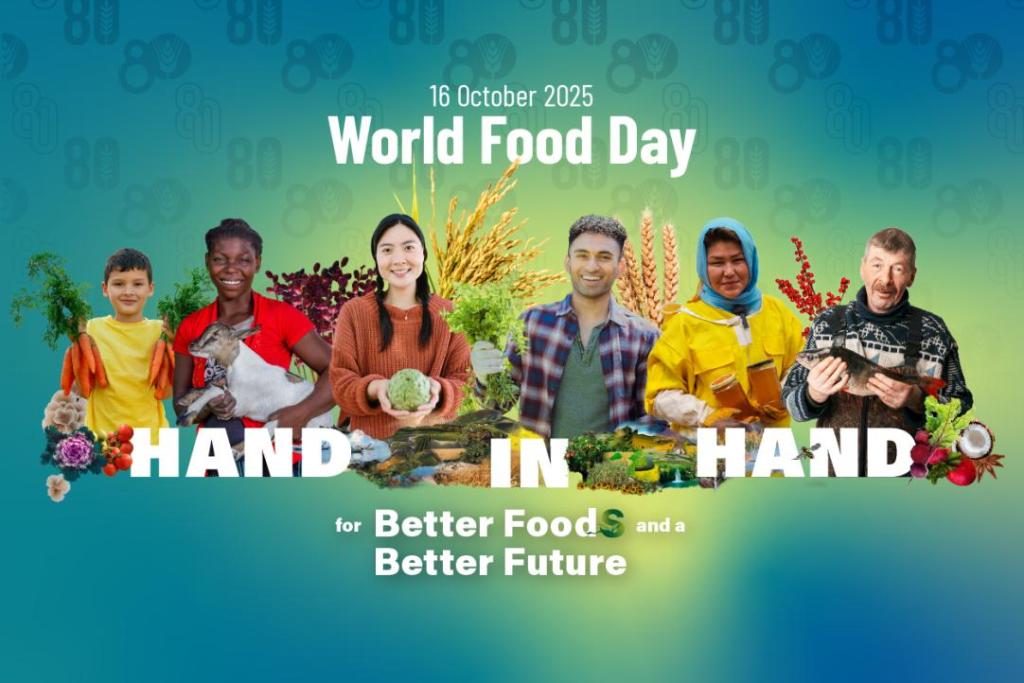
World Food Day aims to raise global awareness about food security and hunger, promoting actions to eradicate hunger and malnourishment. The day focuses on sustainable food systems, healthy diets, and equitable food distribution to ensure a better future for all.  The theme for World Food Day 2025 is “Hand in Hand for Better Foods and a Better Future”.

One would hope that with world attention on this critical issue, things would have gotten better in the decades since the establishment of FAO. Well, in fact measures of world hunger over time do show a general decline from that time. But the bad news is that progress has stagnated and reversed in recent years due to factors like conflict, climate change, and the pandemic.

Food Sufficiency

One area of concern in this turbulent world of conflicts and tariff wars is a country’s food self-sufficiency. The alarming fact is that as per a study reported in Science Alert, carried out by researchers from the University of Göttingen in Germany and the University of Edinburgh, only ONE country in the world can is self-sufficient in all seven key food groups (Fruits, Vegetables, Dairy, Fish, Meat, Plant-based protein, and Starchy staples).

And is Guyana! China and Vietnam were the runners-up, producing enough food to meet their populations’ needs in six out of the seven categories. Less than 15% of countries are self-sufficient in five or more food groups. Half a dozen countries– Afghanistan, the United Arab Emirates, Iraq, Macau, Qatar, and Yemen – are unable to meet self-sufficiency in any food group.

This is bad news in a world which cannot count on peace and fair trade across borders. Governments have to urgently re-think their agricultural policies.

India

India’s agriculture has come a long way from the days of ‘ship to spoon’ when we dependent on the largesse of developed countries. Today, we are net strong in staples (cereals including rice, wheat and coarse grains) and dairy.

But we have our vulnerabilities. The weakest points are pulses and oils.

We depend on pulse imports because production fluctuates.We produced around 24-25 million tonnes of pulses in 2024-25 and imported about 4.65 million tonnes. Domestic production fluctuates due to weather etc.

India meets only ~ 40-45% of its edible oil demand through domestic production. The rest is imported (for oils or oilseeds). In 2023-24, imports we imported approximately16 million tonnes of edible oils. Domestic production is increasing but yield gaps, land use, and competition with other crops are constraints.

The issue is not just the macro-numbers. The context of persistent malnutrition and food insecurity due to rising food prices, food wastage, farmer distress and the increasing impact of climate change on agricultural production must be kept in mind.

Respect Food and Farmers

While we hope our governments and institutions will sharply focus on this, as individuals, this World Food Day is an opportunity to think about where our food comes from; how we can eat healthy without imposing enormous costs on the earth; how we can bring food-waste down to zero. And renew our respect for the farmers who feed us, often without due return.

–Meena

With Gratitude for Every Morsel of Food…

The recurrent theme in the last few days has been FOOD.

First, the passing away of Dr. MS Swaminathan, the father of India’s Green Revolution at the age of 98. Today, we have forgotten the first few decades after Independence, when hunger was a reality for many in our country. At Independence, hardly 15 percent of agriculture was under irrigation. The food grain production was 50.8 million tonnes. Agricultural methods, tools and equipment, were centuries if not millennia old, and were grossly insufficient to feed the country’s growing population. On top of that, the vagaries of nature, which saw floods and droughts disrupting cultivation. Food insecurity and shortages were common, and two severe droughts 1964–65 and 1965–66 led to major food shortages and famines. We were dependent on food imports to feed our people, and many people doubted the survival of us as a nation, when we could not even fulfil this basic need.

It is this dismal scenario that pushed people to look for solutions that would make us food secure and food sufficient. And the hero of the hour was Dr. MS Swaminathan. Swaminathan, a student of zoology, who was a witness to the tragedy of the Bengal Famine of 1943 and frequent food shortages, decided to devote his life to improving this situation. And that is what he went on to do just this. He joined the Indian Agricultural Research Institute soon after Independence, and from there went on to do research and post-doctoral work in the subject. At IARI, he learnt about the work of Dr. Norman Borlaug in Mexico, where he had developed a dwarf variety of wheat which yielded more grain, and at the same time had stalks strong enough to hold the weight of the grains. Dr MS saw this as a beacon of hope and worked with Dr. Borlaug to develop improved crop varieties suitable for India. He also worked on fertilizers suitable for our conditions, as well as more efficient farming techniques. This laid the foundation for our Green Revolution, and paved the way for India not only to becoming self-sufficient in food, but becoming a grain basket for the world. Today, our food grain production is estimated at a record 330.5 million tonnes (MT).

The Green Revolution though the saviour, was however not without its flip-side. It needed increased amounts of chemical pesticides and fertilizers thus reducing the soil fertility and quality in the medium term; these crops needed more water; and it led to monocultures based on specific crops and varieties, leading to erosion of agri-biodiversity. Dr. Swaminathan recognized these issues, and for many years led the movement for what he termed ‘the Evergreen Revolution’ which focussed on more environmentally sustainable ways of increasing productivity of the land.

As a part of Centre for Environment Education, we were fortunate to have opportunities to meet and interact with this giant. He came to our campus maybe a few times a year, as Chairman of our sister-institution VIKSAT, and also as guide and mentor to many of our projects and initiatives. I had the good luck to work under his guidance when CEE was putting together Government of India’s official submissions to the World Summit on Sustainable Development, and he was one of the advisors to the process.

And coming to the other food-related events:

Oct 2 marks the birthday of Gandhiji, who believed that farmers, farming and rural India had to be at the core of any development in India. He summed it up with his statement: “To forget how to dig the earth and tend the soil is to forget ourselves. “

It also marks the birth anniversary of Lal Bahadur Shastri, our second Prime Minister, who gave the nation the slogan ‘Jai Jawan, Jai Kisan’, seeing soldiers and farmers at the same level when it comes to ensuring the nation’s security.

And Sept 29 also marks the observance of UN’s International Day of Awareness of Food Loss and Waste. The goal of this day is to raise awareness on the importance of the problem and its possible solutions, and to promote global efforts and collective action towards meeting

And Sept 29 also marks the observance of UN’s International Day of Awareness of Food Loss and Waste. The goal of this day is to raise awareness on the importance of the problem and its possible solutions, and to promote global efforts and collective action towards meeting Sustainable Development Goal Target 12.3, which aims to halve per capita global food waste at the retail and consumer level by 2030, and reduce food losses along the food production and supply chains.

No more appropriate time to ponder on our relationship to food, those who produce it, and how we interact with it. And lets not forget: the prevalence of undernourishment–the share of people who lack regular access to sufficient calories– is increasing, with as many as 828 million people undernourished in 2021.

With gratitude to all the farmers and farm workers; the policy-makers who understand their importance and respect them for their contribution; those who work on the science of it; and those who cook it.

We owe every mouthful to you all. And may we never forget it.

–Meena