
June 5: Marked as Environment Day across the world since 1973.
The world has come a long way since the time in 1972 when such a day was mooted. Not only in terms of becoming more aware about the environment and taking action, but also in terms of the planetary boundaries being pushed to the brink through not taking enough action!
With the environment being such a widely talked-about issue, every actor—governments, businesses, civil society– have taken these issues on board.
Which is very good.
Till it is not.
The ‘till it is not’ includes corporates and other entities passing themselves off as environmentally or socially friendly when they are not. How do they do this? Here are a few terms that are used in the context of the many, many shades of these tricks:
- Green Washing is undertaking misleading promotion of products or policies as environmentally friendly when in reality, they are not—often exaggerating the benefits while hiding the true or non-existent environmental impact. Common and insidious, such examples may range from misleading ads, to misleading recycling claims, to unverifiable carbon footprint claims, and every PR stunt in the book.
- Blue Washing, indulged in by some of the largest corporations across the world, is the practice of businesses to sign up for the UN Global Compact and use their association with the United Nations to enhance their image and shift attention from their controversial business practices.
- Carbon Washing is when companies make misleading or unsubstantiated claims about their carbon impacts or initiatives.
- Social washing is similar to green washing, but in the context of being socially conscious–corporations wrongfully trying to market themselves as socially responsible.
- Purple Washing is when a state or organization appeals to women’s rights and feminism in order to deflect attention from its doing nothing, or in fact actually harming these rights.
- Pink Washing is when companies try to create a false impression of being LGBTQ friendly while doing nothing to make life for their LGBTQ employees easier.
- Rainbow Washing is similar to the above, when corporations use the rainbow symbol or colours, while being involved in activities that are damaging to LGBTQIA+ community
- Vegan Washing is when companies promote their products through appeals to compassion for animals, while actually causing animal suffering
Of recent times, the vocabulary of Green Washing has got even more nuanced! Here are some subtle variations:
- Green Shifting: This is a subtle move, wherein companies highlight consumer choices, thus transferring responsibility to them, rather than highlighting their sustainability efforts.
- Green Lighting: This trend is about corporations highlighting a particularly environmentally friendly aspect of their operations, in an effort to divert attention from less sustainable practices elsewhere in the company.
- Green Rinsing: This involves businesses frequently changing ESG targets without genuine accomplishment, thereby making it hard for stakeholders to track their progress.
The UN warns about the seriousness of the harm that Green Washing (and allied colour-washes) can cause. In the context of climate change, the UN points out that: ‘Greenwashing presents a significant obstacle to tackling climate change. By misleading the public to believe that a company or other entity is doing more to protect the environment than it is, greenwashing promotes false solutions to the climate crisis that distract from and delay concrete and credible action.’
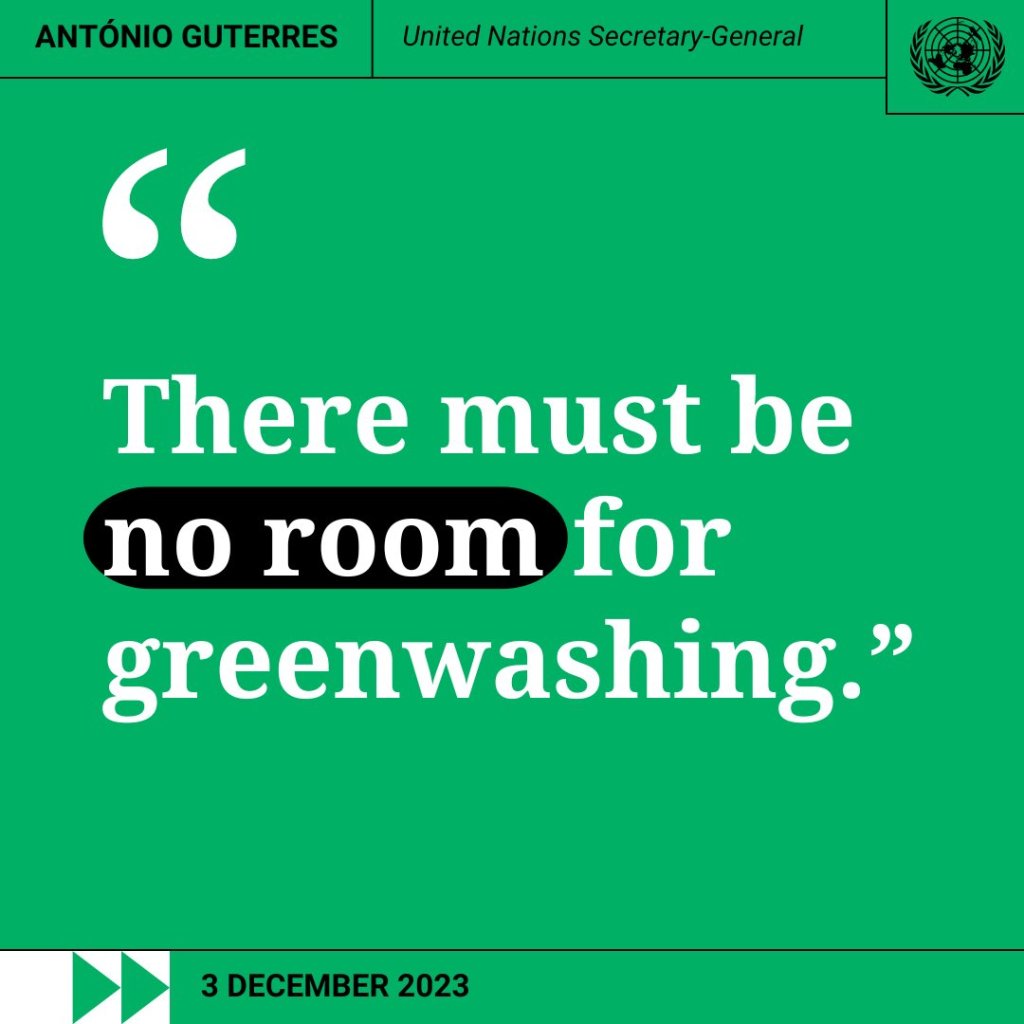
They identify many tactics of green washing including:
- :‘Claiming to be on track to reduce a company’s polluting emissions when no credible plan is actually in place.
- Being purposely vague or non-specific about a company’s operations or materials used.
- Applying intentionally misleading labels such as “green” or “eco-friendly,” which do not have standard definitions and can be easily misinterpreted.
- Implying that a minor improvement has a major impact or promoting a product that meets the minimum regulatory requirements as if it is significantly better than the standard.
- Emphasizing a single environmental attribute while ignoring other impacts.
- Claiming to avoid illegal or non-standard practices that are irrelevant to a product.
- Communicating the sustainability attributes of a product in isolation of brand activities (and vice versa) – e.g. a garment made from recycled materials that is produced in a high-emitting factory that pollutes the air and nearby waterways.’
The UN urges us all to be more responsible by:
- Learning more about green washing techniques so that we are more discerning
- Make better consumer choices by buying only from companies whose green claims have been substantiated
- Taking into account a product’s lifecycle and its environmental impact through every stage of making, use and disposal.
This Environment Day, let’s become better watch-dogs for the environment by getting more savvy about this colour palatte!
–Meena
 Millennial Matriarchs