
Civil-Society Seshan: A Tribute to Jagdeep Chhokar

Mr. TN Seshan’s tenure as Election Commissioner (12 December 1990 to 11 December 1996) changed how we Indians viewed elections—he made free and fair polls a public expectation rather than an exception. The revolution he brought about was to enforce the Rules, provisions and systems that already existed, but no EC before him had acted sufficiently on. The Model Code of Conduct for instance, which political parties routinely flouted, with EC looking in the other direction. He cancelled or postponed elections where the MCC was blatantly violated. He took action to drastically reduce booth capturing, and clean up electoral rolls and reduce bogus voting. He made candidates and parties accountable for their campaign spending and took strong action against black money in elections. He strengthened monitoring of polling stations, and deployed paramilitary forces in sensitive areas. He laid the ground for Voter ID cards. He increased transparency by publishing election schedules and guidelines well in advance.

The man who ‘ate politicians for breakfast’ helped strengthen and deepen Indian democracy.

If Mr. Seshan brought about all these changes through rigorously using his given power as a bureaucrat, Jagdeep Chhokar, did it purely from the outside. He co-founded the Association for Democratic Reforms (ADR) in 1999 along with his colleague Prof Trilochan Sastry and others as an NGO.

ADR’s primary mission is to improve governance and strengthen democracy by bringing transparency and accountability into India’s political and electoral processes. Over the past two decades, it has become one of the most credible civil society voices on issues of electoral reforms, political funding, and the integrity of candidates and parties.
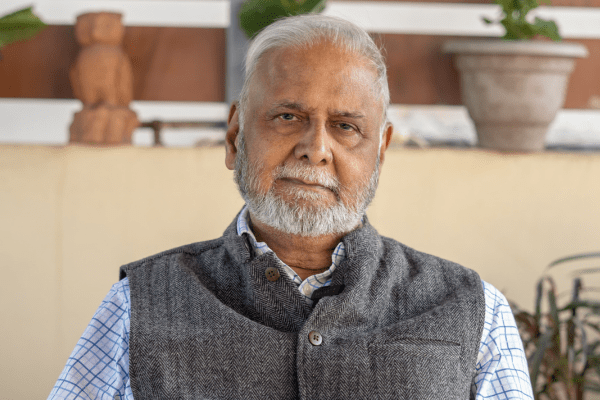
One can see echoes of Mr. Seshan’s work–one of ADR’s most significant contributions has been its role in disclosure of criminal, financial, and educational background of candidates contesting elections. Following a landmark Public Interest Litigation (PIL) filed by ADR, the Supreme Court of India in 2002 mandated that all candidates must file self-sworn affidavits disclosing their criminal records, assets, liabilities, and educational qualifications. This judgment fundamentally changed the way Indian voters access information about their representatives. Since then, ADR, through its platform MyNeta.info, has been collecting, analyzing, and disseminating this information for every state and national election, enabling citizens to make more informed choices.

ADR has also been active in examining political party funding and expenditure, a highly opaque area of Indian democracy. By studying income tax returns and donation reports of political parties, it has consistently highlighted the growing role of unaccounted money in politics. ADR’s reports show that a large proportion of party funding comes from unknown sources, often via electoral bonds or cash donations, which raises concerns about transparency. These findings have been widely cited in media, parliamentary debates, and reform discussions.

Beyond data disclosure, ADR has worked to strengthen electoral reforms in collaboration with the Election Commission of India (ECI), civil society organizations, and policy experts. Its advocacy has covered areas such as decriminalization of politics, regulation of inner-party democracy, curbing misuse of money and muscle power, and improving voter awareness.

Another major initiative is citizen empowerment through voter education. ADR conducts voter awareness campaigns, disseminates easy-to-understand report cards on candidates, and organizes debates and dialogues to promote ethical voting. It also collaborates with other organizations on programs like the National Election Watch (NEW), a network that monitors elections and promotes democratic accountability.

ADR has been central in challenging the electoral bond scheme in courts. In February 2024, the Supreme Court of India struck down the electoral bond scheme as unconstitutional, ordering disclosure of donor identities, amounts, etc.

In essence, ADR’s work has created a data-driven framework for citizen engagement, holding both candidates and political parties accountable. While challenges remain in implementing deeper reforms, ADR has significantly advanced transparency in Indian democracy and continues to push for systemic change.

Recent Initiatives of ADR

  • ADR has published updated data (as of July 2025) on how parties redeemed electoral bonds from 2018-24, including comparison with State Bank of India RTI responses. Their analyses show that in FY 2022-23, 82.42% of the income from “unknown sources” declared by national political parties came from electoral bonds.
  1. The report also examines the financial disclosures of Registered Unrecognised Political Parties (those registered with the Election Commission but not recognised as state or national parties).  There was a 223% rise in declared income during FY 2022-23 among these parties.
  2. ADR and its network National Election Watch (NEW) analysed the affidavits of 8,337 out of 8,360 candidates in the 2024 Lok Sabha elections
  3. Among findings:
    • Around 20% of all candidates had declared criminal cases; for state party candidates it was ~47%.
    • 46% of the winning MPs declared criminal cases, up from 43% in 2019.

A Friend

For Mamata and me however, he was Jagdeep, husband of colleague and dear friend Kiran. For me, he was also the colleague of my husband, and neighbour for decades.

What I recall very fondly is how caring of older people Jagdeep and Kiran were. Often when my parents were visiting and they knew I was travelling, they would ensure to drop in and chat, and solve any little problem they might have. The affection was mutual. He was a particular favourite of my mother’s who would rush to make rasam if she heard he had a cold.

Jagdeep did his Law when he was teaching at IIM. And he never did well in exams at all, because he did not follow the quarter-baked kunjis from which examiners expected students to mug and regurgitate answers. He would regale us with the regressive and misinterpreted answers that featured in crib-books, and while we laughed, we also worried about what lawyers were learning.

All of us who knew Jagdeep personally will of course miss you. But the whole country will miss you. Thank you for everything you have done for India’s democracy. We know it was your consuming passion and commitment for the last 25 years. And we also know it took an immense amount of courage.

Thank you Jagdeep. RIP.

Wish you all strength, Kiran.

–Meena and Mamata

Also see: Close encouters with Al-Seshan at https://millennialmatriarch464992105.wordpress.com/wp-admin/post.php?post=1106&action=edit
Wise Words on Democracy

Election fever is well upon us. Not just us in India. An estimated third of the world goes to the polls this year.

A good time to pause and reflect on what people who have contributed so much to the shaping of our nation have said about democracy?

The first section is devoted to quotes taken from the discussions in the Constituent Assembly of India in 1949. The later section reflects Gandhiji’s thoughts on the subject.

‘What is democracy? I define it, in one word. Democracy is accommodation. Any person who does not understand this small definition of democracy, cannot be a democrat at all. ‘(Shri R. V. Dhulekar)

‘If we are going to have a democratic form of Government we should have as real democracy as possible by giving as much power to as small a unit as practicable so that the individuals composing the unit may have easy and ready remedy ..’. ( Shri B. P. Jhunjhunwal)

‘..the strength of democracy lies in the character of the people and their representatives.’ (Shri B. M. Gupte)

Constitution of India
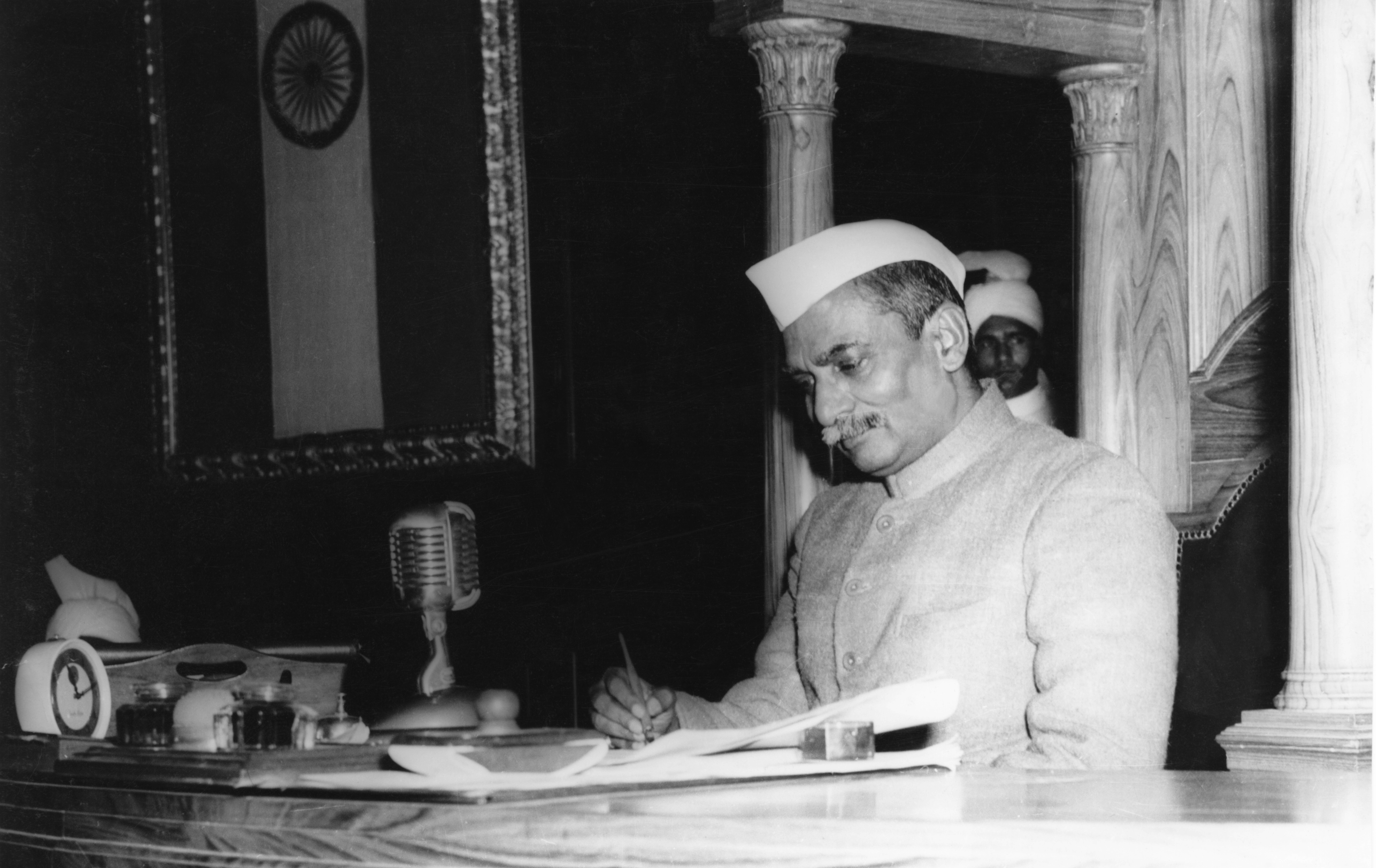
Dr. Rajendra Prasad, President of the Constituent Assembly, signing the Constitution of India.

‘The essence of democracy is not so much the existence of what are called political parties, etc., but the essence of democracy is the effective participation of the individual in the actual government of the country. The greater and more effective the participation of the individual in the government, the greater is the democracy, because democracy is still only an ideal which has yet to be reached by humanity.’ (TJM Wilson)

‘..Gandhiji  said that true democracy rose not from the top but from the bottom. Power and authority should not be centered at the top but should be distributed among the people at the base of society. Then alone can true democracy be established and then alone can people enjoy freedom.’ (Shri Kamlapati Tiwari)

‘We must observe the caution which John Stuart Mill has given to all who are interested in the maintenance of democracy, namely, not “to lay their liberties at the feet of even a great man, or to trust him with powers which enable him to subvert their institutions“. There is nothing wrong in being grateful to great men who have rendered life-long services to the country. But there are limits to gratefulness. As has been well said by the Irish Patriot Daniel O’Connel.. no nation can be grateful at the cost of its liberty. This caution is far more necessary in the case of India than in the case of any other country. For in India, Bhakti or what may be called the path of devotion or hero-worship, plays a part in its politics unequalled in magnitude by the part it plays in the politics of any other country in the world. Bhakti in religion may be a road to the salvation of the soul. But in politics, Bhakti or hero-worship is a sure road to degradation and to eventual dictatorship. (BR Ambedkar)

‘We must not to be content with mere political democracy. We must make our political democracy a social democracy as well. Political democracy cannot last unless there lies at the base of it social democracy. What does social democracy mean? It means a way of life which recognizes liberty, equality and fraternity as the principles of life.’  (BR Ambedkar)

From: Discussion in the Constituent Assembly of India. 1949.

Gandhiji on Democracy

‘I understand democracy as something that gives the weak the same chance as the strong.’

Democarcy is ‘..”the art and science of mobilizing the entire physical, economic and spiritual resources of all….in the service of the common good of all”

‘There is no human institution but has its dangers. The greater the institution the greater the chances of abuse.  Democracy is a great institution and therefore it is liable to be greatly abused. The remedy, therefore, is not avoidance of democracy but reduction of possibility of abuse to a minimum.’

‘..if individual liberty goes, then surely all is lost, for, if the individual ceases to count, what is left of society? Individual freedom also can make a man voluntarily surrender himself completely to the service of society. If it is wrested from him, he becomes automation and society is ruined. No society can possibly be built on denial of individual freedom.’ ‘In the democracy which I have envisaged, a democracy established by nonviolence, there will be equal freedom for all. Everybody will be his own master.’

Profound perspectives indeed, and we would do well to reflect on them, and to think about the fundamentals of democracy, which are:
1) Respect for basic human rights,
2) A multi-party political system paired with political tolerance,
3) A democratic voting system,
4) Respect for the rule of law,
5) Democratic governance, and
6) Citizen participation

Democracy is much more than election day and inking the finger!

–Meena

Pic: http://www.nbpgr.ernet.in

Game of Thrones

The small screen is definitely dominated by GOT currently. Whether the much-awaited HBO release, or the Indian elections.

GOT-HBO is a debate at some level on the divine right of kings and queens; defining bloodlines and who has the right to inherit; and on the need for popular support even if one thinks one has the ‘divine right’.

Not unlike the Indian elections!

But that is not the substance of my Election Day piece.

What’s in a Word?

It really started with a confusion about the word ‘suffrage’. We learnt it by rote in middle school Civics, as in ‘India has Universal Adult Suffrage.’ Such a strange word. Seems more related to suffering than anything else. But surely that couldn’t be!

The origin of the word is not clear. To quote Merriam Webster dictionary, ‘suffrage has been used since the 14th century to mean “prayer” (especially a prayer requesting divine help or intercession). So how did “suffrage” come to mean “a vote” or “the right to vote”? To answer that, we must look to the word’s Latin ancestor, suffragium, which can be translated as “vote,” “support,” or “prayer.” That term produced descendants in a number of languages, and English picked up its senses of “suffrage” from two different places. We took the “prayer” sense from a Middle French suffragium offspring that emphasized the word’s spiritual aspects, and we elected to adopt the “voting” senses directly from the original Latin.’

Another theory says that the voting meaning comes from the second element frangere, and the notion is “use a broken piece of tile as a ballot”, and seems to go back to the 1530s. The meaning as in “political right to vote” in English is first found in the U.S. Constitution, 1787. (https: //www. etymonline.com/word/suffrage)

Making It Universal

Well, as our Civics books told us, India has Universal Adult Franchise. At 12 years of age, I did not understand how profound that was. Each and every citizen of the country who has crossed a certain age, irrespective of gender, education, caste, creed, religion, properly ownership, can vote. And this has been in force from our very first elections in 1951-52. Many countries of older democratic tradition came to adult suffrage only by slow and painful steps. For instance, in most countries, originally only land owners could vote. Universal suffrage came to South Africa only in 1993. Between the 1890s and 1960s, many state governments in the US insisted that voters pass a literacy tests before they could be allowed to vote—a ruse to exclude African-Americans and other racial minorities from voting.

The most vigorous battles of course were for Women’s Suffrage—fought by women on the streets of many countries including the UK and the US. In most countries, there was a lag of a generation between adult men getting the franchise, and women getting it.

Women in India got this automatically from 1950. But while we had the vote from the very first elections, there were many women who did not exercise this the first time around. Here are some very interesting insights from a piece in the Economic Times: ‘During the creation of the electoral roll, a number of women, nearly all in North India, wanted to be registered not under their own names, but as “wife of..” or “daughter of…”. This was the practice in their communities and when this issue first came up in provincial elections in the 1930s, colonial bureaucrats allowed this.  But now the officials of independent India refused. “The introduction of adult franchise is intended to confer on every adult, male or female, the right to participate in the establishment of a fully democratic system of Government,” the government of the United Provinces (now UP) wrote, emphasising the need that “no adult, male or female, is as far as possible left unrecorded in the electoral rolls”.

Many women could not vote in the first election: The Chief Election Commissioner of that time, Sukumar Sen, estimated that ‘out of a total of nearly 80 million women voters in the country, nearly 2.8 million failed to disclose their name, and the entries relating to them had to be deleted from the rolls. Sen decided that registrations would happen by the next elections. Votes for women, in their own identities as citizens of India, was a principle that could not be compromised.’  (https:// economictimes.indiatimes.com/news/politics-and-nation/on-the-centenary-of-womens-suffrage-a-look-at-how-india-achieved-electoral-equality/articleshow/63150595.cms).

Something to be said for the strength of conviction of the Chief Election Commissioner!

Voting Age

While most countries—over 100–have 18 as the minimum age for voting, there are some countries who hold the age as 16, and a few at 17. There are a handful of countries who have set the age at above 18. For example, South Korea’s legal voting age is 19 years; Nauru, Taiwan, and Bahrain hold it at 20 years; Oman, Samoa, Tokelau, Tonga, Singapore, Malaysia, Kuwait, Jersey, and Cameroon at 21. The United Arab Emirates has the oldest legal voting age in the world. Citizens can only vote when they attain the age of 25 or older.

Many may not remember, but in India, we started out with a voting age of 21. The Sixty-first Constitutional Amendment brought about in 1988, lowered the voting age from 21 years to 18 years.

Vote, vote thoughtfully, vote with the hope that exercising suffrage reduces suffering!

–Meena