Casting a Spell

The Indian-American domination of a peculiarly American phenomenon—the Spell Bee—is something that intrigues me no end. Not to say Indian-Americans don’t excel in many pursuits out there, but these kids winning the national level spelling competitions year after year after year after year is quite something.

The American tradition of spelling competitions may have started with the Puritans. By the mid-18th century, spelling competitions were common across the country. In 1750, Benjamin Franklin apparently recommended their use in a proposal for a school. Spelling challenges were quite the rage with both adults and children in the 19th century. Mark Twain apparently mentions ‘spelling fights’ in Adventures of Tom Sawyer!

The use of the term ‘bee’ for these competitions started in the mid 1870s. It is an unusual usage of the word, as ‘bee’ usually refers to a community activity with a shared goal—like quilting bees or knitting bees.

English, with words from various sources and a variety of languages, probably peculiarly lends itself to this pastime. Afterall, I don’t think there can be much confusion how 99% of words are spelt in Tamil or Kannada or Oriya– languages with phonetic writing systems do not have so much confusion in spelling. Moreover, because English has borrowed words from many languages through its history, the result is a diverse vocabulary with inconsistent spelling patterns which are carried over from the mother-languages.
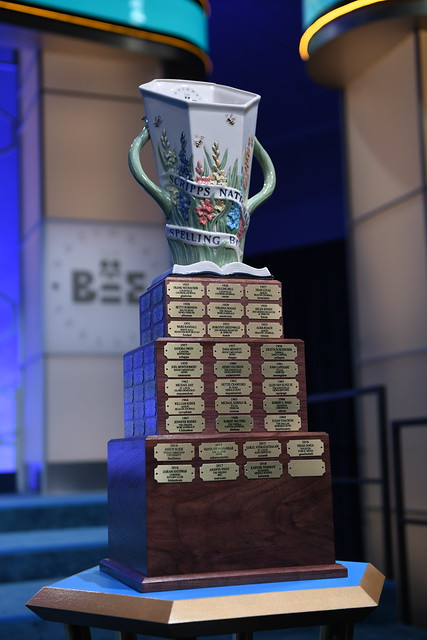
In the US, the National Spelling Bee, as we know it today, was established in 1925. The Louisville Courier-Journal was the first sponsor, who saw it as a way to foster interest in spelling and language. 

The E.W. Scripps Company acquired the rights to the National Spelling Bee in 1941. This company was started by E.W. Scripps who founded The Penny Press, a daily newspaper in Cleveland. Today, the company is involved in investigative documentaries and enterprise journalism with the purpose to ‘…advancing understanding of the world around us.’

The Spell Bee has been held annually, in late May or early June since its inception, except for a few years during World War II and in 2020 due to COVID-19.  It has evolved over time, beyond just spelling, encompassing vocabulary development and broader language knowledge. 

The first winner of the Spell Bee, in 1925, was Frank Neuhauser of Louisville, whose winning word was “gladiolus”. The next year saw a girl winning for the first time– Pauline Bell, also of Louisville, who spelt the word “cerise”. (Incidentally, girls won nine consecutive competitions from 1932 to 1940.)

Now coming to winners of Indian origin. 30 of the last 36 competitions have been won by them. Which is surely not a chance thing. Before 1999, there were only two spelling bee winners of Indian-American descent—Balu Natarajan in 1985, with the word “milieu”, and Rageshree Ramachandran in 1989 with “elegiacal”.  Nupur Lala opened the floodgates in 1999 winning with “logorrhoea,” and there has been no looking back since then! This year of course we celebrate Faizan Zaki, a 13-year-old Indian-American student from Texas, who won with the word ‘éclaircissement”

Rebecca Sealfon who won in 1997 against Prem Murthy Trivedi, has done some analysis on the subject of Spell Bee competitors, and tells us that children practice for about 500 hours in the years in which they compete; some hire ex-competitors as coaches; and they typically and unsurprisingly relax by playing word games like Scrabble or Boogle. Some try to learn every word in the dictionary. She further tells us that double ‘ll’ words are the ones which have tripped up a large number of contestants, along with the words ‘metastasize’ and ‘metonymy’.

Since I don’t know many of these words, and would certainly not be able to spell them, I can only express my wonder at these sub-14 year olds who can.

Kudos to all of you! You have cast a spell on me!

–Meena

Pic: https:spellingbee.comblogscripps-cups
Reach for the Sky: Recalling Interactions with Dr. Kasturirangan

Last week, India and the world of science lost a doyen: Dr. Kasturirangan who in the decade till 2003, led the Indian Space programme as Chairman of the Indian Space Research Organisation, as Chairman of the Space Commission and as Secretary to the Government of India in the Department of Space. During this period, India saw the launch of PSLV, our indigenously developed launch vehicle; the testing of Geosynchronous Satellite Launch Vehicle (GSLV); and IRS satellites among others.

Before that, as the Director of ISRO Satellite Centre, he headed the development of the Indian National Satellite (INSAT-2) and the Indian Remote Sensing Satellites (IRS-1A & 1B) as well as scientific satellites. He was Project Director of BHASKARA-I & II. He was also the Project Director for India’s first two experimental earth observation satellites, and subsequently was responsible for overall direction of the first operational Indian Remote Sensing Satellite, IRS-1A.

It was in his time as ISRO chief that Chandrayaan-1 was conceived.

I am proud to say that I had the chance of a few personal interactions. However, not in the context of high-science and technology!

As everyone in the country knows, Dr. Rangan was deeply involved in education, and obviously had a passion for science education (what we today call STEM). It was in this context that I had the chance to interact with him. He was the Chairman of the Board of Governors of the Vikram A. Sarabhai Community Science Centre (VASCSC), where I serve as a member. VASCSC was the result of Dr. Vikram Sarabhai’s vision of enabling the country’s top scientists to contribute to science education. The institution was started in 1966 as a facility where people concerned about the quality of science education could come together to try new ideas and methods of science teaching.

The institution has deep programmatic and emotional links with the various institutions associated with Dr. Sarabhai, the father of India’s space programme.  Dr. Kasturirangan was an obvious choice to chair it!

When very busy people take on yet another committee or chairmanship, it is often really only ornamental. With the best of intentions, they lack the time or mind-space to get deeply involved.

Not so with Dr. Rangan. He ensured to attend VASCSC Board meetings, sometimes in person, otherwise by Zoom. He was there on the dot even for Zoom meetings. He was completely clued in and asked sharp questions about the Action Taken Report. He had a prodigious memory and made quick decisions. He was always supportive of the programmes and publically appreciative of the management and staff for their innovative initiatives and their commitment. He never allowed himself to be distracted with anything else during the course of the meetings, and ensured everyone had their say. It was a humbling experience as well as a learning for all of us.

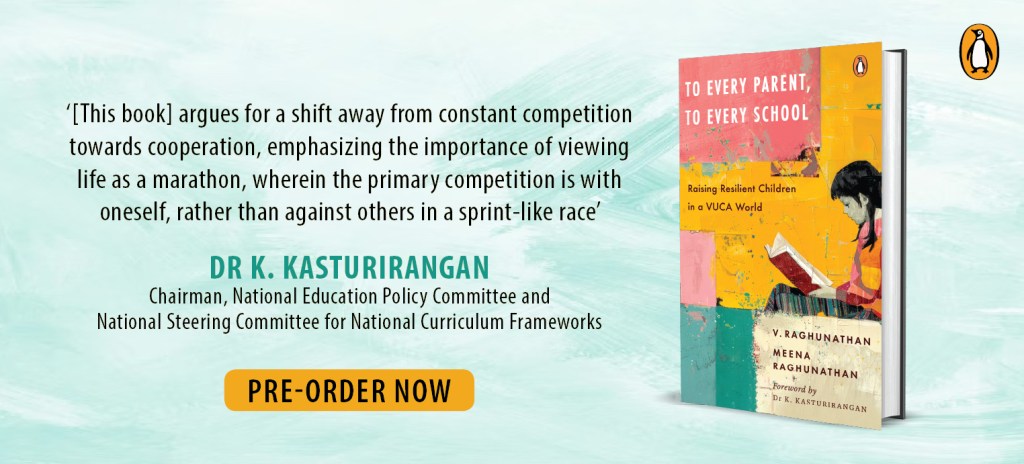
Raghu and I count it as a privilege that he consented to write the Foreword for our book: TO EVERY PARENT, TO EVERY SCHOOL: RAISING RESILIENT CHILDREN IN A VUCA WORLD (Penguin India). Even after he agreed, we were apprehensive: would he find the time to do it within the publisher’s deadline, given the enormous calls on his time? But we need not have worried. The write-up was with us a few days before the date we had indicated! And what a gracious Foreword it was!

These were people cut from a different cloth. They dedicated their lives to their mission. They wore their myriad achievements lightly. They were courteous to one and all. They listened. Nothing was too small for their attention. And they cared.

Grateful for the opportunity to interact with such inspirations.

–Meena

Montessori–For All Our Children

August 31 marks the birth anniversary of Maria Montessori, whose name of course is synonymous with the education system all of us wish our children to undergo. But even if she had not pioneered this revolutionary system of education, Ms. Montessori would still be in annals of history as a path-breaker. In 1883-84, at the age of 13, she enrolled in classes at an all-boys technical school. Not only did she choose technical subjects, but she did it with the hope of becoming an engineer, an almost unheard of choice for a girl. By the time she graduated in 1890, she had changed her mind and decided to become a doctor instead. This was not an easier choice though! She was strongly discouraged from taking up medicine in the University of Rome. So she enrolled for a degree in natural sciences, earning her diploma di licenza in 1892. This along with her studies in Italian and Latin, qualified her for entrance into the medical program at the University in 1893. This was only the first step though.  She was met with hostility and harassment from students and professors. Her attending classes with men in the presence of a naked body was considered inappropriate, and she was required to perform her cadaver dissections alone, after college hours. Nothing deterred her, and she graduated from the University of Rome in 1896. The mores of the times also brought unhappiness in her personal life. She loved a colleague, Giuseppe Montesano, and even had a son with him. But she could not marry him because if she married, she would have to give up her professional work.

She specialized in pediatrics and was involved in the education of mentally challenged children. In 1906, she was invited to set up a childcare centre in San Lorenzo , a poor, inner-city district of Rome, working with the most disadvantaged children of the area, who had no previous exposure to school. She called the center the Casa dei Bambini—Italian for “Children’s House. It was a quality educational environment for youngsters whom many had thought were unable to learn. About 50-60 children were enrolled to being with, and the building porter’s daughter was the first teacher, under Dr. Montessori’s guidance.

BunnyThe school showed amazing results. Soon the children exhibited great interest in working with puzzles, learning to prepare meals and clean their environment, were calm, orderly, self-regulating, and engaging in hands-on learning experiences—essentially teaching themselves.
Montessori’s experiments began to be widely studied and replicated, not only in Italy but across the world, till today it is a household name. India too has a long history of Montessori education, going back to the 1920s.

This system of education is undoubtedly what is needed for our young children today. Every Anganwadi  and primary school should be a Montessori school. Considering that the whole experiment began with the aim of catering to under-privileged children who were first generation learners, and with a not very educated daughter of a building porter as the teacher, it is the most obvious model for adoption.

But alas somewhere, this system of education has become identified with exclusive schools for the children of the rich and famous. The fees are out of reach of even the middle class.

Is it that we have, in the pursuit of the letter of Montessori’s methods, completely missed the spirit, and have become inflexible and unable to adapt to make it workable at low cost?

At a time with the new National Education Policy has recognized the importance of education for ages below 5 for the first time, it is time for introspection, creativity and a re-think on how this pedagogy can be the basis of learning in every educational institution.

–Meena


What’s in a Moth?

When is a butterfly not a butterfly? When it is a moth!

20180725_163659_resized.jpg

Butterflies have always hogged the limelight with their beauty and colour. Moths have always been the Cinderella, perceived as drab and uninteresting, and usually overlooked. Yet, moths greatly outnumber butterflies by a ratio of 10:1 and there are more than 12,000 species of moths.

There’s a lot in a moth for Dr Shubhalakshmi Vaylure, the first woman in India to study moths! “Why moths?” she was often asked when she started her research over 15 years ago. In fact, as she related in an interview, once she was asked why she chose to spend the nights studying moths (not quite suited to being a girl!) when she could study butterflies during the day, she replied “Well, someone’s gotta do this unpleasant night shift.”

It is that approach – Passion, Persistence and Push that sums up India’s Moth Lady!

Shubhalakshmi started by studying zoology and entomology in college, which is also when she signed up with Bombay Natural History Society (BNHS) as a student member to use the library, and volunteering, joining nature walks and trails. After graduation she joined the Conservation Education Centre of the BNHS as an administrative assistant. At the time BNHS was the only institution in Mumbai which was offering a master’s degree through research, and she signed up for this.  Isaac Kehimkar, an eminent butterfly expert, suggested she study moths as they had not  been much studied in India. And that is where it all began. On completing her master’s degree, she became an Education Officer at the CEC, and went on to head the Centre.

As fellow environmental educators and Fulbright scholars, Shubha and I have met several times, and her energy and enthusiasm have been inspiring and infectious. Over the years I have been following Shubha’s journey and have seen how capably she has combined her passion for nature with smart use of technology and successful entrepreneurship.

Shubha is one of the pioneers of Citizen Science in India which empowers and enables ordinary citizens to be part of wildlife and environmental research by observing, collecting and sharing local data.

In 2014 she started a social enterprise Ladybird Environmental Consulting. The first project that Ladybird undertook was the development of three mobile-based applications iButterflies, iTrees, iNaturewatch birds under iNaturewatch Urban Challenge, a citizen science programme that worked with schools in Mumbai, New Delhi, Kolkata and Hyderabad to collect data on their city’s flora and fauna. Following this she set up iNaturewatch Foundation, to continue such urban biodiversity citizen projects.

For those who are inspired to become citizen scientists, and follow in the steps of the Moth Lady, a great start will be Shubhalakshmi’s book Field Guide to Indian Moths. The culmination of 15 years of research, this reader-friendly field guide features descriptions of 733 species of moths, supported by over 1000 colour photographs. Shubha also coined for the first time, common names for several of the species. Way to go Shubha!

What better way to mark this week which is designated as National Moth Week.

–Mamata

Average is Normal

It is that time of the year again. It is the season of Superlatives. Exam results with Beyond Belief percentages, pictures of the Highest Scorers in the papers, magazines listing the Best Colleges, coaching classes advertising Record-breaking Achievers. So many wonder-kids? Are there no ‘average’ children anymore?

Even several years ago, I remember meeting my children’s classmates’ mothers when we were summoned to meet the teachers after the exam results were given. I heard exchanges about the achievements of the respective prodigy—prizes for painting, dancing, skating, swimming and more. Class toppers, school leaders all. I wondered, if every child is so brilliant, are there any simply ordinary children in the class?

I began to have doubts about my own parenting responsibilities and skills. Well, I did try to get the children to go for swimming coaching, largely because their cousins were going too (50% success—my daughter picked it up, and my son did not), dance lessons (my daughter did last a couple of years, but never made it till an arangetram!), and karate (my daughter made it till the first camp, my son till the white-one belt!).  Neither they, nor I, seemed to have the endurance run the gauntlet and emerge a Winner every time!

As parents who followed a relatively laissez-faire style of parenting, our considerations were mainly that the children were given the space to simply be, and blossom as they will. But as they grew, it became increasingly difficult to cope with the expectations of a competitive system. Still we thought that we were managing ok within the larger environment. We got a jolt one fine morning, when our son was denied readmission into Class 11 in the same school he had studied in for 10 years, because he missed the “cut off” by a couple of marks. Imagine the devastation for a fifteen year old. The experience that followed is a story in itself. One of the outcomes was that we decided that we did not wish our daughter (who was even less equipped to cope with a mindlessly competitive system) to go through this. Despite being told that “this is the system, your children and you will need to learn to swim with the tide, or sink”, we actively explored alternatives….and found them.

The children made it through! Today they are in the ‘system’ as it were, without being sucked into its vortex. They may not meet the generally accepted norms of Mainstream Success. (“Settled” so to speak, with six-figure earnings, car and apartment, designation, the skills to compete ruthlessly …and burn out at 35). They are following somewhat unconventional paths; they continue to explore, and discover new passions, new horizons, and new accomplishments. They are rich in experience, life skills, and relationships. They have the confidence to be themselves, and “not just another brick in the wall”.

Perhaps the greatest freedom we can offer our children is to allow them to think differently, and more importantly, to act differently.  Gunter Pauli

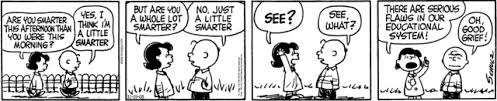
peanuts flaws

From Peanuts by Charles Schulz