The Ship has Sailed

Last week I was reminiscing on my parents’ sojourn in London, and the similarities it held with the sojourn of an ex-PM (Dr. Manmohan Singh) and his family in the UK, around the same time.

Surprisingly, the similarities did not end there. Both families made their way back by sea, on the SS Chusan, a ship of the P&O Company (but at different times).

These days, one thinks of sea-travel in terms of expensive luxurious cruises. But I suspect that in the early ‘60s, it may have been comparative in price to the cost of air-tickets, with the added advantage that it was a great 2-week holiday, with the novelty of the shipboard experience and the possibility of seeing a few new countries on the way.

And indeed the shipboard experience was something that was special. As the book ‘Strictly Personal’ by Damam Singh, a memoir of the lives of Dr. Manmohan Singh and Mrs. Gurcharan Singh says, ‘The SS Chusan offered virtually all the comforts of the cruise. The ship had 464 first-class and 541 tourist class cabins that had only recently been fitted with air-conditioning.’

Of course the first days were horrific with sea sickness for some of the passengers, but the organized fun and frolic was something my parents had probably never experienced before. (I too was there, as evidenced by photographs, but can remember nothing!).  My brother however remembered a penny being pulled out his ear by a magician who was part of the shows put up for kids. There were a variety of shows, music, dancing and games for all age groups. For all of us, as for Mrs. Gurcharan Singh ‘it was like a fifteen-day carnival.’

Many aspects of shipboard life were very formal. For instance, children were not allowed into the dining rooms.  Dr. Manmohan Singh recalls: ’At mealtimes, we could not take Kiki into the dining room. We had to leave her in the nursery, and she used to cry and cry.’ I was quite a happy child, so my parents did not have this problem.

SS Chusan
Being coached by my brother on the deck to run a race!

The SS Chusan was rather a special ship. It was the last and largest ship built for the P&O Company’s Far Eastern Service. It was eqipped with the latest (for the time!) marine technology, and was the first ocean-going passenger ship to be fitted with anti-roll stabilizers (imagine how many more people would have been sea-sick without that!). She was launched in 1949, and was decommissioned in 1973.

Incidentally, P&O stands for ‘The Peninsular and Oriental Steam Navigation Company’, which originally started in 1840. It is, even today, Britain’s biggest cruise line. But today, it declares that ‘We are a holiday company’—as different as can be from the services of yore used by middle-class professionals to commute from UK to India!

And if you have wondered why the names of ships are prefixed with some cryptic letters, well, these indicate the purpose or distinguishing characteristic of the boat. ‘SS’ stands for Steam Ship, or in more recent times, for ‘Single-screw ship’ which refers to the method of propulsion of the ship. Other prefixes include: FB for Fishing Boat; TS for Training Ship; RMS for Royal Mail Ship; MV for Merchant Ship; RV for Research Vehicle, etc.

I still wonder at the shared experiences of Indian families who went to the UK in the early ‘60s. Alas, there was no social media which could have helped them connect and share their experiences, learn from each other and make life a bit easier.

If that had been, who knows, we might have been old family friends of the ex-PM!

–Meena
A ‘Strictly Personal’ Common Experience

Recently I was reading ‘Strictly Personal’ an account of the lives of Dr. Manmohan Singh and Mrs. Gurcharan Singh, by their daughter Daman Singh.

The-then Mr. Manmohan Singh went to Oxford in the early ‘60s. He was joined in a few months by his wife and daughter. He was there for about 2 years. He was there to do his Ph.D

My father went to London in the early ‘60s, He was joined in a few months by his wife and children. He was there for about 2 years. He was deputed there by the Defence Research and Development Organization to train at the Royal Marsden Hospital, towards helping in the operationalization of the Institute of Nuclear Medicine and Allied Sciences (INMAS), which was to be involved in nuclear medicine research, and response to nuclear accidents and explosions.

What amazed me was the commonality between the experience that the book talks about, and the stories which are a part of my family history.

First and foremost, the travails of living on a very limited budget. It was literally hand-to-mouth! My mother recalls that at times, there were not enough pennies to put into the home-heater, and we all spent the day huddled in our woollies. The free milk that my brother and I were eligible for as children was a major saviour. It was not that the pay and allowances were so bad (they were not generous, but adequate). It was that they simply did not come for the first 3 months, till the bureaucratic wheels started moving. And even after, the money came in by fits and starts. One incident which was etched deep into my parents’ memories was a visit to Veerasway, UK’s oldest Indian restaurant. Yearning for other-than-home Indian food, they, with the two of us in tow, ventured in one day. Only to beat a hasty retreat on learning that the cover charge was £ 1 per head!

The book quotes Mrs, Singh as saying ‘We were quite hard up. I don’t know how many pounds a week we got. We had to survive within that. It was not a great, handsome scholarship.’

To the question ‘did you wear Western clothes?’ Mrs. Singh responds ‘No, no, no, never.’ But at least she may have worn salwar kameez. My poor mother stuck to saries through the freezing windy days, walking through hail and snow to the shops or to drop or pick up my brother from the school bus. I fully attribute her getting arthritis by the age of 35 to this exposure to the terrible cold and wet.

Food may have been a bigger problem for my strictly vegetarian family. My mother, on one of her initial trips to the super market, brought home margarine, which an English friend had suggested as a cheaper substitute for butter. It was only after her return home that she read the packaging and realized it was made from pork fat. The trauma stayed with her for life!

The Singhs lived in Oxford. Apart from one trip to London and one to Stratford-upon-Avon, they saw nothing of England. Maybe to that extent we were luckier. Living in London, we at least got to see the sights there—the few family pics taken with my father’s precious camera bought there show us at Trafalgar Square, outside the Buckingham Palace, the Tower, Westminster Abbey etc. The penguin show and the Chimpanzees’ Tea Party (discontinued in the ‘70s) were the highlights of the zoo visit.

The SInghs did not have a TV, and went to a neighbour’s to watch. We did have a television and the show that my parents talked about, which still sticks in my memory is ‘Saturday Night at the London Palladium’, a long-running variety show.

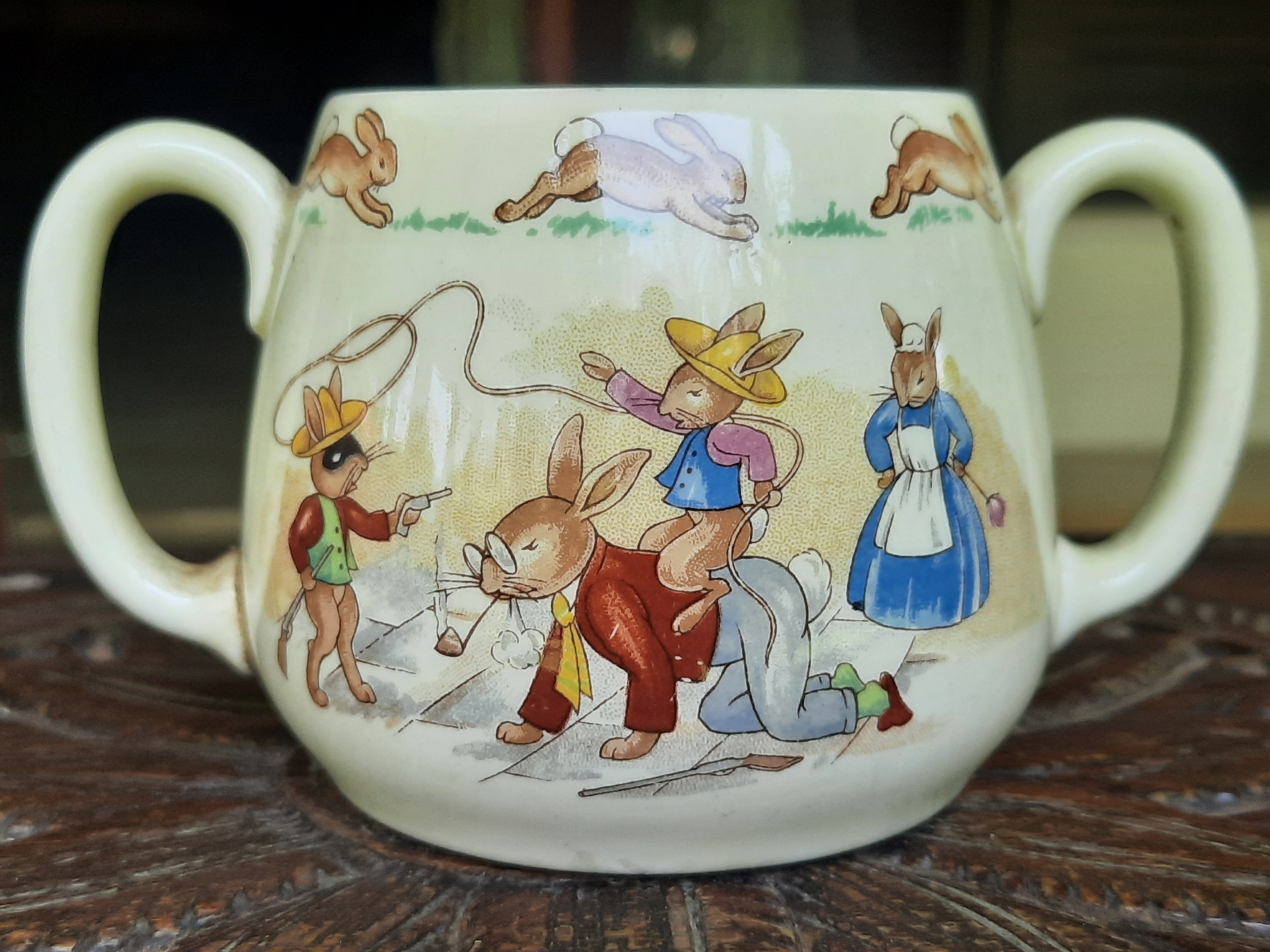
Peter Rabbit Milk Mug
My Peter Rabbit Milk Mug: A Precious Relic

Equally, the things they chose to buy and bring back. Both Mrs. Singh and my mother brought back Baby Belling ovens—a part of British history. The Belling company was established in 1912 and manufactured electric heaters. The first complete domestic electric cooker was made in 1919 and the first Baby Belling oven was manufactured in 1929. The company still exists but is not the gold standard for ovens that it obviously was in mid twentieth century. The other significant item to accompany the Singhs back were three saucepans. In my parents’ case, it was a mixie—a Braun Liquidizer, if I recall. This was my mother’s most precious possession. In fact, when a mischievous visiting child was on the verge of pushing it over, she caught the machine, and her hand was badly slashed, requiring stiches! Mrs. Singh’s oven served her for 3 decades, as did my mother’s mixie!

I think this would be the story of all professionals who went to the UK in those days. But interesting to see that a PM’s family and mine were in the same straits! (We were in other similar ‘straits’, more about which next week.)

In today’s world, all this sounds so strange! Life is so international today, our exposure is great, that nothing really comes as a surprise even when we go to the farthest part of the world. Purchasing power is not a problem, except maybe when there are threats of taxing international credit card payments. Not only are we more international in our eating, Indian food of every variety is available everywhere.

But how did they handle it back then—landing in a country familiar only through books, with few support systems or networks, with little money, inadequate warm clothes, unfamiliar food. They were certainly adventurous, maybe much more than we are today!

–Meena