
When there are myths and stories about the origins of an animal, tree, bird or anything in nature, we can be sure that the particular thing has played a huge part in human lives and society down the ages. The coconut is one such. There are stories from across the world about the origins of the coconut. Even in India, there are at least 4-5 popular stories about this. Not to mention stories from West Africa, China, Malaysia, etc.
Coconuts are an integral part of our lives in India—from the morning chutney for the idli, to the oil we swear by for hair growth, the refreshing and safe drink we give convalescents, to the coir mattresses we sleep on—they touch our lives in so many ways. Coconuts are a must for a visit to a temple, for a housewarming, a puja, or to launch a new vehicle.
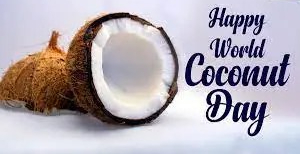
I didn’t know till recently that there was a World Coconut Day, marked on Sept 2nd every year. Nor did I know that there was something as grand and formal as The International Coconut Community (ICC), an intergovernmental organization of coconut producing countries organized in 1969 under the aegis of the United Nations Economic and Social Commission for Asia and the Pacific (UN-ESCAP). Their mission is to ‘To promote, coordinate and harmonize all activities of the coconut industry which sustains the lives of millions of small farmers.as well as those engaged in production, processing and marketing of coconut products.’ The ICC Secretariat is located in Jakarta, Indonesia and is headed by an Executive Director. The ICC has 20 member-countries from Asia, the Pacific, Africa, South America and the Caribbean’s. India is of course one of them.
World Coconut Day commemorates the foundation of Asian and Pacific Coconut Community (APCC), an intergovernmental organization of coconut producing countries.
The coconut certainly deserves all this. It is a tree which provides food, fuel, medicine, cosmetics, building materials, and much more. In the South Seas, there is a saying that ‘he who plants a coconut tree plants food and drink, vessels and clothing, a heat source, habitation for himself, and a heritage for his children’. Importantly, it forms part of the livelihood basket of lakhs of small landholders—98 per cent of coconut holdings are with small and marginal farmers.
India is among the largest producers of coconuts in the world with Tamil Nadu, Kerala, Karnataka and Andhra Pradesh being the major contributors. We produce over 19 million nuts a year, accounting for over 31 per cent of the world’s production. We also account for 66 per cent of the world’s exports, and send our coconuts to over 140 countries.
There is also R&D going on into development of a range of new coconut-based medical products. In the world of healthcare, a number of products from sterilizing agents to fungicides to anti-itch products are being developed. The fashion industry too has taken to developing new products based on coconuts. There is also considerable research in the direction of developing several food-related products like coconut skimmed milk, coconut milk powder, coconut cream, coconut vinegar, coconut jaggery and palm sugar, and we may expect to see many such new products hitting the market soon. There is also on-going effort to make coconut shell charcoal and activated carbon.
So let’s join in the celebration of the ubiquitous coconut that we take so much for granted. Drink tender coconut-water, eat a coconut burfi, make a curry with a coconut gravy, or throw a coconut themed party. Just a way to say thank you to a tree that gives us so much—health, beauty, taste, shelter, sound sleep, and importantly, livelihoods to so many!
–Meena
 Millennial Matriarchs