Jane Goodall: Teaching the World to Care

Jane Goodall’s story begins, as many extraordinary stories do, with an ordinary girl and an unlikely dream. As a child in England, she carried a toy chimpanzee named Jubilee everywhere. No one could have guessed that this early fascination would lead her to the forests of Gombe, where she would change not just how we look at chimpanzees, but also how we think about our relationship with nature.

When Jane set off to Africa in 1960, she had no formal scientific training. What she did have was patience, an open mind, and an eye for detail. Those qualities led to her ground-breaking observations: chimpanzees using tools, showing complex emotions, and displaying social bonds once thought to be uniquely human. These revelations turned the world of primatology upside down, but more importantly, they shifted how the public perceived animals. No longer were chimpanzees just “creatures” in the wild; they were kin.

Jane Goodall was truly path-breaking as a woman scientist at a time when the field of primatology, and indeed most of science, was dominated by men. In the early 1960s, she ventured into the forests of Gombe, Tanzania at a time few women undertook intensive fieldwork. For countless young women, she became a role model who showed that passion and persistence could break barriers, and that it was possible to be both rigorous and compassionate in research. By sharing her journey widely, she inspired generations of women to believe that they, too, could pursue careers in science, venture into the field, and shape the questions that redefine our understanding of the natural world.

Jane’s greatest contribution may not lie in her scientific discoveries alone. It lay in how she chose to use them. From the 1980s onwards, she began to move away from research and into advocacy and education. She saw forests vanishing, wildlife populations declining, and young people growing increasingly alienated from nature. She knew that science alone could not stem the tide of environmental degradation. What was needed was education—education that could inspire empathy, action, and hope.

This vision gave birth to Roots & Shoots, her global program for young people. Starting in 1991 with just a handful of students in Tanzania, it has now spread to more than 60 countries, empowering thousands of young people to become change-makers in their communities. The premise is simple: every individual matters, every individual has a role to play, and every individual can make a difference. Roots & Shoots projects range from planting trees and cleaning up neighbourhoods, to wildlife conservation and social justice initiatives. Jane wanted children to see themselves not as passive inheritors of a troubled world, but as active participants in shaping a sustainable future.
Her approach to environmental education is distinctive in three ways. First, it is grounded in hope. At a time when climate anxiety is widespread, Jane insists that hope is not naïve optimism, but a call to action. “Without hope,” she says, “we fall into apathy. With hope, we find the courage to act.” Second, she emphasised connection—to animals, to the land, and to each other. In her talks across the globe, she reminded audiences that the health of humans, animals, and ecosystems is intertwined. And third, she led by example. Even in her late 80s, Jane travelled around the world, tirelessly addressing schools, communities, and governments, showing that passion has no retirement age.

What makes Jane Goodall so compelling as an educator is that she does not lecture; she told stories. She talked about the moment when a chimpanzee she named David Greybeard accepted her presence, breaking the barrier between human and animal. She recalled village children in Tanzania planting trees that now tower above their schools. Through these narratives, she drew her listeners into a shared emotional space where science and spirit met.

For us, as parents, teachers, and citizens, there is much to learn from her style. Environmental education, she shows us, is not about overwhelming children with statistics on melting ice caps. It is about nurturing wonder, building empathy, and giving them the tools to act. It is about ensuring that the animals the children see today do not become just relics of lost species tomorrow.

Jane Goodall often said that every day we make an impact on the planet, and we can choose what kind of impact that will be. That simple truth is perhaps her most enduring lesson. She taught generations not only how to care about the environment, but also how to carry that care into action.

In a world crowded with crises, Jane stands as a reminder that education is not about filling minds, but about lighting fires. And hers is a fire that continues to spread, quietly but persistently, across classrooms, living rooms, and communities worldwide.

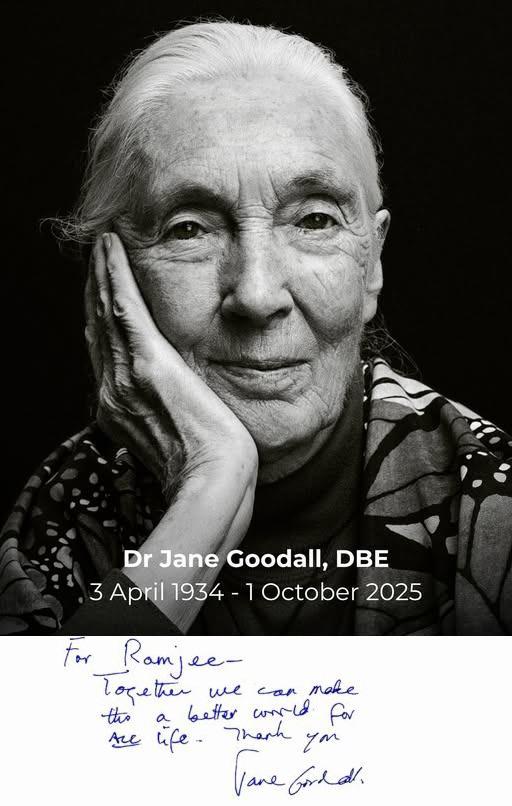
When I worked at Centre for Environment Education, I was lucky enough to meet her to introduce the institution and its work to her. She had very little time, but focussed intently on the conversation. It was indeed a memorable moment!

Thank you Jane Godall for all you have done and all the people you have inspired. RIP.

–Meena

PIC: My ex-collegue Ramjee is lucky to have got this signed pic of her’s when he met her.

COP Out?

The acronym COP has been hitting us in the face for the last few weeks. We know that there is a meeting happening at Glasgow, and that Climate Change is being discussed. And that the decisions made or not made will affect the future of the Planet and of humankind.

COP 26

But what is COP? COP stands for Conference of Parties, i.e., all the nations which have signed the United Nations Framework Convention on Climate Change (UNFCC). This is the foundational treaty on climate change, and came into being at the landmark Rio Convention in 1992. A ‘Framework Convention’ is one wherein parties acknowledge that there is a problem, and commit, more or less in principle, to work together to solve it. However, there are no specific obligations laid out in these. The UNFCC is ‘subject to ratification, acceptance, approval or accession by States and by regional economic integration organizations’. 

Over time, as more information, knowledge and science come in, and consensus grows, a Framework is fleshed out, and specific Protocols and Agreements with clear obligations come in. From UNFCC for instance, we have the Kyoto Protocol and the Paris Agreement, laying down specific obligations on the parties. Each of these has to be signed and ratified separately—and this is where the crux of it is. Easy enough to sign statements of intent, but countries baulk at signing on to specific commitments.

The UNFCC opened up for ratification at the Rio Conference on 4th June 1992. It came into force on 21st March 1994, after the 50th instrument of ratification, acceptance, approval or accession had been deposited. India was one of the early movers, signing the Convention on June 10, 1992, and ratified it in Nov 1993.

As of now, there are there are 197 Parties (196 States and 1 regional economic integration organization). And these are the ‘parties’ referred to in COP. The COP is the highest decision-making body of the Convention and all States that are Parties to the Convention are represented here.

The COP meets every year, unless the parties agree otherwise. The first meeting was held at Bonn in 1995, the year after the Convention came into force. The COP presidency rotates among the five UN regions. COP 8 was held in New Delhi in 2002.

Apart from the Parties, COPs are attended by Observer States. Beyond this, there are two more categories of participants. The Press and Media are one category of participants. The last category is of observer organizations. These ‘observer organizations’ include the United Nations System and its Specialized Agencies; intergovernmental organizations; and non-governmental organizations (NGOs).

The number of people registered for COP 26 at Glasgow was close to 40,000, approximately double the numbers from COP 25 held in 2019. But there have been allegations that many delegates and participants from developing countries could not make it because COVID-related travel restrictions for their countries were lifted too late, thereby restricting the voices of the Global South.

This is not the only angle from which COP 26 has been criticized. More than half way through the event, many are concerned with the progress made. Greta Thunberg feels that it has been a “two-week long celebration of business as usual and blah, blah, blah”.

What can we do but hope? And take actions at the personal level, while the powers talk and discuss and negotiate.

Till another COP next year, at a yet-to-be announced venue.

–Meena

Environmental Scolder-in-Chief

E_SDG goals_icons-individual-rgb-13“You have stolen my dreams and my childhood with your empty words. And yet I’m one of the lucky ones. People are suffering. People are dying. Entire ecosystems are collapsing. We are in the beginning of a mass extinction, and all you can talk about is money and fairy tales of eternal economic growth. How dare you!’ said Greta Thunberg to world leaders at the UN.

And that is a scolding they will not forget in a long time!

Greta, the girl, who in her teens is shaking up the world! Deeply concerned about the climate crisis, and even more concerned that world leaders were not taking it seriously, a few years ago, Greta took off from school to protest outside Sweden’s Parliament, calling for action on climate. She tried to get some of her school mates to join her, but no one was interested. So she took time off from school every Friday, and sat alone outside Parliament for three weeks, holding signs which said ‘School Strike for the Climate’, and handing out pamphlets. Her strikes found their way to social media and started attracting worldwide attention.

As time went on, inspired by her, more school children joined in, and organized protests in their own communities. This developed into the School Climate Strike movement, or ‘Fridays for the Future’. And there have been strikes involving tens of thousands of school children in major cities of the world.

So strong were these voices of the youth that Greta was invited to address the United Nations Climate Change Conference in 2018. Her advocacy is forcing governments to acknowledge that they need to do more for the future generations by taking climate action.

Greta is not just about advocacy and telling other people what to do. She challenged her family to adopt more a more environment friendly life style and reduce their carbon footprint. And she succeeded! Her family is vegan now, and her mother has even given up her career as an international opera singer—which involved a lot of air travel– in order to reduce her carbon footprint!

Greta herself made the headlines once again when in August 2019, she sailed across the Atlantic Ocean from Plymouth, UK to New York, US in a 60ft racing yacht equipped with solar panels and underwater turbines to participate in some key meetings. The 15-day voyage demonstrated that it was possible to reduce emissions and do a carbon neutral transatlantic crossing serving. Greta attended the UN Climate Action Summit in New York City and COP 25 (Conference of Parties) Climate Change Conference in Santiago, Chile.

Greta has told the world what young people expect. Will world leaders and adults like us be able to step and do what it takes?

–Meena

Haiku…Then and Now

The Haiku is a 17 syllable poetic form that has been written in Japan for three hundred years. Haiku poets have, over generations, celebrated the changing seasons, and also the mystical relationship between non-related subjects. Most of the poets reflected the Zen Buddhists doctrine that all things and creatures in this world are part of the universal and interconnected brotherhood of creation.

Today the cycle of seasons is not what it used to be.  The world is apprehending, rather than celebrating Climate Change. Reports predict the dire consequences of the 1.5 degree rise in temperature, for all living things, interconnected as they are in the intricate web of life.

Among the scientists too there are poets! Some of them have tried to interpret the consequences of Climate Change in Haiku!

Interesting indeed to compare the Haikus from then and now.


Then Now
Snow is melting…

Far in the misted

Mountains

A caw cawing crow


Big, fast carbon surge

Ice melts

Oceans heat and rise

Air warms by decades


Icicles and water

Old differences

Dissolved…

Drip down together


Seas rise as they warm

Rates quicken

Last century

Melting ice joins in


Even the ocean

Rising and falling

All day

Sighing green like trees.


More warming,

Higher seas.

Maybe much higher.

Could wake sleeping giants.


Ultra-pink peony…

Silver Siamese

Soft cat…

Gold-dust butterfly…


Warming is bad news

For many species.

Once gone…

We can’t bring them back


The Then Haikus are from compilations of haiku by some of the best loved Japanese poets—Basho, Buson, Issa and Shiki.

The Now haikus are from the compilation by oceanographer Gregory Johnson (https://www.sightline.org/2013/12/16/the-entire-ipcc-report-in-19-illustrated-haiku/and  Andy Reisinger one of the contributing authors to the Intergovernmental Panel on Climate Change (IPCC) special report on 1.5 °C (https://cicero.oslo.no/no/15-graders-haiku)

–Mamata