
At first glance the landscape looks like ‘waste land’. Miles of flat land with dry dusty soil punctuated only by the thorny bushes of Prosopis juliflora. The stubble of what seems to be dry remains of grass are barely noticeable. Ironically, we are driving through what is one of India’s unique ecosystems—the Banni grassland. Spread across almost 3000 sq km in the Kachchh district of Gujarat, it is believed that the land here was formed from sediments that were deposited by Indus and other rivers thousands of years ago. The rivers changed course, and the once fertile land gradually turned into a vast arid stretch. Today the region of Kachchh is usually associated with the word rann or desert. However this rann is far more than the textbook description of a desert. The Rann ecosystem of Kachchh is unique, with characteristic landforms, biogeography, flora, and fauna. And though the flat saline stretches are the predominant sight for a large part of the year, these conceal many natural depressions which are transformed into water bodies during and after the monsoon rains. It is these wetlands, within the arid land, that transform into ecosystems themselves, with their special features and creatures.
The local language of the region has four terms to describe these wetlands. The smallest waterbody is called kar, the one bigger than kar is called chhachh, the next bigger one is called thathh, and the biggest is called dhandh. The size of each of these seasonal freshwater wetlands during any given year depends on the amount of rainfall received in that year.
I recently had a chance to visit the largest of these seasonal wetlands called Chhari Dhandh. Spread over around 10 sq km, this water body plays host to tens of thousands of migratory birds who traverse many thousands of miles, as they journey from the frozen steppes of Siberia, crossing the mighty Himalaya, to spend the winter months here. The wetlands are located on the flyway of Palearctic migratory birds who arrive in late August and remain till March, using the ecosystem for foraging, roosting, resting and building reserves for the long return flight back to their summering grounds.
The water body hosts a huge concentration of water fowl. The drying of the soil due to evapotranspiration after the monsoon rains have receded, and the high salt content in the soil create a unique saline grassland ecosystem that supports a variety of grass species and shrubs that are a vital source of food for important bird species, as well as suitable roosting sites for a variety of birds including lapwings and coursers. The grasses also provide essential nutrients for the livestock of the Banni region, which is renowned for its milk and dairy products.
Visiting the wetland at what is almost the end of the season, we missed the flamingoes, but were rewarded with the sight of thousands of common cranes and hundreds of pelicans, as well as a number of raptors.
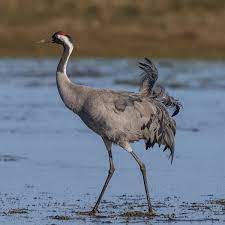
Two birds make their presence best felt in this wetland. The flocks of flamingoes that paint the landscape pink were no longer in residence, but the Common cranes were there in abundance. Their presence was evident all along the edges of the flats, well before the bumpy dusty track ended at the water body. As the vehicle made its dusty way along the track, the seemingly small conglomeration of tiny dots in the distance turned into swathes of smooth wings and tails as hundreds of birds rose as one graceful swoop into the air where they glided on to settle back to earth further on.
These are but short hops for the Common crane who undertakes a marathon flight from Central Asia and Mongolia to winter in the wetlands of Kachchh. The Common crane is a large slate-grey bird, with a long neck, beak and legs. The forehead and the region between the eye and the beak on the side of the head are blackish with a bare red crown and a distinct white streak extending from the eyes to the upper back. The neck, chin and throat are dark grey. The flight feathers are black, with the longest inner ones forming a drooping bushy cloak over the tail when the bird is standing.
This is a shy bird that takes off as soon as it senses that it is being approached. Before taking to the air it runs for a few metres with its wings spread out before it takes to the air. Once in the air, the birds often fly in V-formation with outstretched neck, and stiff wing beats. The flight is smooth and unhurried and makes for a beautiful moving picture high up in the sky. This bird has a wide repertoire of calls, including a loud trumpeting, which carry over long distances.
Common cranes live in large and small flocks. They spend the evening and night near the water body. They leave early in the morning to feed in the adjoining grasslands, and fields on tender shoots and roots, and insects, go back to the water at mid-day, and return in the afternoon to continue feeding until dusk. The feeding flock is always watchful, with a couple of designated ‘sentries’ that immediately alert them in case of any threat, whereupon they take flight. A spectacular flight indeed.
We were lucky to see this sight, along with flocks of pelicans at Chhari Dhandh. During a good rainfall year, the winter season in Chhari Dhandh sees up to 40,000 Common cranes and thousands of pelicans along with a number of other waterfowl, raptors and other birds which include about a dozen globally threatened species and a similar number of near-threatened species as per the IUCN. The area has been identified as an Important Birding Area in India.
Recognizing the conservation significance the wetland of Chhari Dhandh covering an area of 227 sq km was declared as a Conservation Reserve in 2008. The Government notification towards awarding this status noted that “given its ecological, faunal, floral, geomorphological, natural, and zoological significance, the aim of declaring Chhari Dhandh a conservation reserve is to protect, propagate, and develop wildlife and its environment”. This is the first Conservation Reserve in Gujarat.
A wetland well worth conserving and celebrating.
–Mamata
 Millennial Matriarchs