
April 1 traces back to the International Convention for the Protection of Birds, one of the earliest international efforts to formally recognise the need to conserve avian life. On International Bird Day, observed each year on April 1, the focus is usually on birds themselves—their fragile habitats, their migrations, their role in holding ecosystems together and the threats they face.
But today we are looking more at the people who watch birds and their idiosyncrasies.
Every obsession develops its own private vocabulary. Birdwatchers—or birders, as they prefer—have taken this instinct a step further. Over time, they have shaped a dictionary so distinctive that to outsiders it can sound faintly eccentric. Words here behave differently: they slip free of their everyday meanings, acquire new ones, and quietly signal who belongs.
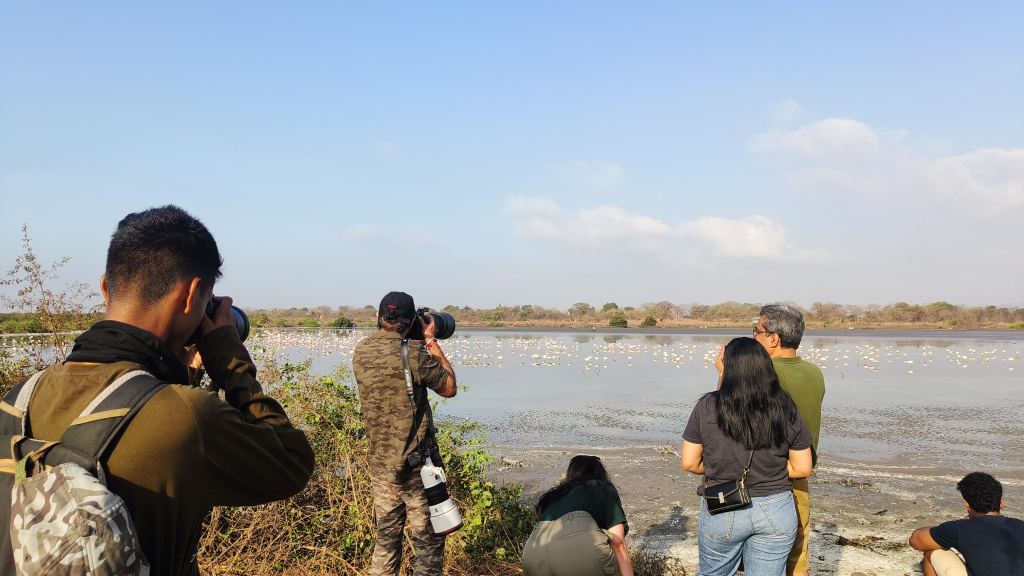
Consider twitching. To most people it suggests nervousness or involuntary movement. In birding, it means deliberate, often hurried travel to see a rare bird reported elsewhere. A twitcher is someone who drops everything at short notice and sets off, binoculars in hand to chase that possibility. The term emerged in mid-twentieth-century Britain, when news of sightings spread through phones and handwritten notes, carrying with them a sense of urgency and barely contained excitement.
This habit of birders to repurpose language runs deep. A tick is not a parasite but a small victory—a species added to one’s personal list. A lifer marks a first-ever sighting, the kind that stays with you. A dip, on the other hand, captures a very specific disappointment: travelling all that way and missing the bird.
Some of the most intriguing expressions describe perception. Jizz—sometimes softened to giss—refers to the overall impression of a bird: its shape, posture, movement, the rhythm of its flight. You may not catch every marking, but you recognise it instinctively. “It had the jizz of a harrier.” There is no real substitute for this word, which perhaps explains why birders defend it with quiet determination.
Then come the social terms, edged with humour. A stringer is someone suspected of stretching the truth about sightings—their records “on a string.” A lagger arrives too late. A gripper is not an object but a bird so rare it inspires envy, and to be gripped off is to feel that envy keenly while still offering polite congratulations.
Even equipment is linguistically reshaped. Bins are binoculars. A scope is a spotting-telescope. To lock on is to get your optics trained on the bird before it disappears. These are practical words, forged in moments where seconds matter.
Place, too, carries its own vocabulary. A patch is a birder’s regular haunt, revisited across seasons and years. A stakeout involves waiting patiently at a known location. Suppression refers to an ethical choice—not publicising a rare bird’s location if attention might disturb it. To flush a bird is simply to make it fly off, usually by getting too close, and is generally frowned upon.
What stands out is how emotionally evocative this language is. It does not just describe birds; it maps the experience of pursuing them. Like any specialised language, birding slang creates community. To know the terms is to belong; to learn them is to enter gradually. Yet many of these words travel beyond their niche. Twitching now describes reactive behaviour more broadly. Jizz has been borrowed into design and art. Patch has found a life in other forms of local attachment.
Colour, in birding, acquires a precision that everyday language rarely demands. Birds are not simply brown or grey; they are rufous, buff, ochre, slate, ashy, olive, chestnut. A drab-looking bird, on closer inspection, becomes a composition of tones—warm on the flanks, cooler on the crown, a faint wash along the breast. These are not ornamental choices of words but functional ones, allowing birders to separate one species from another in seconds. To say “yellow” is often useless; to say “sulphur-yellow with a greenish wash” is to narrow the field.
Even familiar colours are subtly reworked. A “black” bird may, to a birder, show glosses of blue or green; a “white” wing might carry a hint of cream or grey that matters enormously in identification. Terms like supercilium (the eyebrow stripe), mantle (the upper back), and primaries (the outer flight feathers) turn the bird’s body into a map where colour is carefully located, not loosely described. Over time, birders learn to see in these finer gradations, and the language follows suit—less about naming colours as we know them, more about learning to see them as birds wear them.
Some colour words have travelled the other way—borrowed not to describe birds, but from them. Teal is the most familiar example, a word that once referred primarily to the small freshwater duck, the Eurasian teal, whose striking greenish-blue patch lent its name to a shade now used everywhere from fashion to design. What began as a bird became a colour, and then quietly detached itself, so that many people use “teal” today without any awareness of its avian origin.
This is not an isolated case. Duck-egg blue, robin’s egg blue, and peacock blue all carry traces of the natural world into everyday speech. The Indian peafowl, for instance, has given us a whole palette of iridescent blues and greens, while the soft tint of a robin’s egg has become shorthand for a particular pastel. In these instances, birding has quietly shaped how colour is named and imagined—proof that even those who never lift a pair of binoculars are, in some small way, speaking a language borrowed from birds.
In an age where English is increasingly standardised, birdwatching offers a reminder that language still evolves wherever people care deeply enough. These words were not coined for effect. They emerge out of necessity—to express experience, to share feeling, to laugh gently at oneself.
So this International Bird Day, stand quietly at the edge of a wetland or in your garden. Watch the birds and hopefully, you will get a tick!
–Meena

 Millennial Matriarchs