Libraries Take Wing

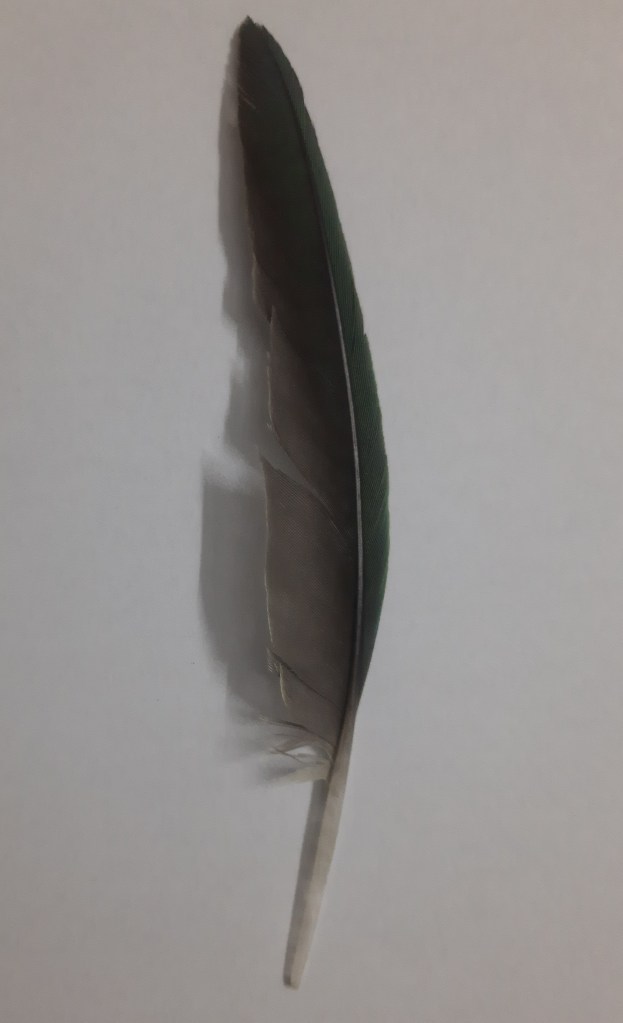
How often we randomly pick up a feather as we walk along. And wonder which bird it could belong to.

A feather library is where we can turn to for help in such a situation. These are digital or physical collections of bird feathers, used for research and education. They are an invaluable resource for understanding bird species, identifying feathers, and gathering data on bird health and natural history. These libraries are important tools for the study and conservation of bird species, offering insights into bird morphology and helping in the identification of feathers found in the wild.

There are not too many across the world. Some of the established ones include:
1. The Feather Atlas created by the U.S. Fish and Wildlife Service is a comprehensive image database of North American birds and covers about 438 species. It can be browsed by bird order, family, or species. It has an open identification tool in which one can fill in details about feather patterns, colors, size, and position, which can help you identify the bird your feather belongs to.

2.Featherbase (Germany) has been created by a working group of German feather-scientists and other collectors worldwide who have come together and contributed their personal collections. It holds close to 8000 specimens from over 1,000 bird species, with a focus on European and African birds. The collection includes high-resolution images and detailed anatomical information, and has supporeted studies in forensics, conservation, and biodiversity monitoring. It is rigorously classified and offers options of various languages so that birders from across the world can use it.

3. Found Feathers (iNaturalist Project) is a citizen science initiative where users contribute observations of feathers they find. The project encourages the collection of feather length and placement data, enhancing the database’s utility for researchers and birders. There are over 2,00,000 observations from across the world.

Special among these is India’s Feather Library. This pioneering initiative is the first of its kind in India and the world, dedicated to documenting, identifying, and studying the flight feathers of Indian birds. It is the passion project of architect Esha Munshi, a dedicated bird watcher who has seen over 1500 bird species across the world, and veterinarian Sherwin Everett who works in a bird hospital in Ahmedabad. They have created the library with the aim of having all feather-related data under one roof, fostering collaboration and advancing the collective understanding of Indian birds. In the short span of time since inception on Nov 15, 2021, 135 species have been documented.

The process is rigorous. They collect feather specimens from dead birds at rescue centres to establish a primary database of bird species. They then make detailed notes on the flight feathers, taking into account the number of Primaries, Secondaries, Tertials (Wing Feathers), and Rectrices (Tail Feathers), along with basic details such as overall length, bill length and width, leg lengths, etc. Then they stretch out one wing and fan the tail in both dorsal and ventral views to document the exact number of feathers, unique characteristics, colour, pattern, and size etc. The physical collection is housed at the National Centre for Biological Sciences (NCBS) in Bangalore.

The database is open to all and provides easy access.

Kudos to the dedication and passion of people like Esha and Sherwin who through their efforts help support avian research, conservation efforts, and educational outreach. And make a better world.

Happy Environment Day!

–Meena
A MURDER OF CROWS

A few days ago our champa tree was the venue for an impromptu gathering of crows. They descended literally out of the blue and within flapping seconds, settled onto the branches and commenced a raucous chorus. What a “cawcaphony” I said to myself and peeped out to investigate the cause of the assembly. It turned out that there was a dead crow not far from the tree, and the incident was being marked with a suitable mourning from its clan. Quite spontaneously, I remembered that the collective noun for a group of crows is called a ‘murder’ of crows. Well here I was witness to a murder of crows in action!

Why this descriptor? The term is believed to have originated in England in the 15th century, and was linked to old folk tales and superstitions. In the Middle Ages, collective nouns were often given to animals based not only on their behaviour but also on superstitions or prevalent attitudes towards them.

One among these was the belief that crows will come together to decide the fate of another crow (a court of crows?). Another belief was that the appearance of crows was an omen of death. Yet another, based on the fact that crows are scavengers and were thought to circle over areas where animals and people were expected to die. A more scientific reason for his may be that crows are opportunistic feeders and will eat everything–carrion, small animals, insects, or crops, and thus find their way to wherever these may be available.

In fact, crows, though often considered to be pests, and generally irritating, are a highly intelligent and social species. They have the ability to create and use tools, they have been known to solve multi-step puzzles. They are extremely social birds that flock together and also have an ability to learn from each other.

Crows
Pic: Northern Woodlands Magazine

Another interesting aspect of crow communities is that they have been shown to recognize their dead and hold “funerals” for dead individuals, something that has only been observed in a few other species including elephants, dolphins and some primates. This could be an unsettling scene for observers, (probably what I witnessed) but scientists believe this is a way by which they communicate to their fellow crows about potential threats to be avoided.

Besides ‘funerals’ why do crows flock together? For many reasons. Crow are smart and adaptable, and gathering in large groups is often both a solution to a problem and a social benefit. Communal foraging strengthens social bonds and hierarchies within the crow community as well as efficiency. Communal roosting provides safety from predators and establishes social bonds, social learning and information.

The ‘cawcaphony’ also has its reasons. Loud and distinctive cawing is used to convey messages about food locations, to call others for support in defending their territory, or to alert the flock of approaching predators. There are specific caws for different types of danger. As well as caws, crows have softer calls which are used within family groups.

Yes crows are a part of our lives, generally around, but not really headline grabbers. Until recently, when crows have been in the news. And this time the news is about a literal “murder of crows”. The target of this planned execution is the Indian house crow Corvus splendens, whose population is being systematically eliminated in Kenya.

The story of the crow in Kenya goes back to the 1880s when it is believed that the first few pairs of Corvus splendens arrived on the island of Zanzibar by ship. One story goes that a breeding pair was presented to the Sultan of Zanzibar as a gift from an Indian dignitary. Another account believes that the scavenging crows were brought to the island in a bid to clean up the garbage. The introduced species soon gained a foothold not only on the island, but also spread to nearby mainland countries like Tanzania and Kenya. Showcasing all their traits of intelligence, adaptability and resourcefulness, the crow population grew rapidly and began to not just scavenge but also raid crops and poultry farms, as well as food sources in urban areas. By 1917, House crows were officially declared as ‘pests’ by the local authorities.  

The House crow reached Kenya in 1947, and since then its numbers have exploded. The growing human population, both local and tourists (tourism is the mainstay of Kenyan economy) has led to growing waste sites with mounds of garbage. The municipal authorities have not been able to efficiently manage the waste. This has led to a huge proliferation of crows who not only feed on the garbage but have also learned to mob eating places and swoop up food from diners’ plates.

Besides the pestering of humans, conservationists are concerned that the overwhelming numbers of crows are driving out many smaller indigenous species of birds, impacting biodiversity. With decline in indigenous bird species, pests and insects begin to proliferate, impacting local flora as well as crop plants. This is one more case of how invasive species can impact local ecosystems.

The Kenyan government undertook a programme to control the invasive bird species twenty years ago. While this helped reduce the crow population for some time, the resilient species bounced back with an exponential rise in numbers. In the past there this menace has been addressed with the baiting of food with Starlicide, a slow-acting poison to tackle the crow menace. This time the Kenyan government is planning to use all methods, including this, to eliminate a million crows by the end of the year. A sad, but perhaps unavoidable, murder of crows.  

And just last week was the news that the US Fish and Wildlife Service proposed to kill half a million Barred owls across the states of California, Washington and Oregon over the next ten years. This is because the population of Barred owls is crowding out its less aggressive relative the Northern spotted owl which is an endangered species. This news has sparked of several debates. While this is not a case of an invasive species, it is a case of one species becoming dominant, to the detriment of other species. There is also the moral issue of killing one species to protect another. Perhaps it will take a ‘parliament of owls’ to resolve the case!

See also:

The Camel in the Tent: Invasive Animal Species

A Parliament of Owls

–Mamata

The Great Babbler Mystery

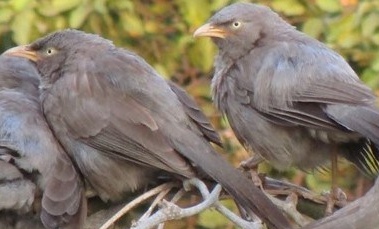
I call them Angry Birds! They are continually at war with the world, making their views heard with an incessant grating cacophony of sounds. Their beady eyes glint as they stare angrily at you, and their dusty khakhi-brown feathers are always dishevelled, as if they have just emerged from battle!

They are ubiquitous, making their bedraggled group appearance in the garden, on the sun deck, in the wash area and on the window ledges. They make their presence felt with their incessant quibbling and squabbling. In the morning they are busy poking at the lawn before our first cup of tea. In the afternoon they hop around in the verandah and outside the windows, peering through the glass and rapping sharply with their beaks as if to reprimand us for some misdeed. They are the band of vigilantes—sounding a harsh and strident chorus that makes the intruding cat slink away to safety. They fight like fishwives! Screeching, pecking, pulling, merging into a heaving mass of untidy feathers; and emerging with scrawny bare necks that reveal the wounds of war.

They are the Jungle Babblers or the Seven Sisters as they are called in English, and for some reason, Seven Brothers in some Indian languages.

And I wake up with the comfort of starting the day with them.

Until last week….

My angry birds have disappeared en masse!

At first I thought it may be the grey drizzly weather that we have been having after a long, blazing hot and dry summer that was deterring their forays. Then I thought that maybe they had decided to put in a late appearance; I watched for them morning, noon and evening. Not a straggly feather to be seen! I looked at all their haunts, their favourite foraging patches; the bare branches of the tree at the gate and the wires running overhead, but nary a glint of an eye could I see. I thought maybe they have taken off on vacation, but my bird book tells me that they like their home turf and are not likely to wander far.

How can they all vanish? I haven’t a clue!

jungle-babblers-in-Lucknow-India-bird-festival-uttar-pradesh-2 (2)
Missing from action!

Will they reappear soon? I do hope so!

Till then, the great babbler mystery continues!

–Mamata

Magnificence—Endangered

Not just endangered, critically endangered. We are talking of the Great Indian Bustard (GIB). There are only about 200 birds left in the wild in India, mainly in Rajasthan and Gujarat. There are a few birds still in Maharashtra, Andhra Pradesh, Gujarat, Karnataka and Madhya Pradesh. But they have completely disappeared from Punjab, Haryana, Uttar Pradesh, Orissa and Tamil Nadu.

GIB has been listed as Critically Endangered in 2011 on the IUCN Red List, which means that it faces an extremely high risk of extinction in the wild. When we say that a species is extinct it means that there is not be a single living member left of that species.

The Great Indian Bustard is a magnificent bird, standing about 1 metre tall. Its wingspan is more than 2 metres. It is mostly brown, with a light-coloured head and neck. The distinguishing feature is the black crown on the head. Interestingly although they look closer to ostriches or cranes, most recent research shows that the Bustard family is more closely related to the cuckoo family!

At about 15 kg, it is the heaviest flier in India, but not in the world. The world record is held by a relative, if we may call it that, the Kori Bustard which is found in Africa. The Kori often weighs upwards of 18 kg.

These birds live in wide open landscapes which have sparse grasses and shrubs. They spend most of their time on the ground. Their long legs and front-facing toes help them to run fast. Although they are usually seen striding or running, they also have strong wings and can fly well.

Their diet varies depending on what is available during a particular season. These birds feed on grass seeds, agricultural crops such as groundnuts, millets and legumes, as well as insects like grasshoppers and beetles, and rodents and lizards

They usually breed in the monsoon season which is when food is most easily available. The female scrapes the soil in a secluded place to lay her egg. Generally, she lays only one egg. She incubates the egg for 25 days before the chick is hatched. The exposed egg is always in danger from predators. The mother has to be alert to keep the egg and the new chick safe. The male does not play any part in making the nest, incubation or raising of the chick. It is the Mother GIB who does this alone!

What are the threats? Plenty! GIB can be found in some parts Pakistan also, and there, it is still hunted. There is also some amount of poaching occurring in India. Apart from that, the natural home of these birds is reducing in size. A major cause for this is expansion of agricultural fields and increase in mechanized farming in the areas where the GIB live. This also means that human settlements get closer. Then there other very mundane reasons. Dogs are a major threat to GIBs. As I told you, GIBs lay their eggs on the ground. With the villages so close, dogs often eat the eggs. Also, there has been a huge increase in high tension electric wires in the habitat area. GIBs often dash against these and get electrocuted. They may also get hit by fast-moving vehicles.

Only urgent mission-mode action can save the GIB. Can we let this magnificent bird got the way of the Dodo?

–Meena and Mamata

An Avian Tale With A Happy Ending

bird

Our office in Yelahanka Bangalore is small and homely. The second floor place is surrounded by lovely trees, and we can see thick foliage from our windows.

Last summer, every now and then, we used to hear loud thuds. Not too often, but often enough for us to wonder what it was about. To begin with, we couldn’t figure out what on earth those were about. But then we realized that birds were crashing into our windows. Generally, it was crows. One day, a female koel hit her head. They all banged into the windows and then fell onto our narrow balcony. It did not seem to affect them too much. They just rested for a few minutes and were on their way again.

But one day, there was a huge bang and thud. We rushed out to our balcony, to find a small bird lying on its back. It seemed to barely be breathing. We panicked. We had no clue what to do. Anuradha and Sudha got busy talking to friends who might know what to do. But no clear suggestions came. They then tried calling animal shelters, NGOs, the Forest Department. Some numbers were old and out of commission. Some didn’t respond. Some didn’t have any solutions. The Forest Dept. was helpful. They suggested we could take the bird to their shelter. But unfortunately, that was 25 kms away. A drive of 2 hours during morning hours in Bangalore. It was unlikely the bird would survive the traffic and drive.

We did not want to disturb the little bird, but noticed some crows circling around, and figured it needed to be moved indoors. So we found a cardboard box and put it into it. It was still opening its eyes once in a while, so we held on to hope. We put it away in a quiet, dark room, with a bowl of water by the side. We restrained ourselves with great difficultly from going into the room every two minutes to check on it. We used the time, and a little help from friends, to figure out that it was a juvenile brown headed barbet.

bird 1.PNG

We gave it half an hour and then went in. And lo and behold, to our great relief and joy, it was sitting up. Still looking dazed, but definitely alive. We once again closed the door and left it alone. After another half an hour, when we went in, it was sitting on the window sill.

bird 3

Now the challenge was to get it out of the office and out on the wing. It was extremely confused and kept flying away from us and the door. It took 10 minutes but Vinod, a colleague who luckily was visiting the office that day, managed to gently catch it. Then the release ceremony! We took it outside and with a gentle tap, it flew into the tree top.

What a relief!

But the morning was so traumatic, we felt we couldn’t go through such an experience again. So we tried to work out out why the birds were crashing. Finally, we figured that it was the tinted glass windows. The trees and thick foliage around were reflected faithfully in this and it looked like open skies, so birds seems to continue flying forward, not realizing that there was a barrier. We were not sure, but since it was the only possible solution we could think of, we decided to replace the tinted glass with plain glass. Before that, we went through elaborate trials, when we called for various types of glass, propped them up and checked the reflections.

Since the day we replaced the glass, there have been no bangs, thuds or accidents, so looks our problem analysis was right.

Though I have to admit, my room is uncomfortably sunny on some days! Well, a small price to pay.

A Sad Ending

We are wakened at dawn every day by the melodious duet of the Coucals. The Coucal couple share our little garden, and we watch over each other. The Coucal or Crow Pheasant is a handsome bird; its glossy black body, chestnut wings and long black tail lends it a special dignity and grandeur. After the morning duet of soft whoops and klak-kloks, they join us as we have our morning tea. Sitting amongst orange flowers of the Cordia tree, or flitting across to the Champa tree, they offer a reassuring start to our day. As the day progresses, they descend lower to drink from the water container, as the smaller birds respectfully make way for them. Then as the sun reaches its peak, the omnivorous birds stride confidently across our small patch of lawn, looking for sustenance. Through the rest of the day, they call to each other using an amazing repertoire of calls. We could never have imagined that a single bird could produce such a variety of sounds.

About a month ago we noticed that the Coucal couple were more than usually busy. We saw them flying back and forth all day long, carrying in their beak a strand of the creeper with the white flowers, twigs from the nearby neem tree, long blades of grass and other trailing vegetation. Some days later, having tracked their destination, we discovered that they had made a nest high up in the tangle of our bougainvillea. The nest was very large, and from ground level looked quite messy! Even though we only had a worm’s eye view of their new home; there it was, testimony to the well-coordinated effort of our faithful couple. We were honoured that they liked our garden enough to move on from cooing and courting to setting up home! We were not quite sure when Mrs Coucal decided to start her family in her new home. But we watched and waited eagerly, like anxious grandparents-to-be. We hoped that at least one or two eggs had successfully hatched. While we could not follow all that went on in the nest, we were reassured that the parents were assiduously flying back and forth, this time with morsels in their beaks. It was amazing to see how the couple worked relentlessly and in perfect tandem—getting food, keeping an eye on the nest and around, being alert and protective—all the while calling to each other, with gurgling chuckles and raucous croaks.

Then yesterday we heard a rustling in the dry flowers and leaves piled under the bougainvillea. A closer look revealed a tiny little cluster of black and brown feathers fluttering weakly in the undergrowth. The chick had not yet developed wings strong enough to make it back to the nest. We were very concerned, and felt quite helpless as the anxious parents hovered nearby. We prayed, and tried to see how it could be safe. When we did not see it late last evening, we hoped for the best.

Sadly this morning we saw the still little bundle of feathers. Nature had not meant it to grow into a handsome young Coucal, and to share our garden. Today, the Coucals do not call.

–Mamata