August 12 is marked as World Elephant Day. And it is also Ganesh Charurthi time. So an appropirate time to talk about elephants.
The Asian Elephant is an endangered species, with less than 50,000 left in the wild across the world. And hence the importance of marking this day as a way of raising awareness about elephants and the dangers that threaten them.
What we see is what we grow to love and respect. And hence the importance of all the depictions of elephants we see around us—from sari borders to sculptures in ancient temples to the life-sized sculptures made from invasive weeds found in the Nilgiris, crafted by indigenous communities. Each and every one of them is an opportunity for education about our biodiversity and this magnificent species.
One can understand the ubiquitousness of elephant imagery in India—after all we hold about 60 per cent of the numbers. But interestingly, it is Taiwan which was well-known for elephant imagery all over its public parks and schools, in the form of Elephant Slides.
These are the whimsical, solid, painted playground fixtures affectionately known as “Grandpa Elephant”— and they hold fond memories for a generation of Taiwanese kids, now grown.
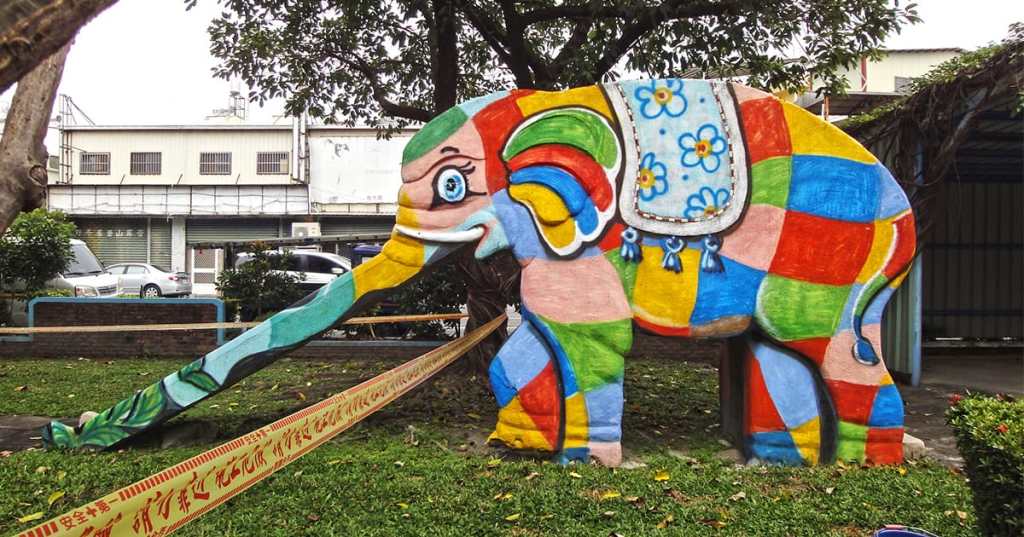
The elephant slide was a fixture of childhood in Taiwan from the 1960s through the 1980s. Found in schoolyards and public parks, these slides were typically made from china-mosaic or concrete, with a stairway or ladder up the back and a gently curved trunk functioning as the slide.
Many bore motivational slogans etched into the sides: “Strengthen your body to build the country.” Even in play, the messaging was patriotic. But for kids? It was all about the joy of scrambling up that broad back and riding the trunk like it was the gateway to an imaginary world.
Now, with safety codes tightened and tastes modernized, many of these eleslides have disappeared. But a movement to preserve and honour them has taken root, led by artists, writers, and nostalgic grown-ups determined to keep these gentle giants from fading away completely.
A Concrete Revival
Writer Yu Chiu-ling and designer Hsiu Pi-cheng have been at the forefront of this effort. Yu founded the Facebook group “Find Our Elephant Friends,” a digital scrapbook of elephant slide-sightings across the island. Hsiu has documented over 400 slides, many tucked away behind schools or community centres, quietly waiting to be remembered.
Their work isn’t just about playground preservation — it’s about cultural memory. About honouring the handmade, the imperfect, and the deeply local.
Elephants Across Borders
Asian elephants range across. Bangladesh, Bhutan, Cambodia, China, India, Indonesia, Laos, Malaysia, Myanmar, Nepal, Sri Lanka, Thailand, and Vietnam. Strangely, there have never been elephants in Taiwan in the wild in recorded history. While elephant fossils have been found on the island, indicating their presence in prehistoric times, there is no evidence to suggest that elephants lived in Taiwan during the period of human history documented by archaeology and literature.
But Taiwan does have the most emotionally iconic version of the elephant slide! You will also find their cousins in parks across Japan, Thailand, Vietnam, and parts of Eastern Europe. From Soviet-era concrete sculptures to candy-coloured cartoon versions in Tokyo suburbs, the idea of turning a beloved elephant into a playmate has clearly crossed cultures. But sadly, no ele-slides in India!
Unfortunately today, both real elephants and their concrete urban renderings are endangered. One is fighting for survival in an increasingly human-dominated world. The other is quietly disappearing with changing times.
Elephants have always symbolized memory, strength, and gentleness.
Let’s protect the real ones. And let’s remember the playful ones, too.
Happy Ganesh Chaturthi!
–Meena
PIC: https://www.thisiscolossal.com/wp-content/uploads/2023/07/pi-og.jpg
 Millennial Matriarchs
