
So many of India’s treasures are hidden, waiting to be discovered. No, it’s not just old monuments or beautiful sights.
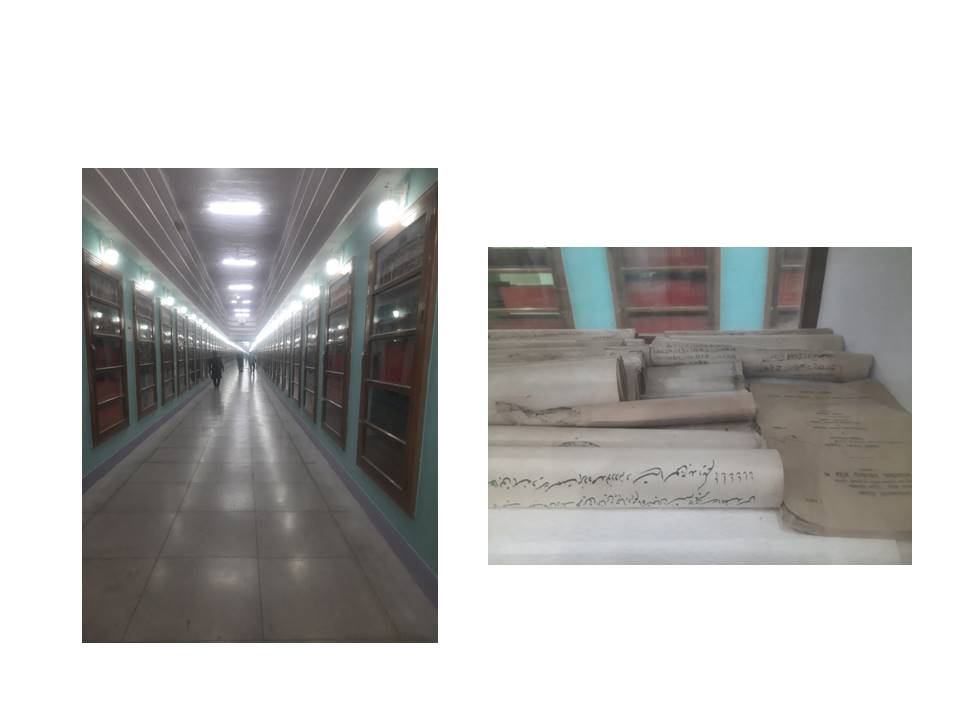
It includes—wait for it—libraries too!
The Bhadariya Library is a prime example. Bhadariya is a tiny village, near Pokhran, with a population of less than 2000. Situated about 76 kilometres from Jaisalmer, off the Jaisalmer-Jodhpur highway—it remains a hidden gem, with only a fleeting mention on travel sites.
Once off the highway, there is quiet road flanked on both sides by vast cow shelters, leading to the serene Shri Bhadariya Mata Ji temple. Originally erected in 1831 by Maharawal Gaj Singh of Jaisalmer, it commemorates his victory in a bloody battle against Bikaner.
And underneath the temple lies a humungous 50,000 square feet underground library—probably Asia’s largest. It houses the personal collection of one man–Harbansh Singh Maharaj, a social reformer from Punjab who moved to Rajasthan in the 1960s. Built in 1998. It houses around 200,000 different titles and a total of 900,000 volumes, with seating for 4,000 individuals.
As one climbs down a flight of steps to the library, there is an unusually long corridor, probably some 150 metres in length. Closed glass shelves line either side. As one continues onwards, each corridor leads to the next and then to the next identical corridor. The illusion of immensity is compounded by the mirrored walls at each end of every corridor. There are eight such corridors with 562 spotlessly clean glass shelves.
These shelves are filled with a rich and varied but largely random collection. It is obviously the work of a person passionate about books and education, but untrained as a librarian. The books range from British-era gazetteers and law books, to a vast collection of mythological works, books in English, Urdu, Sanskrit, Tamil, and various other languages. It contains some rare manuscripts which may be over a thousand years old.
Harbansh Singh Maharaj or Sri Bhadariyaji Maharaj as he was called, built the library to encourage reading and education in a place where there was little interest in either. He wanted readers to have a cool, sheltered place to sit and study, and so choose to have an underground facility. The local communities contributed shramdaan to do the excavations. His ambition was to start a University, but alas, this could not happen.
Today, the library has neither a librarian nor any staff to manage it. The sole caretaker of the library is an attendant from the Jagdamba Seva Committee Trust’s office. The immaculate condition of the interiors and the shelves speak volumes about the love the staff of the Trust have for the library. It is no mean feat to maintain such a large facility of this nature, in such a location absolutely dust-free.
But they can do only what they can do. Professionals and resources are needed–the books are not even catalogued and carry no library classification numbers, hindering their integration into any library network.
And even more sadly, there are no readers either. Apart from locals, no one really knows about the facility or the treasures it offers. The attendant told us that the library was hardly ever used by anyone. It is in a remote location, and there is no really convenient accommodation for scholars who may come from far away. Moreover the library lacks a system to assist visiting scholars.
But yes, the potential for scholars to come from far and wide exists. As a visitor to the library has mentioned ‘Bhadariyaji Maharaj has left a vision. If someone could resurrect it, it would uplift the field of education,’
This was Bhadaria Maharaj’s life’s work, which he carried out with the vision to spread education. It is now our responsibility to build on this invaluable legacy.
–Meena
 Millennial Matriarchs