
The Nobel Peace Prize for 2023 has recently been awarded to Narges Mohammadi for her fight to promote human rights and freedom for all, especially in the context of the oppression of women in Iran. Her brave struggle has come with tremendous personal costs. She becomes the 18th woman to be awarded this prize since the first Nobel Peace Prize was awarded in 1901.
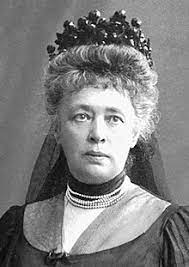
The first woman recipient of the Nobel Peace Prize was Bertha von Suttner who was awarded in 1905. The trajectory of her life, from aristocracy to advocacy, is indeed interesting. She was born in 1843 in Prague which was then a part of the Hapsburg Empire. As Countess Bertha Kinsky von Wchinitz she grew up in a family with a military history. Her father died before she was born, and she was brought up by her widowed mother in less than affluent circumstances; tutored by a cousin in languages and music, and reading voraciously. At the age of 30 she decided to move away and earn for herself, taking on a position with Baron Suttner’s family in Vienna as teacher-companion to his four daughters. It is here that the Arthur the youngest son of the family and Bertha fell in love. However the family was strongly opposed to their marriage. Thus Bertha left for Paris where she became secretary and housekeeper to Alfred Nobel. The two became close friends and remained so, corresponding frequently. It is believed that Bertha played a significant role in inspiring Alfred Nobel to establish the Peace Prize.
Bertha however returned after a short stay in Paris to elope with Baron Arthur von Suttner, even in the face of his family’s opposition. The young couple moved to the Russian Caucasus (what is Georgia today) where they lived for nine years earning a living by giving language and music lessons, and eventually as journalists who wrote about the increasing ethnic conflicts in Russia and Central Europe. During this time Bertha also wrote several novels, including Es Lowos, a description of their life together. Her writing began to reflect her thoughts about conflict and peace.
In 1885, following reconciliation with Arthur’s family, the couple moved back to Austria, and then Paris. It is here that they learned about the International Arbitration and Peace Association in London, and similar groups in Europe that were engaged in promoting the ideal of arbitration and peace in place of armed force. It is then that Bertha’s work started to move away from the purely literary. Wanting to contribute in her own way to the growing peace movement, Bertha wrote a novel, based on careful research, in which the heroine suffers all the horrors of war. The book Die Waffen nieder (Lay Down Your Arms) was published in 1889. This book, criticizing many aspects of the times, was among the first to foretell the results of exaggerated nationalism and armaments. The pacifist novel made a tremendous impact across the world. It was published in 37 editions and translated into 12 languages before World War I.
Bertha von Suttner transitioned from being simply an author to a peace activist. She became an active leader in the peace movement, devoting a great part of her time, her energy, and her writing to the cause of peace – attending peace meetings and international congresses, helping to establish peace groups, recruiting members, lecturing, corresponding with people all over the world to promote peace projects. She supported the foundation, in 1889, of the Inter-Parliamentary Union, a global inter-parliamentary institution which was the first permanent forum for political multilateral negotiations. In 1891 she helped form a Venetian peace group; initiated the Austrian Society of the Friends of Peace, of which she was for a long time the president, and attended her first international peace congress. She also took on the editing of the international pacifist journal Die Waffen nieder! (Lay Down Your Arms!), named after her book, from 1892 to 1899.
After her husband’s death in 1902, Bertha moved back to Vienna. She worked as a writer, travelled, and gave lectures. 1904 she was invited to address the Third International Congress of Women in Berlin. She continued to campaign for peace, and argued that a right to peace could be, and should be, international law. She dedicated her life to peace and disarmament and used her position as a writer, journalist, feminist, lecturer, and political activist to promote the belief that peace is a solution that is both necessary and obtainable. At the dawn of the 20th century, few could write or speak about peace and disarmament with greater authority than Bertha von Suttner.
On 10 December 1905 Bertha von Suttner became the first woman to be awarded the Nobel Peace Prize as a recognition for her life-long fight for peace.
Bertha continued her active dedication to the cause even as she grew older and frailer with cancer. She passed away on 21 June 1914, just a week before the assassination of Archduke Ferdinand and his wife in Sarajevo, the spark which triggered World War I. In the hundred years since, the world has witnessed the horrors of two world wars. And today, violence and war mark every continent on earth. In this period, several women have followed in Bertha’s footsteps, as they fight the continuing battles against violence and oppression in different parts of the world.
Just as this year’s Nobel Peace Laureate was announced, we are seeing the ravages of wars in Gaza, and Ukraine, which may well plunge the world into a cataclysmic situation. A time, surely, to recall the words of Bertha von Sutter: One of the eternal truths is that happiness is created and developed in peace, and one of the eternal rights is the individual’s right to live. The strongest of all instincts, that of self-preservation, is an assertion of this right, affirmed and sanctified by the ancient commandment: Thou shalt not kill.
–Mamata
 Millennial Matriarchs