
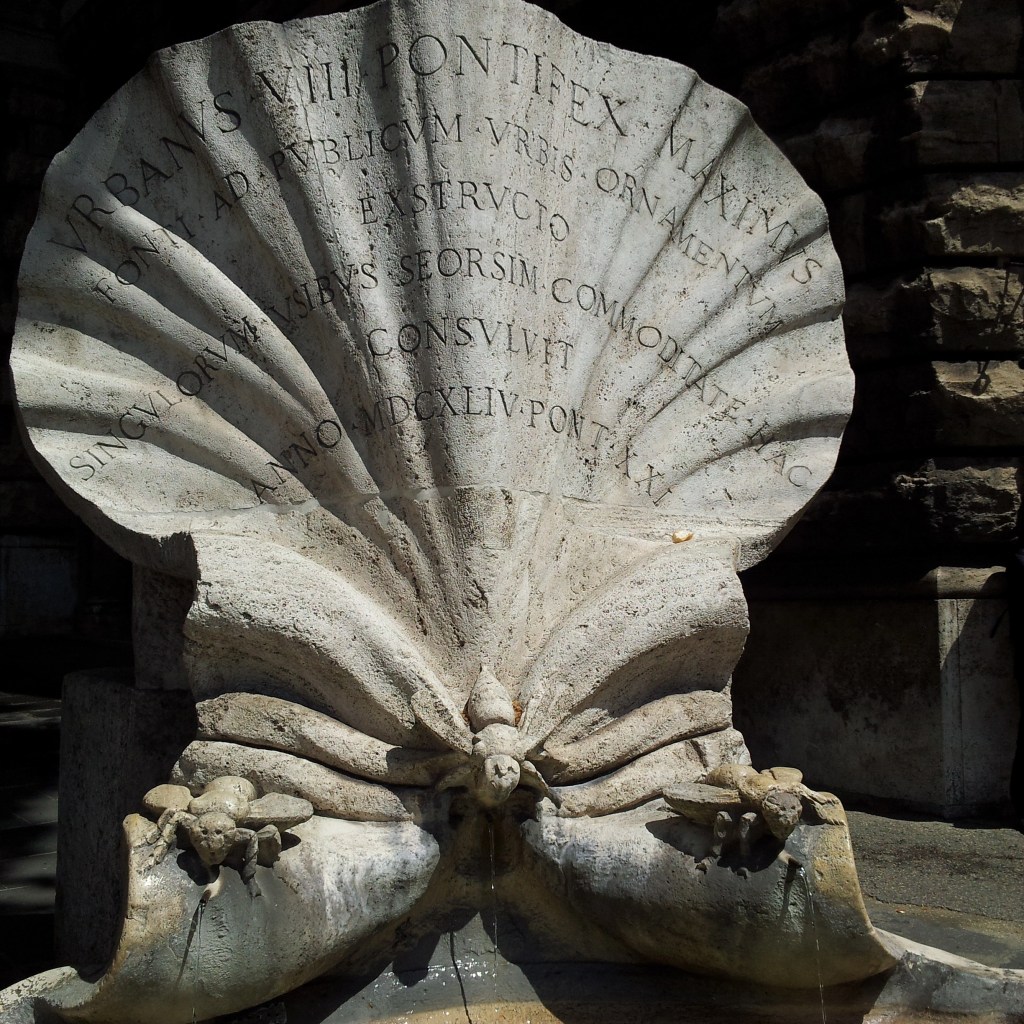
Fountain of Bees, Rome
They make up over 90 per cent of life on earth.
There are about 1.3 million species of them.
They are found in every part of the world.
They range from one-fifth the thickness of a strand of your hair, to the 30 ft long giant squid.
These are the invertebrates—animals without a backbone. Why backbones, in fact, invertebrates don’t any bones at all! Invertebrates include ants, spiders, worms, snails, bees, butterflies, corals, lobsters, crabs…they are the spineless majority!
As the famous biologist EO Wilson put it, ‘Invertebrates don’t need us, we need invertebrates’. Critically, they pollinate flowers, hence allowing plants to propagate so that there is food for all. They are at the base of all food-chains. Humans also eat invertebrates—think crabs, lobsters etc. They maintain the ecological balance by eating each other and being eaten! Earthworms and some related creatures help dig up and aerate the soil, and make it fertile. They are important in another way too—most parasites are invertebrates!
All invertebrates are cold-blooded and about 80 per cent of them are terrestrial. Most of them undergo metamorphosis.
They fall into nine phyla, compared to vertebrates which all belong to one phylum.
In spite of their ubiquitous presence and the role they play in our lives, we don’t pay enough attention to these co-inhabitants of our world. For instance, while most countries have national animals or birds, few have national invertebrates. Exceptions include Denmark, which lists the Small Tortoiseshell as its national butterfly; Estonia which lists the Swallowtail; Finland which lists the Seven-spot Ladybird as its national insect and Latvia which has the Two-spot Ladybird for its. Several US states have State Insects, as does Karnataka (the honeybee). Many Indian states also have State Butterflies.
India is unique in that it has named a National Microbe—the Lactobacillus bulgaricus. This was done in 2012, based on a nation-wide completion. It was selected based on its importance in making yogurt or curd. Some US states also have State Microbes. The first state to declare an Official State Microbe was Oregon which chose brewer’s or baker’s yeast as the Official Microbe because of its importance to the craft beer industry there.
Designating such national and state symbols is important, given that we don’t focus enough on these creatures which make up about 95 per cent of all species on earth. Creating a buzz brings attention to them, hopefully leading to more studies and research, ensuring their well-being which is so critical to ours.
In order to increase awareness about invertebrates, last year the well-known British newspaper The Guardian started an ‘Invertebrate of the Year’ contest. This was confined to the UK. This year’s competition, the second of the series, has gone international. So any of us can send in a nomination for an invertebrate, along with reasons why we favour this particular one.
To give you an idea, last year’s winner was the earthworm, which was voted in with 38 per cent of the total votes. The least number of votes was garnered by the invasive Asian or yellow-legged hornet.
Surely you have an invertebrate you love or hate. This is your chance to put it on the world map. Submit your entries at https://www.theguardian.com/environment/2025/feb/12/nominate-your-invertebrate-species-of-the-year by midnight (GMT) on Tuesday 4 March.
–Meena
 (CBRTI) of the Khadi and Village Industries Commission (KVIC) provide training to not just farmers or those who wish to commercially supply honey, but also to anyone who is interested in beekeeping. They can be contacted at
  Millennial Matriarchs