Carravaggio Crosses the Seas

When we hear the name ‘Michealangelo’, we think of the Sistine Chapel. But there was another one of the same name, Michelangelo Merisi da Caravaggio (known as Caravaggio) born a few years after the original’s death, who played own his part in significantly re-defining art.

Born in Milan, his father was an architect. The family left the city in 1576 to escape a plague and moved to Caravaggio. In 1584 our Caravaggio was apprenticed for four years Simone Peterzano, a painter. He became familiar with the works of Leonardo da Vinci, Michelangelo, Titian, Raphael, and other Renaissance masters during this time.

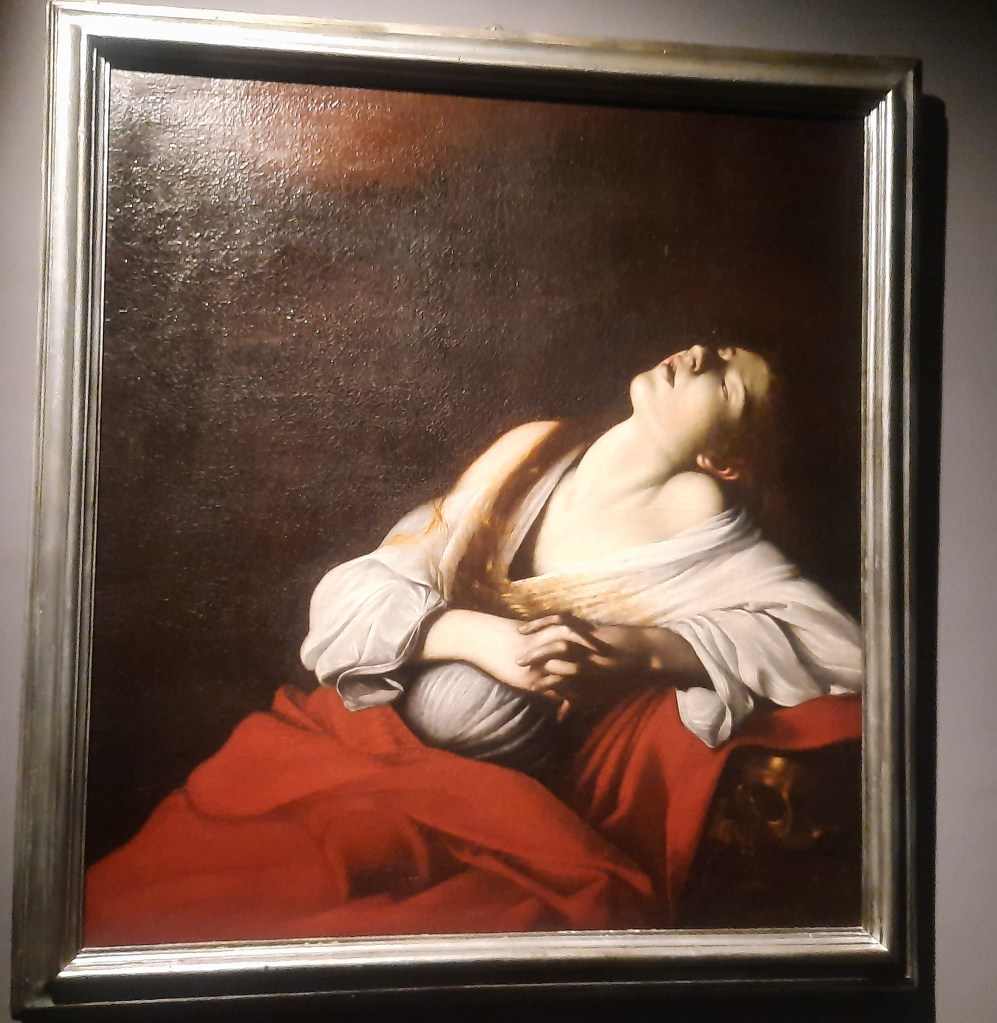
He moved to Rome, and set up in due course as an artist in his own right. Caravaggio’s work is known for its chiaroscuro (from Italian chiaro, “light,” and scuro, “dark”) technique—basically the use of light and shadow to define three-dimensional objects. Caravaggio and his followers used a harsh, dramatic light to isolate their figures and heighten emotional tension. Caravaggio’s use of realism and chiaroscuro helped to create a new style of painting that came to be known as Baroque, which shaped European art in the centuries to come.

One of his masterpieces has come to India. This is ‘Mary Magdalene in Ecstasy’, which was painted around 1606, and exemplifies his use of chiaroscuro. This painting was lost for centuries, re-surfacing only in 2014. It was authenticated as an original masterpiece by a team of leading art historians and is generally accepted as such today.

The painting travelled to India a few months ago, and was first exhibited in Delhi under the aegis of The Kiran Nadar Museum of Art, in partnership with The Cultural Centre of the Italian Embassy. Now it has come to Bangalore, and is exhibited at the National Gallery of Modern Art.

Three armed policemen are at the entrance to guard this $50 million work.The NGMA has also done its best to make it an enriching experience, with detailed panels about the artist and the painting, as well as a Virtual Reality experience.

Admittedly, It is a slightly strange feeling to go into a large, empty, almost-dark hall with only the one painting on the wall, with just one light focussed on it. A very different experience from seeing tens of paintings displayed in a room, with visitors filing from one to the other, and sometimes sitting on the benches provided to contemplate on something that catches their attention (or just to rest tired feet).

But all the care being taken with the work certainly proves India’s seriousness to protect and display of priceless art that comes to visit us.

It is not as if international masterpieces have not come to India before. Picasso’s works have been exhibited in India–the first exhibition of his works in South Asia was held at the National Museum in Delhi in December 2001 and featured 122 works. 

There are reports of original Botticelli paintings being exhibited in India too. For example, there are some reports that “Madonna of the Pomegranate” was displayed at an exhibition in Thiruvananthapuram. 

While no originals were physically displayed, there was an online exhibition of Raphael’s drawings by the India International Centre (IIC) IIC to commemorate the 500th death anniversary of the artist. 

Immersive, virtual experiences around Van Gogh’s work as well as da Vinci’s work have come to India in recent years.

Looks like India is now on the art-map, and we will be getting to see more such international masterpieces in the near future.

In the meantime, we can of course take in all the amazing art, craft, sculpture and architecture our own country offers!

–Meena

A Maharaja and his Art come to Town

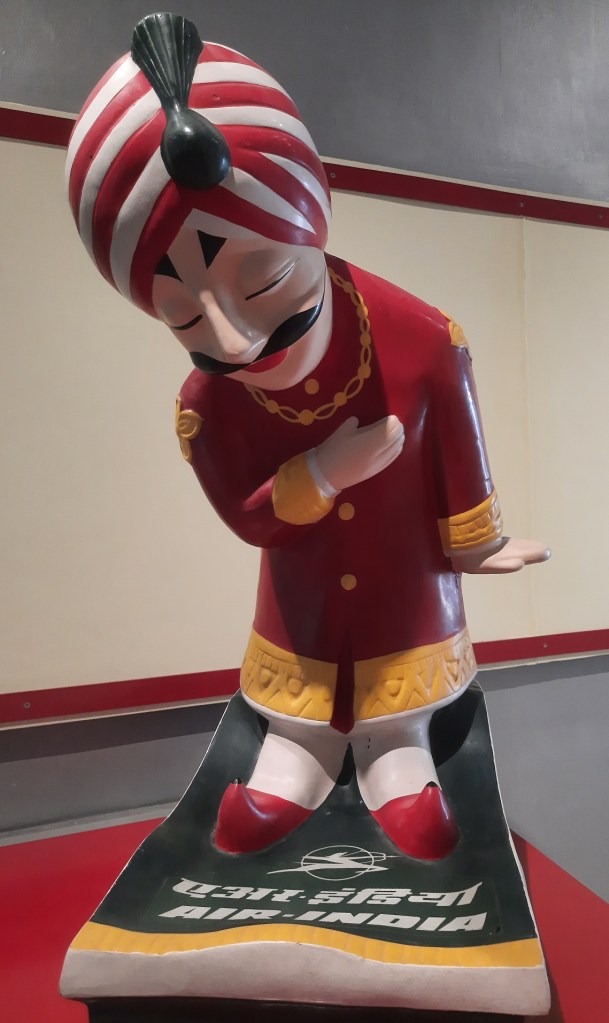
Like many of my fellow citizens, I am not a great fan of rajas, maharajas and their ilk. Nevertheless I love one Maharaja. The Air India Maharaja of course!

And the Maharaja has come to my neck of the woods (Bangalore), bringing with him a part of his famed art collection. Yes, the National Gallery of Modern Art (NGMA) here is hosting close to 200 pieces from the Air India art collection for six months.

Air India’s was one of the largest corporate art collections in India, estimated to have been worth over Rs. 350 crores about eight years ago. The collection has been built over almost seven decades and comprises close to 4000 works. It spans across modern and contemporary paintings, folk art and miniatures, as well as sculptures, textiles, photographs and antique clocks.

The collection started in the 1940s, propelled by JRD Tata, who wanted all of Air India’s booking offices across the world to represent India. Bobby Kooka and Jal Cawasji were mainly responsible for selecting and buying the art pieces. They would not only buy paintings from established artists, they would also visit student exhibitions and pick up paintings. Many of these would be used to make calendars, post cards etc. There was another interesting way of acquiring paintings—the transportation service contract. In exchange for the works of artists, Air India would give them international air tickets! Many an artist, including MF Hussain found this offer irresistible!

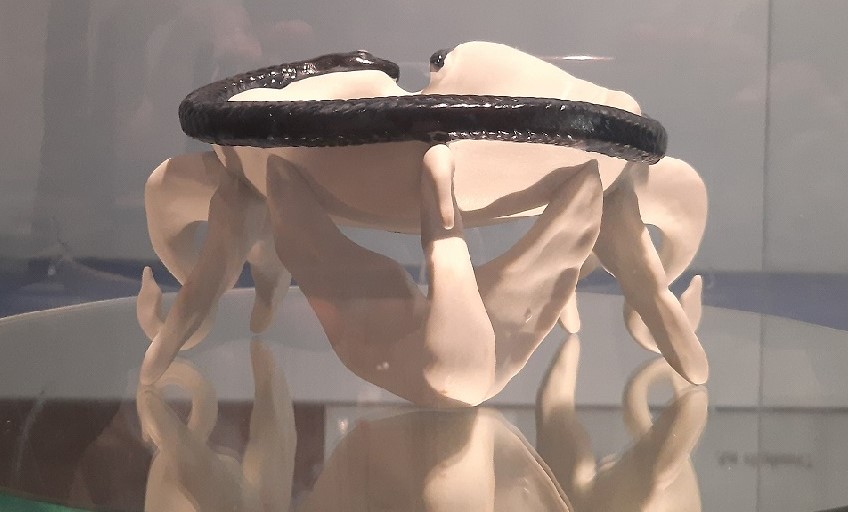
There were specially commissioned art works too. For instance, in the days when smoking in the air was quite normal, the airline commissioned Salvador Dali to design a special ashtray to be given to first class passengers. This was in 1967. 500 limited edition pieces were made of an ashtray comprising a shell-shaped centre with a serpent twined around its perimeter, supported by two surrealist elephant-heads and a swan.  Dali asked for a baby elephant as payment, and got it too!

When the Tatas controlled Air India, the art works were carefully documented, displayed, stored and issued out from the Mumbai office to various domestic and international offices. After the merger with Indian Airlines in 2007 however, things went awry. The collection was moved to Delhi and there was no real ownership. There were scandals with one of Jatin Das’ works allegedly disappearing. Moreover, the works were not properly stored or cared for.

When Air India was re-privatized a few years ago, it was decided that the collection would go to the NGMA, where it could be taken care of professionally. A further decision was taken that the collection would not just stay in one location, but would travel across the country and to other countries as well.

It is as part of this that the collection has now come to Bangalore, where it is being displayed at the NGMA building which itself is a sight. Called the Manickyavelu Mansion, it belonged to Manickyavelu Mudaliar, a mining baron, who himself bought it from the Wadiyars of Mysore.  Mudaliar who came from a poor family made it big thanks to his forays into manganese and chrome mining. But the fortune did not last long and the mansion was taken over by the City Improvement Trust Board.  In 2000, it was leased out to the Ministry of Culture. So today the imposing mansion with grand rooms and a scale quite fitting to a national museum, set in serene green grounds with century old trees, is the Southern Headquarters of the NGMA.

So if you are in Bangalore, ensure you drop into the gallery to see the Air India exhibition. You will see works by Anjolie Ela Menon, B. Prabha, Arpana Caur, MF Hussain, Jatin Das and Raza, among others.

And one room is devoted to the Braille versions of these works. The paintings and the information about them are done in Braille and hopefully will be enjoyed by many.

A special exhibition indeed!

–Meena

Famous Women on the Wall: Happy Women’s Day

This week we celebrate International Women’s Day.

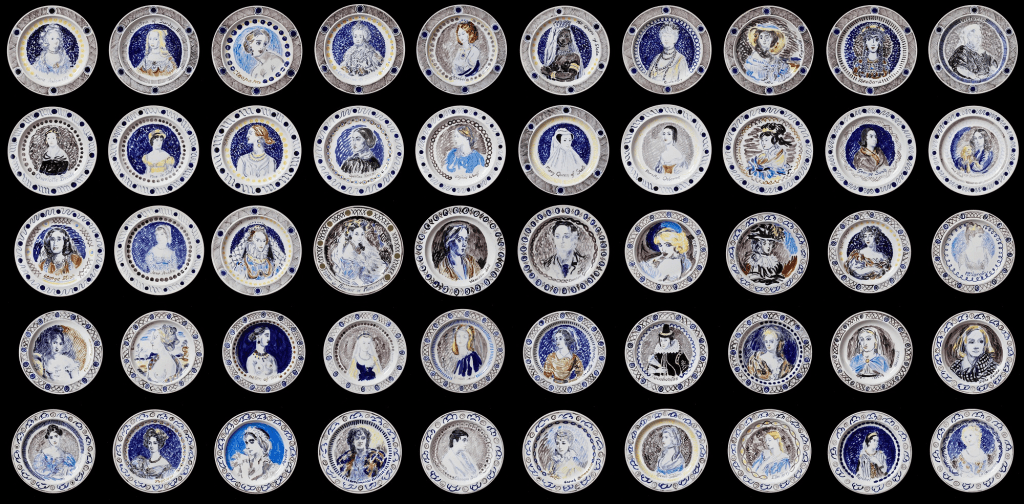
It was in 1911 that IWD started being marked. A couple of decades after that was when something called the ‘Famous Women Dinner Set’ was commissioned. This was a set of 50 dinner plates depicting famous women down history.

Kenneth Clark (Baron Clark), the art-historian and museum director, commissioned these. (Those of an older vintage may remember the BBC serial ‘Civilization’ which discussed Western art, architecture and philopsophy. Though made in 1969, it was broadcast in India in the late ‘70s or early ‘80s, and was one of the most popular art-history programmes in the world.)

Coming back to the dinner-plates, the artists given the commission were Vanessa Bell and Duncan Grant, of the famous Bloomsbury Group. This was the name given to a group of English writers, philosophers and artists who met between 1907 and 1930 in the Bloomsbury  district of London, the area around the British Museum , and discussed matters of art and philosophy.

It is said that Kenneth Clark got the idea of commissioning a special dinner service when he was dining off a historic blue-and-gold Sèvres service, originally made for Catherine the Great.

Kenneth and his wife did not interfere in any aspect of the creative work—what form or shape it would take, what pieces it would consist of, or even what it should portray.

In 1933 the work was completed, and after showing it to the Baroness, the artists presented the set of 50 plates to Kenneth Clark, who was probably quite surprised to see the result if his commission, because he thought he would be getting’…a wide ranging set of decorative crockery that included everything from soup tureens to mustard pots’

Picture from https://www.charleston.org.uk/event/famous-women-dinner-service

Vanessa and Duncan had selected 50 famous women down history—twelve each from four categories: Women of Letters (e.g George Eliot, Charlotte Brontë, 10th-century Japanese poet Murasaki. Virginia Woolf and Elizabeth Barrett Browning); Queens (including Catherine the Great, the Queen of Sheba, Elizabeth I, and Victoria); Beauties (among whom were Pocahontas and Helen of Troy); , and Dancers and Actresses (including Sarah Bernhardt, Ellen Terry and Greta Garbo). That made 48 women. The last two plates portrayed the artists Vanessa Bell and Duncan Grant. The artists had hand painted beautiful portraits of their subjects on Wedgewood plates.

Though he was initially a bit confused with the dinner service, it seems that Baron Clark quite grew to like his plates. It is said that he used to select specific plates from the service for use for particular guests, depending on their interests, or to poke fun at their sensitivities.

The dinner set, after being sold and re-sold disappeared from view for some decades, but later re-surfaced. They are now housed in the Charleston Museum in the UK—the original home of Vanessa Bell.

Another major work of art involving women and dinner is ‘The Dinner Party’, a 1979 installation by Judy Chicago. This is a dinner table arranged with place settings for 39 mythical and historical women. They are seated around a triangular table. Though controversial, this is considered a classic of feminist art.

In India we do have portraits (paintings and photographs) of women. But they are outnumbered by artistic works down the ages which put females at the centre—the oldest probably being the Harappan Girl, going back to 1750 BC or thereabouts. From there, to all the art in temples, to Raja Ravi Verma and his goddesses and mythical women, to the controversial portrayals of MF Hussain, to women painted by Amrita Shergill, Anjolie Ela Menon, Arpana Caur, Bharathi Kher and others, which are all classics today.

May many more artists immortalize real women in their art. It is an apt tribute.

Happy Women’s Day!

–Meena

And thanks to all our readers on this, the anniversary of our blog! And all those whose encouragement and support keeps it going!

Hussain-Doshi Gufa

I was recently on a nostalgia trip to Ahmedabad, visiting/re-visiting haunts of yore. One of these was Ambadvad ni Gufa (Hussain-Doshi Gufa for old-timers like me). This is an underground art gallery where both the structure and ‘contents’ are works of art

Born of a collaboration between the renowned architect Balkrishna Doshi and MF Hussain, it exhibits works of MF (Maqbool Fida) Husain, in a unique structure designed by Doshi. It is and unusual juxtaposition of architecture and art—a situation where a work of art contains works of art.

Hussain and Doshi both belonged to and loved Gujarat, and hence the decision to create a permanent structure in Ahmedabad which could showcase both their work.

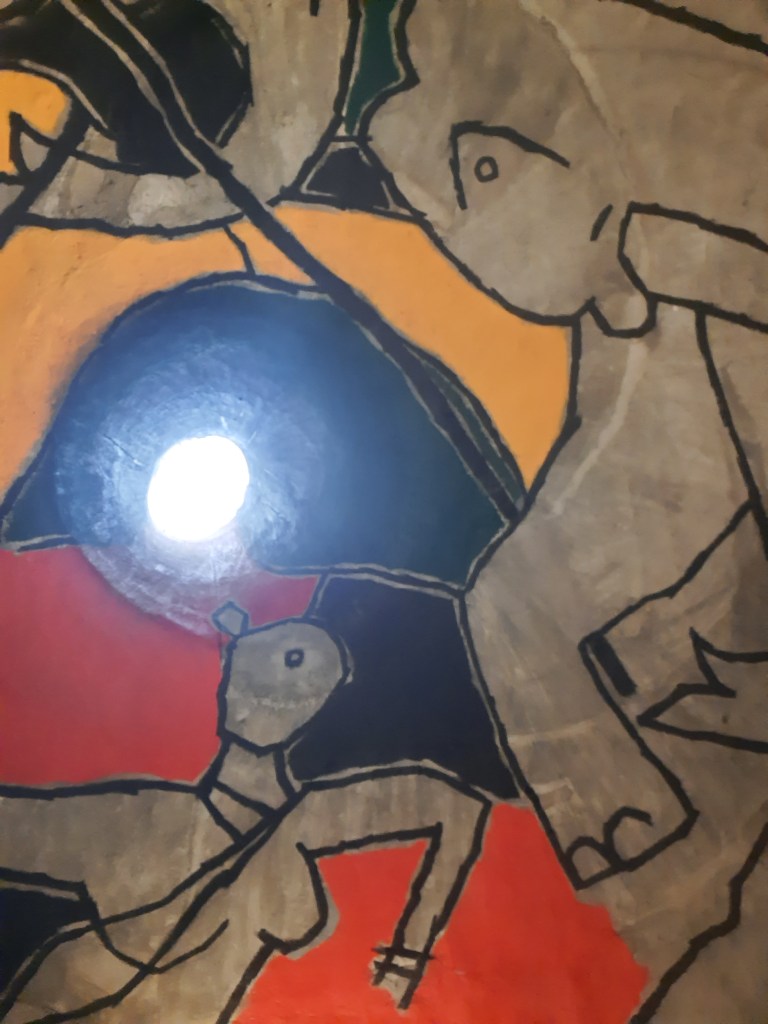
The underground gufa (cave) has a roof made of multiple interconnected domes which are covered with a mosaic of tiles. As one descends a not-so-obvious staircase, the inside opens up. It has irregular and inclined tree-like columns supporting the domes. The roof and walls are painted by Hussain. Light enters the cave though snouts, creating spots of light on the floor. The lighting is thus very different at different times of the day, and creates a mystique of its own. The cave spans across 1000 square metres.

The inside walls serve as a canvas, on which Hussain painted with bold strokes and in bright colours. There are depictions of human figures and animals, including of course, his iconic horses. The idea was to recreate ancient cave-type paintings in a modern environment. A few metal sculptures of human figures are also placed in the niches between the columns.

However, the largest artwork is on the mosaic outside surface of the gufa. This is a depiction of the Sheshnag (divine serpent), winding across the surface over a length of 100 feet, and is visible at eye-level as one walks past the structure.

The Gufa is considered a milestone in collaborations across disciplines. When Hussain visited Ahmedadab once, he asked Doshi, who was a close friend, to design a permanent art gallery for his works. Doshi said he would design something unique but Hussain would need to rise to his structure in his artwork! The planning was a process of interplay of ideas.

The objective was to develop something contemporary, but based on ancient design ideas, and in sync with the natural environment.

Given Ahmedabad’s high temperatures, it was designed as an underground structure. The white porcelain mosaic tiles covering the outside reflect sunlight and reducing the heat reaching the inside of the structure. The Buddhist caves of Ajanta and Ellora inspired Doshi to design the interior in the form of circles and ellipses. The domes are inspired by tortoise shells (kurma avatar) . The mosaic tiles on the roof are similar to those on the roofs of Jain temples at Girnar. Hussain’s wall paintings are inspired by Palaeolithic cave art, and serpent by the Seshnag of Hindu mythology.  The interior columns resemble columns at Stonehenge.

The Gufa has been attacked and vandalized several times—ironic for something designed as a syncretic work. In the very first attack on October 11, 1996, Bajrang Dal activists damaged 23 tapestry items and 28 paintings which were on display. The excuse for the attack was Hussain’s depiction of Hindu goddesses.

What is nice today is that there is a lively café around it, and young people throng the place. The Gufa is a part of a cherished hangout. They look on to the mosaic domes and the Sheshnag as they munch on their snacks and sip on their iced tea. And hopefully, through the process, imbibe an appreciation of the art so close to them, and moved to cherish both the art and the spirit behind the work.

–Meena