
The Matilda Effect: When Women-Scientists are Written Out

As appropriate to the month when we mark International Women’s Day, our pieces have revolved around women, their achievements and barriers to their growth. This week, we look at an uncomfortable historical pattern: how many of the contributions made by women have been ignored, minimized, or credited to men. This phenomenon has a name — the Matilda Effect.

The term was coined in 1993 by historian of science Margaret W. Rossiter, who used it to describe the systematic denial of recognition to women-scientists whose work was often attributed to male colleagues. Rossiter named it after the 19th-century American activist Matilda Joslyn Gage, who had earlier observed how women’s intellectual achievements were routinely erased from public record.

In simple terms, the Matilda Effect refers to the tendency for women’s scientific or scholarly contributions to be overlooked while men receive the credit.

Why the Matilda Effect Matters

Recognition is not just about credit; it shapes opportunity.

Academic promotions, research funding, leadership roles, and history are all tied to who gets acknowledged. When women’s contributions are under-recognized, it creates a cycle in which fewer women are visible as role models for the next generation.

Young girls interested in science, technology, engineering, and mathematics often search for people who look like them in positions of intellectual authority. When those figures are missing from textbooks and public discourse, aspirations can quietly narrow.

The Matilda Effect therefore operates not only as a historical injustice but also as a structural barrier to gender equity in knowledge systems.

History’s Striking Examples

Consider Rosalind Franklin’s whose X-ray crystallography images were critical to understanding the structure of DNA and enabled the breakthrough model proposed by James Watson and Francis Crick. Yet when the Nobel Prize was awarded in 1962, Franklin — who had already passed away — received little recognition for her role.

Another well-known case is of Lise Meitner, the Austrian physicist who played a key role in explaining nuclear fission. The Nobel Prize for the discovery went solely to her collaborator Otto Hahn.

India’s own intellectual history reflects similar patterns.

Take Janaki Ammal, the pioneering botanist and cytogeneticist whose work significantly advanced plant breeding and biodiversity studies in India. Despite her groundbreaking research, she remained far less publicly known than many of her male contemporaries.

Or Anna Mani, the pioneering physicist and meteorologist whose work laid the foundation for modern meteorological instrumentation in India. She played a crucial role in standardizing weather measurement systems and advancing research in solar radiation and wind energy, contributing significantly to India’s renewable energy potential. Despite the far-reaching impact of her work, she remained relatively under-recognized outside scientific and policy circles.

(MM blogs on these two amazing ladies are linked below)

Similarly, Asima Chatterjee, one of India’s foremost organic chemists, made pioneering contributions to the chemistry of natural products and anti-malarial drugs. Although widely respected within scientific circles, her name rarely appears in popular narratives of Indian science.

Signs of Change

Things are hopefully changing. An example is Tessy Thomas, often called India’s “Missile Woman.” As a senior scientist at the Defence Research and Development Organisation, she played a key role in the development of the long-range ballistic missile Agni‑V. Her journey from a small town in Kerala to leading strategic defence projects has made her an inspiration for many young women considering careers in engineering and defence research.

Another widely admired figure is Gagandeep Kang, a leading medical scientist known for her work on infectious diseases and vaccines. As the first Indian woman elected Fellow of the Royal Society in the field of biomedical science, she has become a powerful role model for girls interested in medical research and public health.

In the world of space science, Ritu Karidhal and Muthayya Vanitha gained national recognition for their leadership roles in India’s lunar mission Chandrayaan‑2 at the Indian Space Research Organisation. Their visibility during the mission helped reshape public perceptions about who leads complex scientific and technological projects.

Similarly, Nandini Harinath, another senior scientist at ISRO, became widely known after the success of the Mars Orbiter Mission, where she was part of the core navigation and mission design team.

Dr. Gagandeep Kang

What distinguishes these scientists is not only their technical expertise but also their public presence. Through lectures, interviews, and outreach programs, they actively encourage young girls to consider careers in STEM — science, technology, engineering, and mathematics.

Recognition is the first step. Structural barriers — from access to research funding to representation in leadership — still need attention.

Here is to women-scientists having their day and say in scientific research!

–Meena

Picture: Indian Academy of Sciences

​See Magnoila Lady Janaki Ammal https://millennialmatriarch464992105.wordpress.com/wp-admin/post.php?post=2994&action=edit

and Weather Woman Anna Mani at https://millennialmatriarch464992105.wordpress.com/wp-admin/post.php?post=3235&action=edit
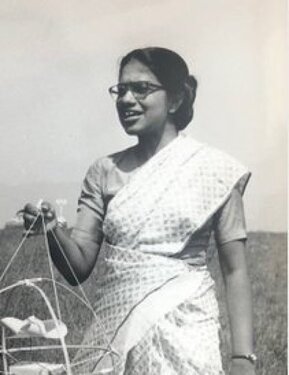
Weather Woman Anna Mani

When she turned eight, Anna Modayil Mani was to be gifted a pair of diamond earrings, as per her family tradition. Young Anna requested instead a gift of Encyclopaedia Britannica! This was a bit of a shock for the Mani family in Travancore in Kerala. Anna, the seventh of eight siblings, grew up in a well-to-do but traditional family where sons were groomed for high level careers and daughters were trained to be mothers and housemakers in preparation for an early marriage. Anna however showed signs of breaking the mould from an early age when she spent her time devouring all the books in the house. Her lifelong love for nature was planted and nurtured by long walks in the forests around her father’s cardamom estates, and swimming in the backwaters and rivers. And her scientific mind was imprinted with her father’s teaching not to accept any statement unless it could be tested and verified.

Born in 1918, Anna was only seven years old when Mahatma Gandhi visited Travancore which was the epicentre of the Vaikom Satyagraha. Gandhi’s visit made such a deep impression on the young girl that she decided to wear only khadi. The spirit of nationalism that pervaded the period also instilled in young Anna the fierce spirit of freedom, including the freedom to make her own decisions. Thus, she chose to pursue higher education rather than marriage which her sisters had easily opted for.

Anna joined Presidency College in Madras from where she graduated with an honours degree in Physics in 1939. A year later she got a scholarship to undertake research at the Indian Institute of Science in Bangalore where she was accepted as a research scholar in CV Raman’s laboratory to work on the spectroscopy of diamonds and rubies. Thus Anna began to research the very stone that she had turned down in her childhood.

The experiments were challenging and laborious; Anna worked for long hours, often through the night. Between 1942 and 1945, she published five single-authored papers on luminescence of diamonds and ruby. In August 1945 she submitted her PhD dissertation to Madras University. The University, with a blend of bureaucracy and gender bias, denied granting her the degree on the basis that she did not have an MSc degree. This, despite the fact that she had won a scholarship for research at the Indian Institute of Science, and had worked with CV Raman.

Anna was not daunted by this. Around the same time, the Indian government had announced scholarships for internships abroad in various fields, and Anna applied. In 1945, just as WWII was ending, she boarded a troopship to England with the government scholarship to take up an internship in in meteorological instrumentation at the Imperial College in London. Although she had wanted to pursue further research in physics, this was the only internship available. And it is meteorology that was to become her life’s metier.

Anna Mani returned to an independent India in 1948, and joined the Indian Meteorological Department at Pune where a programme to design weather instruments was taking shape. Anna was put in charge of construction of radiation instrumentation. Despite a paucity of resources, she would not compromise on research or quality; she inspired the scientists under her to “Find a better way to do it!”

Anna Mani standardised the drawings for nearly 100 different weather instruments and started their production. She worked with members of the World Meteorological Organisation to rigorously compare measurements to verify the accuracy of Indian instruments, as she fiercely believed that “Wrong measurements are worse than no measurements at all.” She continued her link with academic research and published a number of papers on subjects ranging from atmospheric ozone, to the need for international instrument comparisons and national standardisation

During the International Geophysical Year (1957-58), she set up a network of stations in India to measure solar radiation. Her focus was on the instrumentation meant to measure solar radiation, taking into account its seasonal and regional variation across India.

By 1964, Anna Mani became involved in the ozone-monitoring efforts in India; this was well before the Ozone Hole became an international issue. India had stations to measure ozone since the 1940s, but it was Mani’s team that in 1967, developed the Indian ozonesonde, a balloon-borne instrument to measure ozone levels. They also updated ground-based equipment so that Indian scientists had a lot of data to work with. The scientist also published a number of papers on subjects ranging from atmospheric ozone to the need for international instrument comparisons and national standardisation. Anna Mani received a citation from the International Ozone Commission for her work on ozone-level measurements from 1960 to 1990.

In 1963, at the request of Vikram Sarabhai of she successfully set up a meteorological observatory and an instrumentation tower at the Thumba rocket launching facility.

Anna Mani’s work of three decades made a valuable contribution to Indian meteorological sciences, indigenously manufactured instruments, reliable data, scientific rigour and up-to-date methodology. It was Mani who spearheaded India’s efforts to manufacture its own weather observation equipment, such as barometers and wind gauges, dramatically bringing down their cost – at the same time, she ensured their reliability and precision.

Anna Mani retired as deputy director general of the Indian Meteorological Department in 1976. She returned to the Raman Research Institute as a visiting professor for three years. Later she set up a millimetre-wave telescope at Nandi Hills, Bangalore. She published two books, The Handbook for Solar Radiation Data for India (1980) and Solar Radiation over India (1981), which have become standard reference guides for solar tech engineers.

Mani did not marry, she spent her life in the pursuit of science, In 1994 she suffered a stroke which affected her mobility; and died in 2001.

Anna Mani was steeped in, and driven by her passion for work. As she once said “I should be most unhappy to wake up without the prospect of some work to do.” But she went on to say that when the work was done, she enjoyed listening to music, reading and enjoying nature, her childhood passions.

Her advice to young meteorologists was, “We have only one life. First equip yourself for the job, make full use of your talents and then love and enjoy the work, making the most of being out of doors and in contact with nature.”

23 March is marked as World Meteorological Day. This is a good time to celebrate Anna Mani and her significant contributions that made independent India self-reliant in measuring aspects of the weather, and helped lay the ground for harnessing solar and wind power as alternative sources of energy.

–Mamata