
What do Ben Kingsley, Engelbert Humperdinck, Cliff Richard, Sebastian Coe and Derek O’Brien have in common? While they have each made a name in different spheres from entertainment to sport, they are all described by a common word ‘Anglo-Indian’.
This word which was more often heard when we were young, as compared with today, was used to refer broadly to people who were ‘anglicised’ in the way they looked, and the way they lived. They were often better English-language speakers, wore ‘western’ clothes and ate food that combined local as well as ‘foreign’ flavours. They appeared in literature as ‘gora memsaabs and sahebs’.
The term Anglo-Indian commonly refers to people with British and Indian parentage. Legally, it means Indian citizens who are of European descent on their father’s side – which means that their paternal ancestors could be British, French or Portuguese. Thus the history of this community is tied with the history of colonialism in India. It goes back to the 16th century when the Portuguese colonised parts of India. It is believed that the Portuguese encouraged their soldiers to marry local women to “create a community that would be loyal to the colonisers, yet comfortable living in the colonies”. The offspring of these couples were called Luso-Indians, and then Eurasians. Later, the Dutch and British traders and colonists also adopted this strategy. In the early years East India Company employees and British officials who came to India left their families behind. The men had relationships with Indian women resulting in mixed-race children.
The East India Company directors in the seventeenth century paid one gold mohur as family allowance, for each child born to an Indian mother and a European father. Children with British or European fathers and Indian mothers were called “country-born” and included those with Portuguese, Dutch or French fathers. These offspring grew to become what was called the Anglo-Indian community, which was a kind of middle population between the British rulers and native subjects.
The term “Anglo-Indian” was first used by Warren Hastings in the eighteenth century to describe both the British in India and their Indian-born children. Once English women also started accompanying their men and living in India, the racial lines became more defined. In the nineteenth century the British in India still separated themselves from coloured people but accepted fairer (and often wealthier) people of dual heritage as “Anglo-Indian”. Darker (and usually poorer) people were given the name “Eurasian”. From 1791 the Anglo-Indians were debarred from the East India Company’s armies and many trained the armies of the Indian princes.
The Anglo-Indian identity originally developed out of this fusing together of eastern and western cultures. But this blending of cultures over time also became a source of discomfort and alienation. Historically, the community was discriminated against by the British for their skin colour and mixed race. They were also viewed with suspicion by native Indians because of their loyalty to the crown.
In the Indian census of 1911 the term ‘Anglo Indian’ was used as a category denoting persons of mixed ethnicity. Being defined as a separate group from both white Europeans and Indians had its advantages and disadvantages. They were put in a superior group from the general Indian population, but remained inferior to the white-skinned British. Within the group itself those with lighter skin had better access to white spaces and privileges. Many secured jobs on the British civil service, trade and industry. They were described as the wheels, the cranks and the levers of the Empire-building machinery. They were employed in large numbers to work on the railways, working in many associated fields from engine driver to fire-fighter. These “railway people” as they were called, lived in railway towns built for them by the British. Later it was the Anglo-Indian girls who were the forerunners in a number of professions, from being one the first air hostesses, to teachers, nurses and secretarial assistants who were skilled at their work. They also evolved their own culture with distinct style, cuisine, and music.
In the early 1930s Ernest Timothy McCluskie, an Anglo-Indian businessman from Calcutta, approached the erstwhile King of Ratu for a 10,000-acre land to establish a settlement, or ‘mooluk’ for the Anglo-Indian community. He was granted land about 65 km from Ranchi in what is now Jharkhand, on a perpetual lease. It was a beautiful location amidst forests and rivers and more than 400 Anglo-Indian families from across the country moved to settle there. Here they created a ‘mini England’ and lived a luxurious life. This continued till the mid-1960s. The lack of livelihood options, and adequate facilities for education and healthcare led to most of the people moving out, and McCluskieganj or the “Gunj” as it was called became a ghost town. Today this almost forgotten town has some educational institutions and is an out-of-the-way tourist spot.
In 1926 Henry Gidney, who had an Irish father and Indian mother founded the All India Anglo-Indian Association to represent and campaign for the interests of this mixed-race group.
The Government of India Act of 1935 defined an Anglo-Indian as “a person whose father or any of whose other male progenitors in the male line is or was of European descent but who is a native of India.”
When India attained freedom from British rule this community was placed in a dilemma. Those with lighter skin returned to Britain and gradually integrated into British society. Many also chose to migrate to other countries of the Commonwealth, especially Canada and Australia where they set down roots. Most of these immigrants went on to marry the within the population of those countries, and in a couple of generations were completely absorbed within the culture of the country where they had settled. However a section of the Anglo-Indian community continued to remain in India and like their immigrant fellows went on to marry Indians and gradually merge into the mainstream. However they also retained some of the characteristics of their distinct culture.
Meanwhile the All India Anglo-Indian Association, headed by Frank Anthony since 1942, lobbied for an official recognition of the group in India, and secured special provisions for Anglo-Indians in the constitution of the newly independent country. Article 366 of the Constitution defined Anglo-Indian as “a person whose father or any of whose other male progenitors in the male line is or was of European descent”. The key points of this definition were retained when Anglo-Indians were listed as an official minority group in India’s constitution in 1950. Two seats were reserved for Anglo-Indians in the Lok Sabha, and in the Legislative Assemblies of the States. These members were to be nominated by the President of India. The reservation continued until 2020 when the clause was amended, and the special status was removed.
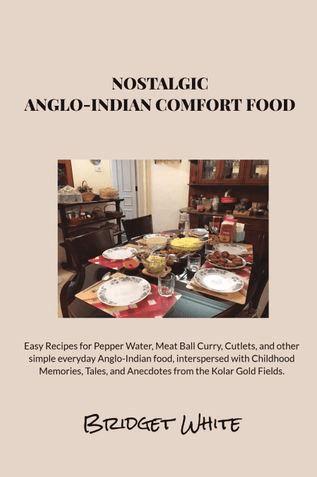
Today the original Anglo-Indian community has dwindled considerably. New generations with Anglo-Indian roots have fully assimilated into the culture of the countries or communities that they have settled in. However in recent times there has been a growing curiosity among these to trace their ancestry and heritage. Today there are internet communities that are inviting people to contribute family histories and memories. Cookbooks with revived recipes of the distinctive dishes like Jalfrezi, country Captain Chicken and Railway Lamb Curry and pepper water are becoming popular. Community gatherings in places where there are still pockets of Anglo-Indian populations are an occasion for the elders to share reminiscences of childhood meals of yellow rice and meatball curry, lively dance parties and perhaps “the good old days.” There is a special celebration every year on 2 August which is as World Anglo-Indian Day. This was the day when the definition of Anglo-Indian featured for the first time as part of the India Act 1935.
–Mamata
 Millennial Matriarchs