
Not long ago I wrote about the Kuchchhi Kharek or Date that was given a GI tag. Just last week another fruit from Gujarat has been given this tag, making it the third fruit from the state (after the Gir kesar mango and Kuchchhi kharek) to be tagged thus. This is the Amalsad chikoo or sapodilla.
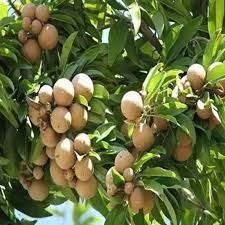
We generally think of the chikoo as being a very ‘desi’ fruit with its grainy texture, caramelly flavor and colour, and sticky latex at the stem of the fruit. However, the origin of the fruit can be traced back to the Yukatan peninsula in Mexico. Its history goes back to ancient Mesoamerica where it was cultivated by the Mayans and Aztecs who used its sweet and nutritious pulp was a part of their indigenous diet. European explorers to this region discovered this fruit, and the zapote or chicle spread with them as they continued their explorations across Central America and the Caribbean, and then further afield, reaching Asia, Africa and the Pacific. The well-travelled chikoo adapted to different climates and cultures, thriving in tropical and sub-tropical regions, to become a ‘local’ favourite across different continents. Manilkara zapota (its botanical name) acquired local names like chicozapote, naseberry, nispero, soapapple, sapota, sapodilla, and chikoo.
As with most fruits, chikoo has its share of health and nutrition benefits. Several parts of India provide ideal soil and climatic conditions for cultivating chikoo. In fact India is the world’s largest producer of the chikoo which is also widely exported. There are also several varieties of chikoos grown here. But not every variety of chikoo has the distinction of gaining a GI Tag.
What is this tag and how is it obtained. A Geographical Indication (GI) sign is used on products that have a specific geographical origin and possess qualities or a reputation that are due to that origin.
Geographical Indications are typically used for agricultural products, foodstuffs, wine and spirit drinks, handicrafts, and industrial products. In the case of fruits and vegetables the product needs to conform to certain parameters such as size, colour, number of seeds, flavour and aroma.
What is important is that the qualities, characteristics or reputation of the product should be essentially due to the place of origin. Since the qualities depend on the geographical place of production, there is a clear link between the product and its original place of production.
The use of place names to identify the place of origin of products goes back centuries. However the legal connotations of such names were introduced in the form of Geographical Index by the World Trade Organization in 1994. In India, the GI tag system came into force in 2003. Darjeeling tea was the first product in India to get a GI tag. But since then the awarding of GI tags has been active, and as of July 2024, there were 605 products with GI status, spread across agricultural, natural, manufactured goods, and handicrafts.
One of the main objectives of the GI tag is to protect and preserve traditional goods and crafts, and the communities that make them. It functions as a seal of authenticity to highlight that a product claiming to be from a certain region is in fact from that region, is produced by people living in that region, and that it meets certain quality standards set up to ensure this. The GI status also offers legal protections since only registered or authorised producers are allowed to use the tag. The GI registration allows registered parties to launch a lawsuit for infringement against unauthorised parties using the tag.
The GI tag values the traditional skills of artisans, unique ingredients, and region-specific delicacies, and agricultural produce. The attraction of a GI tag is that it is believed that it will give the producers a better status and the ability to get better price for their products.
In India, the process of obtaining a GI tag is rigorous, and often takes time. It begins by submitting a physical application by an association of persons producing the goods to the Geographical Indications Registry in Chennai, which is under the purview of Department of Promotion of Industry and Internal Trade, Ministry of Commerce and Industry.
The information in the application needs to prove the historical and regional antecedents of the product. In the case of agricultural produce, details required include the exact area, the cultivar, how it’s grown, how long it had been linked to the region, and agricultural factors that make the ingredient unique. The approval process can take anywhere between one and three years to get the tag, sometimes even longer. For example, it took eight years for the Erode turmeric and Basmati rice to get their GI status. The GI tag is only valid for 10 years, which means that producers have to renew their application to keep the status.
The Amalsad chikoo is not the first chikoo to get the GI tag. It was preceded by another chikoo variety called the Dahanu Gholvad Bordi Chikoo in 2017.This variety cultivated on the Maharashtra-Gujarat border was recognized for its unique sweet taste, soft creamy texture and high nutrition value attributed to the high calcium content in the soil of the area. This region has been a hub of chikoo cultivation for over a hundred years; also it is possible to harvest the fruit here round the year.
Now the Amalsad chikoo joins the club. It was awarded the Geographical Indication (GI) tag in recognition of its “unique characteristics and deep rooted connection to the region”. The chikoo gets its name from a village in Gujarat’s Navsari district. However the region recognised by the GI covers 51 villages in Gandevi taluka, 6 in Jalalpore and 30 in Navsari which together produce about 30% of Gujarat’s chikoo yield. The region has ten chikoo cooperative societies which contribute substantially to the export of this fruit.
The application for GI certification was made jointly by the Gujarat Council on Science and Technology (GUJCOST) and Navsari Agricultural University (NAU). GUJCOST carried out research on proof of origin of the fruit cultivation in Amalsad while NAU worked on the special characteristics of this chikoo variety. This variety is recognised for its exceptional sweetness, fine texture, and long shelf life compared to several other varieties of India. The region’s unique soil composition, coupled with traditional farming practices passed down through generations have contributed to its quality and reputation. The GI certification acknowledges “the distinct quality, taste, and cultivation methods that make Amalsad chikoo a symbol of excellence in Indian horticulture.”
The GI tag is not only enhances the reputation of this chikoo but is a recognition of the traditional agricultural practices of the local horticulture community; this also boosts their business while giving them a level of legal protection. For the rest of us, it is one more incentive to enjoy a chikoo shake, ice cream, or simply chilled slices of this delicious fruit this summer.
–Mamata
 Millennial Matriarchs