
This week, 6 July, marked the 85th birthday of His Holiness the Dalai Lama. Five years ago, in 2015, to celebrate the Dalai Lama’s 80th birthday, a unique meeting took place. The Dalai Lama’s close friend the Archbishop Desmond Tutu came to Dharamshala to visit his “kindred spirit”. Both great spiritual masters and moral leaders of our time, and Nobel Prize winners, the two spent a week together—sharing their thoughts and vision, exchanging memories, and reveling in the simple joys of being together, laughing, and teasing each other.
Interestingly, four years before this meeting, when Desmond Tutu turned 80, a similar meeting between the two had been planned in Cape Town, South Africa. But the Dalai Lama was denied a visa by the South African government, bowing to pressure from the Chinese government.
The Dharamshala meeting was, thus, more than special, and its purpose even more so. They took this rare occasion as a chance to sit down together, and evaluate one of life’s most important questions: how do we find joy in the face of life’s inevitable suffering? The outcome was The Book of Joy.
As the facilitator of the dialogues, and editor of the book, Douglas Abrams explains, ‘From the beginning the book was envisioned as a three-layer birthday cake: their own stories and teachings about joy, the most recent findings in the science of deep happiness, and the daily practices that anchor their own emotional and spiritual lives.’
The book documents the interactions between the two great minds through daily dialogues over seven days, starting with identifying the obstacles to joy: fear, stress, anxiety, anger, sadness, grief, loneliness, envy, suffering and adversity, illness and fear of death.
From there the dialogues move on to explore the paths to experiencing Joy. Both the great minds emphasise that joy and happiness are by-products that spring from one’s attitudes and actions, and the cultivation of certain qualities.
What are these positive qualities that allow us to experience more joy? Four are qualities of the mind: perspective, humility, humour and acceptance. Four are qualities of the heart: forgiveness, gratitude, compassion mind: and generosity. These are the eight pillars of Joy. Each of these is discussed at length in the book.
Five years ago, the two gurus talked about the untold horrors, tragedies and suffering that the world was facing, and how to find joy whilst accepting, and yet transcending these. Today, in addition to these, the world is facing an all-encompassing and overwhelming new challenge. More than ever before, their words of wisdom may be the one’s to guide humanity through the pandemic that has been the greatest equaliser of all.
Perhaps the key to coping with the immense stress, anxiety, frustration and anger that all of us are facing during this period is Perspective. I cannot help but share some excerpts which are so relevant today.
“Yes there are many things that can depress us. But there are also are very many things that are fantastic about our world. Unfortunately the media do not report on this because they are not seen as news. …When bad things happen they become news, and it is easy to feel that our basic human nature is to kill or rape, or to be corrupt. Then we can feel that there is no hope for the future. …No doubt there are very negative things, but at the same time there are many more positive things happening in our world. We must have a sense of proportion and a wider perspective. Then we will not feel despair when we see sad things.”
“For every event in life there are many different angles. When you look at the same event from a wider perspective, your sense of worry and anxiety reduces, and you have greater joy. …If you look from one angle, you feel, Oh how bad, how sad. But if you look from another angle at the same tragedy, that same event, you see it gives me new opportunities.”
“The wider perspective leads to serenity and equanimity. It does not mean that we do not have the strength to confront a problem, but we can confront it with creativity and compassion rather than reactivity and rigidity. We are able to recognise that we do not control all aspects of any situation. This leads to a greater sense of humility, humour and acceptance.”
“The way we see the world is the way we experience the world. Changing the way we see the world in turn changes the way we feel and the way we act, which changes the world itself. A healthy perspective is really the foundation of joy and happiness.”
The book records the thoughts of the two thinkers not just through their words but also by their body language—the mischievous tugging and patting of arms, the heartfelt clasping of fingers, the respectful folding of hands and bowing, and above all the twinkling of eyes and the easy laughter of two dear friends sharing jokes, and enjoying their pudding! No wonder they are they are also known for being among the most infectiously happy people on the planet!
I myself have felt engulfed in this childlike exuberance and humour both times that I have had the privilege of attending a talk by the Dalai Lama, even as one of an audience of hundreds.
The Book of Joy has been on my bookshelf the last couple of years, but I was not in the right frame of mind to start reading it. It is only last week that I felt the urge to read it. I intensely related to it, and it put a lot of things in perspective. Every word in the book is thought-provoking and profound. I know that I will go back to these again and again. Perhaps there is a time and place for everything indeed.
But, there is always time and space for Joy.
–Mamata
 On the day of the challenge, Amaravathi positioned herself behind a curtain, out of sight of her lover. She had at her side two baskets. One was empty and the other had a hundred beautiful blossoms (I visualize them to be jasmine). The idea was that as Ambikapathy finished a verse, she would transfer one flower from the filled basket to the empty one. When the basket was empty, she would know that he had finished his 100 verses and she could appear before him.
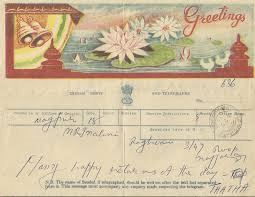 The last telegram in India was sent at 11.45 p.m. on the 14th of July, 2013. The telegram service in the country started in 1850 on an experimental basis, and was made available to the public in 1854. It connected us across the vast country, the harbinger of joys and sorrows. The arrival of a telegram definitely did give rise to butterflies in the stomach and a rise in blood pressure.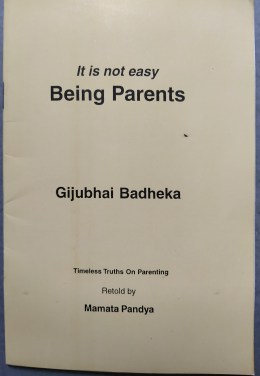


 Over 30 years ago.
 y for an environmental educator whose work and mantra for over three decades had been ‘connecting children with nature’. Environmental education as we believed was learning in the environment, learning through the environment, and for the environment. More than anything else, this was true for nature education. Based on this conviction we worked with passion and imagination to create hands-on teaching-learning experiences–from stepping outside the classroom to observe a single tree, to a camping experience of immersion in natural surroundings. These were experiences that engaged not just the head, but all the five senses—seeing, hearing, smelling, tasting and feeling—and thence the heart. We believed that it was the heart and not the head which would create a new generation of sensitive, informed and able champions of the environment.
 ies, just to pick up a book. One went to feast on the shelves lined with books, to run one’s eye across and up and down, pulling out a familiar name, or a new unfamiliar one; to peruse the blurbs on the cover to get a taste of what was within. One went in, sometimes with the certainty of coming out with a specific title, but equally the expectation of discovering new authors, or new works by familiar authors. It was the exploration that was the real fun, not so much the final selection.
 Millennial Matriarchs