Froglore

May 22 is marked as the International Day of Biological Diversity. Last year the theme was Nature is the Solution. And carrying forward the same, the theme this year is We are Part of the Solution—a reminder that humans are but one strand in the intricate web of life, and that our lives are intricately and inextricably bound with every other strand in this web. Nature sustains us not only in terms of resources, but also nurtures us culturally and spiritually.

A few weeks ago I wrote about an example of how plants are an integral part of the traditional knowledge, culture and customs of many indigenous peoples. (see https://millennialmatriarchs.com/2021/04/22/maria-and-her-magic-mushrooms/).The study of this close relationship is called ethnobotany. Scientists and anthropologists also study the past and present interrelationships between human cultures and the animals in their environment. This is called ethnozoology. One of these relationships that has long fascinated anthropologists is the one with snakes and amphibians. These are creatures that commonly evoke revulsion, fear, suspicion and awe, sometimes even hysteria. And yet these are richly represented in mythology, culture, art, and literature of indigenous cultures around the world.
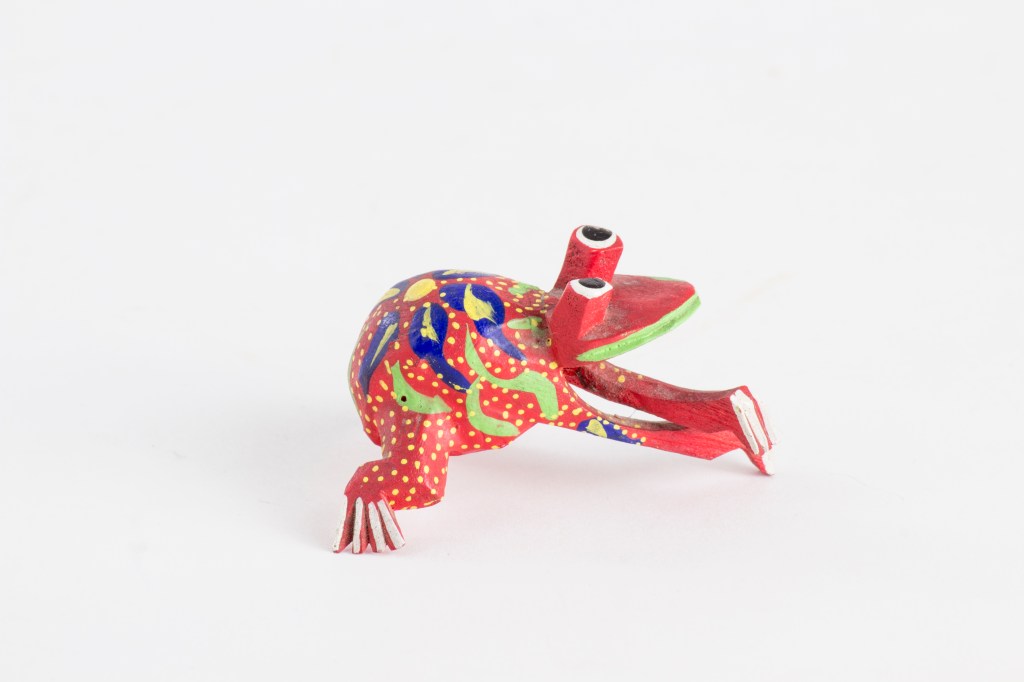
Source: Frog artefact collection of Seema Bhatt

While researching for an exhibition on frogs, I discovered a wealth of fascinating facts and beliefs about creatures that we don’t often give a second look, let alone a second thought to—frogs and toads.

The human imagination, has over eons, cast and recast frogs and toads in legends, and beliefs. They appear in the stories and myths of almost every human culture, taking on almost every role conceivable, from the trickster, to the devil, to the mother of the universe.

In many traditions around the globe, frog is generally associated with the water element and it symbolises cleansing, renewal, rebirth, fertility, abundance, transformation, and metamorphosis in different cultures.

In ancient Egypt, the frog appears as a symbol of fertility, water, and renewal. The water goddess Heket often appeared as a woman with the head of a frog. Frogs were also the symbol of the midwife goddess Heqit, who ruled conception and birth, and Egyptian women often wore metal amulets in the form of frogs to enlist her good favour. Ancient tribes in Central America worshipped a goddess known as Ceneotl, the patron of childbirth and fertility, who took the form of a frog or a toad with many udders.

This association with fertility was also ecological. Every year the flooding of the Nile provided water and brought rich silt to grow crops; at that time frogs also proliferated in such huge numbers that the frog became a symbol for the number hefnu, which meant either 100,000 or simply “an immense number.” Thus the frog’s association with water and fertility, so important for life, made them positive symbols, 

Frogs and toads were also considered to be spirits of rain, and were used in many rituals intended to invoke the rains. The Aymara tribe of Peru and Bolivia made small frog images, which they placed on hilltops, to call down the rain. Indeed, if the rains failed, some tribes blamed the toads for withholding the rain, and would lash them in punishment.

In India it is believed that the ‘singing’ of frogs indicates that the rains have come and it is a time for celebration, while the silence of the frogs means that nature and the Gods have forsaken man. In some parts of India frog weddings are held with rites and rituals, and celebrated with feasts to invoke and appease the rain gods, especially in times of drought.

In Ancient China images of frogs were found on the drums used to summon thunder and much needed rain.

Frogs feature in the myths of many Native American tribes. In some they represent transformation and growth, while in others they are associated with springtime and renewal. They are believed to have healing powers and are considered medicine animals. In the shamanistic traditions of some of these cultures, hallucinogenic compounds derived from frogs and toads are used for religious rituals of communion with the spirit world and self-transcendence.

Thus most native cultures revered frogs and toads, as they did all forms of life, and recognised that these were all intrinsically linked with the elements of nature and each other. However in later periods and cultures, the “strange” appearance of frogs and toads with their awkward form, huge eyes and croaking calls evoked fear and a sense of eerie mystery. Folklore from medieval Europe depicted toads as evil creatures whose blood was a potent poison and whose body parts had unusual powers. Toads were commonly seen as evil spirits who accompanied witches, assisting them in their evil designs, and providing poisonous ingredients for potions. Many myths were perpetuated around toads. One widely held myth concerned the Toad-Stone, a jewel that was supposed to be found inside the toad’s head. According to myth this jewel, placed in a ring or a necklace, would heat up or change colour in the presence of poison, thereby protecting the wearer from foul play. Such references are even to be found in some of Shakespeare’s plays.

In many ancient Chinese tales and legends also, the toad is a trickster and a magician, a master of escapes and spells. Some Chinese tales refer to the toad whose face is believed to be visible at the full moon; and they believe that it is this moon-toad that occasionally swallows the moon, causing eclipses.

But the Chinese also believe that that toad is the keeper of the real, powerful secrets of the world, such as the secret of immortality. There are several legends that reinforce this belief. One is about a wandering wise man called Liu Hai and his three-legged toad companion Ch’an Chu who knows the secret of immortality, and who reveals this secret to the wise man who befriends him.

This awe of the benevolent magical powers of frogs and toads is seen in most oriental cultures. In China the frog is a symbol of good luck. The Frog spirit Ch’ing-Wa Sheng represents prosperity in business and healing. Frogs and toads also signify protection. The Chinese Danwu, or Dragon Boat Festival was traditionally celebrated to ward off diseases and plagues for the coming year. Several symbolic creatures are worshipped on this day for protection against evil spirits, and ill health, among which the three-legged toad Ch’an Chu is significant.

In Japan frogs are very auspicious. The Japanese word for frog is kaeru. Kaeru also means “return”. Travellers carried bring a frog amulet on their journey as this was believed to secure a safe return.

Thus have frogs and toads captured human imagination since time began. It is also these myths and beliefs that reminded humans of the vital role that even the seemingly insignificant creatures play. But with the march of “progress” and as humans have been relentlessly destroying the habitats of uncountable, and as yet unaccounted for, living things we are losing much more than species. We are losing the essence of what makes our lives rich and meaningful. Who will populate our mythologies when these creatures are gone? Perhaps we will be left with only one story: the story of loss.

–Mamata
Of Logs and Constants…

I grew up believing that there were three pillars on which every middle-class household was built: a dictionary, an atlas, and the Clark’s table!

Our household dictionary was a Chambers with a hoary history (see https://millennialmatriarchs.com/2021/04/13/silver-tongued-orator-of-the-british-empire/). My father would often read out to us, and such occasions were always punctuated with me or my brother being asked to go and fetch the dictionary when we came across a difficult word. I am not sure why we did not bring the dictionary along with the story book, in the first place. It might have saved the interruptions. But I don’t recall we ever did that.

One of the tasks my father set us was to open the dictionary as close to the word being searched as possible. He maintained that one should be so familiar with the dictionary that we should have a good feel of where a word would be. For instance, if the word we wanted to look up was ‘signet’, at first go we were expected to open the book somewhere between ‘se..’ and ‘so..’. And as we progressed, within a few pages of the word.

The newspaper was generally the trigger for referring to the Atlas. I was a reluctant and late newspaper reader. And I think my father’s well-intentioned efforts to ask me to find obscure places and landmarks mentioned in the day’s news as part of the exercise only intimidated me and put me off newspapers even more. Political maps were a little more comprehensible than the physical maps, but neither was my comfort zone.

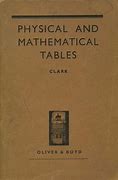
The Clarks Table was the third pillar. This was called for at frequent intervals when my father needed to look up any constant, any formula, any log. Being a small book, it had the tendency to get mislaid, unlike the dictionary or atlas which had their own set places. So as I recall, I spent more time looking for the Clarks Table, than into it. As we grew up and were doing our homework, if the Clarks Table was on the study table, it seemed to reassure our parents that we were seriously at work. It being the era before parents got too hands-on with regard to studies, it was a useful ploy!

Of the three, the Clarks Table was the least ubiquitous, probably confined to families who had serious science students. But my father would be sad when he came across any household which did not have all three. I have no idea what kind of conversations could possibly take place during social home-calls (frequent when we were young), which would veer around to the need for calling for the Clarks, but they did seem to happen. Because my father would often return from a friend’s house clearly saddened by the fact that there were households which did not have all these books. It was not that he was being judgmental, but he felt in his heart the disappointment that some people were being deprived of access to true knowledge!

And I let him down! Soon after we got married, my father visited us in Ahmedabad. He was there to present a paper at a scientific conference and was going over some calculations. At around 7 o’clock in the evening, he asked me for a Clark’s. And I did not have one! He was fairly taken aback, though he sought bravely to mask his disappointment. Not only had I let him down, but Raghu, a serious academic not caring to have the Tables in the house (never mind that Raghu was a professor of Finance, not math or science)!  We went out and bought one the very next day, but alas, we could never quite make up!

I am sadly not able to find out much about the history of the Clark’s Table. Apart from the fact that it is now published by Pearson, and edited by Tennent, and that it ‘..contains tables with information about topics like squares, square roots…, and all the necessary data for reference purpose for science students’.  I am not able to find any clue as to who the meticulous Mr. Clark was, and how the book was put together and when. And who is Mr. Tennent who has edited this? I am sure there must be lots of interesting stories about all this, but no information is available to the casual reader.

I would surmise from the fact that the older editions were brought out by a Scottish publishing firm called Oliver and Boyd, that Mr. Clark was Scottish. The firm was established in 1807 or 1808, and started by publishing books for young people, as well as abridged histories and songbooks. When the next generation took over from the founders, they established themselves very strongly in educational publishing, especially medical textbooks, and had a strong presence in British colonies. The firm wound up in 1990.

I suppose that in today’s world, we don’t need such reference books anymore. But being old-fashioned and with the conditioning I have, it remains a constant in my life that good education stands on the foundation of three books I can touch and feel!

–Meena

Smiling is Infectious

Among the many “pick-me-up” messages that are circulating these days is a poem that exalts the magical power of a smile. The poem is attributed to Spike Milligan, a British comic poet, actor, playwright and author. The son of a British military officer, Spike Milligan was born in Ahmednagar and spent his growing up years in India, and this is reflected in several of his poems.

I have always enjoyed his tongue-in-cheek poems, but I had not seen this one before.

Smiling is infectious

You catch it like the flu

When someone smiled at me today

I started smiling too

I walked around the corner

and someone saw me grin

When he smiled I realised I

I’d passed it onto to him.

I thought about the smile

And then realised its worth

A single smile like mine

Can travel across the earth.

So if you feel a smile begin

Don’t leave it undetected

Let’s start an epidemic quick

And get the world infected.

When I read this I thought that it was a bit ironic, and somewhat contra indicatory in these times when all our smiles are tucked away behind our masks.

So here are some alternate lines for the times, that I have penned.

Thanks to Spike Milligan (an old favourite) for the inspiration!

.

Sneezing is Infectious

Sneezing is infectious and coughing is contagious too,

It can spread the virus that is way wickeder than the flu.

When someone simply smiled at me today, even behind their mask,

I drew back in terror and turned my face; “Such rudeness?” let them ask!

I walked around the corner, and there before my eyes

I came upon an unmasked group of goodly size.

I had to other way but to pass them by, but I was filled with tension

What was floating through the air, and spreading the infection?  

I thought about the virus and how deadly it can be

And realised how fast it spreads and offers itself for free.

A conversation, a slogan, or a song can spread it far and wide

Crossing every boundary, and respecting no identity nor side.

So if you feel a sneeze begin don’t leave it undetected

Isolate, test, and quarantine; always stay protected.

Wash your hands like Lady Macbeth, and mask up like the Lone Ranger

Let’s restrain and refrain, so that we can live to smile again without danger.

Who would ever have imagined that there would come a day when we would not encourage people to “Be Positive” and instead wish that they “Stay Negative”!

Stay safe. Keep smiling–behind that mask!

–Mamata

Living the Senior Life…

It starts with your mornings…

When you are in your teens and twenties, its all about lotions and potions.

Then, somewhere in your thirties you figure that you must have soaked almonds every morning. So there is one little bowl that makes its appearance on the kitchen platform–on the evenings you remember to soak them. And then of course, simultaneously you start warm water with lemon and a dash for honey. These two things before morning coffee become the routine.

But then the 40s and the 50s happen.

And you slowly add:

  • Maybe methi seeds
  • Maybe garlic
  • Maybe wheatgrass powder
  • Maybe chia or sabza seeds
  • Maybe karela juice
  • Maybe ghia juice
  • Maybe moringa powder
  • …….

Till your kitchen platform groans under the weight of all the little bowls of assorted items soaked every night.

And you set your alarm earlier and earlier, so you take each of these (which is supposed to be taken on an empty stomach), with at least 15 minute intervals.

And then you re-do your lighting..

Lighting in the house of course had to be yellow. How show-roomish and horrible were white tubes! A complete no-no.

And then comes a time, when room by room, socket by socket, you retro-fit with white tubes of the highest wattage you can get. Till only the drawing room and the dining room are left with their soft, subtle yellow lights.

And even then, you give up reading the comics page in the papers because you can’t make out the words for the smudges.

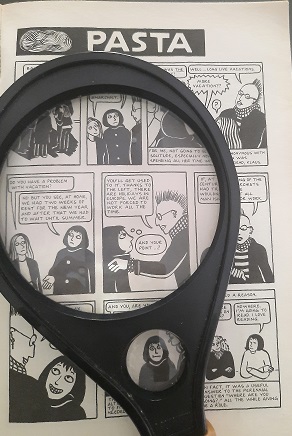
And when someone speaks of Graphic Novels, you quietly go and Google what on earth that is. And then, when you read rave reviews of one, debate within yourself if you should attempt to read it, and not fully convinced, still procure a copy. To find that even under the newly-installed white lights, you have to read the 374-page novel with a magnifying glass.  (I did it! The novel was ‘Persepolis’ by Marjane Satrapi. Well worth it, but I don’t think I can read another one unless they come out with a large-print edition!)

And then your exercise routines and paraphernalia change…

From worrying about the best cross-trainer and home gym equipment, you are looking for the best knee-braces and neck-collars.

And you set up a hunt for your grandkid’s discarded Montessori toys which helped them develop fine-motor skills at two years old, to keep your arthritic fingers limber at 60 years old.

When you start up an elaborate yoga and stretching routine—only to find that the asanas recommended for your weak knees, are contra-indicated for your cervical spondylosis.

And your routine adds on more and more exercises for newly emerging stiff joints and aches and pains, till it seems to take up almost half the day!

And you sadly realize

That from lotions and potions

It is now all about decoctions and concoctions.

And though you may have avoided Morning Sickness

There is no way you can avoid Morning Stiffness.

Such is the Senior Life!

–Meena

The Mother of the Rhymes

Meena’s piece last week on nursery rhymes set me thinking. How is it that one clearly remembers most of the rhymes that one had heard and learnt when one was between 2 and 5 years of age, while many poems ‘learnt by heart’ subsequently do not seem to pop up as effortlessly? Why is it that the minute I see a toddler, I can’t resist the playing the silly  little game of Johny Johny Yes Papa, or This Little Piggy Went to Market? This is not the case with just English nursery rhymes, but equally with the Gujarati rhymes that I heard as a child. We may not have understood the words, (and often the words themselves were nonsensical), but it was the repetitive rhythm and rhyme that frolicked and danced in the head till they were firmly entrenched for life.

Today many studies have shown that nursery rhymes are very powerful influencers in early childhood development and education. At an age when children have limited attention spans, the brevity and repetitiveness make them fun to recite again and again. In the process, children develop the practice of listening and speaking; their ears and tongues become sensitive to the rhythm and patterns of language, and their vocabulary is enriched. Experts in literacy and child development have discovered that if children know eight nursery rhymes by heart by the time they’re four years old, they’re usually among the best readers by the time they’re eight.

Thinking about nursery rhymes also led me to remember that as children our nursery rhyme books were titled Mother Goose’s Nursery Rhymes. While Meena discovered the  curious origins of some popular rhymes, for hundreds of years it was thought that all the popular nursery rhymes were written by an author called Mother Goose. Over the years scholars tried to find out who exactly was this Mother Goose?

Mother Goose is so old that no one knows for sure whether she was a real or a fictional character. There are several legends, dating back to the tenth century, related to this character. One theory is that she was based on an actual person—the second wife of King Robert II of France who was nicknamed Queen Goose-Foot because of her misshapen feet. Her real name was Bertha of Burgundy; she was also known as Berthe la fileuse (Bertha the Spinner) as she was believed to be a wonderful storyteller, spinning tales that enraptured children, though she did not have children of her own. But historians have said that this is but a legend and not a fact.

The character of Mother Goose seems to have made her first appearance when French author Charles Perrault published a collection of rhymes and tales inspired by the old oral traditions of French and European folklore. The collection, in French, included rhymes as well as the classic fairy tales like CinderellaSleeping Beauty, Puss in Boots, and Little Red Riding Hood. The book, published in 1697 under his son’s name, was titled Tales and Stories of the Past with Morals (Histoires ou Contes du Temps Passé). It was subtitled Tales of Mother Goose (Les Contes de ma Mère l’Oye). And it became known by this subtitle. Perrault’s publication is believed to be the first authenticated starting-point for Mother Goose stories.

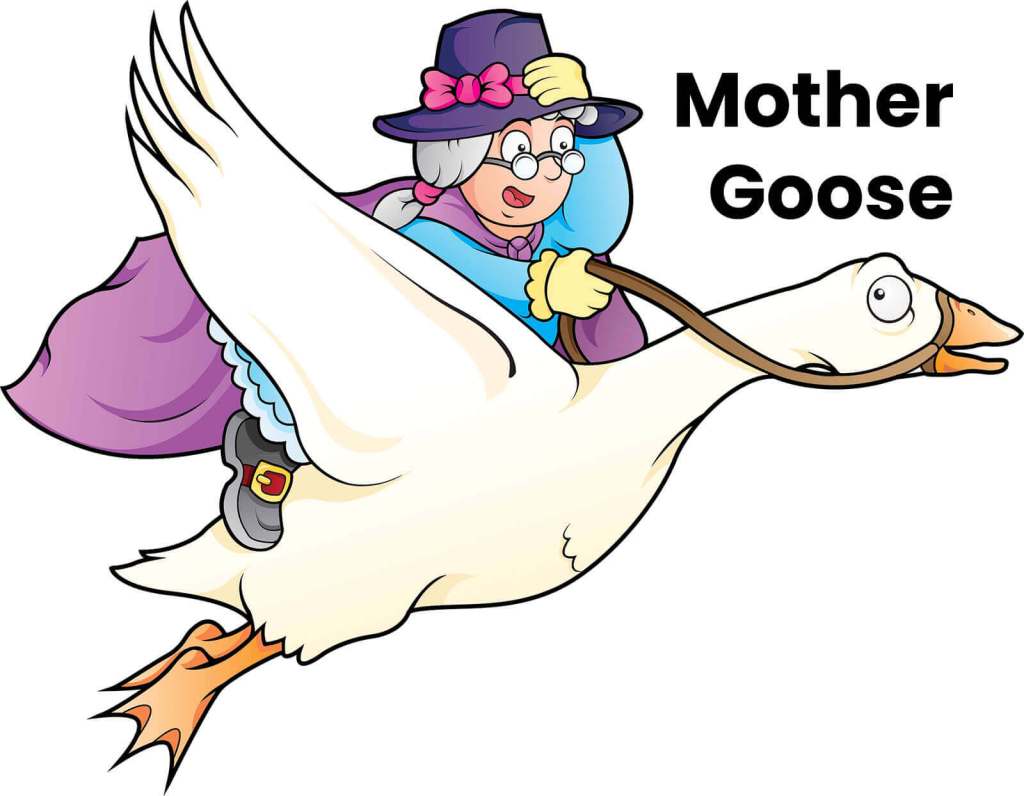
The English-speaking audience was introduced to Mother Goose through the translation of Charles Perrault’s book by Robert Samber.  First published in 1729, the book was titled Histories of Tales of Past Times Told by Mother Goose. The illustration on the cover of the English edition of the book showed an old woman telling tales to a group of children under a sign that says “Mother Goose’s Tales.” Some say this art is what started the Mother Goose legend. In subsequent editions and publications she was also depicted as a sweet elderly woman who magically travelled on the back of a gander or male goose. Thus the only rhyme in which she appears as a character goes

Old Mother Goose
When she wanted to wander,
Would ride through the air
On a very fine gander.

Somehow, over time, the sweet old lady metamorphosed into the legendary human-sized goose with thick glasses and a bonnet. 

Mother Goose was not widely known in America until after 1786 when a publisher Maby Isaiah Thomas reprinted Samber’s book under the same title. But this gave rise to another theory that the original Mother Goose was an American lady from Boston whose name was Mary Goose, and who used to sing ditties to her grandchildren and other children. The legend spread and her grave became a tourist attraction, where visitors toss coins, even today, for good luck!

Whether fact or fiction, Mother Goose has been synonymous with childhood rhymes for generations, and remains popular even today. So much so that in America, 1 May is celebrated as Mother Goose Day. This started in 1987 when a book titled Mother Goose: From Nursery to Literature, tracing the history of the character’s evolution was published. This day reminds yet another generation of parents of the continuing magic of rhymes.

In naming a national day as Mother Goose Day, America has recognised the value of rhymes in child development, and uses this day to remind parents and educators of this. This is with specific reference to the well-known and popular English rhymes. Perhaps we should take a cue from this and also recall, as well as revive, the great wealth of traditional rhymes in our own regional languages. Sadly many of these have been part of the oral tradition, passed on from generation to generation; many have not been compiled and published. And with the craze for everything “English medium” our children are rote learning only English rhymes from Mother Goose. In the age of nuclear families and YouTube offerings, it is sad that young children today are missing out on rhymes in their own language. If only every child could have a Nani Goose or Dadi Goose to enrich and enliven their life and language. 

–Mamata


Srinivasa Ramanujan: A Book and A Movie

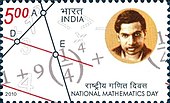
April 26th marked the 101st death anniversary of one of 20th century’s greatest mathematicians, Srinivasa Ramanujan. By coincidence, I was finishing ‘The Indian Clerk’ by David Leavitt at just about this time. And then went on to watch ‘The Man Who Knew Infinity’.

When it comes to the book, even with its various digressions, the mystic mathematical genius of Ramanujan comes through. The trials and tribulations of lower-middle class lad from the deep South of India, steeped in religious tradition, totally unprepared for the England of the 1910s, are heart-rending. The mathematical genius is an uncomfortable social being–moody, vulnerable, lonely, awkward, under-confident. Never mind food for the heart and soul in terms of companionship and friendship, he does not have enough food to keep in good health. First his strict vegetarian regime and various taboos make it imperative to cook for himself. But more seriously, as the First World War breaks out, he does not even get basic rations, vegetables and fruits. This, coupled with the cold, had lasting impacts on his health, which not only led to serious bouts of illness and hospital stays, but his tragically untimely death at the age of 32.

Away from anything familiar, longing for his wife, and with only a few Indian friends, how lonely life must have been!

But whatever the body, the heart and the soul missed, the mind just went on! And in Prof Hardy who was instrumental in bringing him to Cambridge, England, he had an intellectual companion, albeit they did not always agree on ‘ways and means’. Ramanujan’s refusal to provide systematic proof for his intuitive mathematical assertions led to many an argument. His insistence that his mathematical claims and insights were written on his tongue by the Goddess Namagiri irritated and baffled Hardy.

Ramanujan’s legacy was in the form of 37 published papers, as well as three notebooks and a ‘lost’ notebook (discovered only in 1976) with approximately 4,000 mathematical claims, most without proofs. Almost all of these have now been proved, in the century and more after his death. They continue to inspire modern-day mathematics and expand its boundaries.

I got a sense of all this from the book.

Coming to the movie, starring Dev Patel as Ramanujan, I found it sadly unsatisfying. To begin with, I could not reconcile the tall, debonair and poised Patel with my image of the short, stout, badly dressed and awkward Ramanujan. However good the actor, there have to be some physical similarities. It cannot be that the first Indian at hand is cast in a movie with an Indian protagonist. Ben Kingsley’s looks were as important as his acting, in bringing the Mahatma to life.

And then, small trivial details about life and mores in Tamilnadu of a century ago. Just a little fact-checking could have made it so much better.

Though both are for a general audience and cannot by definition get into too much math, of course a book can deal a little better with math than a movie can. So there is that too.

Both play up the ‘saas-bahu’ drama between Ramanujan’s mother and wife to the hilt, the movie a little more sympathetic to the MIL than the book.

All in all, worth it for anyone to spend some time on. It will surely awaken a sense of wonder about the unimaginable achievements of a short life—not only blazing paths that no Indian had trod, but impacting the course of mathematics for times to come. And give a sense of genius which is beyond rational explanation.

‘Man Who Knew Infinity’ by Robert Kanigal, is a more serious, and hence somewhat heavier read. There is also a movie titled ‘Ramanujan’, which I have yet to see.

–Meena

Hope in a Time of Despair

April has been the “cruelest month” as TS Eliot wrote in The Waste Land.  As we are swept and tossed in the tsunami of the pandemic; as numbers take on names and faces; as we find ourselves struggling to take each step in the dark tunnel which seems no have no light at its end, we are engulfed by despair.

Now more than ever before we feel the need to reach out, to connect, to be reassured that we are not alone. A time when we seek words that offer solace and hope.

While we feel alone and helpless in these grim times, may we get some comfort from these wise words.

They were written by Muriel Rukeyser, an American poet, playwright, biographer, children’s book author, and political activist. For Rukeyser, poetry was the strand that encompassed both science and history, that of the past and of the present. In the introduction to her 1949 book of essays The Life of Poetry she writes:

In times of crisis, we summon up our strength.

Then, if we are lucky, we are able to call every resource, every forgotten image that can leap to our quickening, every memory that can make us know our power. And this luck is more than it seems to be: it depends on the long preparation of the self to be used.

In time of the crises of the spirit, we are aware of all our need, our need for each other and our need for our selves. We call up, with all the strength of summoning we have, our fullness. And then we turn; for it is a turning that we have prepared; and act. The time of the turning may be very long. It may hardly exist.

In this moment when we face horizons and conflicts wider than ever before, we want our resources, the ways of strength. We look again to the human wish, its faiths, the means by which the imagination leads us to surpass ourselves.

If there is a feeling that something has been lost, it may be because much has not yet been used, much is still to be found and begun.

Now, when it is hard to hold for a moment the giant clusters of event and meaning that every day appear, it is time to remember [poetry], which has forever been a way of reaching complexes of emotion and relationship, the attitude that is like the attitude of science and the other arts today, but with significant and beautiful distinctness from these — the attitude that perhaps might equip our imaginations to deal with our lives — the attitude of poetry.

However confused the scene of our life appears, however torn we may be who now do face that scene, it can be faced, and we can go on to be whole.

With these words, remembering two dear friends with whom one had exchanged, over many years, so many words of joy and sorrow; comfort and excitement; wonder and wisdom, and much more. You will be sorely missed.

–Mamata

Rhymes for the Times

In times such as we are passing through, poetry is catharsis; it is a way to share emotions and feelings; it represents the triumph of creativity even in difficult situations; it brings a ray of hope and humour, albeit often black.

And so naturally, there have been thousands of poems on COVID all over print media and social media. In fact, the Washington Post focused its annual kids’ poetry writing competition on Corona this year, with “Poetry of the Pandemic” as the theme of their 2021 poetry contest.

Corona Poetry has taken such proportions that there are several appeals against more of the genre.

So this piece will now stop talking about Corona and move on to trivia about other well-known nursery rhymes.

A widely-held belief—though some scholars disagree—is that ‘Ring-A-Ring of Roses’ has its origins in another pandemic, the Great Plague. The ‘roses’ are the red rashes which are a symptom of the disease; the ‘posies’ are the herbs that were carried as a protection against the infection; and the ‘Atishoo, atishoo’ (which at least in my childhood version became ‘husha-busha’!) represents the final sneezing before falling down dead.

But moving on to some poems with non-pandemic associations:

The rhyme ‘There was a little girl, who had a little curl’ is believed to have been written by the famous American poet Henry Wadsworth Longfellow for his daughter Edith, on a day she was throwing tantrums about having her hair curled. Well, I suppose that is the difference between poets and others—most parents’ reaction to a tantrum is a raised pitch rather than a rhyming verse!

‘Humpty Dumpty’ is very ancient and there are variants all over Europe. This is obviously a riddle whose answer is ‘egg’, but seems to have lost that connotation, especially as most illustrations of the poem clearly show an egg, not leaving any suspense.

‘Tinker, tailor, soldier, spy’ is played with counters, and is supposed to indicate what the child will become when it grows up.

The historical event of the Norse King Olaf destroying the London Bridge in the 11th century probably gave rise to the popular ditty ‘London Bridge is falling down’.

Children across the world wistfully recite ‘Rain, rain go away’ when downpourings stop their games. The poem’s origins go back to ancient Greece, and it is supposed to be a charm to keep rain away.

‘Little Miss Muffet’ was probably written  Dr. Thomas Muffet, an entomologist of the 16th century, who was fascinated by spiders for his daughter Patience. ‘Incy winsy spider’ or ‘Itsy bitsy spider’ the other popular spider-verse was first published around 1910, thought it may be older. It is a ‘finger song’ and children mimic the actions of a spider climbing up and down.

A popular poem about an insect is ‘Ladybird, ladybird fly away home’. It is to be recited when a ladybird lands on your hand or arm, as harming these creatures is supposed to bring bad luck.

 ‘This little pig went to market’ is a toe game played with toddlers while counting off their toes.

While the origins of many nursery rhymes is speculative, the author of ‘Twinkle, twinkle little star’ is known definitively to be Jane Taylor, who published this in 1806. She and her sister Ann were popular nursery-rhyme writers.

And to end, a story about a poem which is not very popular today.

Three wise of Gotham

Went to sea in a bowl.

If the bowl had been stronger

My story would have been longer.

It does not rhyme particularly well, and sounds pretty abrupt. But the origin-story is very interesting. Apparently, in England during the reign of King John (about 800 years back), when the King passed through any road, that road became a public road. Now the King on one of his journeys planned to pass through the village of Gotham. The citizens of that village did not want their village road to become a thoroughfare. So they came up with a strategy. They all decided to start acting completely silly when the King’s advance party came around. So some went in pursuit of a cuckoo, and spread the word that they were doing it to capture it and hence have perpetual summer. Others tried to drown an eel in a pond. The King’s guards were convinced that the villagers were all mad, and advised the King to change his route, which he did. So the ‘mad men’ were actually wise, and saved their village.

If only we could strategize, cooperate and subvert the more unreasonable of the plans of our rulers like this!

–Meena

Maria and her Magic Mushrooms

Source: psychedelicreview.com

I recently read a beautiful poem and I was curious to know more about the poet Maria Sabina. I assumed that she would be a modern poet, but what I discovered was a fascinating story. 

María Sabina Magdalena García was born over a century ago in a community of Mazatec, an indigenous people of Mexico who live in Oaxaca in southern Mexico. Maria Sabina spent her entire life in the remote village of Huautla de Jiménez, up in the Sierra mountains in this area. Maria Sabina belonged to a family of traditional curandera (healers) and shamans. Among many indigenous peoples the healer or shaman has a very important function in the community. It is believed that these healers communicate with this world and that of the gods, and thus have the ability to cure both physical and spiritual conditions, and even predict the future.

The healing ceremonies of the Mazatec included the use of hallucinogenic mushrooms (which they called “holy children”) as a method of contact with divinity. It is said that when Maria was just eight years old she and her sister were sitting under a tree when they noticed some of these mushrooms growing wild, and ingested them. The little girls had a terrifying hallucinatory experience, but during this Maria heard an otherworldly voice that told her about some herbs that would cure her uncle who was very sick at the time. She followed the instructions about where to find these, and the herbs cured her uncle.

The young girl became known in the village as a sabia or wise one. Maria seemed to have intuitively developed a knowledge of the ancient Mazatec rituals and the healing power which was attributed to the ritual intake of a particular species of fungi (Mexican Psilocybe) which grow only in mountain range of Sierra Mazatec.Thus began Maria’s lifelong use of ‘magic mushrooms’ for special healing sessions known as velada. Local people visited Maria not only to be healed physically, but also for spiritual guidance. Under the influence of the hallucinogenic mushrooms she guided the patients through out-of-body experiences that revealed the cure for the illness. She claimed that the mushrooms produced wisdom in her; as she said much later in life “I am the woman who looks inside and examines.”

Maria was totally dedicated to her healing ceremonies with mushrooms that included ritual chanting, tobacco smoke, consumption of mescal (an agave plant), and ointments extracted from medicinal plants. Therapeutic laughter was also a part of the ceremony. The rituals were conducted at night because it was believed that the healer was guided in the journey by the stars. The veladas were held purely for medicinal purposes, to purge illness and heal the sick.

Maria Sabina would have continued to live her life as the local curandera and sabia in her remote mountain village, and she and her practice of magic mushrooms or “holy children” as she called them, would have died unknown to the outside world. But destiny had planned another ending to her story.

In the early 1950s, an American Robert Gordon Wasson and his wife who were interested in ethnobotany were looking at the use of hallucinogenic plants in the rituals of indigenous groups in different parts of the world. As they were travelling in the Mazatec Sierra region, they heard of a famous healer of Huautla. In 1955, they travelled to the remote mountain village, and to gain access to her, pretended that they had come to be treated by Maria Sabina. As a curandera, Sabina would never deny a request for help. By then she was already in her sixties and her ceremonies were not known outside her immediate area. She conducted several veladas using the mushrooms with the foreigners, who also documented the entire experience in photos and recordings. When they returned, they also took back with them samples of the fungi which was identified as Psilocybe Mexicana. The fungus was cultivated in Europe and its primary ingredient, psilocybin, was isolated in 1958 by Albert Hofmann, the discoverer of LSD.

In 1957 Life magazine published an article which chronicled the Wasson’s experiences with Maria and her magic mushrooms. Maria Sabina became famous; people from all over the world began to visit her. By the mid-sixties, at the height of the hippie culture, there was a deluge of visitors to Huautla de Jiménez–media, tourists, artists, intellectuals, anthropologists, researchers, and celebrities (including among others, John Lennon, Walt Disney. Aldous Huxley, and Carlos Castaneda). Sadly, many of these visitors were interested purely in getting high on the magic mushrooms, and psychedelic recreational pursuits, and were disrespectful of local culture and traditions. The wanton rush to gather the mushrooms also eroded the delicate ecological balance of the mountain slopes and forests.  

The unwanted attention completely altered the social dynamics of the community and threatened to destroy an ancient Mazatec tradition. The people of Huautla de Jiminez put the blame on Maria Sabina and accused her profiting from their tradition. Villagers attacked and tried to burn down her house several times; they tried to run her out of the village. The police accused her of being a drug dealer. Maria Sabina was ostracised by her community.

Interestingly, she accepted her fate as if it were pre-determined and had been told to her during one of her ceremonies. But she regretted that she had opened up the ceremony for a foreigner, and felt that the sanctity of the velada had been irredeemably desecrated by the recreational use of her “holy children”. She realised that From the moment the foreigners arrived, the holy children lost their purity. They lost their force. They ruined them.” Later in life she became bitter about her many misfortunes and how others had profited from her name. She spent her last years in abject poverty and malnutrition, and died in a hospital in 1985 at the age of 91 years.

While she may have later attained notoriety for her magic mushrooms, María Sabina is regarded as a sacred figure in Huautla. She is also respected and honoured as one of Mexico’s greatest poets.  She did not know how to read or write; her verses were either spoken or sung like chants in her native dialect. She said that it was not her words that she expressed, but the voice of her ninos santos or holy children who spoke through her. She claimed to see the mushrooms as children dancing around her, singing and playing instruments. She was simply their interpreter and she treated them with great respect. She added cadence to her words and expressed them with her entire body. Her chants were first translated from her native Mazatec into English and, only later, into Spanish.

Sharing the poem that led me to this incredible story.

Cure yourself with the light of the sun and the rays of the moon.
With the sound of the river and the waterfall.
With the swaying of the sea and the fluttering of birds.

Heal yourself with mint, with neem and eucalyptus.

Sweeten yourself with lavender, rosemary, and chamomile.

Hug yourself with the cocoa bean and a touch of cinnamon.

Put love in tea instead of sugar, and take it looking at the stars.

Heal yourself with the kisses that the wind gives you and the hugs of the rain.

Get strong with bare feet on the ground and with everything that is born from it.

Get smarter every day by listening to your intuition, looking at the world with the eye of your forehead.

Jump, dance, sing, so that you live happier.

Heal yourself, with beautiful love, and always remember: you are the medicine.

Today is Earth day. What better way to celebrate than to savour these words and make them our mantra for life and living.

–Mamata

High-tech Barriers to Heritage

In between the first COVID wave and the second ongoing one, we were tempted to get a little adventurous. We scouted around for sites which we could visit on day-trips.

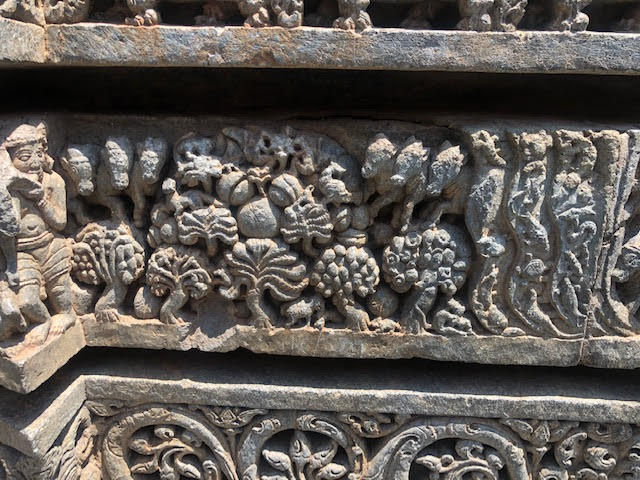
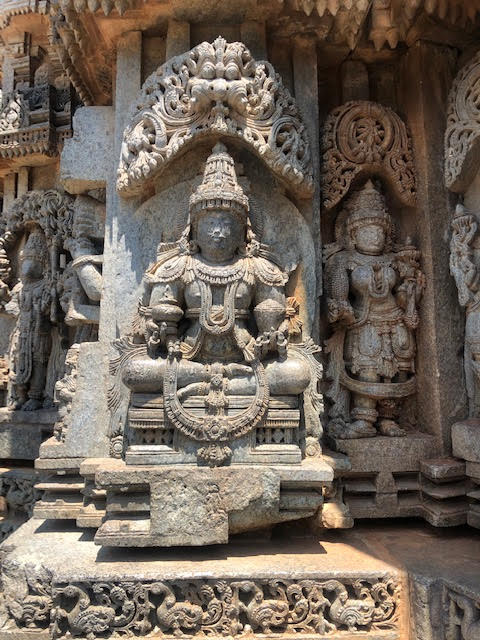
It is in this process that we got to know about a beautiful Hoysala-style temple situated in Somanathapura, which lies about 130 kms from Bangalore. This is the Chennakeshava Temple built by the Hoysala commander, Somanatha, in 1268 A.D.

And we made our way there with some friends.

It is an astounding structure, made completely of sandstone, with the most intricate carvings, built at the peak of Hoysala architectural excellence.

Chennakeśava means ‘handsome Keshava’, and the temple is dedicated to three forms of Vishu—Keshava, Janardhana and Venugopala. The main temple is on a star-shaped platform with three garbagrahas, each dedicated to one on the three forms. Besides this, there are 64 corridor shrines, set in magnificent pillared corridors. The main temple is surrounded by a pradakshina patha, all along which are carvings from the Ramayana, Mahabharata, Bhagavata Purana etc., which unfold as one undertakes the pradakshina.  The ceilings are decorated with intricate sculptures depicting different stages of the unfolding of a lotus. The massive stone pillars supporting the inner shrine were turned in ancient animal-drawn lathes.

The temple took several decades to build, but was in worship for only 60-70 years before it was sacked by invaders. Since the statues and the structure were defaced and broken, worship could no longer take place there, as per tradition.

It is a wonder that such an old and disused structure still stands in such good shape today—it is nearly 700+ years after it stopped being an active temple. It is in the hands of the Archaeological Survey of India (ASI), and one must appreciate their efforts to have the site in such good shape, standing in such well-maintained grounds. Even the toilets are fairly functional and clean.

But….

And it is a big BUT.

It is plagued by some problems which many of our heritage sites suffer from. For instance, we did not see a single signage anywhere on the roads telling the passers-by of the existence of such an amazing monument close by. Or to direct those who were looking for it.

Within 25 kms of the structure—leave alone on or near the premises—there is not a decent restaurant or even a picnic ground for those who had their own food.

But for the first time we came across a tech-challenge in such a place!

When we reached the gates of the monument and looked around for a ticket window, there was none. Instead there were a few flex posters, informing us of the rates (Rs 20 for online tickets), and a barcode to scan and pay. There were about six groups of tourists, all desperately trying to scan but no one was successful. After about five minutes, the helpful security guard came up to us and told us that it was not working. He suggested we should try to log into the ASI site, pay online and get our tickets. We all tried dutifully. But the signal was at best patchy and the site slow. My friend could get in. The names of each one of the group had to be entered. And the Aadhar or PAN of the person doing the booking. When she tried to pay, it got into a loop which there was no coming out of. We looked around, and many other people were in the same soup. We asked the Guard if he could not just take the money and give us tickets, but he told us that was not allowed. By this time, one person from another group was successful in getting his ticket from the ASI site. So using typical Indian jugaad, we begged him not to exit, but to do our ticketing online, and that we would pay him the Rs. 20/head in cash. He obligingly did this for some of us.

The whole process took us about 20 minutes and was pretty stressful.

And then we went in to visit the monument. Which fortunately was amazing enough to make it all worth while.

But it left us wondering what the point was. Does anyone who wants to visit a heritage site HAVE to have a smartphone? In a country where literacy, let alone digital literacy, is not to be taken for granted, should lack of these prevent a person from such basic access (never mind that it is a barrier even to COVID vaccination!). Is there an inherent age-discrimination–many older people are uncomfortable with all these scan-and-pay modes.  If the wifi does not work at a site, are people to go back the 150 kms they came to visit the monument? And why is the name of every visitor needed for buying entry tickets? Why is Aadhar or PAN information needed? Where does this information go, and what becomes of it?

If the purpose of technology is to make life easier for citizens, then this is surely not the way! The system is good in that it provides a nudge for digital payment (if you scan and pay it is Rs. 20, and if you could buy a physical ticket it is Rs. 25 per ticket). Nudges are good for bringing about behavior change. But taking away options is discriminatory and against basic rights. As is seeking information which is not relevant to anything!

Why does something like a visit to our own heritage sites have to become a battleground about rights?

–Meena