A Shout-out for the Environment: NEAC

India has always been a little ahead of the curve in its thinking about environmental issues. Four decades ago, it recognized that raising public awareness and educating key target groups as well the future generations on environmental issues, were key to a sustainable future. It designated a Centre of Excellence in this area way back in 1985–viz the Centre for Environment Education.

In 1986, the Ministry of Environment and Forests (as it was then) launched another unique initiative called the National Environmental Awareness Campaign (NEAC). The unique feature of this was that it called upon various types of organizations to plan their own Environmental Awareness programmes for their own local communities or other target groups, and implement them with the support of small grants from the Ministry.

Every year, NEAC started on Nov. 19th. Nov 19 to Dec 18 was marked as Environment Month in the old days in India—Nov 19 being Mrs. Indira Gandhi’s birthday, and she certainly had a big role in setting the environmental agenda for the country, and was a voice for developing countries on these issues at global forums.

NEAC was unique that it was conceived as a pan-national programme, at a time when there were not very many such. Even in the first year of its launch, it already touched almost every state and union territory. And it was unique in its proactive involvement of a variety of agencies as implementers. NGOs, educational institutions, professional associations, scientific bodies, community-based organizations—all were welcome to put in proposals, which were scrutinized and passed. There was a degree of trust which is not often seen.

And there were few constraints on media and methods for outreach—from street plays, to seminars to drawing competitions to films to essay-writing to teacher training to door-to-door campaigns to wall-painting to bringing out booklets and posters to….. The NEAC probably saw a flowering of outreach methods which was unique. And it reached every nook and corner of the country—from women in remote forest villages, to students in the Andamans; from famers in Assam to small industries in Gujarat.

NEAC
NEAC Campaign. CUTS.

The numbers were mind-boggling. From the involvement of 120 NGOs in the first year, it went to 9784 implementing agencies in 2006-2007. A total of 13,336 campaigns are reported to have been conducted in 2014-15. And each of these reached hundreds of people.

And the administrative backbone also evolved with the growing numbers. To begin with, there was one central Committee set up by the Ministry to scrutinize and pass the proposals. Slowly, the concept of Regional Resource Agencies (RRA) took root—reputed NGOs or academic institutions which were well networked in specific areas were given the responsibility to set up their own expert-committees and pass the proposals. Within 10 years of the programme starting, there were 27 such RRAs, making for very decentralized operations.

The amount of money involved was not high. Each implementing NGO got about Rs. 30,000 to implement the programme. But the energy, creativity and outreach it gave rise to were truly remarkable.

The NEAC has been more or less been given up in the last few years. Environment Minister Anil Madhav Dave in a written reply to Parliament said that the NEAC could not be conducted during 2015-16 and 2016-17 due to lack of funds.

Nov 19 is almost here. It does not seem that there is much action on this front this year either.

There were a lot of problems with NEAC, with the key ones being: Were the funds being utilized properly? Did the kind of awareness programmes being done make a difference?

Many evaluations of NEAC were done, the latest one being in around 2017. But the report of the evaluation is not exactly locatable. So has NEAC been dropped due to lack of funds? Because it was not making a difference? Because something else has taken its place? It is not clear.

The one thing that is clear is that with environmental crises looming, the need for environmental awareness and education have never been greater. OK, if the NEAC was not effective, let’s revamp it. Surely the evaluation report should tell us how to do it. But let’s not forget that building public opinion is critical to saving the world!

–Meena


COP Out?

The acronym COP has been hitting us in the face for the last few weeks. We know that there is a meeting happening at Glasgow, and that Climate Change is being discussed. And that the decisions made or not made will affect the future of the Planet and of humankind.

COP 26

But what is COP? COP stands for Conference of Parties, i.e., all the nations which have signed the United Nations Framework Convention on Climate Change (UNFCC). This is the foundational treaty on climate change, and came into being at the landmark Rio Convention in 1992. A ‘Framework Convention’ is one wherein parties acknowledge that there is a problem, and commit, more or less in principle, to work together to solve it. However, there are no specific obligations laid out in these. The UNFCC is ‘subject to ratification, acceptance, approval or accession by States and by regional economic integration organizations’. 

Over time, as more information, knowledge and science come in, and consensus grows, a Framework is fleshed out, and specific Protocols and Agreements with clear obligations come in. From UNFCC for instance, we have the Kyoto Protocol and the Paris Agreement, laying down specific obligations on the parties. Each of these has to be signed and ratified separately—and this is where the crux of it is. Easy enough to sign statements of intent, but countries baulk at signing on to specific commitments.

The UNFCC opened up for ratification at the Rio Conference on 4th June 1992. It came into force on 21st March 1994, after the 50th instrument of ratification, acceptance, approval or accession had been deposited. India was one of the early movers, signing the Convention on June 10, 1992, and ratified it in Nov 1993.

As of now, there are there are 197 Parties (196 States and 1 regional economic integration organization). And these are the ‘parties’ referred to in COP. The COP is the highest decision-making body of the Convention and all States that are Parties to the Convention are represented here.

The COP meets every year, unless the parties agree otherwise. The first meeting was held at Bonn in 1995, the year after the Convention came into force. The COP presidency rotates among the five UN regions. COP 8 was held in New Delhi in 2002.

Apart from the Parties, COPs are attended by Observer States. Beyond this, there are two more categories of participants. The Press and Media are one category of participants. The last category is of observer organizations. These ‘observer organizations’ include the United Nations System and its Specialized Agencies; intergovernmental organizations; and non-governmental organizations (NGOs).

The number of people registered for COP 26 at Glasgow was close to 40,000, approximately double the numbers from COP 25 held in 2019. But there have been allegations that many delegates and participants from developing countries could not make it because COVID-related travel restrictions for their countries were lifted too late, thereby restricting the voices of the Global South.

This is not the only angle from which COP 26 has been criticized. More than half way through the event, many are concerned with the progress made. Greta Thunberg feels that it has been a “two-week long celebration of business as usual and blah, blah, blah”.

What can we do but hope? And take actions at the personal level, while the powers talk and discuss and negotiate.

Till another COP next year, at a yet-to-be announced venue.

–Meena

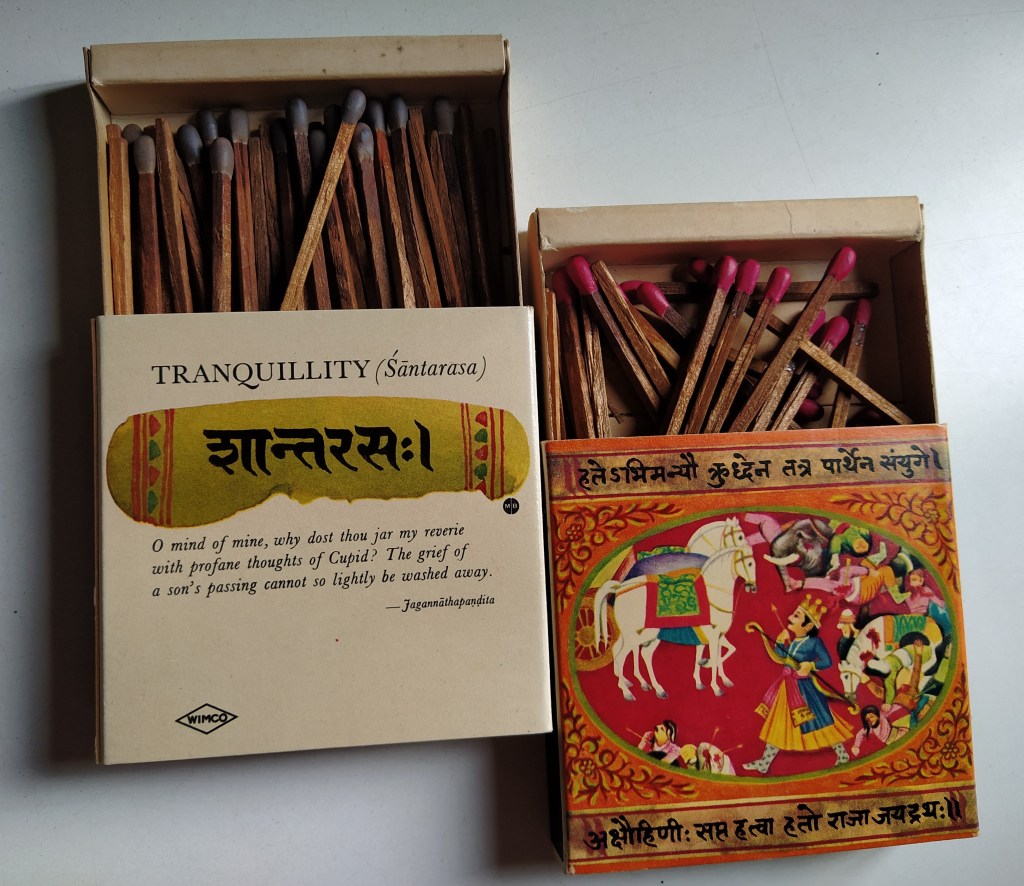
Spark a Match, Light a Lamp

A recent news item caught my eye. It said that the price of a matchbox is to go up after 14 years. And what is the price hike? A whole rupee more—from Rs 1/- to Rs 2/-! The last time the price was revised was in 2007 when the rate went up from 50 paise for a matchbox to Rs1/-. In a time when prices of foodstuff and fuel are in the ‘hundreds’ range, and spiralling every day, it is unbelievable that there is even an item in the market that costs as little as Rs 2/-

Yes, this is the ubiquitous, but not really noticed, little box that we need so many times a day, for so many uses—a matchbox.

The early history of the matchbox, as we know it, in India is not well documented. It appears that one of the early indigenous match manufacturers in India was the Gujarat Islam Match Factory founded in 1895 in Ahmedabad. However there was no commercially successful manufacture of matches in the country till 1921. In fact before World War 1 most of India’s matches were imported, mainly from Sweden, Austria and Japan. In the early 1900s, about half of the total imports of matches came from Japan. After World War I there was a struggle for supremacy in the Indian matchbox market between the Japanese and the Swedish who were represented by the Swedish Match Company

Around the same period some Japanese immigrants settled in Calcutta and began manufacturing matches. The locals also picked up the skills and small match factories came up in and around Calcutta. Following World War I, many manufacturers migrated to the state of Tamil Nadu where the climate was dry, labour was cheap, and raw materials were easily available. Starting as small family-based units, match-making continued as a mainly small-scale cottage industry, but over time, expanded into a booming industry. Today, the Match Kings of South India as they are called, supply the bulk of the country’s matchbox needs, employing around four lakh people, directly or indirectly, of which 90% are women. Sivakasi of the fireworks manufacturing fame is also the home of match production. Fourteen raw materials are needed to make matchsticks and matchboxes, including red phosphorus, potassium chlorate, and sulphur as well as wax, paper board, and splints.

In 1950 a matchbox cost 5 Paise, in 1980 it went up to 25 paise, in 1994 to 50 paise, and in 2008 to Rs 1/-. Considering that the cost of all the raw materials has increased manifold, the matchbox seems to have defied all laws of inflation!

While the economics of the industry is about numbers, the labels of the matchboxes reveal fascinating facets of history and culture. These are the aspects that fascinate matchbox collectors or phillumenists as they are called. It is from their collections that that many interesting stories emerge.

Some early matchbox labels which bore the sign Made in Sweden had pictures of Mughal emperors on the labels. It is believed that the royal family of Bhavnagar in Gujarat commissioned a special matchbox for their personal use during British rule.

During the freedom movement Swadeshi matchboxes appeared in the market, carrying slogans (in different Indian languages) extolling boycott of foreign goods and promoting swadeshi. These were often confiscated by the British. India’s independence was celebrated with matchbox labels carrying the tricolour, and pictures of people who had played a role in the struggle for independence. In the 1960s, popular matchbox labels included pictures of ‘matinee idols’ of the day—popular film stars, as well as a number of sports superstars. Matchbox labels have also carried pictures of brands like Pepsi, Fanta, Thums Up, Pan Parag, Frooti, Parle, Nescafe, Vat 69, Kitkat, Complan, Amul, Lux, as well as of TVs, cameras and computers (most likely not with permission from the companies, but definitely free publicity for them!) to name a few.

A souvenir of my phillumeny phase

Phillumeny or the hobby of collecting different match-related items: matchboxes, matchbox labels, matchbooks, match covers, etc. has its own band of aficionados, perhaps not as large as stamp or coin collectors. I went through a brief period of phillumeny in my college days. In the days when smoking in public places was not taboo, restaurants and hotels had interesting matchbooks, and for us these were great souvenirs of places visited, and memorable events!

Economics and commerce, history and culture–the matchbox has its little niche in many subjects. But perhaps the most innovative use of the matchbox has been in the teaching of basic science. In the words of Arvind Gupta one of India’s pioneering simple science educators who has used the matchbox in an amazing number of ways:  In the seventies a pioneering science programme in India attempted to revitalize the learning of science in village schools which had no science labs. The shift was from the chalk-and-talk method to hands-on, on making things with simple humble material available in the village. The hunt was on for low-cost, locally available very affordable things to do science.

The matchbox surprisingly emerged as a STAR. Being mass produced in a factory the matchbox confirmed to certain standard dimensions. The length of the matchbox is very close to 5-cm (2- inches) – a very good estimate of length. You could put six matchboxes back-to-back to make 30-cm (1-foot). The weight of the new matchbox was very close to 10-gms. Ten new matchsticks (not burnt) weight about 1-gm and the weight of a single matchstick is very close to 0.1-gm! Paint the matchbox drawer with some oil to make it water proof. Fill it with water and the drawer holds roughly 20-ml of water. Pour out 5 drawers of water in a bottle to make 100-ml. The humble matchbox becomes a good measure for volume. So, using a universally available matchbox, children could get a good feel of length, weight and volume – all very basic entities of any science curriculum!

How many things can you fit in a matchbox? 20…. 30…. 100? This exercise was given to children many years back. One child actually managed to pack in a whopping 250 things inside a matchbox! Just look around for small minute things – a mustard seed, hair, thread, cumin, moong dal etc. While doing this project children searched for the smallest artifacts in their vicinity and they came up with surprises which are difficult to imagine! They really had a good peep in the world of small things! Science is all about keeping our eyes open and looking at similarities, forms, patterns in the world around us. Science in short, is the discovery of order.

Source:  https://www.arvindguptatoys.com/arvindgupta/DH-AG-MATCHBOX.pdf

As our markets and homes get flooded with numerous new gadgets and geegaws, we tend to forget some of the simplest but most versatile household items. As we celebrate the festival of lights let us give thanks for the small things that make our life better and easier. Let us spark a match and light a lamp.

Happy Diwali!

–Mamata

Cantonments: Serene Oases

I recently came across a fascinating 2017 publication titled ‘Cantonments: A Transition from Heritage to Modernity’. This coffee table book has been brought out by the Director General of Defence Estates, which has ‘the task of Cantonment Administration and Land Management of all the defence land in the country’.

The word cantonment is derived from the French word canton, which means corner or district. Originally, it referred to temporary arrangements made for armies to stay during campaigns or for the winter. However, with colonization, the colonial powers had to set up more permanent military stations, and in India and other parts of South Asia, such permanent military stations came to be referred to as cantonments. In the US too, a cantonment is essentially ‘a permanent residential section (ie., barracks) of a fort or other military installation’. In India, the very first cantonment was set up by the British at Barrackpore about 250 years ago (though Danapur in Bihar also makes a claim to be the first!), and they grew in numbers in the 18th century.

Coffee table book on Indian Cantonments
A Coffee table book on Indian Cantonments

There are 62 cantonments in India, classified into four categories, depending on their size and population. The total cantonment land in the country totals to over 2 lakh acres. Cantonments are mixed-use areas, with both military and civil populations, unlike Military Stations which are exclusively inhabited by the Armed Forces. Cantonments are governed by the Cantonments Act, 2006, and the ultimate decision-making body is the Cantonment Board, which has equal representation of elected and nominated/ex-officio members.

Coming back to the book I started the piece with, it is a fascinating display of visuals from cantonments, and a great showcase of the diversity that cantonments are home to.

I learnt a lot of things I was not aware of. For instance, that the site of the Kumbh Mela, the Sangam, is within the Fort Cantonment of Allahabad. During the Kumbhs, the state government takes over the management of the area. Or that the Agra Fort, to which all of us troop, to get a glimpse of the Taj as Shah Jehan did a few centuries ago, is within a cantonment. Or that the Allahabad Cantonment houses an Ashokan pillar with edicts. This pillar is unique in that apart from Ashoka’s inscriptions, it contains later inscriptions attributed to the Gupta emperor, Samudragupta of the 4th century (an early case of state-sponsored graffiti?). Forts at Ahmednagar, Belgaum, Cannanore etc., are also part of cantonments.

Dr. Ambedkar, the father of our Constitution, was born in Mhow Cantonment—his father Ramji Maloji Sakpal held the rank of Subedar in the British army. Mhow is in fact today officially called Dr. Ambedkar Nagar. The Cantonment houses the Dr. B.R. Ambedkar Smarak, a marble structure which has an exhibition on the life of the leader.

Gurudev Rabindranath Tagore spent considerable time at the Almora Cantonment Board and is said to have written a number of books, including parts of the Gitanjali, during his sojourn here. The building where he stayed is now called Tagore House.

Cantonments house excellent buildings—the Flag Staff House built in 1828 on the banks of the Hooghly is now the Barrackpore home of the Governor of Bengal. The Rashtrapathi Nilayam at Secunderabad is part of a cantonment.

Expectedly, many war memorials are also housed in various cantonments, including the Madras War Cemetery, the Kirkee War Cemetery, Delhi War Cemetery, etc.

These areas also have a number of old and revered places of worship, from churches to temples to masjids.

And of course these are biodiversity havens—especially the ones up in the hill reaches of Shillong, Ranikhet, Landsdowne etc. Migratory birds visit the Danapur Cantonment, and thousands of open-billed white storks breed here.

We have all seen/passed through/visited/lived in cantonments, and have to admit they feel like serene, clean, green, well-ordered oases.  But cantonments are not without their controversies. Not only are they criticized as Raj-era relics perpetuating colonial mindsets, but also, there have been several tussles between civilians and the Forces establishment—whether public access to roads that run through these areas, or the issues of civilians who live within them—they cannot for instance, access home loans or government housing schemes.

The Comptroller and Auditor General of India (CAG) has been rather scathing with regard to the management of lands under Defence Control. The Army itself at some stage has wondered if it can afford the money spent on the upkeep of these areas. In a major development, at the start of 2021, the PMO has asked for views on the abolition of all cantonments.

So it seems there is some kind of a push at the top levels to do away with them. But one wonders—is that throwing out the baby with the bathwater? Would it not be better to re-conceive them to give a fair say to all stakeholders, and make the management more inclusive and responsive? And learn lessons from them on how to run our urban settlements well?

–Meena

Devil’s Tree

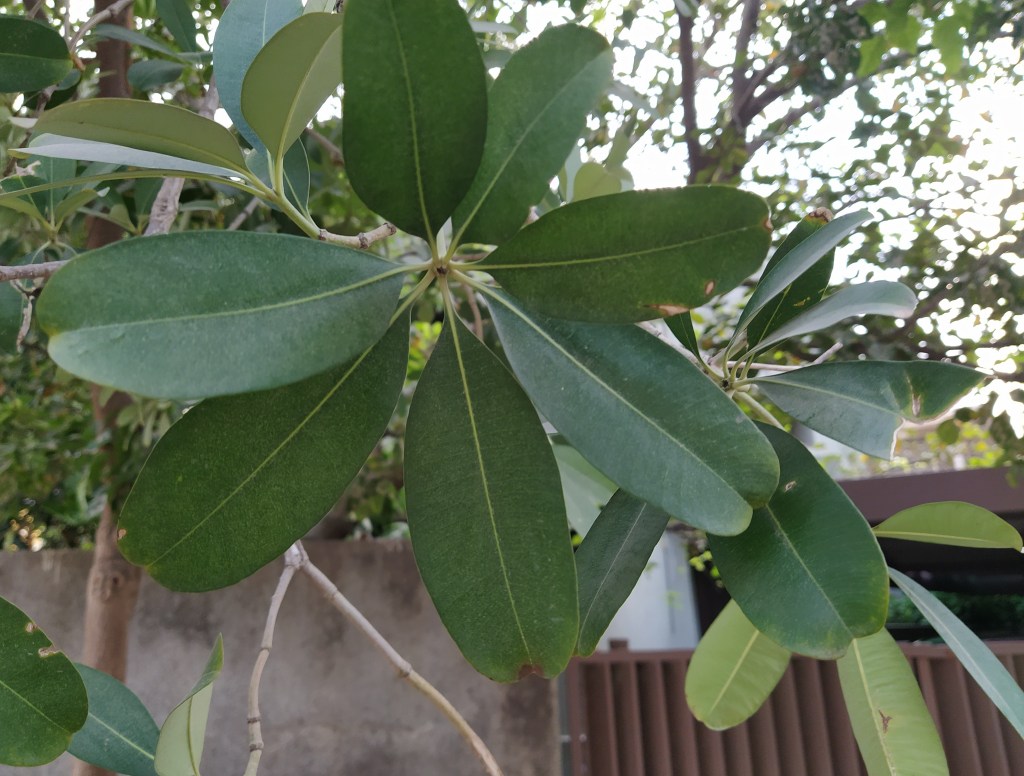
As we go for our walk nowadays, the early October mornings are filled with a heavy sweet fragrance. We look up to see the trees that look as if they have been sprinkled with an overnight flurry of snowflakes. The Saptaparni is in bloom!

The Saptaparni is one of the many names of the tree, but one that most literally describes it. It comes from two Sanskrit words—sapta meaning seven, and parni which refers to leaves. The tree is characterised by its pattern of (generally) seven leaves which grow in a whorl attached around a stem. In addition to Saptaparni which the tree is called in Sanskrit as well as in Gujarati, the tree is known by different names in different Indian languages: Marathi – Satvin, Hindi – Shaitanki Jhur, Chatwan, Chatian, Bengali – Chattim, Tamil – Palai, Elilaippala, Malayalam – Palai, Telugu – Edakulapala, and Kannada – Maddale.

One of the English names of the tree–Devil’s Tree–however refers to the beliefs associated with the tree. Folklore in many parts of India associates the tree as one on which the Devil resides. This association is reflected in the local names such as Shaitan, Chaitan, Chattim etc.

Another English name of the tree is Blackboard tree or Scholar tree. This is because in the past the wood of the tree was used to make slates and blackboards. This is also reflected in its botanical name Alstonia scholaris. The generic name Alstonia commemorates the distinguished botanist Professor Charles Alston of Edinburgh, while scholaris is a reference to its traditional use to make wooden slates for students. 

When leaves are plucked the tree yields a milky sap. The sap is toxic, and in large doses the bitter and astringent extract from its bark can be harmful. But the tree is also known to have a number of medicinal uses, especially in traditional medicine. The famous Ayurvedic physician Charaka used a paste of Saptaparna bark, known as Dita Bark, in ointments for chronic skin problems, and in prescriptions for urinary diseases. Another ancient physician and surgeon Sushruta prescribed the drug internally as well as externally in urinary diseases, poisoning, fever, malignant ulcers, leprosy and other virulent skin diseases and fistula. It is said to be useful in heart diseases, asthma, chronic diarrhoea, and to stop bleeding from wounds. The fresh bark juice with milk is said to be administered in leprosy and dyspepsia as well as to treat ulcers. The bark is also used in Homoeopathy for weak digestion, anaemia, low fever often with diarrhoea, dysentery and as a tonic after exhausting fever. The tree has been used in traditional Chinese medicine to treat headache, influenza, malaria, bronchitis and pneumonia.

However it may be named—by form, by folklore, or by use, this indigenous evergreen tree is found in most parts of India. It has a rough greyish bark, and the branches grow evenly around the trunk giving the tree a beautiful form. The whorled pattern of slightly rounded dark green leaves distinguishes it. The tree is transformed in the flowering season, which is between October and December. A night bloomer, the greenish-white flowers grow in ball-shaped clusters and exude a heady fragrance. Perhaps it is this phenomenon that has led to the belief in many tribal communities that the tree is where the devil resides; and thus people avoid sleeping under the tree, or even sitting under it. The belief could also be related to the fact that some people may be allergic to its pollen or fragrance, irritating eyes, or causing breathing problems. This may have led to the association that sleeping under a saptaparni tree could make a person ill.

This tree does not feature as prominently in art and literature as do some others. But the Soptoporni or Chatim (as it is called in Bengali), has an interesting link with Tagore’s Shantiniketan. The story goes that in 1862, Debendranath Tagore (the father of Ravindranath, and a leading figure in the Indian Renaissance) was on a boat journey. As he was passing the village of Bhubandanga, he saw lush green paddy fields bordered by rows of wild date palms and Chatim trees. He decided to step off the boat to rest; and sat in a glade of chatim trees for his evening prayers. He was filled with such a sense of peace and happiness that he bought 20 bighas of land there to set up a spiritual retreat which he named Shantiniketan (the abode of peace). The place with the grove of Chatim trees was named Chatimtala. Later Rabindranath expanded the retreat and its activities and it became the Vishwa Bharati University, but the Chatim trees became a symbol of the origin and spirit of the great institution. This was also demonstrated in the tradition that at the university’s convocation ceremony, every student was given, along with their degree, a whorl of saptaparni leaves. In recent years, supposedly to prevent excessive damage to environment, this presentation has been made symbolic–the vice chancellor of the University accepts one saptaparni leaf from the chancellor on behalf of all the students.

Going back to its other name—Devil’s Tree, there is a lovely folk tale from Madhya Pradesh.

Once upon a time there was shepherd boy who loved to play the flute. Every day as his goats grazed in the hills, the boy sat in the shade of a Chatian tree and played his flute. In the tree lived a fierce spirit or shaitan who scared away anyone who dared to sit in the shade of its tree. But when the spirit heard the boy playing his flute, he could not help being charmed by the melodious music. He would come down from the tree and dance joyfully to the lively tunes. The shaitan and the boy became good friends and passed the days with music and dance.

One day a prince was passing by and he heard the notes of the flute. He was entranced. He asked the boy to play for him every day. He promised that when he became king, he would make the boy his minister. After he left, the shiatan came down from the tree and warned the boy not to believe rich people who made false promises. But the young and innocent boy was taken in. The prince came every day and the boy entertained him with his music. The shaitan was upset and refused to come down from the tree anymore.

Time passed; the king died and the prince ascended the throne. The shepherd boy was excited; he went to the palace to meet his friend who was now the king. But young king refused to recognise his old friend and drove him away. Heartbroken, the boy returned to the hills and sat dejectedly under the Chatian tree, not even able to play his flute. The shaitan was concerned. He came down and the boy told him his sad saga. The Shaitan was enraged; he put a curse on the king which transformed him into an ugly monster. The palace announced a reward for whoever could break the spell. The shaitan was delighted that he had taught the king a lesson, but the kind hearted boy was very upset and said that he would not play the flute until the shaitan had taken away his spell. Finally the shaitan relented. He told the boy to go to the palace with a branch of the chatian tree, and wave it three times in front of the king, with the words “the spirit of the chatian tree release you from their magic”. This time the boy was allowed in, and he did as the shaitan had told him to. The king was restored to his original form. The king was overjoyed and asked the boy to stay in his palace and become his minister. But the boy was wiser this time. He said “I am only a shepherd, and all I know is to play the flute.” And he returned to his hills and his goats and his favourite chatian tree, to play his beloved flute. And the shaitan joined his friend to dance in joy every day. 

I love this story. We have a Devil’s Tree at our front gate. I would like to believe that the friendly spirit in the tree protects our home, and that it enjoys the music that we play!

–Mamata

Gandhi’s Women Warriors: M.S. Subbalakshmi

‘Warrior’ is a word far from the image of M.S., the doyen of Carnatic music, and the personification of spirituality, goodness and gentleness to people across the country and the world. The one who voiced the message of world peace at the UN on the occasion of its 50th anniversary through Kanchi Shankaracharya Shri Chandrasekarendra Saraswathi’s composition, which starts with ‘Maithreem Bhajatha Akila Hrith Jeththreem’—meaning,Serve with Friendship and Humility which will conquer the Hearts of Everyone; and ends with ‘Shreyo Bhooyaath Sakala Janaanaam’—meaning,  May All People of this World be Happy and Prosperous.

But she was indeed a warrior active in the Freedom Movement.  Along with her husband Sadasivam who participated in the first Satyagraha launched by Gandhiji in 1920, she was passionately committed to India’s Independence. She attended several Congress Sessions in the thirties and forties and sang at many of them. Her husband Sadasivam also used to sing at the start of local political meetings–usually songs by the fiery Tamil poet Bharatiyar–to enthuse the crowds and fill them with patriotic fervour. But after he got married to MS, he never sang publically!

MS Amma and Sadasivam were close to Gandhiji, Rajagopalachari, and many other freedom fighters, and were iconic in the South as symbols of the freedom movement.

Gandhiji recognized her ability to raise money for the freedom struggle through her music. She gave several concerts to do this. In 1944, she gave a series of five concerts to raise resources for the Kasturba Memorial Fund. Gandhiji wrote her a letter to thank her for this, signing it in Tamil.

Gandhi MS.Subbalakshmi
Gandhiji’s Letter to MS Subbalakshmi. Google Arts and Culture

In 1947, a few months prior to Independence, M.S Amma received a message from Gandhiji to record one of his favourite bhajans ‘Hari tum haro..’ and send it to him. In keeping with her characteristic humility, Amma did not feel she could do justice to the bhajan as she was unfamiliar with it, and suggested to Gandhiji that someone else should sing it. Gandhiji replied that he would rather have her recite it, than have anyone else sing it! So she did the recording and sent it on immediately. Not long afterwards, Gandhiji passed away. After the announcement of this news on All India Radio, they played her rendition of the bhajan. It is said that M.S. fainted at this point.

She was the first musician to be awarded the Bharat Ratna, and was the first Indian musician to get the Ramon Magsaysay award.

Her generosity and charity saw her support to many other causes through her lifetime.  The Tamil Isai movement—the movement to promote Tamil songs in Carnatic music–was one she was passionate about, and raised a lot of money for.  Her manifold awards included huge cash prizes, most of which she donated. She is said to have given over 200 concerts for charity, and raised over a crore of rupees  (in the sixties and seventies!). The royalties from her recording of Venkatesa Subrabhatam, which rings out every morning in every South India town and village, were written over to the Veda Patasala of the Tirupati Temple. Royalties from many other recordings were given to several other charities. In fact, so deep was her charitable instinct that it depleted her personal wealth considerably, necessitating considerable modification of her lifestyle.

But in the spirit of any of Gandhiji’s warriors, it was others before self for M.S. Amma!

–Meena

Gandhi’s Women Warriors: Poornima Pakvasa

The women of India should have as much share in winning swaraj as men.  …I hope that women all over India will take up the challenge and organize themselves.”

It was in words such as these that the Mahatma appealed to the women of India to join the struggle for freedom.

Among the thousands of women across the country who responded to Gandhi’s call, and who continued to live and practise his message of satyagraha, self-reliance and dedicated service to the people right through their life, was a young woman from Gujarat—Poornima Pakvasa.

Poornima was born in Ranpur near Limdi in Saurashtra in a family of strong nationalistic beliefs. She first met Gandhi when she was eight years old, and this proved to be the defining moment in her life. By the time she was 18 years old she was an active participant in the Satyagraha movement.

Gandhi’s Dandi March in 1930 had ignited a nationwide fervour. Initially Gandhi had included no women in the Dandi March. But women everywhere protested this decision and insisted that they wanted to be full participants in the protest marches, demonstrations, boycotts, and even imprisonment. Kasturba Gandhi herself was equally adamant on this point. These women went from village to village and town to town, urging other women to come out of their homes and join the movement by picketing liquor shops, advocating the boycott of foreign cloth, and encouraging the spinning and weaving of khadi. Young Poornima was an impassioned crusader in the swadeshi movement and demonstrations of defiance to the British rule. It was during this period that she was arrested and put in prison in Rajkot. As it happened, she was incarcerated in the same cell as Kasturba Gandhi, Maniben Patel and Mridula Sarabhai who became her real-life inspirations and role models. While she was in prison Poornima spent her time teaching English reading and writing to the women inmates, including Kasturba. The two became close, with Kasturba nurturing the young girl, who in turn found in Kasturba the mother that she had lost. It is said that Gandhi was so pleased with Poornima’s efforts that he gave his blessings that she should continue on the path of education. And indeed, this is what was to become Poornima’s life mission.

In the meanwhile Poornima became more deeply involved in the politics of the freedom struggle. She participated in the 51st session of the Indian National Congress at Haripura in 1938. There was a massive turn out, estimated at more than half a million people, and Poornima proved her mettle as a volunteer in managing the crowds.

It was in the same year that Poornima got married to Arvind Pakvasa, the son of Mangaldas Pakvasa who was a close confidante of Gandhi, and who had left a successful practise as a solicitor to devote himself to the freedom struggle. He later became one of the first five governors of independent India. Thus Poornima moved into an active nationalistic family. But she herself took a break from political activism to devote time to her family, and bring up her three children. One daughter went on to  achieve fame as the danseuse Sonal Mansingh. Poornima herself was an accomplished Manipuri dancer, and singer.

Having been a part of India’s struggle for Swaraj, Poornima could not but be drawn back into active engagement with the issues that the Independent India was challenged with. In 1954 she started Stree Shakti Dal an organisation for the cultural, physical and spiritual education of women in Bombay. She encouraged women to become physically and mentally strong; girls were trained in using laathis, rifle shooting, and self defence. She also headed the Bhonsala Military School in Nasik for 25 years.

Through the years, Poornima had been deeply concerned about the condition of tribal girls, and was strongly driven by a passion to do something concrete about this. Poornima remembered how, when she was just a teenager, Kasturba had nurtured her with love and compassion, and also Gandhiji’s belief that she could contribute to the field of education. She pledged that she would live up to the faith of Kasturba and Gandhiji, and strived to give generously of herself to better the lives of young tribal girls.

Her vision and mission fructified with the establishment of the Ritambhara Vishwa Vidyapeeth in the Saputara region of the Dangs district of Gujarat in 1974. The early days were challenging, in a place (a remote hilly area) and time when education for tribal girls was unheard of. Poornima herself went from door to door to convince parents to send their daughters to school. The school started with only 15 girls. Poornima mentored the young girls and inculcated in them a love for education, and classical arts, as well as empowerment through physical fitness and vocational skills. 

Directed by Poornima’s vision and passion the Ritambhara Vishwa Vidyapeeth extended its activities to become a residential school and college for tribal girls of the area, where hundreds of tribal girls are provided free lodging and boarding facilities and education from 6th up to 12th standards. Over the years, thousands of tribal girls have emerged from the Rithambhara Vidyapeeth as self-confident and capable young women.

The Gramin Vikas Trust was set up to complement Poornima Pakvasa’s work in the educational field with overall developmental activities. Her trailblazing work and contribution to the nation was recognised by conferring on her the Padma Bhushan in 2004. But for the people of the Dangs, she was simply “Didi”– the big sister who was a mentor, a steady supporter, and an inspiration.

Poornima Pakvasa continued to live and work in Saputara until she passed away at the age of 102 on 25 April 2016. Her legacy lives on through the thousands of lives that she touched.

–Mamata

RIP Dr. SM Nair: Father of Natural History Museums

There are the pioneers, and he was among them. Museology is not a widely-known or popular field of study even today. Way back in the 1950s, it was even less so. This is the time at which a young boy from Kerala, after finishing his B.Sc in Trivandrum, travelled all the way to Baroda to pursue his M.Sc in the subject, at the M.S. University. He went on to do research on the Bio-deterioration of Museum Materials, and was awarded the first Doctorate in Museology from M.S. University for this work.

Dr. Nair started his career as an academic, first teaching at his alma mater in Baroda, and then moving on to Department of Museum Studies, BITS Pilani.

Mrs. Indira Gandhi, then-PM, and a leader who took great interest in the environment, had been very impressed by the Natural History Museums she saw during her visits to Europe. She wanted to create similar ones in India. She conceived of a plan for one in New Delhi and one in Bhopal. She put together an eminent team of museum professionals and scientists to take this idea forward. One thing led to another, and Dr. SM Nair, only 37 years old at that time, was chosen as the Project Director for this initiative in 1974.

Dr. Nair and Mrs. Gandhi at NMNH

Four hectic years followed, when the conceptualization, planning and execution was done by a dedicated core team including Shri D.P.Singh, S.K. Saraswat, B. Venugopal and several others. Dr. Nair visited the best Natural History Museums around the world. He got several artists and model-makers trained at the best centres in the world. And the National Museum of Natural History opened its doors to the public on June 5, 1978 (Environment Day). Subsequently, Regional Museums of Natural History came up in Mysore, Bhopal and Bhubaneswar  under Dr. Nair’s guidance.

The stuffed rhino that greeted one on the ground floor of the FICCI building where NMNH was housed, will surely be in the memories of many a Delhi school child. The rhino had died a natural death at the Delhi Zoo, and was stuffed and kept here.

The effort in NMNH was always to make the experience interactive for children. For those times, when most museums were static displays, this focus was unusual. The Museum also had a major thrust on outreach and extension. It had an active teacher training and orientation programme, which reached out to thousands of educators in its time.

Dr. Nair had a personal connect with every exhibit and activity at NMNH, and continued to take an interest in it even after his retirement in the late ‘90s. What he must have gone through on 26th April 2016, when the news of a fire breaking out in the museum and destroying the entire collection, can only be imagined.

Dr. Nair continued to be active in his mission of Environmental Education long after his retirement, working at WWF-India and Centre for Environment Education.

Not just at a national level, he was extremely respected internationally, serving as Chairman of Natural History Museum Committee of ICOM (international Council of Museums) and as

a Member of the Joint Museum Committee of the lndo-US Subcommission on Education and Culture.

Among his books are ‘Endangered Animals of India and their Conservation’, brought out by the National Book Trust, and  ‘Bio-deterioration of Museum Materials’ by Agam Kala Prakashan.

We knew Dr. Nair since the mid-eighties, as one of the fathers of the Environmental Education movement an India.

He mentored us first as a member of the Governing Council of CEE, and then as a senior colleague. Even today, old-timers in CEE-VIKSAT recall his contribution to these institutions with great respect—when it was a struggling NGO, he spotted the potential of the team and gave them a project to develop labels and take-away materials for the NMNH exhibits. This not only paid salaries for a couple of months, but gave them their first project from a national-level, government institution. This project was a critical stepping-stone.

We have also known him as the father of a colleague, Meena, who was inspired by him to follow in his footsteps in a career in Environmental Education.

NMNH and other natural history museums excited the imagination and curiosity of generations of children. NMNH may no longer exist, but Dr. Nair’s legacy lives on.

Dr. Nair passed away last week. May his soul rest in peace.

Dr. SM Nair (1937-2021).

–Meena

Gandhi’s Women Warriors: Perin Captain

This month as we remember the Father of the Nation Gandhi, it is also a good time to remember some of the many women warriors who played significant parts in the march for Indian independence. Among these was Perin Naoroji Captain.

Perin was the granddaughter of the ‘Grand Old Man of India’ Dadabhai Naoroji. She was born on 12 October 1888 in Mandvi in the Kutch district of Gujarat. Her father Ardeshir, Dadabhai Naoroji’s elder son was a medical doctor and her mother Virbai Dadina a home maker. Perin’s father died when she was only 5 years old. She did her schooling in Bombay and moved to Paris for higher studies where she did a degree in French language.

It was while she was a student at the Sorbonne in Paris that Perin met Madam Bhikaji Cama who was living there in self-exile. Bhikaji had gone to Europe, and then to London in1902, to rest and recover from the bubonic plague of 1896 which she had caught while volunteering to work with the victims in Bombay. Though she recovered, the disease left her in poor health. While she was in London Bhikaji met Dadabhai Naoroji who was a strong critic of the British economic policy and she began working for the Indian National Congress. She also was a close associate of Veer Savarkar. It was while she was in London that Bhikaji was informed that she would not be allowed to return to India unless she signed a statement that she would not take part in nationalist activities. Bhikaji Cama refused to do so, and remained in exile in Europe from where she continued to support the revolutionaries in every possible way.

At the time when Perin met Madam Cama, the latter was deeply involved in trying for the release of Savarkar who was imprisoned in London for defying the British. During her Paris student days Perin was actively involved in a number of ‘revolutionary’ causes including the conspiracy to get Savarkar out of jail, and working with Polish émigré organisations who were opposing the Tsarist rule in Russia. During these interactions, Perin and her sister Gosi also learned how to use firearms and assemble bombs.  

Perin returned to India in 1911. An opportunity to meet Gandhi transformed her ‘revolutionary’ zeal into a lifelong belief in the power of non-violent protest as an effective weapon. By 1919 she was fully committed to the Swadeshi movement and started wearing khadi. In 1920 she helped to establish the Rashtriya Stree Sabha, a women’s’ movement based on Gandhian ideals. She married the eminent lawyer DS Captain in 1925. The couple did not have children. 

The countrywide civil disobedience movement that Gandhi launched with the Salt March in 1930 marked the first time that women, en masse, became active  participants in the country’s struggle for freedom. Thousands of women, in cities and villages, demonstrated their support by joining the protest marches, picketing of foreign goods, and manufacturing and selling salt. In the first ten months of 1930 as many as 17,000 women were convicted for these activities.

 Perin Captain, along with other women leaders like Kamaldevi Chattopadhyay was on the forefront of the protests in Bombay. Every day they led groups of satyagrahis, singing national songs, to the seaside to bring sea water which was dried in cement pans. The salt was packed in small packets and the ladies went to different places to sell the packets. Sometimes the salt packets were auctioned and sold to the highest bidder (at one place the highest bid was two rupees). Perin and Kamaladevi addressed a number of public meetings encouraging people to show their solidarity and join the peaceful protests. This was all under the watchful eyes of the British police. The name of Perin Captain features frequently in the Daily Reports of the Police Commissioner of Bombay submitted to the Secretary to Government of Bombay Presidency. The police intelligence was keeping a close watch on the unfurling movement of civil disobedience, as well as its leaders.

As an active member of the Congress party Perin was also trusted by Gandhi to ensure that the protests remained scrupulously non-violent and passive. On 4 July 1930 Perin was arrested as she was setting out for the Congress office. As a newspaper reported “she cheerfully submitted to the officers who came to her home”. Once the news of her arrest spread, the Municipal Corporation of Bombay adjourned, the Sugar Merchants’ Association passed a unanimous resolution to boycott British refined sugar.

Perin Captain’s leadership qualities saw her playing an active role in many other areas, but the Civil Disobedience Movement was a defining episode in her public life.

Perin was a trusted and active member of the Congress party in the state. In 1932 she became the first woman president of the Bombay Provincial Congress Committee. In 1937 the Congress Party came to power in eleven provinces in the provincial elections. In order to prepare for the future responsibilities that such developments would lead to, the Indian National Congress formed a National Planning Committee with Jawaharlal Nehru as Chairman. The Committee was clear that in such a future, women would be on an equal footing with men, and any planning should be based on this premise. Perin was a member of the sub-committee on Women’s Role in a Planned Economy. This committee debated and planned policy for issues such as women’s social, economic and political status, education, marriage, maternity and succession.

Over time smaller Gandhian bodies were merged into what became the Gandhi Seva Sena. Perin became its Honorary General Secretary, a post she held until her death. The Gandhi Seva Sena promoted khadi by selling rural and khadi products from their stores.

Even after independence Perin continued to work actively in the field of social work and welfare.  Perin was appointed Chief Commissioner of Bharat Guides. She was honoured with the Padma Sri in 1954, the first batch of civil awards presented in independent India. She died in Jahangir Nursing Home, Pune in 1958.

Perin Naoroji Captain was not only the granddaughter of the Grand Old Man of India, she was a true daughter of India’s swadeshi movement who boldly carried the message of the Mahatma to thousands of her fellow sisters.

–Mamata

All Dolled Up: Golu Festival

When we were young, Navaratri was one of the most exciting festivals. Several reasons: first, it was the only festival which stretched for so many days; then, for the girls, it involved getting dressed up every evening and visiting neighbours, friends and relatives; it meant different interesting prasads every day; and importantly, there was an ‘official’ ban on studying on the day of Saraswathi Puja, when all books, musical instruments etc., had to be kept at the altar.

The highlight of Navaratri for South Indians is Golu, the display of dolls.  The first step involves the putting up of the ‘golu padi’ or steps on which the dolls would be arranged. Some houses had modest 3-step set-ups, while others had up to nine steps (always in odd numbers). Households brought their their engineering skills to full play—sometimes steps were made of trunks ingeniously stacked to form a stair case, and covered with a cloth. Some constructed temporary arrangements from year to year. Others had permanent dismantalable steps which were stored away in some attic and assembled every year.

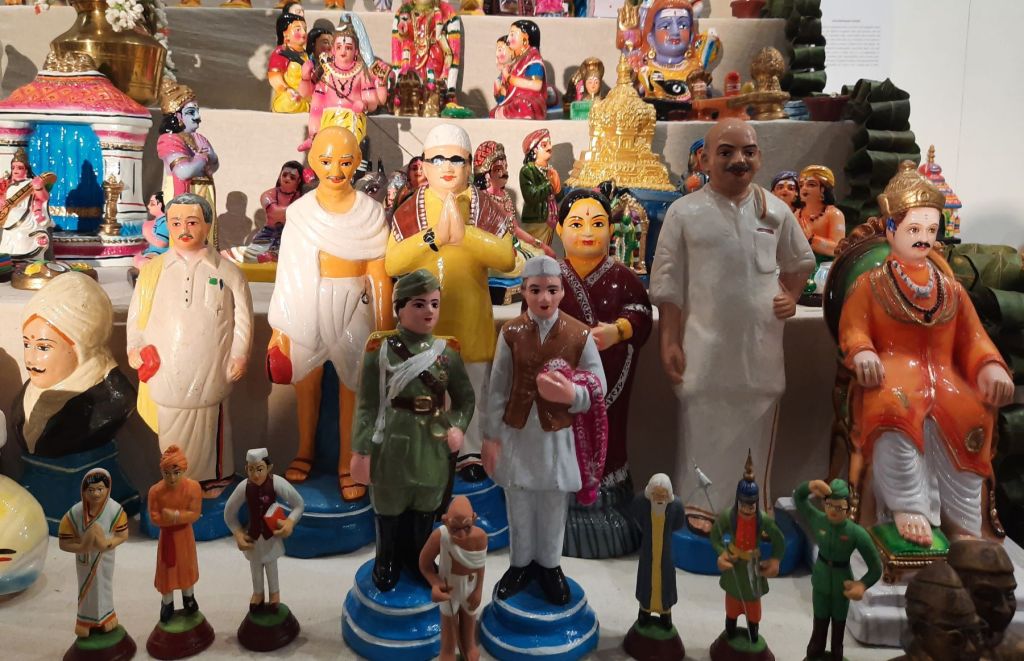
Popular leaders in Golu. Dusshera Dolls Exhibition

Then the dolls would be unpacked. Wooden ones, clay ones, porcelain ones, you name it. Those whose dresses were worn-out would need new clothes. Others needed a lick of paint or minor repairs. There was a particular order to arranging these dolls, with gods on the top steps, saints and famous people below them, and regular ordinary everyday people and scenes below these. There used to be sets—e.g., village scenes, scenes from the Ramayana, occupations, musicians, etc. Every year, each family also bought a few new dolls.

Golu dolls
Kumbhakaran being woken up. Dusshera Dolls Exhibition.

Below the steps on the floor, would be garden scenes, or most coveted, a ‘thopakulam’ (pond). Again, family ingenuity would come into play here. What container would hold the water (usually a large shallow tub); how it would be concealed (that involved importing a lot of sand or mud into the house!); what would float in it—ducks and other birds, flowers (real or plastic), etc; and the scene around the pond, including benches, trees, people strolling around, and when there was a particularly enthusiastic family, twinkling street lights.

Hi-tech was very much part of the display. Not just the lighting, but setting up elaborate working train sets or car racing-tracks instead of a traditional pond, and running the trains was a favourite.

And then, every day, elaborate rangolies had to be made, as well as prasad including the mandatory sundal (legumes like chana, lobia etc. cooked with coconut etc.).

For the little girls, it was about pulling out all the pattu-pavadais (silk longskirts), reviewing which would be worn on which day, which had grown short and needed to be let out, begging mothers and aunts to buy them blingy ornaments, and deciding whose house to visit when. We also had to prepare songs—every Aunty would ask every visitor to sing, and after the mandatory coy no’s, we would all sing the songs we had prepared. It must have been torturous to the listeners because most of us couldn’t hold a tune to save our lives. But everyone would applaud most politely, and then we would be given our vatala-paaku, fruit and packets of sundal wrapped in newspaper, and depart to the next house. The highlight of course was to savour the sundals—all of them used to taste delicious, partly because there was a limited quantity in the packages we were given.  We would discuss the relative merits of the doll display for days, and neighbourhood reputations were made or unmade based on the displays and sundals.

Such were the excitements of our simple lives. And so are memories made and traditions continued.

–Meena

Both pictures were taken at the Exhibition of Dusshera Dolls, Karnataka Chitrakala Parishath, Bangalore.