The Jawaja Project

One of the criticisms against academic institutions is that they are far removed from every day realities and seldom contribute in solving real-life challenges.

The Jawaja project undertaken by IIM Ahmedabad in partnership with the National Institute of Design (NID), Ahmedabad is an early exception.

It was in 1975 that Ravi Mathai, IIM-A’s legendary first fulltime director, set out on a journey to see how corporate management principles could be used to solve the major problem facing India-poverty. Ravi had stepped down as Director and could now devote time to such a project.

The decision was taken to work in Jawaja, a drought-prone district of Rajasthan, consisting of about 200 villages and 80,000 population. There seemed very little scope for development there, given the arid landscape and lack of water and other physical resources. But Prof Ravi Matthai had a different perspective, because he saw people as the biggest resource.

As they understood the area better, they found that the area had a 300-year tradition of leather-craft. The communities there were also skilled at weaving. And so they decided to build on these skills to develop sustainable livelihoods for the communities there. Prof. Mathai roped in NID to join hands with IIM-A, to work on livelihoods and empowerment of the communities in Jawaja. He and Ashoke Chatterjee, his counterpart in NID, started the journey which involved many faculty from both institutes.

The idea was to connect artisans with contemporary disciplines of management and design, and knowledge institutions which had this knowhow. There were some important basic principles underpinning the effort. The first and foremost was that the relationship was one of mutual respect and learning—after all, even as the communities learnt new skills, the faculty of the institutions were learning how their knowledge could be put to use in solving social problems. Another important aspect was to see how much of the value chain could be controlled by the artisans and communities themselves, so that their incomes could be enhanced. The idea was to innovate and design new products which would have new markets, so that the traditional value chains could be broken and the craftspeople could play a greater role in more areas. The focus was also on working in groups, to give greater resilience and strength to the efforts.
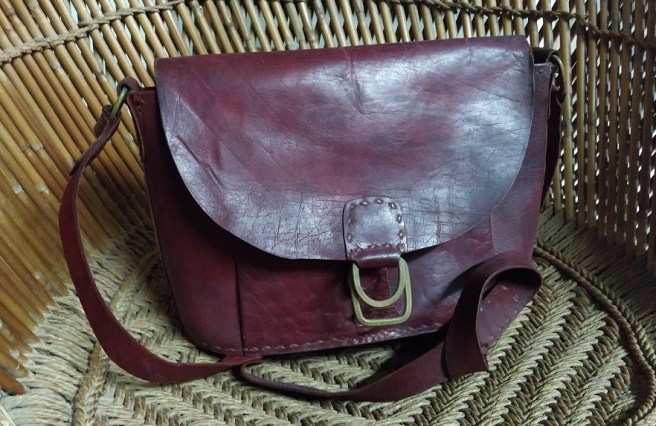
Jawaja bag
A prized Jawaja bag

The process was by design a gradual one, moving from basic products which did not need very high quality—e.g, leather school bags and woven floor mats, to higher value ones like office supplies, more trendy bags, and high-end furnishings.

The challenges were of course many. Apart from the need to design new products which would use the old skills, technologies and equipment, another major concern was quality control.

With regard to production of new designs, a train-the trainer model was envisaged, which did not work quite as planned. With regard to quality control, the idea was that it would initially be done by external experts, and would then be taken over by the crafts groups themselves. This again went slower than foreseen. Funds and resources for developing new products and for procurement of raw material were always a constraint.

But the enduring success of the bold experiment is seen even today at several levels.

The first was the creation of self-reliant institution of crafts people– the Artisans’ Alliance of Jawaja and its associations. These started to manage all links of the value chain in Jawaja, from raw material procurement, finances, bank dealings, design and technology know how, and marketing processes. These are still active today and continue to innovate, produce and market these products which are highly valued.

The second is the impact of the project on the larger development scene. It was the learning from running this grassroots education and empowerment project that the idea of setting up a specialized institution for education in rural management came up, and the Institute of Rural Management (IRMA), Anand, was born. This was given shape by Prof Ravi Mathai and two other professors who had been with IIM-A—Dr.Kamala Chowdhary and Dr.Michael Halse.

The Jawaja experiment widespread legacy is that it influenced development sector thinking on how to approach community-based livelihood interventions in a spirit of mutual respect and learning.

It is an initiative which needs to be much more widely known, understood and discussed.

–Meena
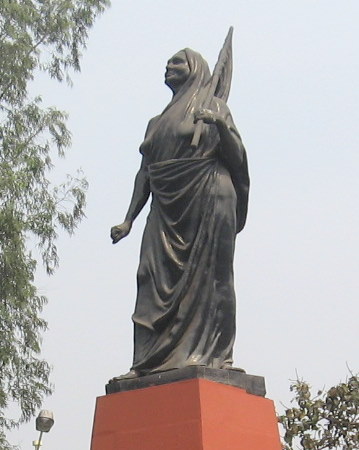
‘Gandhi Budi’ Matangini Hazra

It is in this week, 80 years ago, that Gandhi’s call for Quit India reverberated through the length and breadth of the country, and struck a chord in the heart of old and young. People everywhere gave up their all to heed Gandhi’s call of “Do or Die” as they joined protests against the British government, boycott of foreign goods, and demonstrations in support of swadeshi goods. Last week we remembered a young girl Kanaklata Barua from Assam, who gave her life for the tricolour.

The movement was not confined to the young. People from every walk of life, and of every age threw themselves into the nationalist cause with fervour, undaunted by the challenges, and the risk to their own life. One of these was a poor, uneducated woman from Bengal who lived, and died, for a dream of a free India. This is the story of Matangini Hazra.

The first statue of a woman revolutionary put up in Kolkata in independent India was that of Matangini Hazra.

Matangini was born in 1870, a girl child in a very poor family in Hogla village near Tamluk in Midnapore district in what was then the Bengal Presidency. Her family could not afford to send the child to school, and she remained unlettered all her life. The family circumstances also led to her being married off early to a sixty-year old widower. The child bride became a widow herself by the time she was eighteen. Thereafter, Matangini returned to her parent’s village but chose to live separately. Over the next few years she spent most of her time helping people in her community.

The turn of the century also brought a turn in the life of the young widow. The nationalist movement was gaining momentum; the idea of engaging in a cause that transcended her own village and community attracted the interest and attention of Matangini. She began to participate in local events of protest. Even as she continued her work with local community, she was following the growing movement for independence across the country.

Years passed, as Matangini grew older, but still full of spirit and passion for the cause. On 19 December 1929, the Indian National Congress passed the historic ‘Purna Swaraj’ (total independence) resolution at its Lahore session. A public declaration was made on 26 January 1930 – a day which the Congress Party urged Indians to celebrate as ‘Purna Swaraj’ or ‘Total Independence’ Day.

The Purna Swaraj declaration was followed by the announcement of the Civil Disobedience movement which was led by Mahatma Gandhi. Protesting against the taxation on salt production, Mahatma Gandhi led his followers on a 26-day Dandi March which lasted from 12 March 1930 to 6 April 1930.

On 26 January 1932, the menfolk of Matangini’s village took out a procession to create awareness about the non-cooperation movement, and the political situation in the country. As they passed by her hut, Matangini felt herself being irresistibly drawn into the heart of the action. She joined the procession and marched with the young men, chanting slogans against the British. She was 62 years old, small, and frail in health, but strong in resolve; and she vowed to proactively fight the struggle for independence.

There was no looking back. She joined the nationwide Salt Satygraha. She walked long distances to attend various Congress meetings, and threw herself into all the protest activities. She was arrested for the first time when she took part in salt manufacturing at Alinan, her late husband’s village. After her arrest she was made to walk many miles before she was jailed. She was then released because she was a woman, and her advanced age.

She later participated in the movement for the abolition of the chowkidari tax, a tax collected from villagers to fund a small police force in their areas. This was not only unfair, but the police troops were also used as spies against the villagers by the British Government

During a march towards the court building, to protest against the Governor’s harsh decision to punish all agitators, Matangini was arrested again and made to serve a six-month prison term at Baharampur jail.

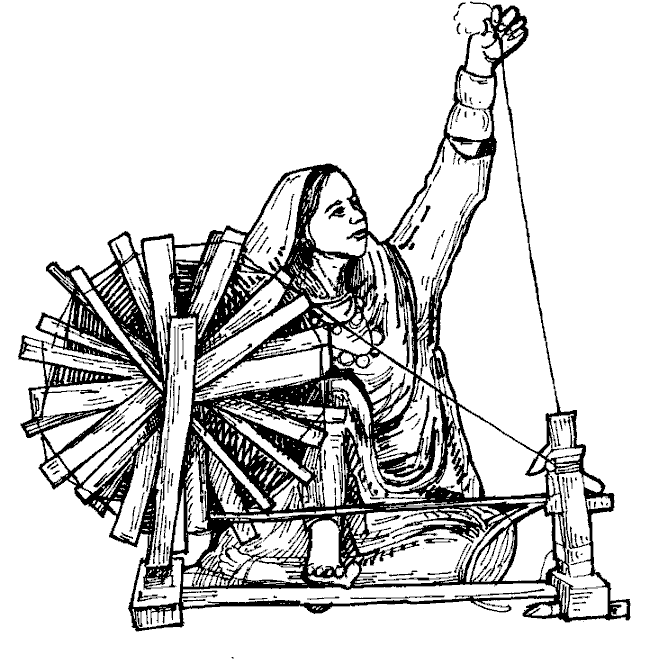
In 1933, the then Governor of Bengal Sir John Anderson came to Tamluk to address a gathering. There was tight security everywhere but Matangini managed to reach the dais and stage a black-flag demonstration. She was sentenced to six months rigorous imprisonment. While she was incarcerated, she came in contact with other political prisoners and used this opportunity to learn more about the movement and Gandhi. She was strongly drawn to Gandhi’s ideas and committed to following these in practise. After being released she became an active member of the local unit of the Indian National Congress. She took to regular spinning of khadi on her own charkha, even as her eyesight was failing and her health was deteriorating.

In an incident during the same period, the story goes, that one summer afternoon Matangini was part of a freedom march in the district capital. The marchers reached the residence of the Governor who was standing on his balcony and observing the demonstration while his soldiers cordoned off the immediate area. Matangini, who was leading the protesters managed to break the cordon, and holding aloft the freedom flag rushed ahead shouting Go Back. She was beaten up by British police for this daring act, and was severely injured.

Even as her age increased year by year, so did her rebellious acts. So closely did she associate with Gandhi and his movement that she began to be locally called Gandhi Budi or ‘old lady Gandhi’.

Her feisty spirit and commitment to the cause culminated with the tidal wave of Quit India that was sweeping India. On 29 September 1942, Gandhi Budi led a procession of about 6,000 protesters, mainly women, heading for the Tamluk police station. The plan was to take over the police station from British authorities, and establish home rule in the small town.

Just as the team reached the outskirts of the town, the British police arrived and ordered the marchers to disband, or else be penalised for violating Article 144 (Unlawful Assembly) of the Indian Penal Code. There was chaos. The police tried to stop the march by threatening to shoot at the advancing crowd. Matangini appealed to the police force to refrain from shooting at the protestors. But the police were in no mood to listen. Even after they started to fire, Matangini continued to advance alone, holding aloft the tricolour. The police bullets hit her three times. Injured on the forehead and both hands, Matangini continued to struggle onwards, uttering Vande Mataram and not letting the tricolour fall. She continued marching till she collapsed and died.

Matangini Hazra was 72 years old. She lived a life of dedication to service, and died a hero’s death in the service of the cause of freedom.

–Mamata

I

Fabrics for Freedom: Khadi and Beyond

We are all aware of how central khadi was to our struggle for independence. It was not only about defying the British and refusing to buy their imported cloth, but a potent symbol that it was not mere freedom from colonial rule that was critical, but also economic independence—a means of livelihood for millions of people of the country. In the words of Divya Joshi: ‘Gandhiji presented khadi as a symbol of nationalism, equality and self-reliance. It was his belief that reconstruction of the society and effective Satyagraha against the foreign rule can be possible only through khadi….The spinning wheel was at one time the symbol of India’s poverty and backwardness. Gandhiji turned it into a symbol of self-reliance and non-violence.’

Khadi

But India is not the only country where spinning and weaving of textiles were a core part of a movement for independence. Another large British colony also used this as a weapon. This was the USA!

Britain saw its colonies including the American territories, as suppliers of raw material, insisted that they export all cotton to it, and buy all finished cloth from it. And of course it imposed huge taxes on all these products including fabric.

In defiance, the people in the American colonies started spinning their own cloth, and the spinning wheel because as important a symbol of patriotism in Americanin the 1760s and 1770s as the charkha was to the become in the 20th century in India.

Women were at the forefront of the spinning movement in the American War of Independence, and created their own homespun cloth to disrupt the British monopoly.  Fabric made this way was called “homespun.” Wearing homespun was a symbol of patriotism.  

In certain areas like New England, women showed their protest by going to ‘spinning bees’ where they would set up spinning wheels and keep each other company while they spun yarn. And these were not isolated events—for instance, in a single area, from Harpswell, Maine to Huntington, Long Island, over 60 spinning meetings were held over 32 months starting in March 1768.

The Daughters of Liberty, a group of political dissidents who got together to fight for liberty, were at the forefront of these spinning bees. They organized boycotts of British goods, especially tea, and they manufactured replacement products, especially cloth.

As in India, spinning was at the centre of a lot of publicity and was a rallying point for the freedom fighters. Newspapers reported elaborately on the smallest cloth-making development to amplify the message. Spinning schools were set up and awards were offered for the person who wove the most cloth. Old and young learnt to spin—it is reported that a 70-year-old woman in Newport, R.I., learnt to spin for the first time during the movement. Competitions were held—‘in 1769, two Connecticut women held an all-day spinning contest in which the winner spun seven skeins and two knots of fine linen yarn, just a little more than her competitor’.

The boycott of imported fabric and other goods from tea to molasses, worked, and it is estimated by some sources that the value of imported goods from Great Britain to the US fell by half in 1769 over the previous year, from 420,000 to 208,000 pounds.

So ‘swadeshi’ proved a potent war cry against imperial colonizers halfway across the world!

As it did in India almost 150 years later–rallying self-confidence, morale, giving a sense of identify.

Happy Independence Day!

Buying one pair of Khadi clothes a year can contribute to livelihoods for our millions of weavers. And they need it more than ever now, as the spinning of the national flag, which was their monopoly, has been taken away.

–Meena

‘Birbala’ Kanaklata: Teenage Martyr for the Tricolour

Here is a mantra, a short one that I give to you. You may imprint it on your hearts and let every breath of yours give expression to it. The mantra is ‘Do or Die.’ We shall either free India or die in the attempt; we shall not live to see the perpetuation of our slavery. Every true Congressman or woman will join the struggle with inflexible determination not to remain alive to see the country in bondage and slavery.

These words spoken by Gandhi on 8 August 1942 launched the Quit India movement. Although Gandhi and many other leaders were arrested within hours of his speech, with the expectation that without their leadership the resistance movement would be rudderless, the effect was the opposite. Thousands of Indians, young and old, heeded this call and plunged into the movement, each contributing in their own way.

This mantra shared by Gandhiji at the Gowalia Tank Maidan Park in Bombay echoed across the country. Its reverberations reached the eastern corner of India, to Assam, and lit a spark in the heart and mind of a young girl named Kanaklata.

Kanaklata Barua was born on 22 December 1924 in Barangabari village of Gohpur, now in the Sonitpur district in Assam. Her mother died when Kanaklata was only five years old, and the young child developed a sense of responsibility much beyond her tender age. Her father remarried but he also died when she was thirteen. With added household responsibilities, and caring for her siblings, Kanaklata had to drop out of school and could not continue her studies after third standard.

Even as she was growing up in her village in Assam, the sparks of the nationwide freedom movement were spreading across the length and breadth of the country. The non-cooperation movement was gaining strength. The movement reached a climax with Gandhi’s call for “Do or Die”, and the wave of the Quit India Movement surged to new heights.

In Assam too there were widespread protests against British rule, and young and old joined in. Initially the protests were peaceful, but the British arrested all the Congress leaders of the state, and stepped up their brutal repression of the people. This only strengthened the opposition, and engendered underground conspiracies to fight the British. Among these was the setting up of a suicide squad which engaged in subversive activities like derailing and burning trains, attacking army outposts and snapping communication channels.

Seventeen-year-old Kanaklata was inspired and fired by the cause, and eager to contribute. Her dream was to join the Azad Hind Fauj, but as she was still a minor, she was not permitted to do so. Undeterred, she volunteered to join Mrityu Bahini–a suicide squad. For this too she was technically underage, but her determination and passion for the freedom movement was considered suitable for granting her membership. Subsequently she became the leader of the women’s cadre of the Mrityu Bahini.

The then president of the local Congress committee, Kushal Konwar was an ardent believer of non-violence proposed by Gandhi. He was falsely accused by the British for derailing a train which killed many British soldiers, and he was hanged. After the martyrdom of Kushal Konwar, the revolutionary camp of Gohpur division, under the leadership of Jyoti Prasad Agarwala, decided to mark their protest by removing the British flag and unfurling the National Flag at the local police station.

On 20 September 1942, Kanaklata led the procession of members of the Mrityu Bahini, walking proudly with the national flag in her hand, and with cries of Vande Mataram. The officer-in-charge of the police station was anticipating this. He warned the procession not to proceed further. He threatened that the police were duty-bound to start firing if the protesters advanced. Kanaklata responded by saying that he could do his duty while she carried on with her duty.

The procession carried on towards the police station; Kanaklata was leading, with the tricolour held aloft in her hands. As they neared, the police fired. Kanaklata fell to the bullet, with the flag still firmly held up. Before the flag could touch the ground it was taken by Mukunda Kakoti, another member from the group. He too was felled by a police bullet. Two young lives, snuffed out even before they attained adulthood. Kanaklata was not yet eighteen years old, and did not live to see the independent India of her dreams.

Their martyrdom did not go in vain. Even as their comrades were breathing their last, the others in the group did not let the tricolour down. They picked it up and with cries of Vande Mataram, the flag was eventually unfurled at the police station. One of the millions of small but significant gestures that added nail after nail to the coffin of the end of British rule in India.

While Kanaklata’s tale is not well known, it has at least been told. This month as we remember the many struggles and sacrifices that contributed to the unique non-violent movement that led India to become Independent, let us also pay tribute to the many unsung heroes and heroines who gave their all, even their life, for this cause.  

And as we swell with pride to see the Indian tricolour fly freely and fearlessly, let us not forget the brave young woman “Birbala” Kanaklata Barua who gave her life for it.

–Mamata

Animal Tales

Since the beginning of human history, people and animals have lived in close contact. Animals are an integral part of our lives. The relationships vary: animals may be domesticated for work; they may be loved as pets; they may be hunted as food; they may be admired and envied for their strength or other qualities; they may be. But even beyond these relationships, animals fascinate humans and so the numerous myths and stories, the worship of animals, and their symbolism.  

In last week’s post marking International Tiger Day, we saw a few myths, stories and legends about tigers. While there are many tiger-stories, it is not just tigers, but many, many animals and birds—real and imaginary who feature in these tales.

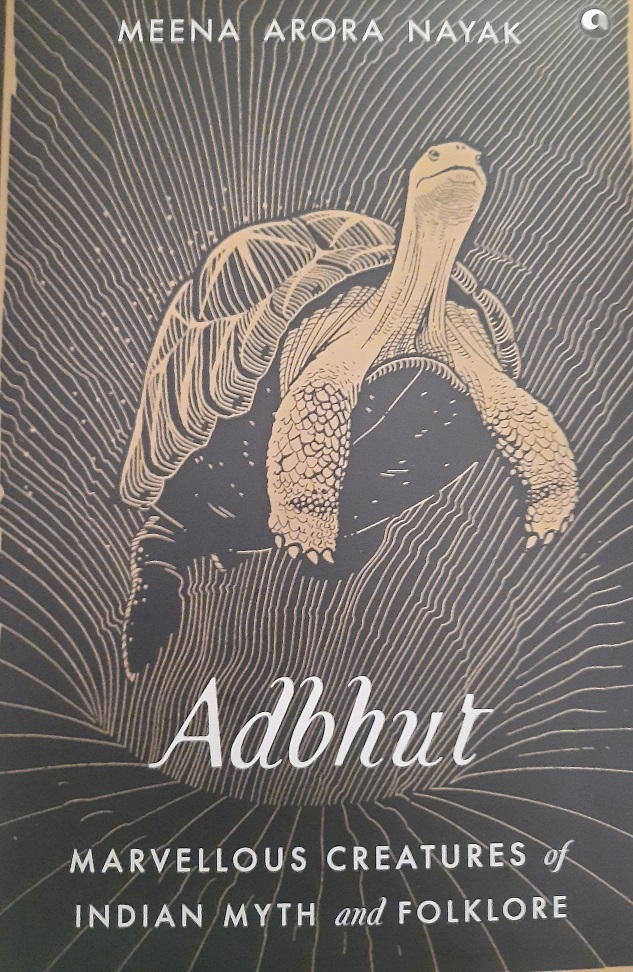
The book ‘Adbhut: Marvelous Creatures of Indian Myth and Folklore’ by Meena Arora Nayak, provides an overview of many of these. The book compiles 55 stories, drawing from all religious and cultural traditions.

The book is organized into different sections: Creatures of the Sky; Creatures of the Sea; Creatures of the Earth; Other Creatures of Air, Water and Land—Worms, Insects, Reptiles and Dragons; and Creature of Amalgam.

The last two are less familiar categories, so here are a few fascinating stories drawn from these sections of the book:

Bhramari the Beehive Goddess: Aruna was a daitya who had received a boon from Brahma, giving him immunity from death by war, weapons, man or woman, biped or quadruped or a combination thereof. To circumvent these conditions, Goddess Adi Shakti took the form of Bhramari, and her body became a beehive from which swarms of bees emerged. The bee swarms attacked and destroyed the daityas, who had no weapons against them. And at the end of the mission, all the bees merged into the Goddess’ form.

Shamir the Stone-cutting Worm: Shamir the worm was just the size of a grain of barley, but his gaze is so sharp that it could cut through stone, iron and even diamond. It is believed that the Shamir was used by Moses to engrave the names of the twelve tribes of Israel on the breastplate of a priest. After this, Shamir disappeared. It was with great difficulty that King Solomon found him and brought him to help build the First Temple in Jerusalem. The King did not want to use any tools to cut the stones because the use of such tools symbolized violence. He therefore used the shamir to cut the stones.

Nariphon the Plant Women: Both Hindu and Buddhist traditions talk about these. The mythical mountain of Meru stands in the midst of thick forests. The trees in this forest bear not fruits but beautiful young women. They emerge from the pods feet first, hanging from the trees on stems attached to their heads. They are about eight inches long. It is believed that in the last incarnation of Buddha before he was born as Siddhartha Gautama, he was so generous that his people banished him, his wife Maddi and children, to the jungle so the kingdom did not go bankrupt. Indra is said to have created Nariphon so that the eyes of itinerant sages would be drawn to these exquisite little creatures rather than to Maddi.

An interesting book which gives insights into the fascinating relationships of humans and animals, and reminds of the close bonds between humans and other animals. While not told in a story-telling style, it does indicate how our love, fears, imagination all come into play in the creation of myths and legends. The book lends itself to creative illustrations, and one wonders why only the back and front covers have them.

–Meena

Paper Tigers

29 July is International Tiger Day. The day was first launched at the Saint Petersburg Tiger Summit in Russia in 2010 and is observed annually to remind the world about the decline of the global tiger population, and to encourage efforts for tiger conservation. On this day we will see many reports and statistics about tigers and their falling/growing population, and many conferences and seminars will be held on research and studies on tigers.

This is perhaps a good time to look at the tigers that roam not the forests, but that have also populated the pages of language and literature. The tiger has been a dominant character in folklore and mythology in many cultures.  

Perhaps China is the richest country in myths, representations, traditions, and legends related to tigers. Tigers have been a Chinese cultural symbol which has inspired story tellers, singers, poets, artists, and craftspeople for over 7000 years. In Chinese folklore, tigers are believed to be such powerful creatures that they are endowed with the ability to ward off the three main household disasters: fire, thieves and evil spirits. A painting of a tiger is often hung on a wall inside a building, facing the entrance, to ensure that demons would be too afraid to enter. Even in modern- day China, children wear tiger-headed caps, and shoes embroidered with tiger heads to ward off evil spirits; they are given tiger-shaped pillows to sleep on to make them robust. During the year of the Tiger, children have the character Wang painted on their foreheads in wine and mercury to promote vigour and health.

The tiger has equally captivated the people of the Indian subcontinent since time immemorial – feared and revered at the same time. These majestic beats and the lives of the people, especially those that live in close proximity to the tiger and its habitat, have long been intertwined, giving rise to several myths and legends surrounding them. Tiger lore has been interwoven with gods and legends, giving it a mythical status.

According to stories from Indian mythology, the tiger is believed to have powers to do everything from fighting demons, to creating rain, keeping children safe from nightmares, and healing. Humans are often attributed as having tiger characteristics. The consecration ceremony of a king in ancient times required the king to tread upon a tiger skin, signifying the King’s strength.

Songs, proverbs, and sayings in most Indian languages feature tigers as part of their treasury of folk lore and literature. Tigers appear in many stories in the Panchatantra.

A popular belief among many tribes in the Northeast of India is that the cosmic spirit, humans, and tigers are brothers. There are many folk tales based on this theme, with local variations. The belief that the tiger is a human’s brother has meant that the people of these tribes would rarely kill a tiger. There are traditional rituals performed even today to honour and worship the tiger.  

In more recent times, tigers were introduced to non-Asian audiences through the writings of Englishmen who had lived in colonial India by authors such as the famous hunter-turned-conservationist Jim Corbett. His books like The Man Eaters of Kumaon were perhaps some of the early depictions of human-tiger conflict.

In the culture of the West, where they are not found in the wild, tigers have nevertheless sparked the imaginations of writers, and have become popular fictional characters in stories, films, cartoons, songs, and even advertisements. Perhaps the best recreation of the fearsome tiger is Shere Khan of the Jungle Book fame.

Anthropomorphized tiger characters in children’s books have won their place in millions of hearts. There is boisterous and exuberant, Tigger, who is a one-of-a-kind friend in the world of Winnie the Pooh. He eagerly shares his enthusiasm with others—whether they want him to or not, and steals our heart.

Calvin and Hobbes

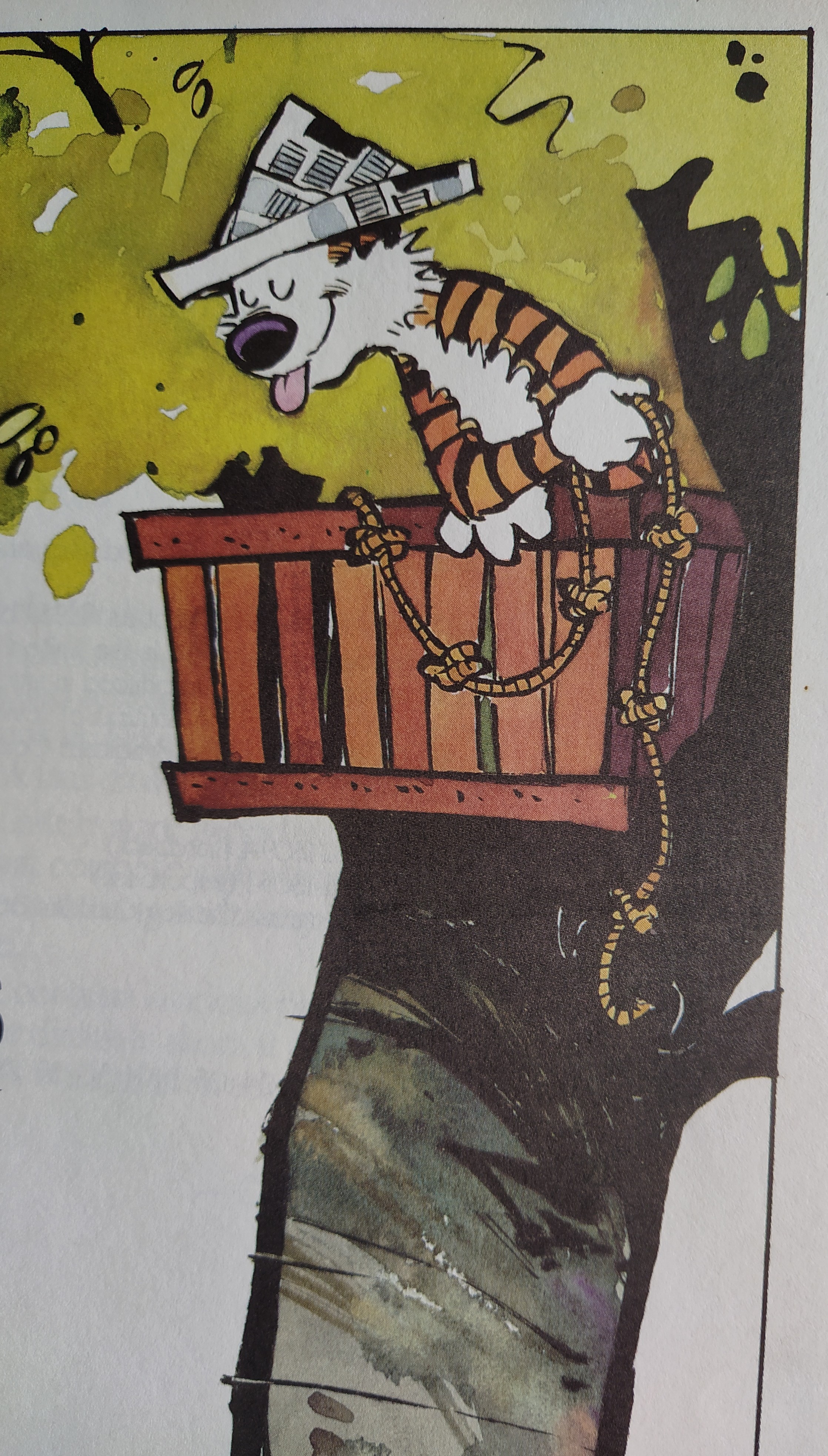
And we have the imaginary stuffed tiger Hobbes in the cartoon strip Calvin and Hobbes, who is very real to the irrepressible six-year-old Calvin—a faithful companion in all the capers, sometimes a comforting friend, sometimes a savage beast. The two friends have deep philosophical conversations, ruminating on how best to find meaning in their lives, the essence of which is what all of us are seeking.

Other than literature, tigers have permeated our language through numerous aphorisms, proverbs and sayings. Here are a few ‘tigerisms’.

Paper tiger: Someone who at first glance seems to be in charge but who, on closer examination, is completely powerless.

Tiger economy: A dynamic economy usually referring to of one of the smaller East Asian countries, especially that of Singapore, Taiwan, or South Korea.

Tiger mom: A particularly strict mother who makes her children work very hard in school to achieve success.

Catch a tiger by the tail: Try to control something that is very powerful; have a difficult problem to solve.

A tiger cannot change its stripes: You can’t change your true nature, even if you pretend or claim otherwise.

Eye of the tiger: Determined and focused

A new-born calf has no fear of tigers: A Chinese saying that means that the young are brave, but often due to inexperience.

As tigers in the wild continue to be threatened and pushed towards extinction, International Tiger Day is also an occasion to celebrate the power of words that keep the tiger alive and vibrant in the pages that they also inhabit.

Some beautiful words by Ruskin Bond capture this spirit.

Tigers Forever

May there always be tigers

In the jungles and tall grass

May the tiger’s roar be heard.

May his thunder

Be known in the land.

At the forest pool by moonlight

May he drink and raise his head

Scenting the night wind.

May he crouch low in the grass

When herdsmen pass.

And slumber in dark caverns

When the sun is high.

May there always be tigers

But not so many that one of them

Might be tempted to come into my room

In search of a meal!

Ruskin Bond

–Mamata

The Proud Tricolour

75 years ago, on 22 July 1947, Jawaharlal Nehru moved the motion for the adoption of the national flag. This is what he said on the occasion: ‘the national flag of India shall be horizontal tricolor of deep saffron (kesariya), white and dark green in equal proportions. In the centre of the white band, there shall be a wheel in navy blue to represent the chakra.’

Indian flag

Today, there are many who interpret the symbolism of the flag in different ways. But it would make sense to go back and understand the thinking of the founding fathers of the nation, who discussed and debated these issues long and hard. And what better way to understand this than through the words of one of the most eminent thinkers of the 20th century, academic, statesman and philosopher, Dr. Sarvepalli Radhakrishnan?  Dr. Sarvepalli Radhakrishnan later President of India, speaking on the motion moved by Nehru, explained the meaning of the flag design. Here are some quotes from this speech:

‘The world is full of misunderstandings, suspicions and distrusts. In these difficult days, it depends on us under what banner we fight. Here we are putting in the very centre the white, the white of the sun’s rays. The white means the path of light. There is darkness even at noon .. but it is necessary for us to dissipate these clouds and control our conduct—by the ideal light, the light of truth, of transparent simplicity which is illustrated by the colour of white.

We cannot attain purity, we cannot gain our goal of truth unless we walk the path of virtue. The Ashoka wheel represents the wheel of the law, the wheel of Dharma. Truth can be gained only by the pursuit of the path of Dharma, the practice of virtue. Truth, dharma, virtue, these ought to be the controlling principles of those who work under this Flag.’

‘The red, the orange, the Bhagwa colour, represents the spirit of renunciation. …Our leaders must be disinterested. They must be dedicated spirits.’ ..’That stands for the fact that the world belongs not to the wealthy, not to the prosperous but to the meek and humble, the dedicated and the detached.’

‘The green is our relation to the soil, our relation to plant life here on which all other life depends. We must build our Paradise here on this green earth. If we are to succeed in this enterprise, we must be guided by truth (white), practice virtue (wheel), adopt the method of self-control and renunciation (saffron).’

 In the same speech, he refers to the need for our society to change what is wrong with it. ‘Dharma is something that is perpetually moving. ..There are so many institutions which are worked into our social fabric like caste and untouchability. Unless these things are scrapped, we cannot say that we either seek truth or practice virtue. ..Our Dharma is Sanatana, eternal, not in the sense that it is a fixed deposit, but in the sense that it is perpetually changing…So even with regard to our social conditions, it is essential for us to move forward.’

Dr. Radhakrishnan occupied the George V Chair in Philosophy at Calcutta University; served as Vice Chancellor of Andhra University and Benaras Hindu University. Oxford University appointed him to the H.N. Spalding Chair of Eastern Religions and Ethics. He served on India’s Constituent Assembly and also as chairman of the University Education Commission. He was a chairman of the Board of UNESCO and leader of the Indian delegation to the same. He was Indian Ambassador to Moscow, then Vice President of the country, and its second president from 1962 to 1967.

He was a nationalist who believed in an India built and guided by those who were truly educated, by those who had a personal vision of and commitment to raising Indian self-consciousness.

His scholarly works include: Indian Philosophy, 2 vol; The Philosophy of the Upanishads;  An Idealist View of Life Eastern Religions and Western Thought;  East and West: Some Reflections; A Sourcebook of Indian Philosophy; and The Pursuit of Truth.

And of course, many of us have grown up reading his Ramayana and Mahabharata!

So as we mark the 75th anniversary of the adoption of the Tricolour, and are almost upon our 75th Independence Day, it is time to re-dedicate ourselves to the real meaning of the flag, which Dr. Radhakrishnan’ sums up as: ‘The Flag tells us ‘Go ever alert, be ever on the move, go forward, work for a free, flexible, compassionate, decent, democratic society in which Christians, Sikhs, Moslems, Hindus, Buddhists, will all find a safe shelter.’

–Meena

View From the Window

In a recent piece, my favourite nature columnist reminded us that while the Red Lists continue to add to the growing number of species that are endangered, threatened and even close to extinction, there are many small ‘disappearances’ that are happening all around us, ones that we do not obviously notice on a day-today basis. The author, a reputed bird watcher and note-keeper realised this when he looked back over his old records of birds around his house, and found that many of these were no longer to be seen. 

This led back to my own observations, jotted down over the years.

Circa 2000

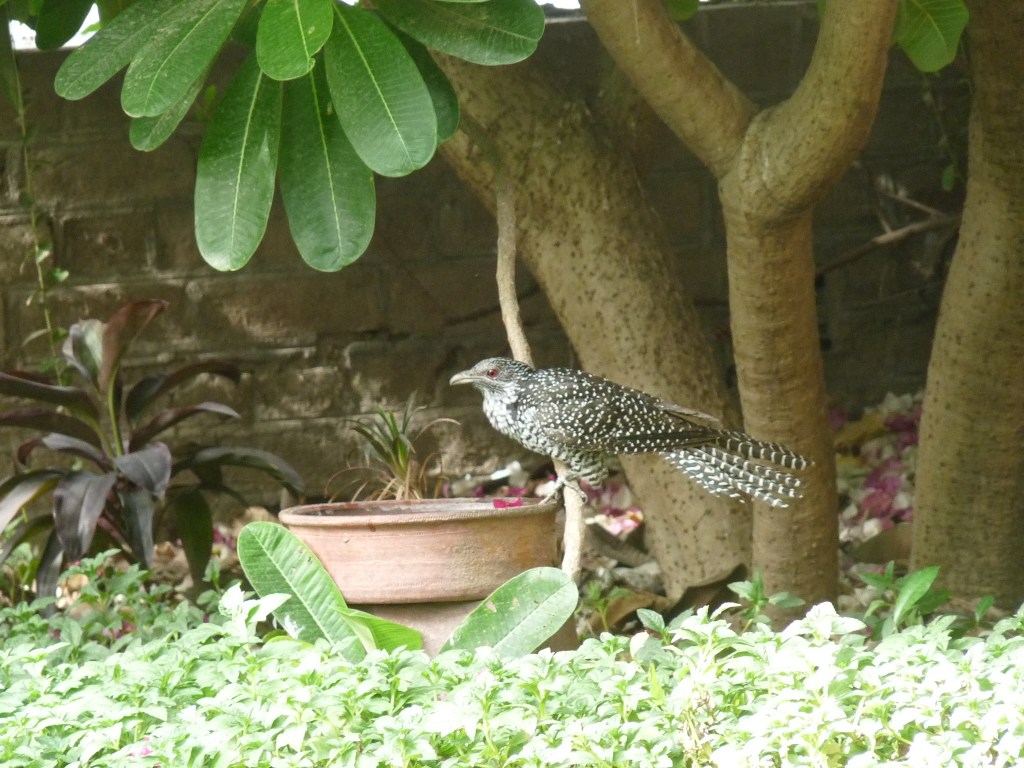
Before the first rays of the sun painted the sky pink, the echoing call of the majestic Sarus crane would wake me from deep sleep. I knew that the pair would be flying off to an unknown destination for the day, to return after sunset.

The summer heat was compensated by the brilliant scarlet of the gulmohar at our front gate and the molten golden blooms of the laburnum at the back. The melodious tunes of the magpie robin filled the dawn, while the metronomic tuk tuk tuk of the coppersmith echoed from the top of the raintree. The morning haze was often streaked with the dazzling blue of a kingfisher in flight, while the green bee-eaters lined neatly on the wires, made swift graceful swoops in search of a breakfast-insect or two. Our little patch of grass and the surrounding hedge was lively with the orchestra of calls from tailorbirds, sunbirds, bulbuls, doves, mynas, and babblers that co-existed harmoniously, each finding their own pockets for food and shelter. The same space also saw the raucous coucal proclaiming its territory from the champa tree, and the occasional visits by the Shikra that immediately silenced the rest of the avian crowd

When the first rains came, so did the jacanas, with their mewling cries, almost like that of babies. They would make their floating nests on leaves in the vacant ground across from our house which turned into a wetland in the monsoon. Once the water dried they would disappear, as quickly as they had appeared. 

The stream of other seasonal guests to that water-filled depression in the ground across the road included buffaloes that spent the day wallowing in the mud, naktas or comb ducks that glided smoothly on the water, and an occasional water hen awkwardly crossing the road on its long yellow feet. As evening fell the air filled with the symphony of the frogs.  

The first nip of winter brought back the single Yellow wagtail to our small lawn. It came from far away to spend the winter soaking up the golden sunshine that seemed to glow on the patch on its breast. Another familiar visitor was the Hoopoe. We would see it walking back and forth on the dusty roadside, with its pickaxe head bobbing constantly.

And then there was the monitor lizard which seemed to put in an appearance only on weekends. And the shy mongooses that streaked across the gravel, disappearing soundlessly into the undergrowth. The little turtle that we found one day in our garden may have been washed in with the rain. It adopted us before we adopted it. We named it Tortolla and no matter how early we awoke, it was up before us, taking its morning walk from one end of the courtyard to the other. Not to forget the adventures of discovering snakes in the house—once coiled in a corner of the kitchen, and once neatly tucked under the dining table.

These were some notes that I made of the life around me—not from a cottage in a beautiful forest, but from my windows in the dusty city of Ahmedabad that I made my home. The house that we made was at the time, in a slowly developing area of the city, close to a natural talavdi or small lake. There were still open spaces around; and the trees and shrubs that we planted when we moved in provided homes and shelter to many other fellow living beings—winged and tailed, with two, four, a hundred, or even, no feet. As a newly-minted environmental educator this was my private lab for observing, noting, researching, and discovering the excitement of seeing the little things from my windows. Little then did I imagine that things could change so much.

Circa 2022 (Same window different view)

The wetland that once was a soothing symphony of sound and sight has metamorphosed. My days (and often nights) are filled with the sound of concrete mixers, trucks offloading mountains of gravel and bricks, the incessant hum of machinery, and the clatter-bang of steel and iron. The Sarus cranes, long flown, have been replaced by the huge construction cranes. These swing their gigantic metal arms as they lift and drop the raw material from which begin to sprout the concrete blocks that will grow into the new jungle of high rise apartments. Where the jacanas and water hens stepped daintily, now the humungous metal claws of the JCBs dig ruthlessly, scooping out mountains of soil, and creating abysses to be filled with cement. Now the rains only bring waterlogging, floating litter, and swarms of mosquitoes.

I haven’t heard the nightly frog chorus in so many years. I am beginning to forget the cries of the jacanas. My morning wake-up call is no longer that of the magpie robin. The permanent dust haze has suffocated the gulmohar and the raintree to an untimely demise, and deprived so many feathered friends of perches and abodes. The wagtail no longer visits, and I miss the comforting sight of the neatly-groomed hoopoe on its regular march. A rare flash of kingfisher blue, remains just that, as also the aerial antics of the bee eaters in pursuit of prey. The incessant din of the traffic has drowned out even the strident call of the koel, the twitter of the little birds, the soothing murmurs of the doves, and the soft babble of the bulbuls.

Day after day, the concrete jungle closes in relentlessly, we are engulfed by dread and despair. And now a single flower that blossomed, or a simple bird call can uplift our spirits.

–Mamata

Purposefully Unparliamentary

Over the last week, media has been full of news, editorials, funny pieces and trying-to-be-funny pieces about the list of banned words issued by the Parliament Secretariat in India—apparently a standard practice before the start of a session.

banned words

The use of language and words is a zone of contention in most parliaments across the world. Nor is this a phenomenon of recent times. The earliest recorded instances are from 991 AD, when incidents of ritual cursing and boasting (called flyting) were reported between Germanic chieftains.

The discretion to rule what is acceptable and what is not, is generally left to the Speaker of the house, but there are often lists and books and rules to guide them. While some Speakers revel in the power to cut down the words of their House colleagues, others feel constrained to do so by the duty imposed on them. For instance, ‘Un-parliamentary language is one of the things for which a Speaker must be on guard. Since the beginning of Confederation, a list has been drawn up of words, expressions and sentences that are not to be used by Members in the House. To employ them is to incur the wrath of the presiding officer of the day, and the penalties can be swift and harsh.. Now, as a humane, civilized man, it is not a task I relish, but there must be discipline in the Chamber, and I will take whatever measures, no matter how repressive they may seem, to quell unrest.’ said the Speaker of the Canadian House in 2001.

But obviously the members test the limits. For instance, the Scottish Parliament objected to the First Minister being called a liar. So the member who used that word substituted it with ‘dishonest’ and ‘perpetuating a con trick’, which had the precedent of having been used in the same debate but not objected to.

Or they use the word and then apologize: Irish MP Paul Gogarty of the Green Party used the F-word after being heckled by the opposition. He immediately apologized for the rant, which he admitted was “the most unparliamentary language”. Justin Trudeau, before he became PM of Canada, called an MP a ‘piece of shit’ and then quickly apologized.

On the other hand, some don’t apologize or withdraw their words, and are ready to face the consequences. Plaid Cymru AM calling the Queen “Mrs. Windsor” and became the first MP to be ordered out of the Welsh assembly chamber  because she refused to withdraw her words. In the UK, Dennis Skinner called the then-PM David Cameroon “Dodgy Dave”, and was kicked out from the Commons.

There is actually a lot academic research and theorizing on why parliamentarians are so unparliamentary in their speech! Here are some insights from ‘Language and Ideology’ a book edited by Rene Dirven, Roslyn Frank and Cornelia Ilie, which has a whole chapter devoted to this: ‘In a hierarchically-based and rule-regulating setting like parliament, insults are powerful because they challenge the ‘status quo’.’

Our parliamentarians will surely agree with the following finding: ‘Language users have noticed that abusive and derogatory words tend to have a detrimental effect on the target of the insult, while at the same time, they may strengthen the position of the insult initiator.’ The researches aver that ‘By offering the insults publicly, insult initiators intend to reach a wider audience.’

The book explains the three major objectives of parliamentary insults:

  1. To score points by silencing, embarrassing, and/or humiliating political adversaries
  2. To challenge the authority and institutional role of political adversaries
  3. To redress the political imbalance and to strengthen group cohesion.

So next time we hear some unparliamentary language, more than worrying about the words, maybe we should try to fathom the motive!

–Meena

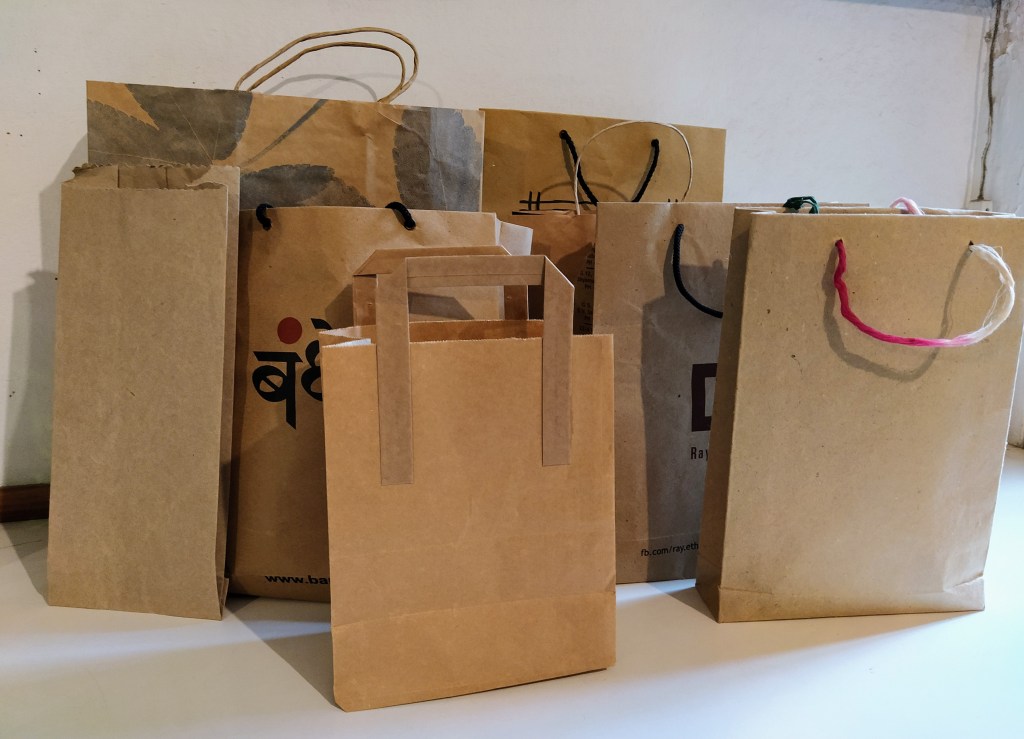
More Than Just a Paper Bag

12 July is marked as World Paper Bag Day to celebrate environment-friendly paper bags as an alternative to harmful bags made of plastic.

This month marks an important step for the environment. The Government of India has mandated a ban on manufacturing, import, stocking, distribution, sale, and use of single-use plastic items. Over the years while there have been both legal as well as voluntary efforts to reduce the menace of plastic pollution, the figures and ground realities across the world indicate an alarming trend of increase in throw-away plastics.

It is at a time like this when there is a deluge of information, and debates, about more eco-friendly alternatives. It is a time when paper bags are remembered and revived.

While the paper bag is an easy shop-and-tote item, it does not often merit much thought beyond its immediate function. However the humble paper bag has a fascinating history, not just as an object, but as a symbol.

Historically packaging material and containers were made of metal, wood, canvas, and jute. While these were durable and sturdy, their production was time-consuming and expensive. In the 1800s paper was introduced as packaging material. It was in 1852 that Francis Wolle an American priest and inventor invented a machine that could cut and paste paper into an envelope-shaped bag. This enabled mass production which lowered the manufacture time and cost; and these bags became popular with grocery stores in the United States.

The next important development in the design of the bag came from Margaret Knight, who then worked for the Columbia Paper Bag Company. Margaret’s job was to fold paper bags by hand, a slow and inefficient process. Margaret had an inventor’s mind; she started thinking of ways to improve the design as well as the process. She noted that the shape of the bag prevented it from being used for a number of items that would not comfortably fit at the bottom. She began to work on designs for a machine that would modify the shape of the bag so that it was flat at the bottom, and automate the manufacture. Within six months she had created a wooden prototype which was more efficient, but not sturdy enough. So she looked for a machinist who could make the machine in iron. After making refinements Margaret felt that she had created a design, and a machine unique for its time. When she filed for a patent for the machine and design, she found that a Charles Anon had already been awarded a patent for the same machine; her invention had been stolen. Margaret was a feisty woman. Not only was it unusual for a woman to file for a patent in the 1800s, she also hired an attorney (beyond her modest income) to fight her case, where her opponent claimed that because she was a woman, and not highly educated, she could not possibly have invented a complex piece of machinery. Margaret won the case, and the legitimate right to her own invention. On July 11, 1871, she became one of the first women to receive a patent. The inventor also became an entrepreneur when she later started her own company the Eastern Paper Bag Company.

The paper bag continued to be symbol of early feminism in the United States. In the 1920s schools in poorer rural areas where children were often underfed, established lunch programmes in schools. But among the more affluent class, the dominant idea was that mothers should be at home to provide children with hot lunches when they came home from school for a midday break. To send a child to school with a packed lunch was considered to be a dereliction of a mother’s duty. In the mid-1970s twenty mothers in New Jersey sent their children to school with their lunch packed in a brown paper bag. This caused some children to be suspended, and became a debated issue. But it also heralded the message that women need not to be confined to the kitchen, and could go out to work, even while ensuring a suitable meal for their children to carry. Paper bags thus became a rallying cry for women who wanted the freedom to be able to work, whether they needed the income or simply wanted a life that involved more than being home to provide hot lunches.

Today in the United States, the term ‘a brown bag meeting’ denotes an informal meeting or training that generally occurs in the workplace around lunchtime, and where participants typically bring their own lunches, which are associated with being packed in brown paper bags.

While the brown paper bag was a symbol of liberation for women in the United States, it was a symbol of discrimination based on colour, in the same country.

Slavery was abolished in the United States only a few years before the paper bag became popular in shops. Slavery itself had its own nuances of ‘colourism’. The slaves were not all of a uniform colour—their complexion ranged from very dark-skinned ones to varying shades of light-skinned. Over time, the lighter-skinned slaves acquired more privileges and education. When slavery was abolished it gave way to a strong hierarchy among the black people, based on the shade of their skin. In the early 1900s upper class Black American families, church and civic groups, and educational institutions devised their own systems of colour-based discrimination. They required members of the Black community to pass a ‘brown paper bag test’ for inclusion.  If an applicant’s skin was lighter than a brown paper bag, they were accepted. Those with skin too dark to pass the test were kept out. Even in prestigious Black universities like Howard University, there were “paper bag parties” where a brown paper bag was pasted on the front door; only those whose complexion matched, or were lighter in colour, could gain admission. It was a brown paper bag that held the key to access to certain public spaces or social events.

Thus the brown paper bag that was a liberating symbol for women in America, also became a symbol of discrimination, reinforcing colourism among the Black communities.

Meanwhile the square-bottomed brown paper bag continued to be popular for its more practical use as a convenient carrier of goods. Innovations were added to further enhance its capabilities. Pleated sides were introduced which expanded its holding capacity, and made it easier to fold. At some point, handles were added which made it easier to carry.

It was in the 1980s that plastic bags began to creep into the market. By the 2000s the plastic tsunami had swept across the world. Plastic bags were touted as the answer to all packaging requirements, as being reusable, and also cheaper to produce and market. Paper bags almost became a luxury, or a symbol of the emerging generation of ‘green consumers’. Today the havoc wracked by that plastic tsunami is evident in the alarming pictures of un-degradable throw-away plastics that are clogging our waterways and oceans, and piling up on our land. There is a clarion call for looking for alternatives, among which the paper bag heads the list.

Perhaps it is time to relook at the history of the paper bag that we hardly give a second thought to. And give it a new use and mission.

–Mamata