A Browser Laments

Browser

*a person who looks casually through publications or at goods for sale

*a software application used to locate, retrieve and display content on the World Wide Web, including web pages, images, video and other files

*an animal which feeds mainly on high-growing vegetation

I fall firmly in the first category. I am an old-fashioned browser of books. For me, the two pleasures greater than actually buying a book are the delicious anticipation of a visit to a bookstore or library, and the time spent there browsing the books on display before making a selection.

Fortunately, as I see it now, I grew up in a time when physical books, and places where books were kept were an integral part of life. Birthday and other presents for oneself and others were always books. Going to a bookstore was the most pleasurable pastime, initially accompanied by parents and later, with friends or by oneself. A library membership card was a precious possession. And having the time to spend just wandering around and looking through the books on the shelves was the ultimate indulgence.

This has remained true for me through all the phases of my life. The childhood summer vacation treat of visiting the small bookshop in our hometown to choose from the few English language books, or the hole-in-the-wall neighbourhood lending library which provided a selection of well-thumbed Mills and Boons. The membership of the Children’s Book Trust library with its colourful colours and cool interior where one discovered Shankar and Children’s World (that I later wrote for myself); and later that of the American Library where one was introduced to contemporary authors and literature. My years as a high school and college student in Delhi were highlighted by long stopovers at the legendary Galgotia and Sons in Connaught Place with its high ceilings, dusty tomes and old-fashioned shelves (replaced in the last decade by the brightly lit steel and glass façade of H&M). And later, by the just-must-go-to bookstores in Khan Market and South Extension which exuded a comforting familiarity even as stores on both sides became more and more glitzy.

One did not go walk in and out of these shops, or librarIMG_20200609_102020ies, just to pick up a book. One went to feast on the shelves lined with books, to run one’s eye across and up and down, pulling out a familiar name, or a new unfamiliar one; to peruse the blurbs on the cover to get a taste of what was within. One went in, sometimes with the certainty of coming out with a specific title, but equally the expectation of discovering new authors, or new works by familiar authors. It was the exploration that was the real fun, not so much the final selection.
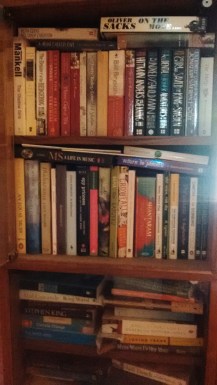
And then, there were the book fairs and book sales. A veritable paradise for a bibliophile like me. The joys of wandering in Pragati Maidan in the mild winter sun, rubbing shoulders with hundreds of fellow book browsers created a sense of community like no other. Here the excitement of exploration and discovery was multiplied many times. Even today, in another time and place, I get the same frisson of excitement when I read of a bumper book sale. It is hard work, sorting through literally mounds of pre-owned books, sweating in the airless hall; but worth it all to stagger out with a sackful of bargain books. And the ultimate thrill of uncovering some classic authors and titles at a throwaway price. The right rewards of patient browsing.

Sadly over the last decade bookstores are closing everywhere. People now ‘browse’ the internet, and order books online. Why, they no longer need physical books as they can store a thousand on a slim Kindle. Now the last straw—social distancing. No crowds, no touch, no wander—no browse. Read what you get on your Smart phone. What a loss; what we are missing! What will a future without book browsing be like? What will it mean for humankind?

“And if anyone wants to try to enclose in a small space, in a single house or a single room, the history of the human spirit and to make it his own, he can only do this in the form of a collection of books.” Herman Hesse

–Mamata

Virtually Missing

Six years ago, what now seems to be another time and another place, I transitioned from full-time paid employment to ‘independent freelance worker from home’. Today WFH is the new buzzword! For someone who had gotten up and out to go to work for over three decades this was a big change. The most obvious was the change in the mental and physical routine. Rushing back and forth between work and home, often hugely stressful, one developed the skills of keeping the domestic and professional arenas distinct, while still maintaining a suitable balance between the two. My new phase of WFH demanded equal skills to keep the two domains separate within the same physical setting. Over time, with some practical planning, some experimentation, some creativity, and a sense of mission I got myself into a suitable groove. Today when I see a barrage of ‘tips and hacks’ on WFH, I cannot help but be amused, with a sense of ‘been there, done that.’

What is new for me however, is the technological take-over. And here I feel “Haven’t been there, don’t want to do that.” Neither my long professional Work From Office life nor my WFH years have been entirely ‘remote working’ experiences in any way. They were not marked by day after day of zoom rooms and virtual meetings. My teaching-learning experiences have not been ‘online’ through artificial screens. My conferences have not been video-linked. My DIY instructions have not been over YouTube. My news has not come from the mobile phone, and my entertainment has not been watching plays, films and concerts on my laptop. I have (barring the last two months) regularly browsed for books in a physical library or bookstore.

For this I am so very grateful; and about this I am now greatly concerned. What is life going to be like in the days to come?IMG_20200526_112241 How much will be lost in terms of simple human contact? When I see members of zoom rooms, each with their own coffee mugs in their own physical rooms; when I see news anchors casually sipping from teacups as they analyse another day of gloom and doom, I can almost taste the consistently  undrinkable tea that I sipped with my colleagues, rubbing shoulders across a small office table. This is what I most acutely missed, and continue to do, in my WFH life.

Two years ago in this space, I described this simple but invaluable ritual thus:

‘Twice a day, as the footsteps heralded the bearer of the teas, it was literally and (later) figuratively ‘pens down’. Time to cluster around, a time for sharing—news and views, happenings and unhappenings (propah English not mandatory, and language khichdi quite delicious!), cribbings and crabbings–and above all, energising. There were snacks too—“hey taste what I baked yesterday,” “oh great, banana chips all the way from home state”, “guess what, I discovered this new naasta shop with 50 flavours of khakhra….”

Tea table became the venue for easing in the newcomers; teasing and ribbing the old-timers; there were no hierarchies and no bosses. The agenda was whatever the mood of the table—sharing, admonishing, admiring, agonising and venting, and yes, laughing a lot.

It was an important support system in so many ways. After just 15 minutes, one returned to one’s desk feeling much better. You weren’t the only one who struggled to keep going as you juggled work and home; your child’s behaviour was not as worrisome as you imagined it was; and yes, in-laws happened to the best of us!’

The world going the way it is, such memories will remain just that—ancient history of another era. This is only one of the many simple joys of physical interaction with fellow humans that we took for granted. Others included the delicious anticipation of meeting friends for coffee; choosing the restaurant for the next birthday lunch; dressing up for an evening of theatre or music; wandering and jostling in a crowded market, and walking amidst fellow human beings on a busy street.

For many like me, the new normal is sadly so abnormal. To live in a virtual world is bereft of meaning, of everything that makes us what we are and what keeps us going. They say that people will get used to this. They say that we must adapt or perish. I am not sure how much I can adapt, so perish I must!

–Mamata


What an Irony!

…Or contradictions in the time of Corona.

Confession. I belong to the age of dinosaurs! Not so old as to reminisce about the freedom struggle, and World War 2 (which my parents did), but old enough to remember one short war, night curfews and blackouts, and shortages. Old enough to remember a time when gymming, pubbing, clubbing, beauty and retail therapy were not considered to be critical to one’s physical and mental health. When staying indoors as a family was not unheard of, and what to do with one’s time was never a stress-inducing problem.

It is in the last month, as they say, “the world as we know it had changed.” Coronatimes newspapers, and especially the Lifestyle and Leisure supplements reveal that yes, the world has changed, but in different ways for different people. I cannot help but think back, and chuckle a bit at the contradictions!

Then and Now…

‘Staycations’ were the trendy way to spend your holidays; but now staying at home for free becomes ‘confinement’.

People went to expensive health spas for detox stints; now have DTs at home without their sustaining substances.

School vacations were a time of simple self-devised ‘time-pass’ activities (or lack of activities); not a time of huge stress for parents as to how to keep the children “engaged”.

Summer holidays were marked by hours spent playing cards, ludo and carom with relatives of all ages; now newspapers feature pictures of this as a wonderful sign of how indoor games lead to ‘family bonding’.

‘Social distancing’ was a cause for concern and counselling, as people addicted to virtual reality could not relate to real people; now when it becomes mandated, people want to break it.

Page 3 celebrities fill pages with pictures of “doing the dishes” or “playing with baby”; while numerous stories of unseen unsung heroes who are risk their own life to save others are inconspicuous among the headliners.

People have to be taught how to cover their faces when outdoors, something the two-wheeler female riders of Ahmedabad have been adept at for years.

Now Kitchen Hacks on innovative ways to make provisions last longer, and replacements for quinoa and parsley; when generations of homemakers have learnt and practised ‘living within their means’ with some saved for a rainy day.

While some eagerly await the resumption of Swiggy and home delivery from restaurants, many middle-class housewives wake up early every day to join the voluntary cooking efforts to feed the homeless and hungry.

Glossy pictures of designers displaying their designer masks; news items of hundreds of ordinary women sewing for hours to make and distribute masks made from old clothes.

Once people had to wear masks when the sky was grey and smoggy; now everyone has to wear masks when the sky is clear and blue.

Then, health and well-being pundits urged and cajoled people to get off the couches and walk; now people are risking fines and arrests to go out for a walk.

Now we need Life Coaches to tell us how to spend our day from the time we open our eyes to shut-eye time; then people did not have time nor leisure to need such coaching, but a lot of basic common sense to guide in how to live, and thrive.

Then we scoffed at mothers and grandmothers who judiciously planned, saved and put away things that “you never know when these may help”; now we remember with nostalgia and regret (or gratitude) that ‘old ladies’, old fashioned’ advice.

SARS CoV-2 did to CO2 levels what 25 Climate Change COPs could not do!

The virus of fake news spreads much faster than the Covid-19.


With gratitude and humility for those of us who are lucky to have the wherewithal to lead the life we do.

–Mamata


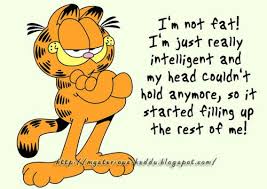
Fatso

Fatso! The word always reminds of the storybooks we read in which the

garfield fat.jpg
Source: Pintrest.com

chubby baby with pink cheeks grew into a rotund schoolboy or roly-poly schoolgirl who was the butt of many jokes and cruel teasing. For many children who were actually on the plump side, it was a real-life experience that followed them through the years of teenage and adulthood. Fat characters depicted in books, movies and television are usually the bumbling comic ones, designed to raise a laugh. The simple three letter word ‘fat’ is, more often than not, used as an adjective that is derisive and pejorative.

The history of the word in the English language reveals that this was not always the case. In the late 1300s, fertile and abundant land was described as ‘fat land.’ In the 1600s, a wealthy or affluent person was described as a ‘fat’ person. This was a period when the general population suffered from poverty and food shortages, and anyone with excess body fat was recognised as being prosperous. Paintings of the Renaissance period in Europe depicted full-figured people. This was also the case in several other parts of the world, including India, where chubbiness was extolled when admiring “healthy” babies, and a skinny child would always be asked “does your mother not give you food?” In women of a marriageable age, a well-rounded body structure was desirable as it was considered suitable for future child bearing.

Changing times brought changing trends. In the 19th and 20th centuries, in the West, technology and industry made food production more stable, cheaper, and more widely available; it also introduced the wave of processed food. This, along with a rise in the overall standard of living, and more sedentary lifestyles, created new concerns, and perceptions, about weight. By the 1940–50s, ‘thinness’ became the new ideal for health and beauty. As early as March 1954, Life magazine featured an article, “The Plague of Overweight,” which characterized obesity as “the most serious health problem today.” “The uncompromising truth,” it went on, “is that obesity is caused by gluttony.” At that time, around three percent of Americans were considered obese. In 2015-2016 the prevalence of obesity in American adults was 39.8%. Today India is one of the countries in which obesity has reached almost epidemic proportions.

As medical science produces numerous reports on the health impacts of obesity, the popular culture has climbed on to the merry-go-round slogan of ‘fat is evil’. This has manifested itself in wave after wave of money-minting slimming coaches, new-fangled fad diets, and lose-weight mantras.

The social fall-out of this has been the culture of ‘fat shaming.’ Responses to this have been varied. The 1960s saw the rise of the movement of ‘body positivity’ to raise awareness of the barriers faced by fat people and highlighted the need for human rights for bigger bodies. As far back as 1969, a civil rights organisation was founded in the United States, The National Association of Advance Fat Acceptance (NAAFA) which works to eliminate discrimination based on body size, through advocacy, public education and support.

Today there is a Fat Acceptance Movement, with Fat Activists, which is working to challenge bias against fat people and end discrimination against them, especially in work places.

At the other end of the cultural spectrum, in several parts of the world, “fat is indeed beautiful.” Heavier girls and women are viewed as beautiful, wealthy and socially-accepted.  As they believe, if you are fat, people respect you; people honour you. Wherever you go, they say, “Your husband feed you fine.” In Mauritania, it is believed that a woman’s size indicates the amount of space she occupies in her husband’s heart!

Even today, in many tribes in Africa, a woman’s attractiveness is measured by her obesity, and a young woman is prepared for marriage in ways guaranteed to ˜fatten her up.” Traditionally brides-to-be would be confined to a hut where they would be fed and fed and fed on high calorie foods until they achieved the desirable size and shape.  Even today, in some places women go to fattening centres, just as in others they go on a slimming programme, before their wedding.

The Fat vs Healthy debate rages on. Every day, through every media, we are besieged by confusing and contradictory messages. Beneath all this, science seems to suggest that that body size is the result of a complex web of factors, including social and economic influences, genetics, food production and availability, urban design, land use, and advertising.

Fatso, or beanpole, beauty, it seems, is in the eyes of the beholder!

–Mamata


Monkey at My Window

Yesterday, the results of the Delhi election were declared. Aam Aadmi Party romped home with a thumping majority.

And this is a piece about monkey business, not politics. (This is a statement of fact. Nothing tongue in cheek).

If so, then why start the piece by talking about politics?

Because monkeys taking over parts of Delhi including Parliament and high government offices is often in the news. And there was a statement made by an AAP MLA that “Monkey problem never became a poll issue”! In spite of that, the issue was serious enough that before the Assembly elections, the Delhi government planned for a census of monkeys in the city, for area-wise identification and tackling of the issue. They have roped in Wildlife Institute of India (WII), the country’s premier research institution on the subject.

So it is not like monkeys and elections don’t have a link. How could I resist the temptation?

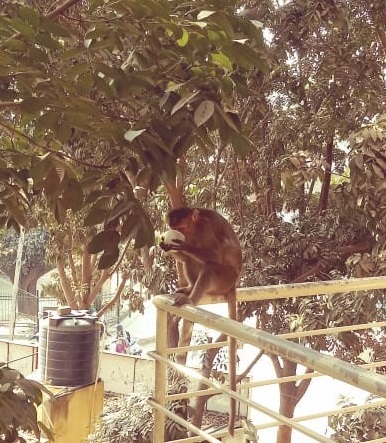
monkeyAnyway, to get to the matter on hand. For the last month or so, a group of Rhesus Macaques has been visiting our small office in Bangalore every once in a few days. The first reactions were of course ‘so cute’, and ‘shall we give them biscuits’. But as days went by, and the visits became a regular feature, they became bolder. They sat outside the door and snarled when we went to shoo them away. Several times they entered the office. And a few days ago, one of them snatched a tiffin box, went out, enjoyed the contents, and threw away the box.
The erosion of natural habitats is pushing wildlife including monkeys out of their homes. Where do they go except to cities? And our cities are very conducive for certain species. For instance, in the case of monkeys, our unorganized disposal of food and organic waste, and lack of garbage system lead to plenty of food being available, and they thrive.


Many means have been tried to keep monkeys away. In Delhi, Langurs were actually employed by the government to visit offices turn by turn and scare the Rhesus monkeys away, till this was stopped as it raised concerns about cruelty to animals (i.e., the Langurs being put to work). Following this, the government is hiring people who can mimic Langur sounds, and they go around doing this, with some success in keeping Rhesus away. A few days ago, there was a news item that Ahmedabad Airport was deploying a man dressed in a bear costume to keep away monkeys. In Bangalore, vegetable and fruit vendors often have large stuffed tigers on their carts for this purpose. (This is what we are going to try in our office too!).

Delhi has also tried translocating monkeys to forests and protected areas. But that obviously has its limits in how many can be accommodated. Himachal Pradesh has spent large sums on sterilization programs, but experts question the efficacy. Now, the Ministry of Environment, Forest and Climate Change has launched a programme with the help of National Institute of Immunology and Wildlife WII to develop a new immuno-contraception technique which will inject a vaccine to prevent female monkeys from getting pregnant. Some experts feel this is the way forward. But when this will be ready, how it will be deployed at large scale across the country, and whether it will ultimately work at scale are questions that remain.

In the meantime, the fundamental solutions remain the age-old ones: (1) vigorously prevent the destruction of natural areas, forests and habitats, and (2) manage waste better.

Not like we don’t know the answers. But …

-Meena


OK Boomer!

It is the story over generations—the older generation that cannot help lapsing into the “when I was your age…” line, and the younger generation with their hidden smirks and “here they go again” line. This year there are two words that sum up the feelings—OK Boomer!

Who or what are boomers? This is the name that was given to the generation that was born between the mid-1940s and mid-1960s. This was the period marked by a baby boom following World War II. In several parts of the world this generation also enjoyed higher incomes and standards of living as compared to their parents. It was a generation that also had some surplus from their hard earned income to spur a surge in consumerism.

Following the baby boomers was Gen X, the generation that was born in the period between the mid-1960s and the mid-1980s. Gen Xers as they were called sometimes called the “latchkey” generation, where both parents either worked, or children of single parents as  more and more women joined the workforce. This generation was perceived by the boomers as being cynical, slackers and drifters.

Then came Gen Y, also called the millennials–a phrase used to generally describe a person who reached adulthood in the early 21st century, and covers the generation of people born between 1980 and 2000.

Now we have Gen Z the generation reaching adulthood in the second decade of the 21st century; in other words those born in the 2000s. A generation also described as iGeneration (iGen), Gen Tech, Gen Wii, Net Gen, Digital Natives, and Plurals.

Today, we often have all the four generations in coexistence and interaction, each with their very distinct histories, experiences and perceptions about life and times. No surprise then that each generation perceives the other very differently, each one articulating the issues of the ‘generation gap’ in their own way. For Gen Z, anyone not in their teens are simply relics from the age of the dinosaurs. For the dinosaurs, the young twenty-somethings are a species apart. The war of opinions and words about the ‘appropriateness’ of attitudes are lifestyles is articulated by the elders in long lectures. But the new Gen needs only two words to sum up their take on this—OK Boomer!  Younger people are calling older people (or anyone who disagrees with their beliefs or are deemed uncool) boomers.

The term “boomer” now represents older people from a different generation that just don’t get it, or anyone who disagrees with their beliefs, or are deemed uncool. A boomer is someone who is intolerant to new ideas and who is ignorant to new ideas.

The term originated as a meme on the social media platform TikTok, and gained popularity throughout 2019. The OK Boomer meme really started out as a fun, light-hearted joke,but soon became viral and was used generally in a humorous and ironic way to describe or dismiss out-of-touch or close-minded opinions associated with the baby boomer generation and older people.

So the next time someone from any Gen preceding Gen Z dares to express concern about the up-and-coming generation as inexperienced or naive, be prepared to have an “OK Boomer” coming at them. And remember that the OK isn’t an endorsement, but just the opposite that means Not OK! Till the next gen takes over!

–Mamata

Year of Moderation—It Was Not!

‘Moderation’, says the dictionary, is the ‘avoidance of excess or extremes, especially in one’s behaviour or political opinions.’ Moderate behaviour is reasonable behaviour.  Synonyms for ‘moderate’ include : Self-restrained, tolerant, balanced, considerate, dispassionate, measured, judicious .

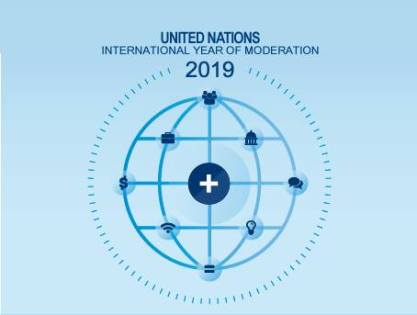
Why this sudden exploration of a vocabulary word? No, not quite a random exercise. Actually, as part of end-of-year exercise, I was checking what 2019 had been ‘Year Of’.  Two I knew about: Year of the Periodic Table, and Year of Indigenous Languages (both covered in the blog). But the third I knew nothing about—that 2019 was supposed to have been the International Year of Moderation. The UN Resolution to mark the Year was moved “to promote moderation as a tool to prevent the rise of extremism and terrorism” and “to promote the values of dialogue, tolerance, understanding and cooperation.” TE202BBC6-BEEB-4844-A799-B9896B8AD33Fhe Year of Moderation was declared in “an effort to amplify the voices of moderation through the promotion of dialogue, tolerance, understanding and cooperation.” The resolution did not pass without huge amount of discussion, debate and dissension. Even at the end, it was not passed unanimously. There were two votes against.
But was it even worth the battle to get the Resolution passed? To begin with, it was the most un-publicized Year ever! And more pertinently, 2019 was anything other than a (let alone ‘The’) Year of Moderation. It was in fact a year of extremes, of polarization, of violence—of thought, word and action. Across the world, governments became more autocratic, and across the world citizens reacted. The world only became more unsafe, less equal and more intolerant.

This was also the 150th Anniversary of Mahatma Gandhi. Another event which has gone by more or less un-observed even in India. The fact that both the anniversaries were ignored is all of a piece. Mahatma Gandhi accepted that people had different points of view and he believed in convincing people through dialogue and discussion. More than anything else, he believed in the fundamental goodness of people, which is the basis of moderation.

Sadly missed opportunities in 2019. Let us see what we make of 2020…

— Meena


Words of Warning

As an environmental educator, one that did not academically have a ‘science’ background, my own ‘learn as you teach’ education included the building up of a glossary of environment-related terms. As environmental educators, our learning needed to be well-grounded; we had to correctly, but creatively communicate the concepts related to the words. In the early 1990s one of these terms was the Hole in the Ozone Layer. We developed an information and activity package to share the causes and consequences of this aberration to Nature’s way of protecting life on earth.

Over the decades that followed, the same exercise was carried out to communicate the issues of global warming, carbon footprint, unsustainability, and other words and concepts that held within them the frightening story of how humankind, in its race for technological and lifestyle progress was carelessly and callously destroying the very foundations of a sustainable life for all living things on earth.

While we struggled as educators to reach out, speci

climate change.jpeg
https://www.cathywilcox.com.au/

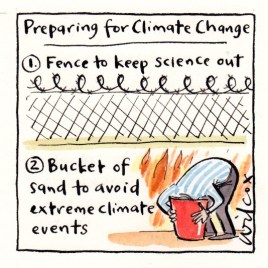
ally to the younger generation with the plea to tread lightly on the earth, the world galloped ahead—consuming more, wasting more, and damaging more, in the race to becoming faster, bigger, and stronger. Nature, overwhelmed, responded with increased frequency and intensity of natural disasters. And scientists introduced, what soon became the ubiquitous  term Climate Change.  This became the blanket word describing the frightening state of the world we live in; the core of international conferences and agreements, and the harbinger of the worse that was still to come. Millions of words were written and spoken on the subject, paying lip service to the concerns about climate change, while actions demonstrated the very opposite.

One way to mark this year that has seen probably the direst impacts of climate change, is the selection of Climate Emergency as the Oxford Word of the Year.  This has been defined as ”a situation in which urgent action is required to reduce or halt climate change and avoid potentially irreversible environmental damage resulting from it.”

The annual Oxford Word of the Year is a word or expression that has attracted a great deal of interest over the past 12 months. Every year, this word is selected from a list as the one that best reflects the ethos, mood, or preoccupations of that particular year, and is perceived to have lasting potential as a word of cultural significance. Surprisingly this year the shortlist was dominated by words related to the environment including ‘climate action’, ‘climate denial’, ‘eco-anxiety’, ‘extinction’ and ‘flight shame’. But the term Climate Emergency stood out like a flashing danger signal.

Interestingly, last year, climate did not feature in the top words typically used in the context of ‘emergency’ which is generally associated with human health, hospital, and family emergencies. The attachment of the word Emergency with Climate reflects, for the first time, the fact that the health of the environment is being viewed with the same sense of urgency as the health of humans. As the editor-in-chief of The Guardian said: ‘We want to ensure that we are being scientifically precise, while also communicating clearly with readers on this very important issue. The phrase “climate change”, for example, sounds rather passive and gentle when what scientists are talking about is a catastrophe for humanity.’

Climate Emergency–Words that warn of impending cataclysm, even as nations and leaders talk and talk at the ongoing UN Climate Change Conference COP 25. Hopefully there will be some words, (and more actions) of wisdom as a fragile world teeters into a new decade.

–Mamata


Silent Reading

Remember how in school we were sometimes asked to read aloud a poem or text to rest of the class, and sometimes we were told that we had to do ‘silent reading’ in which each of us was to read silently to ourselves? I recalled this when I recently read about a concept that is apparently becoming popular. The idea of a silent book club!

The name itself is a bit of an oxymoron.  A book club conjures up a picture of a group of bibliophiles earnestly meeting at designated intervals to discuss at length the ‘assigned’ book. Silent reading brings to mind the concentrated academic reading done in a library, or the simple joy of curling up in a favourite chair with a friendly book; and most often this contentment is a solitary pleasure enjoyed in one’s own home.

The Silent Book Club combines the act of reading, surrounded by other people in a common space, with each person engaged in ‘silent reading’ of their own book. The concept was started in 2012 by two friends in San Francisco–Guinevere de la Mare and Laura Gluhanich. While both loved to read, and also enjoyed the idea of having someone with whom to discuss something they had read, they were equally uncomfortable with book clubs and the pressures of assigned readings and presentations. They imagined a situation where friends could meet together, but with each one reading whatever they liked for a designated time; after which the option to mingle and share remained open.

Unexpectedly, this simple idea has started to become global movement with chapters of the Silent Book Clubs opening in towns and cities across the world. The mandate is simple–bringing people and books together once a month to read in companionable silence in what the founders describe as “introvert happy hour!”

I was intrigued when I read about this concept. Even amused when I read that people are willing to pay handsomely for sitting in a café and drinking coffee while browsing through their book. Why? Because they feel that they cannot make the time for this at home, what with the continuous and overbearing demands of their virtual universe, and distractions of Netflix! Imagine having to wean yourself away from social media for just a couple of hours by physically putting yourself in an alternate space! And I wonder, after the designated time, would one be able to put aside a gripping murder mystery book for the next month, without finding out ‘whodunnit’?

Somewhat difficult for me to get wildly excited over! Luckily for me, (or so I believe) I belong to generation where books were as much a part of, and way of life, as eating and sleeping. When reading could happen at anywhere, anytime, without needing to carve out a special time and space for this. And reading was for one’s own pleasure, rather than an activity to be seen and heard being done. I can’t but help feeling a bit sorry for a generation that needs to be lured into ‘switching off’ and opening a physical book for the simple joy or reading. But if that’s what it takes today, I’m all for it!

The words of Hermann Hesse on the magic of books are reassuring, and timeless: “We need not fear a future elimination of the book. On the contrary, the more that certain needs for entertainment and education are satisfied through other inventions, the more the book will win back in dignity and authority. …And for every true reader this endless world of books looks different, everyone seeks and recognizes himself in it… A thousand ways lead through the jungle to a thousand goals, and no goal is the final one; with each step new expanses open.”

–Mamata


A Smile A Day

It is the face that launched a thousand (and more) emoticons. It is the ubiquitous SMILEY! Probably one of the most recognizable icons across the world, this simple graphic had humble beginnings, and an interesting history.

The original version was created in 1963 by an American graphic artist and ad man Harvey Ross Ball. He was commissioned by an insurance company that had recently been merged with another, and was facing low employee morale. His brief was to create a visual icon to accompany a morale-boosting ‘friendship campaign’ that the company was planning to launch.

smiley.jpg
The original Smiley face Source https://www.smithsonianmag.com/arts-culture/

Harvey Ball  picked up a black pen and a yellow piece of paper and started with just a grinning mouth on a perfect circle. Then he realised that this could be easily inverted to send a “frowney” message, and he added the small oval eyes. The left eye was deliberately created slightly smaller than the right, and the right side of the mouth thicker, larger and slightly off centre, in order to humanize the drawing through its imperfection. Thus emerged the world’s first Smiley Face! The design took Harvey ten minutes, and he was paid $45 for it.


The company first produced this design on a hundred buttons with a 7/8 inch radius, for its employees. But soon their clients also started requesting these, and the company ordered thousands of buttons. Soon the face started appearing on posters and signs also. It is not known to what extent it boosted morale, but the round yellow graphic made up only of two dots and a lopsided line was an instant hit!

Neither Harvey Ball nor the company had thought of taking a trademark or copyright on the design. With its unanticipated popularity, it was only a matter of time before the immense commercial potential of this was exploited. In the early 1970s, two brothers Bernard and Murray Spain added the tagline ‘Have a happy day’ (later changed to ‘Have a nice day’) and copyrighted the logo/slogan combination in 1971. The Spain brothers sold an estimated 50 million Smiley Face buttons, as well as an avalanche of other Smiley merchandise including coffee mugs, T-shirts, posters and, you name it… Beginning in 1996, Walmart tried to claim ownership of the design which they started using in their stores and TV ads. The disputed case dragged on for 10 years before they lost their claim to the Smiley Face.

Over the years as Harvey Ball saw how his simple idea for sharing a smile had changed. He observed that “Smiley has become so commercialized that its original message of spreading good will and good cheer has all but disappeared. I needed to do something to change that.” In 1999, he announced the formation of the Harvey Ball World Smile Foundation, a charitable trust that supports various children’s causes. Its slogan is “Do an act of kindness – help one person smile!”

Harvey Ball died in 2001 at the age of 79. He never regretted the fact that he did not make a penny more than $45 from the million-dollar industry that his Smiley spawned. He was satisfied that the smiling face, “has gone around the world. It’s reached everybody. Its message is as good as you can get.” Proud to be its creator, he often said, “I made the world smile.”

To spread his message, the first Friday in October is celebrated as World Smile Day. A reminder that a smile can make a difference!

–Mamata