The Long Cold Drink

While the summer has been relatively mild, there is still that hot day when after a foray outdoors, one would give anything for a long, cold drink.

But which one?

Rooh Afza

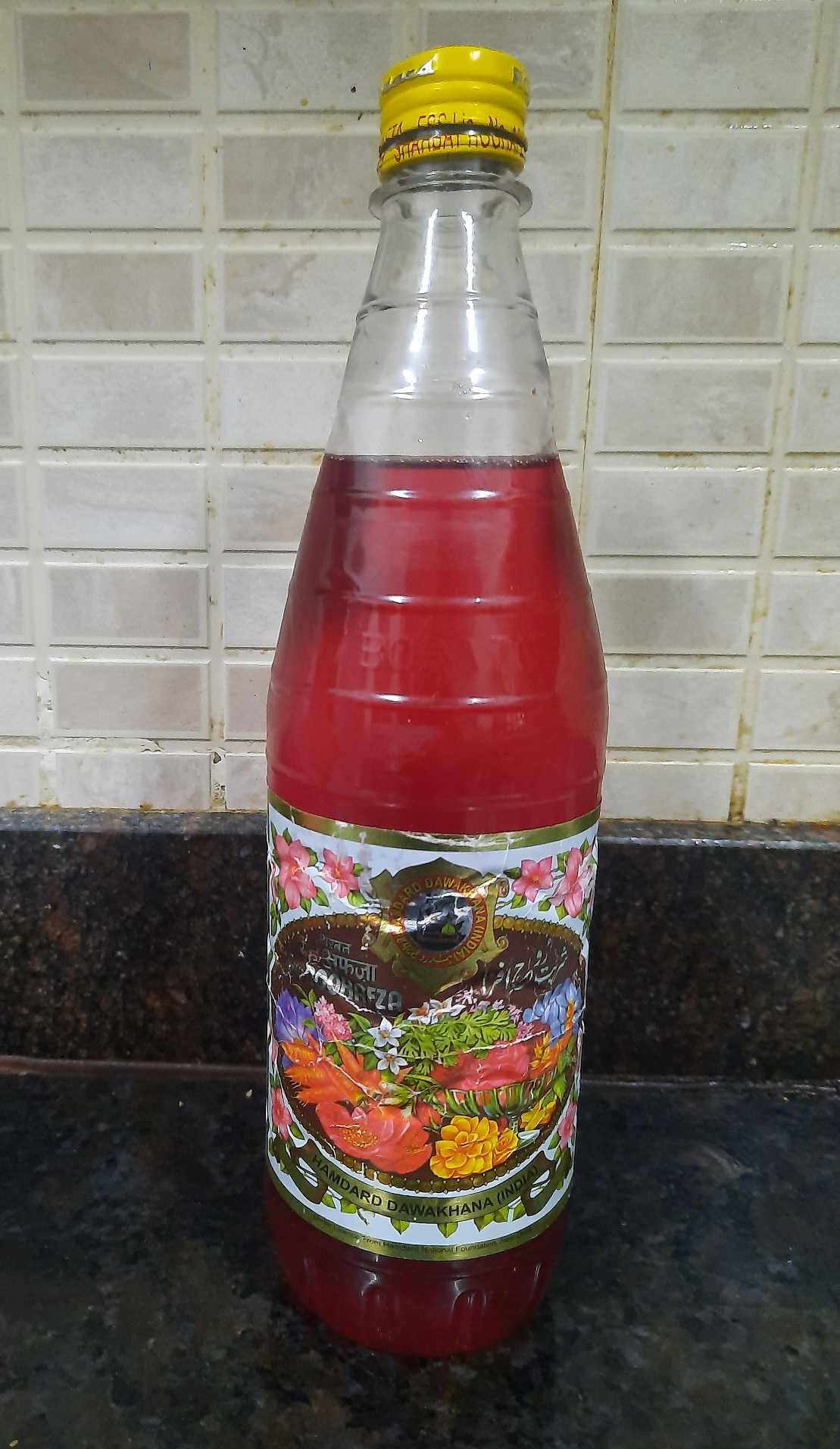
A sharbat? Often called the world’s first soft drink (there are references from as far back as the 12th century), the sharbat probably has its origins in Persia. At least the word itself does, and means a sugar and water drink. It is made by combining fruit juices or extracts from flowers or herbs with sugar and water. India’s favourite sharbat is of course Rooh Afza which means ‘refresher of the soul’. It was formulated in 1906 by Hakim Hafiz Abdul Majeed based on a Unani formula, and contains cooling ingredients like rose. Manufactured by Hamdard (in India, Pakistan and Bangladesh!), this is had with either water or milk, and also poured on falooda and other summer-special sweets.

If you are in Tamilnadu, you can also sample a sharbat unique to those parts—the nanaari sharbat. This is made from the nannari root (Indian Sarsaparilla) which is an Ayurvedic herb. This too is supposed to have cooling properties and helps to prevent dehydration. It is not a taste everyone likes, but for those who do, it is summer’s nectar.

Or how about a squash? Kissan orange squash used to be the staple of our childhoods, a treat that usually was served when guests came around. Also available was lemon squash, and I think pineapple. Basically, a squash is a non-alcoholic drink, made from fruit juice (usually citrus fruits), water and sugar. Sometimes, food colouring and flavouring are added. Squashes are mixed with water or soda before drinking, or even with alcoholic beverages to make cocktails.

Kissan also used to have a lime cordial drink, which for some reason was more rarely bought by my mother. So of course it was something we all hankered after! But now I learn that there is no difference at all between the two! The term squash is used more in the UK, and cordial in the US. However, cordial can sometimes be used to denote an alcoholic beverage like a liqueur, while a squash is always non-alcoholic.

But as age catches up, sharbats and squashers which are super-high on sugar are something that one has to keep away from.

Well, juices I suppose can take their place. Juice can be freshly squeezed or out of bottles or cans. The latter variety may just be the juice canned in liquid form, or made from concentrate. Juice from concentrates is made from fresh fruits, only the water is removed from the fruit pulp. It is easier to transport, and when it reaches its destination, it is reconstituted with the same amount of water that was removed, and canned.

‘To juice or not to juice’ is an eternal controversy. Medical opinion holds that juicing is no healthier than eating whole fruits or veggies, as it is not easier to absorb nutrients from juices than the whole fruits. It is also not significantly less healthy, as most of the vitamins, minerals and plant chemicals come into the juice as well. The only loss may be of fiber, which is lost in the process. So you can guiltlessly drink juice and count it against your fruit/veggie quota, and feel cooler (pun intended) in the process.

And of course the ever-favourite desi options, of which lassi and buttermilk or chaas lead the pack. Lassi, popular in the North, is thick and hearty, and made by blending yogurt with sugar, flavourings, nuts etc. There is also of course the salted version. The ‘malai marke’ version can be a meal in itself!

The ‘chaash’ or ‘mooru’ popular in the West and South is the liquid left after churning butter. It is light and invariably salted, and seasoned with cumin, curry leaves, hing etc. It can be consumed by the gallons!

Nimbu shikanji is Indianized lemonade. It is like a lemonade but with the mandatory addition of shikanji masala which has roasted cumin powder, chaat masala, etc.

Then there is the Aam Panna made from raw green mangoes, sugar, and spices. Again a bit dicey for the amount of sugar needed (and no, substitutes don’t taste as good!).

Another delecious drink is panagam, popular in Tamilnadu. Made of jaggery and lemon juice, and seasoned with cardomom, it is traditionally made for Rama Navami. Sadly, it is forgotten for the rest of summer.

And how can I end without a reference to jigarthanda, the drink of the city of my birth, Madurai? It means something like ‘cool heart’ and obviously is an import from the North. It is made of milk, almond gum, sarsaparilla root,  sugar and ice cream.  Madurai has much to offer visitors, from temples to bazaars. But a visit, especially in summer, would not be complete without a jigarthanda from one of several stalls, all of which of course claim to be the ‘original’!

Whatever your choice, stay cool!

–Meena

Shinrin-yoku: Forest Bathing

International Day of Forests is marked on 21 March every year to highlight the importance and significance of forests and raise awareness about forest restoration. Much has been written about the ecosystem services that forests provide. They purify the water, clean the air, protect the soil, help sequester carbon to fight climate change, and provide food and medicines. Healthy forests are vital for all aspects of a healthy planet, from livelihoods and nutrition to biodiversity and the environment.

Every year the United Nations declares a theme for the International Day of Forests that addresses one of these many aspects of the important role of forests. The theme for 2023 is Forests and Health. This highlights the many connections between human health and forests—from providing food and other life-sustaining resources, including life-saving medicines. 

The contribution of forests on physical health have been well documented, but perhaps not as well-known are the therapeutic effects on mental health. This area has been the field of study of Dr Qing Li who has researched and documented what intuition and common sense have long believed: that being among trees is healthy; it can have positive effects on sleep, energy levels, immune function, and cardiovascular and metabolic health.

This research is well known in Japan and the idea has become popular under the name Shinrin-yoku or Forest bathing.  Forest Bathing is described as the art of plunging oneself in nature to revitalise and enliven the mind, body, energy and to trigger the therapeutic elements of nature.

Forest bathing or therapy originated in Japan in 1980s. Dr. Qing Li is considered to be the founder of this therapy. Dr Qing Li was born in a small village in China and grew up surrounded by nature. He came to Japan in 1988 to study advanced medicine where he was focusing on the effects of environmental chemicals, stress, and lifestyle on immune function and human health. During this period he spent a week camping on a thickly wooded island with his friends. This visit had a profound impact on him, not just personally, but also changing the direction of his professional life.

Experiencing the feeling of well-being amidst the trees, and since it is well-known that stress inhibits immune function, Dr Qing Li developed the hypothesis that immersion in the forest may have a beneficial effect on the immune system by reducing stress. He tested this hypothesis by conducting many experiments on patients with physical as well as mental health issues. He looked at the effects of walking in forests and of phytoncides (the scents that trees give off) on immune cells, stress hormones, blood pressure and heart rate. He compared the effects on mood and mental state (anxiety, depression, anger, fatigue, and confusion) of walking in forests versus walking on treeless city streets.

He focussed his research on what he calls ‘forest medicine’. As he describes this: Some people study medicine, some people study forests; I study forest medicine to find out all the ways in which walking in the forest can improve our well-being.

Forest medicine which encompasses the effects of forest environments on human health is recognized as a new interdisciplinary science, belonging to the categories of alternative medicine, environmental medicine, and preventive medicine.

The terms Shinrin-yoku (literally Forest (Shinrin) bathing (yoku) in English) were first defined in a paper he wrote in 2007.

In his research, Qing Li has found that forest bathing had a healing effect on the mind as well as the body. It reduced blood pressure, reduced stress, improved mood, increased ability to focus, even in children with ADHD, accelerated recovery from surgery or illness, increased energy level, improved sleep, boosted immune system functioning, with an increase in the count of the body’s Natural Killer (NK) cells.

As an outcome of Dr Qing Li’s research, the government of Japan established Shinrin-yoku as a formal practice. This was not only to encourage city-dwelling people to connect with nature. The idea was also part of a campaign to protect the forests: If people were encouraged to visit forests for their health, they would be more likely to want to protect and look after them. The Japanese government invested a lot of money in forest bathing with the goals of protecting the forests, promoting human health, and preventing lifestyle-related diseases.

So what exactly is Forest bathing? This is not exercise, or hiking, or jogging. It is simply being in nature, moving slowly, and connecting with it through all our senses: sight (colours), hearing (forest sounds), taste (fruits and herbs), smell (fragrances from different plants) and touch (feeling textures of leaves and barks). So Shinrin-yokuis the entire experience of immersion in the forest atmosphere, or taking in the forest through all our senses.

The idea behind Shinrin-yoku is very simple: it is the belief that if a person visits a natural area and explores it in a relaxed way, they can achieve physical and mental benefits that are healthy and restorative. It is a form of preventative health care that can be incorporated in nature settings anywhere. You don’t necessarily have to travel to a forest to experience the effects of Shinrin-yoku. Even half an hour in a small park can work its magic. As Dr Li reminds us:

The best way to deal with stress at work is to go for a forest bath. I go for shinrin-yoku every lunchtime. You don’t need a forest; any small green space will do. Leave your cup of coffee and your phone behind and just walk slowly. You don’t need to exercise, you just need to open your senses to nature. It will improve your mood, reduce tension and anxiety, and help you focus and concentrate for the rest of the day.

Today, world over, we have become an increasingly urban and indoor species, focussing solely on screens for a large part of our waking hours. All aspects of our life and lifestyles have led to an escalation of stress, anxiety and depression. Before we sink further into these morasses, let’s take a few minutes to heal ourselves in nature.   

Forests and Health: the theme of International Day of Forests this year is best captured in the words of the guru of Shinrin-yoku:

Forests reduce our stress, boost our immune system and help us to live longer, better and happier lives. Our health and the health of the forest go hand in hand. When trees die, we die. If our forests are unhealthy, then so are we. You can’t have a healthy population without healthy forests.

–Mamata

Bangarpet? Chaat?

What is the connection between the two?

If you live in Bangalore, you wouldn’t ask that question, because every other chaat-cart and every third chaat-shop labels itself as a purveyor of Bangarpet Chaats.

Seems a bit unlikely when we all know that chaats, especially gol-guppas (or pani-puris or puchkas) are not part of the street-food tradition of South India. Tradition places the origin of gol-gappas squarely in North India—most probably Uttar Pradesh.

It is a dish of ancient origins, though how old is of course difficult to say, given our mix of mythology, history and folk tales. According to an interesting Mahabharata-linked story,  Kunti wanted to give Draupadi a test when she first came home. To check whether the new princess-bride would be able to cope with the family circumstance—they were then living in exile in the forests—she gave her some leftover vegetable dishes and enough dough to make one puri. She asked her to cook something for the whole family with this. Draupadi came out with a brilliant innovation, the pani-puri! Kunti was very happy and blessed her. And she also blessed the dish with immortality! (Definitely not fair that Kunti should give her a test, but the usually spunky Draupadi does not seem to have protested. Imagine if Meghan Markle had been in Draupadi’s place—how many TV shows and books would this incident have been worth!).

More historical accounts are divided between two origins—either the Mughals brought the dish with them, or it was made in ancient times in temples as a prasad (I like this God!).

Whether Kunti’s blessing or some other factor, I for one am so grateful that pani-puris in all their variations are ubiquitous today.

Which brings us back to the Bangarpet Chaats and pani puris. Bangarpet is a town in the Kolar district of Karnataka, which came into existence because it was at a useful junction between the Kolar gold fields and the city of Bangalore. It has a population of about 45,000. But for the Bangarpet chaat, the town would be one more obscure dot on the map.

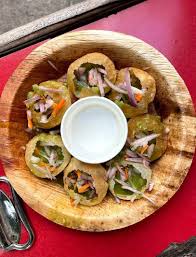
So what is special about the chaats from here? The ‘pani’ of the ‘pani-puri’.  Pani-puris from here are called white pani-puris, for the colour of the water. Usually, the pani is a brown-green, thanks to tamarind and pudina being major ingredients. The Bangarpet pani is not so much white as clear. The secret is not different ingredients, but rather that many of the usual ingredients–cumin, green chillies, ginger, lemon etc.–are all ground together and steeped in the water. The resultant water is then  trained leaving behind a tangy, spicy clear liquid. The innovation came from the heir of a chaat shop. R. Panduranga Setty had been running a chaat shop for many years. When his son Ramesh took over, he wanted to give his own special signature twist, and after much experimentation, came out with this variation which become very popular very quickly. Ramesh Chit Chat at Bangarpet still serves the best version of these, though the popularity has spread far and wide, and we can see Bangarpet chaat shops all over South India—each one asserting that it is the original!

But honestly, who cares where the dish originated? As long as I get my fix of this and all the other variations!

–Meena

Wrap it up!

On Saturday, our 4 year-old neighbour celebrated his birthday. I was my foster grandchild’s ‘plus one’.

It was a lovely affair—games, fun, frolic and yummy kiddy-eats.

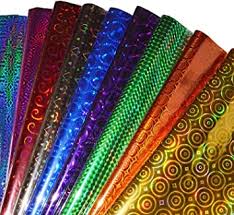
And of course gifts of various sizes and shapes. What united them all was that they were beautifully wrapped in metres of gift paper—shiny, animal printed, cartoon printed, etc. etc.

And the birthday boy, as would any 4-year old, quickly ripped open the packages eager to see what was inside. And the sad pile of paper at his side grew and grew and grew.

Which got me wondering about the waste the practice of gift-wrapping produces.

I fully appreciate how beautiful wrapping adds to the allure and attraction of the gift. How a well-wrapped gift is elegance itself. In fact, countries like Italy and Japan have taken this to the level of a fine art, so that one would rather look at the gift and not open it at all!

But…

….the waste!

Wikipedia informs us that ‘In Britain, it is estimated that 226,800 miles of wrapping paper is thrown away annually at Christmas. In Canada, 6 million rolls of tape are used and discarded yearly for gift wrapping at Christmas.’ There are no statistics that I could easily find for other countries, but of course, with the US being the largest consumer of wrapping paper, the waste there must be in multiples of these figures.

The global market for wrapping paper is estimated at about $ 17.3 billion and growing at a compounded rate of 7.4%. It makes up 2-3% of the world’s paper and paper board market. India and other countries with growing middle classes are expected to be high-growth markets for this product. It is estimated that total sales of gift paper in India will reach about $ 443 billion in 10 years.

I am not sure how much paper all this translates into, but surely sounds like a lot. And most of it is thrown out with the garbage the morning after.

We are assured by many industry sites that gift wrapping paper is sustainable, being made of recycled paper. But making recycled paper in beautiful colours and printing complex designs on them, embossing them, adding gold and silver touches—all of these take energy and release pollutants. And then they go straight into the dustbin. And let’s not forget the increasing trend of shiny, metallic and plastic wrapping paper which are surely not environmentally benign either in the production or disposal. Not to talk about the tape, ribbons, decorative flowers and bows that we put on the gifts.

As we worry about our climate goals and Sustainable Development Goals, this, to my mind, must find a place in our worrying. It’s not as big and visible as fashion and clothing to catch international attention and set off movements towards sector-sustainability. But it surely warrants some thought.

Environmentally conscious people do use alternatives, from unwrapping gifts carefully so as to reuse the paper, to getting creative and making beautiful wraps with newspapers or waste papers, to using bottles and jars for some items, to popping them into a reusable gift bags without wrapping them, to deploying reusable decorative boxes. The Japanese tradition of furoshiki stands out in this—it is the art of using reusable fabric to create beautiful gift wrapping.

But I think society itself has to change its attitude. If it continues to place more value on style than substance, the trend of increasingly fancy wrapping will continue upwards, as disposable incomes increase and societal norms of what is expected grow more and more elaborate.

It is quite the thing these days to say ‘No gifts please’ on invites. But that’s not always possible. No child wants a gift-less birthday party!* Maybe we could make a start by saying ‘No gift-wrapping please’?

–Meena

* My friend Alka did try this once. She specified that kids should not bring gifts for her son’s birthday. Only to get a call from an anxious 10-year old, enquiring if no-gifts also meant no return-gifts! She assured him it did not, and the attendance at the party was 100%.

Tea and Biscuits

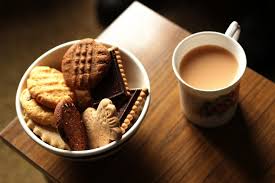
One has always associated the typical English cuppa with a snack of biscuits. A recent news item reported that the new trend in England, especially among the younger generation, is the popularity of samosas as the preferred snack with tea. This is indeed a total reversal of the traditional colonial notion of appropriate accompaniments to tea.

The English connection between biscuits and tea saw two different aspects during the two World Wars. Huntley & Palmers, the first officially designated biscuit manufacturers in England set up a factory in Reading in 1846. By 1874 it was producing tens of thousands of tonnes of biscuits, becoming the world’s largest biscuit manufacturer. When World War I started in 1914 it received a substantial order from the War Office to manufacture biscuits for the British army. The company manufactured Army Biscuits Number 4 and 9. The ‘Service’ biscuits as they were called, were about four inches square, and were made of whole wheat flour, without sugar. The biscuits provided sustenance, but were very hard and could only be eaten when soaked in tea or water. The fact that some of the biscuits survived intact for a hundred years attests to their durability!

Biscuits and tea found a different connection during World War II in England. By then sweet tea was favoured by the British working class. During the war, tea as well as sugar were severely rationed; there were complaints that tea was not sweet enough. So biscuit manufacturers stepped in by supplying the canteens for civilian war volunteers and other services with biscuits which would add a touch of sweetness with the tea. By the end of the war, it became a reflex for many to have biscuits with their tea. This English tea habit also took roots in what were then colonies of the British Empire.

In India, for many of a certain generation, the words ‘Britannia biscuits’ were almost synonymous. The history of these is interesting. Britannia Industries is one of India’s oldest existing companies. It was founded as a small operation in 1892 by a British businessman, with an investment of Rs 295/-.The first biscuits were manufactured in a small house in what was then central Calcutta. In 1897, the outfit was acquired by four Indian brothers, the Gupta brothers, and was called VS Brothers. In 1918 Charles Holmes, an English building contractor and friend of the Gupta family became a partner in the business. Holmes had a construction firm called Britannia Construction Co. and thus VS Brothers the biscuit manufacturer was renamed by him as Britannia Biscuit Company Ltd.

World War 1 (1914-1919) provided a huge boost for the newly-named company Britannia which was contracted by British colonial government in India to supply specially made biscuits for its soldiers on the frontlines. Thus Britannia joined Huntley & Palmer as suppliers of Service biscuits.

Britannia became the first biscuit maker in India to mechanize production, and the first one east of the Suez Canal to use gas ovens, which it imported in 1921.

In the early 1920s the two most successful biscuit manufacturers in the UK Peek Freens and Huntley & Palmers merged to create a company called Associated Biscuit Manufacturer’s Ltd. This led to world-wide expansion. Britannia merged with this larger company in 1924, and set up a factory in Bombay to meet with the growing demand. The company began establishing a reputation for quality and value. It further strengthened its position by expanding the factories at Calcutta and Mumbai.

During the Second World War, once again the company was contracted to produce Service biscuits, and from 1939-45 almost 95% of its total production capacity was used for this war-time effort. 

In 1952 the Calcutta Factory was shifted to spacious grounds at Taratola Road in the suburbs of Calcutta. During the same year automatic plants were installed there, and later in Mumbai in 1954. The same year the company began production of high-quality sliced and wrapped bread in India. This was first manufactured in a new factory set up in Delhi and first sold there. In 1955 the company launched the all-time favourite Bourbon biscuit in India, followed by Britannia cakes in 1963. In 1978, the Indian shareholding in the company crossed 60%. The Company was re-christened from Britannia Biscuit Company Limited to Britannia Industries Limited with effect from 3rd October 1979. By 1994 the annual production crossed one lakh tonne of biscuits. In 1995 Britannia made it a mission to make every third Indian a Britannia consumer and changed its corporate identity to “Eat Healthy, Think Better”. Since then the company has grown from strength to strength, introducing new brands that rapidly became household names. The company sells its Britannia and Tiger brands of biscuits, breads and dairy products throughout India and in more than 60 countries across the world.

While Britannia is one of the oldest biscuit manufacturing companies in India, today there are several companies that offer choices of sweet or salty biscuits. From Parle G, the world’s largest selling biscuit brand in 2021, to the cream or chocolate-filled cookies, to a host of “healthy, low-carb hi-fibre” options. These are not necessarily ‘tea biscuits’. They are multi-place, multi-use snacks, easy to carry, quick to unwrap and fun to savour even on their own. Even while crunching and munching on biscuits, Indians also continue to enjoy the traditional teatime snacks and savouries of which every state and even every household have their own specialties and favourites—from ganthiya in Gujarat, to murukku in south India, to regional varieties of vadas and pakoras. And of course, the transnational favourite samosa. 

Now it looks like we have come full circle—from Indians adopting English biscuits with chai, to the English adopting samosa with tea!

–Mamata

It’s a Dog’s Life!

At the outset let me start with a disclaimer. I have nothing against dogs. In fact I love dogs and my family has had pet dogs right through my childhood and adolescence. And thus any dog-related story catches my eye. The most recent one was a story in my local newspaper that perhaps really takes the cake.

The story that covered several column inches mourned the passing away of a Saint Bernard dog who had been purchased at a premium price, and translocated from the alpine heights to a home in arid Gujarat. The tiled floors of the home had been replaced with wooden floors for the ease of walking of the big dog. The much pampered ‘son’ of the family was fed on milk, curd and paneer from the best Gir cows, as well as seasonal fruits like papaya and melon. The dog was also celibate, which the owners claimed added 4 extra years to his life [sic]. The dog’s recent passing away was marked with full Vedic rites.   

As an avid (physical) newspaper reader it is the news that does not make the headlines that attracts my attention, and provides me not only with wonder and amusement, but also in some ways, provides a window into ‘trends’, as it were.

Prominent among these has been the increasing amount of space being taken up by pet stories, with particular reference to dogs. In the past one usually found a small news item about the annual dog show, with a few pictures of prize winning dogs with their proud owners. Then came dog trainers, followed by dog sitters and dog walkers; these were usually found through word of mouth, or were duties of the domestic help or the children who had a roster of turns to take the dog for its little ‘routine’.  

In the last couple of years one has been seeing from a quarter to a half page of glossy newsprint with dog-related information. This is in the form of advice and tips for “pet parents”. This includes not just diet and grooming, but also a gamut of psychiatric support (which grew exponentially during the pandemic). These can make up a best-selling Dr Spock for canines!  How to handle ‘sibling’ jealousy when your (human) baby is born; How to handle separation anxiety when you return to office after a long stretch of WFH; How to keep your dog from joining the zoom call (without making it feel left out!). There is a whole new profession of pet therapists, psychiatrists, and even ‘pet psychics’ who claim to have telepathic powers to communicate with pets to understand what they are going through and offer support on mental health issues.  

Then of course there are grooming tips galore. Starting with exclusive brands to pamper your pet; these are offered through “pawsome” spa treatments which include luxurious shampoo and bath, hair trimming and styling, and nail clipping, but also offer services like aromatherapy and acupressure massages. One such service even claims: “We offer a unique microbubble spa therapy, with high-density ozone bubbles for cleaning the pets’ coats. Apart from being an absolute fun session for them, it helps deal with rashes and irritation. We also have an automatic pet cabin dryer for noiseless and quick drying,” Bow Wow Wow!

I remember well the weekly struggle I had to put up with to just quickly pour one bucket of water over my very recalcitrant dog. And I still have a scar from when he bit me on a particularly difficult bath day! It will take a wild jump of fantasy to imagine my Bosky wallowing in microbubbles!  I marvel at the ‘new age’ canines who presumably sink gracefully into a bubble bath as they politely extend their paws for a perfect ‘pawdicure’.

But why stop at an afternoon at a Spa? In the highly stressed world that they inhabit, don’t dogs need some ‘time out’ too? Well the travel and leisure industry is all set to make this happen. There are dog resorts, and even luxury hotels for staycations and weekend getaways. Making news is Critterati a luxury pet hotel in Gurugram India which offers ‘air conditioned room; premium beds with luxury bedding, soft padded floors that are easy on paws, three meals for small buddies, and two meals for medium, large and X-large buddies; four times potty break; a nightcap treat before bedtime; TV lounge access; pampering sessions; socializing, vet visit, daily hair brushing to improve blood circulation.’ I kid you not! Check out their website.

Between vacations, for the occasional ‘doggy dine out’ there are dog cafes in many cities that offer a wide menu for the discerning pooch palates—from specially brewed beer to designer dishes. For the more politically correct canines there are sustainable vegan and gluten free options. For a change from the urban jungle there are pet event planners that offer ‘bespoke’ picnic experiences amidst nature.  

I think back to my dogs who lived a middle-class life as did we, doing very well thank you, on roti and milk. The highlight of my Bosky’s gourmet experience was being indulged by my old aunts with the traditional Gujarati snack of ganthia!

From food to accessories the race is on to offer something new, different, unique, and basically ‘pawsome’! A recent half page article in my newspaper described how to help pets beat the heat an array of cool accessories. These included a dog umbrella, a self-filling water bowl and a water bowl that keeps water cool, cooling collars and cooling mats.

With millennials as pet parents it sure is not a dog’s life anymore!

No wonder then that the pet care market is booming as never before. While it has been on the upswing in other countries, India is fast catching up. It is the world’s fastest-growing market, expanding at around 17% annually and is expected to be valued at around $500 million by the end of 2022. Among the growing affluent  generation of aspirational millennials who have the means to indulge their pets as they do themselves, there are also enterprising millennials who are smartly cashing in on the rapidly growing demand by creating and offering a tantalising menu of pet services and products.

If every dog has his day, this indeed is the day and age for every dog!

–Mamata

Of Collars and Colours

A collar is innocently defined as ‘.. a piece of clothing, usually sewn on and sometimes made of different material, that goes around the neck’. So when and why did the word become so loaded with connotations of class, occupation, gender, etc. etc.?

Collar

It seems to have started more than a hundred years back, in the early days of the 20th century. In a practice that started in about 1924, people involved in manual labour started to be referred to as blue-collar workers, as they wore sturdy, inexpensive clothing in colours like blue that didn’t show dirt easily. They were usually daily-wagers. The famous American writer Upton Sinclair is supposed to have coined the term ‘white-collar workers’ in the 1930s, for the white shirts that were popular with office workers at that time.  These are usually clerical, administrative and managerial workers who work on a regular salary.

And in the last few decades, as the nature of work changes, the number of collar colours has exploded.

Here is a look at some of these terms—some fairly common, and some pretty esoteric and niche. Nor is the meaning uniform across the world—a single colour can have many different connotations.

  • Gray collar jobs fall in confusing area, where it is not quite clear if the jobs are white collar or blue collar.  It sometimes denotes under-employed white collar workers.  Some use it as a term for people in the information technology sector. Yet others use it to denote older workers.
  • Red collar workers are those who work in government, supposedly because they draw their salaries from budget lines denoted in red ink. In some parts of the world, those in occupations in primary sectors like agriculture are called red collar workers.
  • Green collars work in environment related jobs and renewable energy jobs. This will hopefully see an explosion as we move towards carbon targets.
  • Black collar workers are those who are involved in manual work in sectors like mining or oil drilling. But sometimes it is used to denote those involved in illegal occupations.
  • Pink collar jobs used to denote job in domains traditionally staffed by women, but has now  fortunately expanded to stand for workers of all genders in the service sector.
  • Orange colour workers refers to prison labour.
  • Gold collar jobs refer to those occupations which need highly-skilled people, and people with specialized knowledge, such as doctors, lawyers, scientists.
  • New collar jobs are those which emphasize skills and capabilities rather than formal educational qualifications, such as the IT industry is moving towards.
  • No collar jobs are for the free spirits such as artists who pursue their passions, rather than money.
  • Popped colour jobs is a new emerging term for young people from rich families who take on 9-5 jobs for character building.
  • Virtual collar or Chrome collar jobs are used to denote robots performing automated, repetitive tasks.

So collar colours are alive and well! Never mind if many of the business icons of today as well as many workers wear collar-less shirts! Sadly, collar colours continue to stereotype people by their occupations, and make assumptions about their level of education, job responsibilities, working conditions, financial situation and even social class.

Well, the only lesson is ‘Don’t judge people by their collar colour’!

–Meena

A Fish on the Road

 Novelty or mimetic architecture is a type of architecture in which buildings are given unusual shapes for purposes such as to convey a message about what they represent, or to copy other famous buildings. They ‘mimic the purpose or function of the building or the product they are associated with.’ They are structures built with the intention that they be used. (They are different from architectural follies which are unusable, ornamental structures often in strange forms.)

While the style started in the US somewhere in the 1930s, India is quite a leading light. Any respectable  ’10 most..’ or ’15 most..’ in the world of mimetic architecture lists would include three buildings from India: the Chowdiah Memorial Hall, Bangalore; the Fish Building Hyderabad; and the Lotus Temple, New Delhi. So maybe we should quickly recap what these are.

The Chowdiah Memorial Hall is a major cultural Centre in Bangalore. It is shaped like a violin to commemorate Thirumakudalu Chowdiah, the violin maestro. The building, designed by Mr. SN Murthy, was completed in 1980. It is shaped like a huge seven-stringed violin, and has all a violin’s essential elements, like the strings, keys, the bridge and the bow.

The Fish Building, Hyderabad, inaugurated in 2021, houses the offices of the National Fisheries Development Board. It is a 4-storey building which incorporates elements of the fish-form, like two circular windows as eyes. The building stands on pale blue pillars and is lighted by blueish lights in the night, to give the impression of a fish swimming in water.   Designed by Narasimham Associates (as far as I can make out!), it is said to be inspired by Frank Gehry’s ‘Fish’ sculpture located in Barcelona.

The Lotus Temple, a temple of the Bahai faith, was designed by the Iranian Faribroz Sahba, and was dedicated in 1986. It is a major tourist attraction of New Delhi. Made of 27 free-standing marble-clad petals, it is a pretty green building too, with 120 kW of its 500 kW electricity requirement coming from solar power generated by solar panels on the building. It also houses a greenhouse to study indigenous plants and flowers that can be grown in the area.

All this build-up to announce that my own nick of the world (truly a backwater by the name of Rajanakunte, in ‘who-lives-there North Bangalore’) now boasts a fish-shop in the shape of a fish! The proprietor proudly told us that it is the first such in Bangalore city itself, though Mysuru has one! While not commenting on the aesthetics of fish-buildings, either this one or the larger sibling in Hyderabad, my yellow, green and blue fish does add quite a pop to the Yelahanka area which is anyway quite rich in street art.

Other examples of mimetic architecture in India are of course the variously-shaped water tanks in many pockets across the country. It is not uncommon to catch glimpses of water-pots, aeroplanes, cars, tablas etc. atop houses. It seems to be like an endemic—there are concentrations of such water tanks in a given stretch, and taper off in the length of 5 km or so. The other prevalent example of mimetic architecture is police stations, with several of them being shaped like helmets!

There is a whole world of mimetic buildings waiting to be explored, including:  The Big Basket, Ohio, the headquarters of the Longaberger Company, an American manufacturer of handcrafted maple wood baskets; Haines Shoe House, Pennsylvania, the house of successful shoe salesman Mahlon Haines designed like one of his work boots; and the Dancing House Hotel, Prague designed as a tribute to the famous dancers, Fred Astaire and Ginger Rogers. 

As you browse the web to locate these, do also look around. Who knows what is waiting to be discovered next door!

–Meena

Winning Words

Language is always evolving. While some words have a history that can be traced back over centuries, new terms and new uses for terms also continue to emerge, and over time find their place in dictionaries. Much of the new vocabulary in 21st century English reflects major social changes and events that have taken place in the real world. New editions of dictionaries have included expressions such as social media, congestion charge, designer baby, flash mob, toxic debt, WMDs (weapons of mass destruction) and wardrobe malfunction.

The major English language dictionaries have an elaborate process of keeping track of new words and their usage, and based on the studies and statistics, announce the winning word or words of the year.

This is the time of the year when Words of the Year are declared by the leading dictionaries. This is the outcome of a process that reviews the ‘usage evidence’ of certain words during the year. The selection of the word/words reflect, as the Oxford English Dictionary explains “the ethos, mood or preoccupations” of the preceding year, while also having “potential as a term of lasting cultural significance.”

It was thus no surprise that the words of the year 2020 were those that dominated the lives and pre-occupations of people around the world. These included Pandemic, Quarantine and Lockdown. These words moved beyond the English language and became part of a universal vocabulary.

A natural progression from these led to the word that has been declared as the Word of the Year 2021 by the Oxford English Dictionary. The winning word is Vax.

The word first appeared as a noun in the 1980s to mean either vaccine or vaccination. But it in this year, that the small but pithy word has been used in so many ways: to denote status—‘vaxed’ ‘double vaxed’ or not ‘vaxed’; attitude—‘vaxers’ vs ‘anti vaxers’, and events—vaxathons, and vaxxies (vaccination selfies!)

In keeping with the trend of abbreviations which pack a punch of meaning, the Merrian Webster dictionary has released its list of new words added to the dictionary in 2021 that reflects the use of language in the age of online communication. Among the words in this category are:

TBH: an abbreviation for “to be honest.” 

Amirite: slang used in writing for “am I right” to represent or imitate the use of this phrase as a tag question in informal speech. An example: “English spelling is consistently inconsistent, amirite?”

FTW: an abbreviation for “for the win” used especially to express approval or support. In social media, FTW is often used to acknowledge a clever or funny response to a question or meme.

And of course these words are the staple of the vocabulary of  the Digital Nomads—a term used to describe persons who perform their occupation entirely over the Internet while traveling; especially if such a person has no permanent fixed home address.

The acceptance of abbreviations as official words that find their place in dictionaries is not a new trend in the English language. In the late 1600s it was linguistically fashionable to shorten words. For example people said ‘pos’ or ‘pozz’ for positive, meaning ‘that’s certain’ or ‘incog’ for incognito in casual speech. Words which were reduced in size in this way were called ‘clippings’. Common examples of words where the ends were ‘clipped’ were ad, doc and prof. Among the words where the beginning was clipped were phone and burger; and words where both the beginning and the end were clipped included flu and fridge. What started as informal usage became the acceptable use, and the full forms were almost forgotten over time; think of fax, memo, exam, vet, pub and bus! And not to forget the Bots whose mechanical messages have all but replaced human voices.

Perhaps the ‘clipped’ word that has dominated the past few decades as much as the word ‘vax’ may do in this decade is ‘app’.

The idea of an ‘application’, a computer function designed to meet specific user requirement had been around since the 1960s. But it was in 1985 that a writer in a trade magazine used the abbreviation ‘apps’ to denote ‘for applications’. The short form immediately caught on. It was ‘phonetically appealing, a short, perky syllable, that seemed to suit the exciting quick fire developments in digital communication of the time.’

Following this came the idea of a ‘killer app’—a function which in the dreams of the multimedia industry, would be so appealing that people would not be able to do without it.

I am not sure if ‘app’ was ever voted the word of the year, but this is one word that has surpassed the boundaries of the English language; it continues to be on everyone’s lips, and fingertips! 

–Mamata

Blender-Composting for the Lazy Gardener

Compost as we all know, is decomposed organic matter. Rich in nutrients, it is also known as ‘black gold’ for the vigour and fortification it brings to soil. Compost is the end-result of the natural degradation of biomaterials like garden waste and kitchen waste. Everything in nature will degrade in the natural course. But left to itself, it may take years or even decades. Composting is a way to nudge the process along. Win-win, because it reduces the amount of green and brown waste entering the garbage management system, and because the end-product enriches soil.

During composting, microorganisms—bacteria, fungi etc.–decompose the bio-materials. Among these, bacteria play a large part—they secrete a variety of enzymes which chemically break down organic materials. Worms, bugs, nematodes, and other critters in the soil contribute by physically breaking down those materials, which makes it easier for the bacteria, fungi and others to do their work.

The resultant compost provides the soil nitrogen, phosphorus and potassium, along with a host of micronutrients and trace minerals.

Fundamentally, there are two types of composting processes which can go to work. The first is aerobic composting, in which the kind of bacteria at work use air to help speed up the breakdown of materials. The other is anaerobic composting, where the bacteria do not need oxygen to carry out the process.

There are several types of composting methods which can be used, basically classified as:

* Hot Composting: This quickly turns organic material into usable compost, but requires a lot of time and effort. Hot composting involves keeping the temperature at the center of the compost pile elevated, ideally to somewhere between 43-60o Celsius. The pile needs to be kept turned once a week or so to move colder material from the outside of the pile to the inside where it is heated and so breaks down into rich humus more quickly

* Cold Composting: Cold composting essentially means creating a compost pile and leaving nature to do its job. It requires less input from the gardener, but does mean that useable compost can take up to a year to be ready.

* Vermicomposting: Here worms are added to hasten the process of composting.

Popular domestic composting methods include open air composting, bin composting, tumbler composting and vermi-composting.

On and off, I have tried my hand at composting my kitchen waste. But being both lazy and inept, it was a mess each time!

Then I came across a method called trench-composting, which basically involves digging up the area around your plants in a shallow ditch, spreading the cut-up kitchen waste in the ditch, and covering it back with soil. I liked this method. Kind of no-fuss, no-muss; possible even for the ten-thumbed like me; and can be done on a daily basis. But then I ran into a problem. This was possible in the kitchen patch or even in the flower-beds. But what about the lawn? I could obviously not dig trenches there.

Then an idea struck. Why not blend up the kitchen waste and just pour it on the lawn? I reasoned that it would return nutrients to the soil, and would also results in a huge reduction of the kitchen waste going out into the waste management system. I started doing this.

And also decided to check if this idea had struck anyone else. Well, yes. Looks it has! The internet has accounts of what is called Blender-Composting. Several gardeners use it, though I could find no scientific papers on it. As some of the participants in the debates point out, this is not composting at all, since one is only physically crushing the pieces. But since that is the starting point of the composting process, I suppose it will help the bacteria and other micro-organisms do their work faster. Gardening experts say that addition of reasonable amount of bio-waste in this form can only have positive effects on the soil, even though it is not clear how much. However, they do caution against adding too much of this, as the early stages of the composting process could deplete nitrogen from the soil.

I can vouch that there is no smell and the goop, properly diluted and spread, attracts no flies or other insects. But depending on what goes into it, the goop can sometimes be yucky-looking, in fact referred to by some as ‘dragon-vomit’. I can vouch for this also—the day the goop is papaya-based, I definitely have to hide it in the soil in the hedges and bushes!

I am sold—it is either trench composting or blender composting for me!

–Meena