Our Dangerous Dunning-Kruger World: Why Ignorance Wins.

Have you ever sat through a meeting where someone confidently proclaimed an idea that made you wonder if you were the only one who found it… well, questionable? Or listened to a neighbour explaining, with great authority, how to “fix the economy” or “end corruption,” in the time it takes for the traffic light to change?

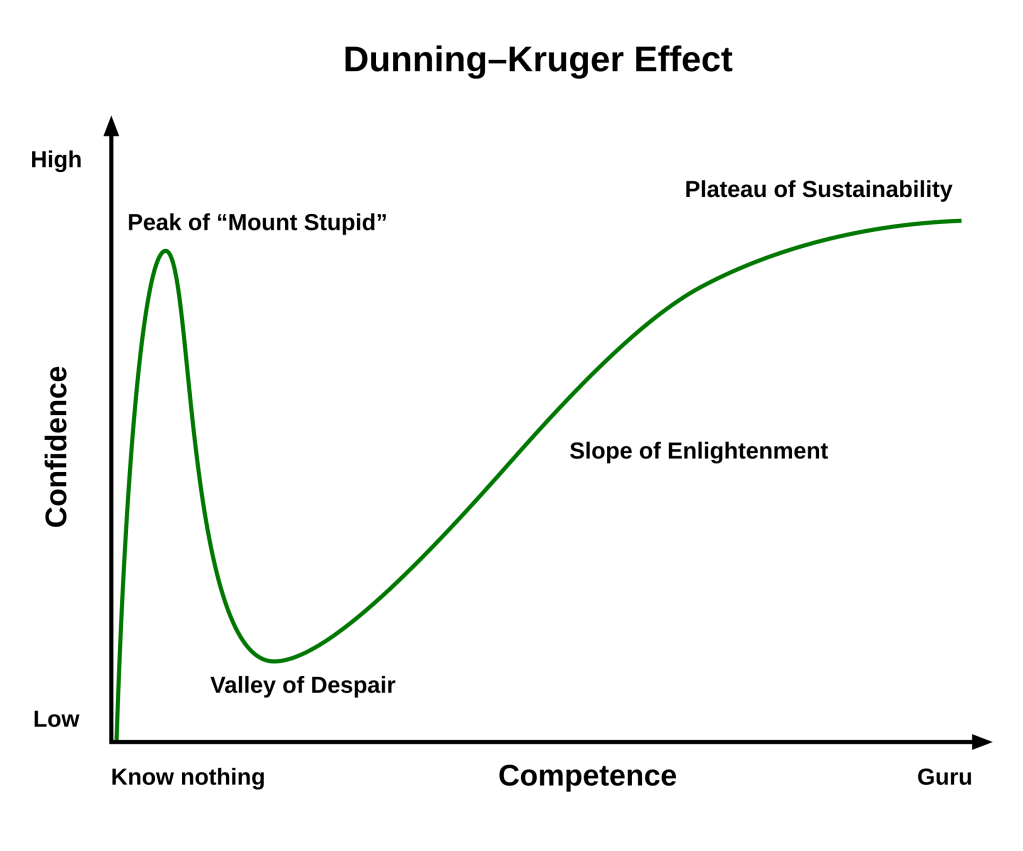
Chances are, you’ve witnessed the Dunning–Kruger Effect in action — that quirk of human psychology where people with limited knowledge or skill in an area tend to overestimate their competence. Ironically, the more ignorant we are about something, the more certain we can feel about our opinions.

The term comes from two psychologists, David Dunning and Justin Kruger, who in 1999 published a study with the rather unexciting title “Unskilled and Unaware of It.” They were intrigued by a bizarre news story about a man who robbed banks after rubbing lemon juice on his face, believing it would make him invisible to security cameras. The man wasn’t joking — he genuinely thought he had found a clever loophole. Dunning and Kruger wondered how someone could be so wrong and yet so sure.

Their research showed that people who perform poorly on tests of logic, grammar, or humour not only make more mistakes — they also lack the skill to recognise those mistakes. In contrast, the truly competent often underestimate themselves, assuming that if something is easy for them, it must be easy for everyone.

So we end up with a world divided between the confidently incompetent and the competently cautious.

If this sounds like a comment on social media, well……. Platforms like X (formerly Twitter) and Instagram stories are veritable festivals of the Dunning–Kruger Effect — where the loudest voices are often the least informed. Whether it’s miracle diets, “instant wealth” advice, or armchair experts diagnosing global issues, confidence is never in short supply. Accuracy, on the other hand, might need a search party.

But before we roll our eyes at others, it’s worth pausing. The uncomfortable truth is that we’ve all been there. Remember that time you confidently assembled a piece of IKEA furniture without reading the instructions — and then found one mysterious screw left over? Or when you tried to give a five-minute explanation of blockchain to someone who actually works in finance? Yes, that too is Dunning–Kruger territory.

What makes this effect particularly sneaky is that it feeds on self-assurance. It feels good to be certain. Admitting “I don’t know” can feel like weakness. Yet, as Socrates famously said, “The only true wisdom is in knowing you know nothing.” In other words, humility is intelligence in disguise.

The flip side of the effect is equally interesting. Those who genuinely know their stuff often hesitate to speak up. They second-guess themselves, feel like impostors, and worry that they might be wrong. This is where the Impostor Syndrome meets the Dunning–Kruger Effect — a perfect psychological storm that ensures the least qualified sometimes take charge, while the best-qualified stay silent.

So how do we guard against it? A few simple habits can help:

  • Ask questions. Even if you think you know. Especially if you think you know.
  • Seek feedback. It’s not always pleasant, but it’s the antidote to self-deception.
  • Stay curious. The more you learn, the more you realise how much there is to learn.
  • Listen before leaping. Sometimes the quietest voices in the room hold the deepest insight.

The Dunning–Kruger Effect may make for amusing anecdotes, but it also reminds us to pair confidence with curiosity. As we navigate workplaces, communities, and conversations — maybe even family and friends WhatsApp groups— it helps to remember that certainty is not the same as wisdom.

In the end, perhaps the best safeguard against foolish confidence is a dose of humble awareness — and a willingness to laugh at ourselves when we realise, as we often do, that we didn’t know as much as we thought.

–Meena

Graph: Wikimedia Commons

Food for Thought

October 16 marks World Food Day—the day in 1945 that the Food and Agriculture Organization (FAO) was set up. FAO is a specialized agency of the United Nations that leads international efforts to defeat hunger. FAO’s goal is to achieve ‘food security for all and make sure that people have regular access to enough high-quality food to lead active, healthy lives.’ 194 countries and the European Union constitute its membership and FAO works in over 130 countries worldwide.

World Food Day aims to raise global awareness about food security and hunger, promoting actions to eradicate hunger and malnourishment. The day focuses on sustainable food systems, healthy diets, and equitable food distribution to ensure a better future for all.  The theme for World Food Day 2025 is “Hand in Hand for Better Foods and a Better Future”.

One would hope that with world attention on this critical issue, things would have gotten better in the decades since the establishment of FAO. Well, in fact measures of world hunger over time do show a general decline from that time. But the bad news is that progress has stagnated and reversed in recent years due to factors like conflict, climate change, and the pandemic.

Food Sufficiency

One area of concern in this turbulent world of conflicts and tariff wars is a country’s food self-sufficiency. The alarming fact is that as per a study reported in Science Alert, carried out by researchers from the University of Göttingen in Germany and the University of Edinburgh, only ONE country in the world can is self-sufficient in all seven key food groups (Fruits, Vegetables, Dairy, Fish, Meat, Plant-based protein, and Starchy staples).

And is Guyana! China and Vietnam were the runners-up, producing enough food to meet their populations’ needs in six out of the seven categories. Less than 15% of countries are self-sufficient in five or more food groups. Half a dozen countries– Afghanistan, the United Arab Emirates, Iraq, Macau, Qatar, and Yemen – are unable to meet self-sufficiency in any food group.

This is bad news in a world which cannot count on peace and fair trade across borders. Governments have to urgently re-think their agricultural policies.

India

India’s agriculture has come a long way from the days of ‘ship to spoon’ when we dependent on the largesse of developed countries. Today, we are net strong in staples (cereals including rice, wheat and coarse grains) and dairy.

But we have our vulnerabilities. The weakest points are pulses and oils.

We depend on pulse imports because production fluctuates.We produced around 24-25 million tonnes of pulses in 2024-25 and imported about 4.65 million tonnes. Domestic production fluctuates due to weather etc.

India meets only ~ 40-45% of its edible oil demand through domestic production. The rest is imported (for oils or oilseeds). In 2023-24, imports we imported approximately16 million tonnes of edible oils. Domestic production is increasing but yield gaps, land use, and competition with other crops are constraints.

The issue is not just the macro-numbers. The context of persistent malnutrition and food insecurity due to rising food prices, food wastage, farmer distress and the increasing impact of climate change on agricultural production must be kept in mind.

Respect Food and Farmers

While we hope our governments and institutions will sharply focus on this, as individuals, this World Food Day is an opportunity to think about where our food comes from; how we can eat healthy without imposing enormous costs on the earth; how we can bring food-waste down to zero. And renew our respect for the farmers who feed us, often without due return.

–Meena

Nature’s Libraries: Where the Wild Data Lives

National Librarian’s Day is celebrated on August 12th every year to commemorate the birth anniversary of Dr. S.R. Ranganathan, the “Father of Library Science in India”.

When we say “library,” most people imagine rows of books, a quiet reading room, and perhaps a stern librarian at the desk. But in the language of library science, a “library” is defined less by its shelves and more by its functions — acquiring, organising, preserving, and making knowledge accessible.

By that definition, the world is full of libraries that hold no books at all. Some store bird calls. Others archive satellite images. Some collect DNA sequences. In fact, they are not physical spaces at all. Many are vast online repositories where scientists and citizens alike can deposit, discover, and use data.

On this Librarians’ Day, let’s explore how these nature and biodiversity depositories perform the same core functions as traditional libraries — only their collections are wild, living, and often invisible to the naked eye.


Acquisition: Gathering the Wild

Libraries begin by collecting materials. In biodiversity repositories, this might mean researchers uploading recordings to Macaulay Library (Cornell Lab of Ornithology) or Xeno-canto, which crowdsource bird calls from around the world.

  • Example: iNaturalist “acquires” photographs and species observations from millions of contributors.
  • Example: GBIF (Global Biodiversity Information Facility) harvests species occurrence data from institutions and citizen scientists alike.

Just as a public library acquires books from publishers and donors, these nature libraries acquire data from field biologists, monitoring equipment, and enthusiastic amateurs.


Organisation: Making Sense of the Collection

Without organisation, a library is just a warehouse. And hence the focus on developing classification systems. Dr. S.R. Ranganathan primarily used and developed the Colon Classification (CC) system. The Dewey Decimal system is the widely prevalent one used in most libraries across the world.

Biodiversity data portals however are based on the Linnaean system of classification and organize living organisms based on evolutionary relationships. This involves classifying organisms into hierarchical groups like kingdom, phylum, class, order, family, genus, and species. This is.

  •  Example: BOLD (Barcode of Life Data System) and GenBank organise genetic sequences by species, geography, and collection method.
  • Example: ITIS (Integrated Taxonomic Information System) standardises names so scientists worldwide speak the same language.

The result? You can search for a frog by its Latin name, its genetic barcode, or the location where it was found — just like you can search for a book by title, author, or subject.


Preservation: Guarding the Record

One of a library’s noblest duties is preservation — ensuring the information remains available for future generations. In biodiversity repositories, this may involve:

  • Storing acoustic recordings (bat calls, whale songs) in durable digital formats.
  • Archiving satellite imagery in systems like NASA Earthdata and Global Forest Watch for long-term environmental monitoring.
  • Keeping herbarium records in Tropicos and long-term forest data in ForestGEO.

Like rare manuscripts in acid-free folders, these data are preserved against loss, decay, and obsolescence.


Access: Opening the Doors

Libraries thrive when they are accessible. Many biodiversity repositories are open access — anyone can explore them. And importantly, contribute to them.

  • eBird lets birdwatchers view migration patterns and personal checklists.
  • FishBase offers species profiles for students, fishers, and marine scientists alike.
  • OBIS (Ocean Biogeographic Information System) gives marine biologists open access to ocean species occurrence data.
  • Merlin helps users identify birds by their calls.

Some repositories, like Wildlife Insights or certain ethnobotanical databases, may have restricted access for sensitive data — similar to a library’s rare books section.


Dissemination: Spreading Knowledge

A library doesn’t just keep information — it shares it. Biodiversity repositories publish datasets for conservation planning, scientific research, and education.

  • Movebank shares animal movement data for migration studies.
  • TRY Plant Trait Database supports climate change modelling.
  • The Digital Himalaya Project disseminates ethnographic and ecological knowledge, bridging science and tradition.

Why These Libraries Matter

By meeting the same functional standards as a traditional library — acquisition, organisation, preservation, access, and dissemination — biodiversity depositories are not just “like” libraries, they are libraries. Their collections may be recordings instead of novels, or genetic codes instead of encyclopaedias, but the principles are identical.

In a time of rapid environmental change, these libraries are our collective memory-keepers for life on Earth. They store the songs of rare birds, the paths of migrating whales, the genetic fingerprints of endangered plants, and the traditional wisdom of communities who have lived with nature for centuries.

So this Librarians’ Day, remember: the guardians of knowledge are not only in buildings with books. They are also in digital sound archives, genetic databases, satellite imagery vaults, and underwater biodiversity surveys. Wherever knowledge is collected, cared for, and shared — there, you will find a library. Dr. Ranganathan, I am sure,  would have been excited to explore the new realms of libraries and library science!

–Meena

There are a wide range of data depositories and libraries related to nature and biodiversity across different domains—ranging from sounds (like bat and bird calls) to genetics, species observations, satellite imagery, and more. Here is a list of some of these depositories, which Chat GPT has been kind enough to put together!


🦇 Acoustic and Sound Libraries

  1. Bat Call Library – Region-specific databases like EchoBank or ChiroVox.
  2. Macaulay Library (Cornell Lab of Ornithology) – Massive archive of bird sounds, videos, and photos.
  3. Xeno-canto – Open-access database of bird calls and songs from across the world.
  4. AmphibiaWeb – Includes some amphibian vocalization data.
  5. BLB (British Library Sound Archive – Wildlife Section) – Historical and contemporary recordings of animals.

🌍 Species Observations and Biodiversity Portals

  1. GBIF (Global Biodiversity Information Facility) – Gigantic open-access database of species occurrence data from around the world.
  2. iNaturalist – Crowdsourced species observations with photos, locations, and identification support.
  3. India Biodiversity Portal – India-specific citizen science portal on biodiversity with species pages, maps, and observations.
  4. eBird – Global birdwatching database with detailed observation checklists and trends.
  5. OBIS (Ocean Biogeographic Information System) – Marine species occurrence data.

🧬 Genetics and Taxonomy

  1. BOLD (Barcode of Life Data System) – DNA barcoding records of species.
  2. GenBank – Nucleotide sequences, often used for genetic identification of species.
  3. Encyclopedia of Life (EOL) – Species information including taxonomy, distribution, and media.
  4. ITIS (Integrated Taxonomic Information System) – Authoritative taxonomic info, mainly for North America.

🛰️ Remote Sensing and Environmental Data

  1. MODIS / NASA Earthdata – Satellite data on vegetation, land cover, fires, etc.
  2. Global Forest Watch – Forest cover, loss, and gain data based on satellite imagery.
  3. NOAA Climate Data Records – Atmospheric, oceanic, and climate-related datasets.

🐾 Camera Trap and Movement Data

  1. Movebank – Open-access database for animal movement (GPS collar) data.
  2. Wildlife Insights – Global camera trap image database, AI-assisted.
  3. PanTHERIA – Ecological and life-history data of mammals.

🌿 Botanical and Ecological Datasets

  1. TRY Plant Trait Database – Global plant trait data.
  2. Tropicos (Missouri Botanical Garden) – Botanical information with herbarium specimen records.
  3. ForestGEO (Smithsonian) – Long-term forest monitoring data across the globe.

🌊 Marine and Aquatic Life

  1. FishBase – Comprehensive fish species database.
  2. SeaLifeBase – Same as FishBase but for all non-fish aquatic life.
  3. Reef Life Survey – Citizen science marine biodiversity data.

📚 Literature and Traditional Knowledge

  1. Digital Himalaya Project – Ethnographic and ecological archives.
  2. Ethnobotanical Database – Plant use in indigenous and traditional medicine.

PIC: wildlifedata.org/

Waxing Moon? Waning Moon?

We usually think we know what we need to about the Moon. After all, we see it almost every night—peeking between clouds, trailing us on evening walks, or gleaming quietly over exam-season all-nighters. But ask most adults how to tell if the Moon is waxing or waning, or what phase it is in, and you’re likely to get a sheepish shrug.

Moon Day (July 20) is a good time to find out more—because the Moon is more than just a pretty face.

The Moon’s Phases

As we know, the Moon doesn’t shine on its own. What we see is sunlight reflecting off its surface. As the Moon orbits Earth once every 27.3 days, the portion we see illuminated changes depending on the relative positions of the Sun, Earth, and Moon.

But because Earth is also moving around the Sun, the complete lunar cycle (from New Moon back to New Moon) takes about 29.5 days. This is called a synodic month.

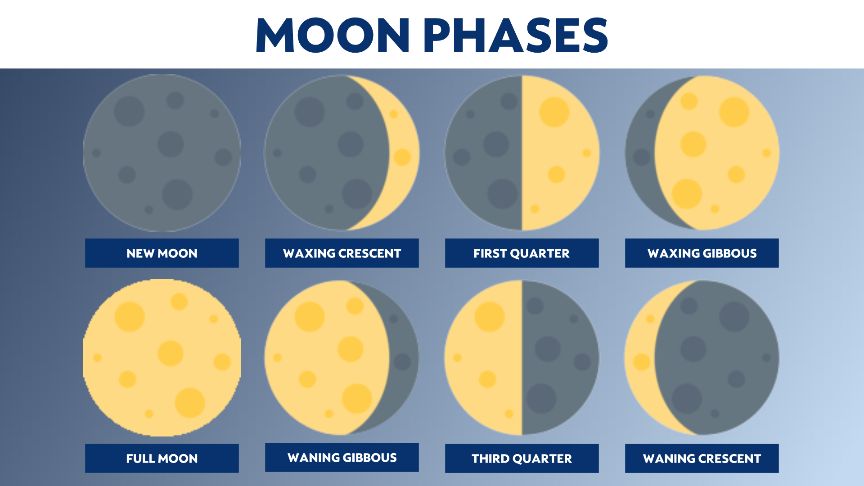
During this period, the Moon goes through eight distinct phases:

  1. New Moon – The Moon is between Earth and Sun; its illuminated side faces away from us.
  2. Waxing Crescent – A sliver appears on the right side (Northern Hemisphere). “Waxing” means it’s growing.
  3. First Quarter – Half of the Moon is visible—right half lit.
  4. Waxing Gibbous – More than half is lit, increasing toward full.
  5. Full Moon – The entire face is illuminated. Earth is between the Sun and Moon.
  6. Waning Gibbous – The light begins to shrink; left side remains lit.
  7. Last Quarter – Half again, but this time the left half.
  8. Waning Crescent – Only a small sliver remains on the left.

And then the cycle begins again.

What Does “Gibbous” Mean?

“Gibbous” comes from the Latin gibbosus, meaning hump-backed or bulging. It refers to the Moon when it’s more than half but not fully illuminated. A nearly full Moon—either on its way there (waxing) or just past (waning). So:

  • Waxing Gibbous = swelling toward full.
  • Waning Gibbous = shrinking after full.

Waxing or Waning?

If you are following the progress of the moon night after night, you will know if it is waxing of waning. But would you know if you just happened to glance up one night? Indeed there are ways to tell. In the Northern Hemisphere:

  • If the right side is lit, the Moon is waxing.
  • If the left side is lit, the Moon is waning.

This holds true whether you’re looking from a balcony in Bengaluru or walking through a park in Boston. But here’s where it gets interesting:

The Moon is Universal—but Not Identical

The same Moon is seen all over the world—but not always in the same orientation. If you’re in the Southern Hemisphere, everything flips:

  • Waxing appears with left side lit.
  • Waning shows up with right side lit.

In fact, a person in the Southern Hemisphere sees the Moon “upside down” compared to someone in the Northern Hemisphere. For example:

  • When it’s a First Quarter Moon in India, the right half of the Moon is illuminated.
    In Australia, it’s still the First Quarter—but they see the left half lit.
  • When it’s a Waxing Crescent in New Delhi, it appears on the right side.
    In Cape Town, that same sliver appears on the left side.

It’s the same phase, same Moon—but reality shifts, depending on where you stand!

Once we learn to read the Moon, it becomes a kind of nightly compass. It connects us to the rhythm of the Earth, of time itself. And yes, it’s also fun to casually identify a “waning gibbous” and enjoy the raised eyebrows from unsuspecting friends.

So the next time someone asks, “Is it waxing or waning?”—you’ll know. And if you’re feeling generous, you might just pass on that little rhyme:

🌒 “Right is bright, it’s waxing with might.”
🌘 “Left is lit, it’s waning a bit.”

–Meena

Picture source: https://spectrumnews1.com/wi/milwaukee/

Space Seeds to Moon Trees

It is Moon Week! Meena wrote about the different facets of the moon, in fact and fantasy. Just a couple of days ago, the Axiom 4 mission returned from its space sojourn with Grp. Captain Shubhanshu Shukla being a proud Indian member of the team. Much has been in the news about the experiments that the team carried out while on the International Space Station (ISS). One of these experiments was to sprout methi and moong seeds in petri dishes and then storing these sprouts in a storage freezer on the ISS. This experiment was part of the Sprouts project, designed to study how spaceflight affects food germination and plant development. Insights from this project could transform space agriculture to enable it to support a reliable supply of food for future space travelers. Some of the seeds will also be brought back to earth, and cultivated over several generations while research is carried out on the genetic, microbial and nutritional changes in these space-returned seeds. Today, astronauts on the International Space Station (ISS) regularly eat salad grown on board. Future long-duration exploration of the Moon and Mars depends on being able to grow fresh food in deep space.

Seeds have been travelling to space since 1971 when the Apollo 14 mission was launched. The mission put two astronauts Alan Shepard and Edgar Mitchell on the moon. As they walked on the moon the third astronaut Stuart Roosa continued to orbit above in the command module. Stuart Roosa was a former US Forest Service smoke jumper (a fire-fighter who parachutes to the site of a forest fire), before becoming a military aviator and astronaut.

When Roosa was selected for the moon mission he was entrusted with another important mission—to carry hundreds of seeds of trees with him. This was part of a joint experiment of NASA and the US Forest Service which selected seeds from five different types of trees. The seeds were x-rayed, sorted and classified, and sealed in small plastic bags stored in a metal canister. Roosa, the official ‘seed ambassador’ for the project carried the canister with more than 2000 seeds in a small canvas pouch as part of his personal belongings. This was the first time that seeds were being sent into deep space and it was an experiment to study how this would affect the seeds’ health, viability and long-term genetics. The seeds under Roosa’s care successfully completed the mission to the moon, but following their return the seed bags burst open during the decontamination process, leading to fears that the experiment’s environment had been contaminated and the seeds would not be viable. Nevertheless they were sent to the Forest Service offices in several places to see if they would germinate. In fact, many did germinate and grew into viable saplings. These 450 saplings were gifted to schools, universities, parks and government offices across the United States, in suitable locations in terms of climate and soil.

The saplings grew into trees which came to be known as ‘Moon Trees’. These were planted alongside their Earth-bound counterparts in order to compare the two. Fifty years later both grew into mature trees with no discernable difference.

Subsequently the collaboration between NASA and US Forest Service has continued with more seeds traveling to space with different missions. Upon their return the space seeds have been planted, and the next generation of Moon Trees are taking root and growing in multiple places. While the seeds in space have contributed to science, the Moon Trees are playing an important role in sparking curiosity about space, fostering a deeper understanding of NASA’s missions among the new generations of students, and nurturing community connections where they thrive.

Today there is a Moon Tree Foundation which aspires to unite, inspire, and conserve by planting a Moon Tree in every corner of the world. Its mission is to inspire interest in education, science, space, conservation and peace for all mankind. Moon trees serve as a reminder to take care of our planet for future generations as “we are under the same sky, looking at the same moon.”

–Mamata

Under the Same Moon

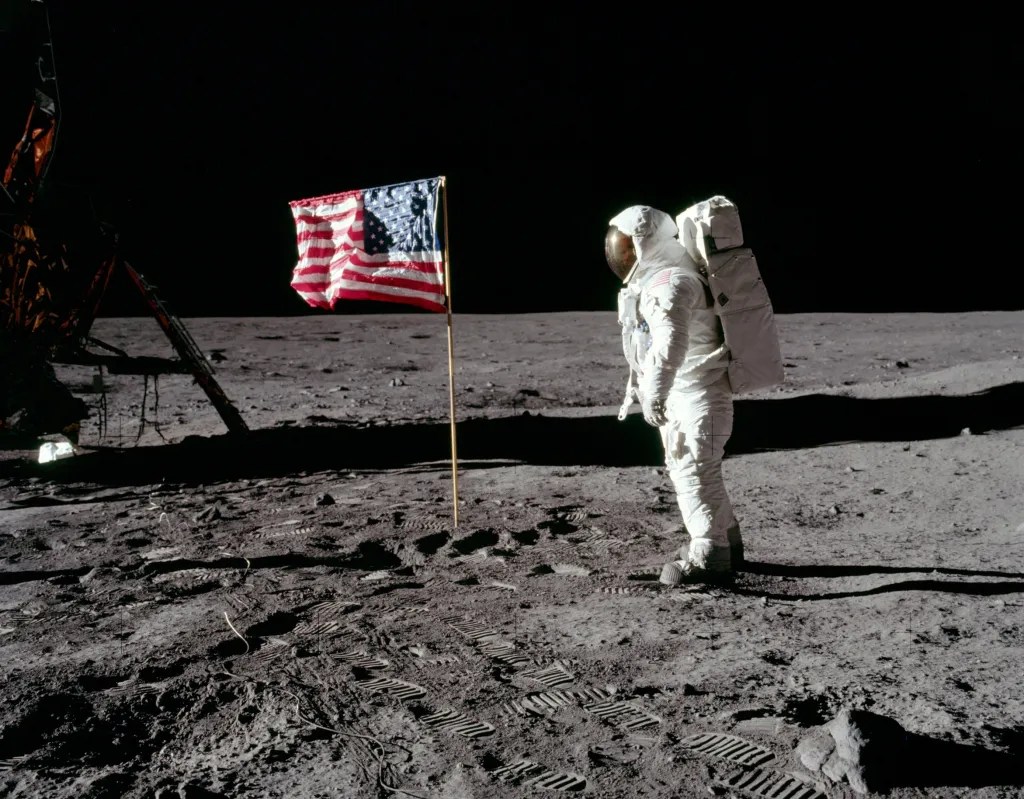
July 20 is a day with special significance for humanity. It is Moon Day—it commemorates the day humans first set foot on the Moon in 1969—a moment that changed forever human imagination, and our relationship to the rest of the universe.

For many of us, the Moon is far more than a historic rock in the sky. It has always fascinated us. It is companion, compass, calendar, and comfort.  It’s poetic, scientific, spiritual, and personal. Whether it is its influence on tides or moods or menstrual cycles—there’s no denying its pull on our lives. It is a part of folklore—in India, a part of the family, with the moon referred to as Chanda mama.

India is writing its own Moon story, with the first manned flight planned for 2027. Grp. Captain Shukla’s sojourn at the International Space Station is part of this preparation. But we have chalked up some notches already:

  • In 2008, Chandrayaan-1 confirmed the presence of water molecules on the Moon—yes, our lunar scout found signs of water where many others hadn’t.
  • Chandrayaan-2 in 2019 didn’t land as planned, but gave us valuable data.
  • And then came Chandrayaan-3 in 2023 when India became the first country to successfully land near the Moon’s south pole—a scientific and symbolic triumph.

This is India’s contemporary moon-story. Here is a beautiful ancient one.

The Rabbit in the Moon: A Buddhist Tale

One of the most enduring tales about the moon is of the rabbit in the Moon, a story rooted in Buddhist Jataka tradition and echoed across generations.

Long ago, the story goes, a kind and gentle rabbit lived in the forest. One day, Lord Indra came down disguised as a hungry old man, asking for food. The rabbit, seeing he had nothing else to offer, jumped into the fire to offer himself as a meal. Touched by this ultimate act of generosity, Indra rescued the rabbit and immortalised him on the Moon—his shape etched forever in the lunar light.

Even today, if you look closely on a clear full moon night, you can make out the shape of a rabbit crouched gently on the surface. Some say he’s still keeping watch. Some say he’s a reminder of kindness and quiet courage.

So on the July 20th, look up at the moon, wonder at its beauty, and ponder the words of some wise people:

“Three things cannot be long hidden: the sun, the moon, and the truth.”

—Buddha

“Don’t tell me the sky is the limit when there are footprints on the moon.”

—Paul Brandt

“The moon is the first milestone on the road to the stars.”

—Arthur C. Clarke

“Always remember we are under the same sky, looking at the same moon.”

—Maxine Lee

“The moon does not fight. It attacks no one. It does not worry. It does not try to crush others. It keeps to its course, but by its very nature, it gently influences. What other body could pull an entire ocean from shore to shore? The moon is faithful to its nature and its power is never diminished.”
― Deng Ming-Dao

–Meena

Next week, some more explorations related to the moon.

Pic: nasa.gov/mission/apollo-11/

Reach for the Sky: Recalling Interactions with Dr. Kasturirangan

Last week, India and the world of science lost a doyen: Dr. Kasturirangan who in the decade till 2003, led the Indian Space programme as Chairman of the Indian Space Research Organisation, as Chairman of the Space Commission and as Secretary to the Government of India in the Department of Space. During this period, India saw the launch of PSLV, our indigenously developed launch vehicle; the testing of Geosynchronous Satellite Launch Vehicle (GSLV); and IRS satellites among others.

Before that, as the Director of ISRO Satellite Centre, he headed the development of the Indian National Satellite (INSAT-2) and the Indian Remote Sensing Satellites (IRS-1A & 1B) as well as scientific satellites. He was Project Director of BHASKARA-I & II. He was also the Project Director for India’s first two experimental earth observation satellites, and subsequently was responsible for overall direction of the first operational Indian Remote Sensing Satellite, IRS-1A.

It was in his time as ISRO chief that Chandrayaan-1 was conceived.

I am proud to say that I had the chance of a few personal interactions. However, not in the context of high-science and technology!

As everyone in the country knows, Dr. Rangan was deeply involved in education, and obviously had a passion for science education (what we today call STEM). It was in this context that I had the chance to interact with him. He was the Chairman of the Board of Governors of the Vikram A. Sarabhai Community Science Centre (VASCSC), where I serve as a member. VASCSC was the result of Dr. Vikram Sarabhai’s vision of enabling the country’s top scientists to contribute to science education. The institution was started in 1966 as a facility where people concerned about the quality of science education could come together to try new ideas and methods of science teaching.

The institution has deep programmatic and emotional links with the various institutions associated with Dr. Sarabhai, the father of India’s space programme.  Dr. Kasturirangan was an obvious choice to chair it!

When very busy people take on yet another committee or chairmanship, it is often really only ornamental. With the best of intentions, they lack the time or mind-space to get deeply involved.

Not so with Dr. Rangan. He ensured to attend VASCSC Board meetings, sometimes in person, otherwise by Zoom. He was there on the dot even for Zoom meetings. He was completely clued in and asked sharp questions about the Action Taken Report. He had a prodigious memory and made quick decisions. He was always supportive of the programmes and publically appreciative of the management and staff for their innovative initiatives and their commitment. He never allowed himself to be distracted with anything else during the course of the meetings, and ensured everyone had their say. It was a humbling experience as well as a learning for all of us.

Raghu and I count it as a privilege that he consented to write the Foreword for our book: TO EVERY PARENT, TO EVERY SCHOOL: RAISING RESILIENT CHILDREN IN A VUCA WORLD (Penguin India). Even after he agreed, we were apprehensive: would he find the time to do it within the publisher’s deadline, given the enormous calls on his time? But we need not have worried. The write-up was with us a few days before the date we had indicated! And what a gracious Foreword it was!

These were people cut from a different cloth. They dedicated their lives to their mission. They wore their myriad achievements lightly. They were courteous to one and all. They listened. Nothing was too small for their attention. And they cared.

Grateful for the opportunity to interact with such inspirations.

–Meena

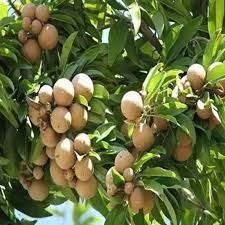
Celebrating Sapodilla: GI Tag for Amalsad Chikoo

Not long ago I wrote about the Kuchchhi Kharek or Date that was given a GI tag. Just last week another fruit from Gujarat has been given this tag, making it the third fruit from the state (after the Gir kesar mango and Kuchchhi kharek) to be tagged thus. This is the Amalsad chikoo or sapodilla.

We generally think of the chikoo as being a very ‘desi’ fruit with its grainy texture, caramelly flavor and colour, and sticky latex at the stem of the fruit. However, the origin of the fruit can be traced back to the Yukatan peninsula in Mexico. Its history goes back to ancient Mesoamerica where it was cultivated by the Mayans and Aztecs who used its sweet and nutritious pulp was a part of their indigenous diet. European explorers to this region discovered this fruit, and the zapote or chicle spread with them as they continued their explorations across Central America and the Caribbean, and then further afield, reaching Asia, Africa and the Pacific. The well-travelled chikoo adapted to different climates and cultures, thriving in tropical and sub-tropical regions, to become a ‘local’ favourite across different continents. Manilkara zapota (its botanical name) acquired local names like chicozapote, naseberry, nispero, soapapple, sapota, sapodilla, and chikoo.

As with most fruits, chikoo has its share of health and nutrition benefits. Several parts of India provide ideal soil and climatic conditions for cultivating chikoo. In fact India is the world’s largest producer of the chikoo which is also widely exported. There are also several varieties of chikoos grown here. But not every variety of chikoo has the distinction of gaining a GI Tag.

What is this tag and how is it obtained. A Geographical Indication (GI) sign is used on products that have a specific geographical origin and possess qualities or a reputation that are due to that origin.

Geographical Indications are typically used for agricultural products, foodstuffs, wine and spirit drinks, handicrafts, and industrial products. In the case of fruits and vegetables the product needs to conform to certain parameters such as size, colour, number of seeds, flavour and aroma.

What is important is that the qualities, characteristics or reputation of the product should be essentially due to the place of origin. Since the qualities depend on the geographical place of production, there is a clear link between the product and its original place of production.

The use of place names to identify the place of origin of products goes back centuries. However the legal connotations of such names were introduced in the form of Geographical Index by the World Trade Organization in 1994. In India, the GI tag system came into force in 2003. Darjeeling tea was the first product in India to get a GI tag. But since then the awarding of GI tags has been active, and as of July 2024, there were 605 products with GI status, spread across agricultural, natural, manufactured goods, and handicrafts.

One of the main objectives of the GI tag is to protect and preserve traditional goods and crafts, and the communities that make them. It functions as a seal of authenticity to highlight that a product claiming to be from a certain region is in fact from that region, is produced by people living in that region, and that it meets certain quality standards set up to ensure this. The GI status also offers legal protections since only registered or authorised producers are allowed to use the tag. The GI registration allows registered parties to launch a lawsuit for infringement against unauthorised parties using the tag.

The GI tag values the traditional skills of artisans, unique ingredients, and region-specific delicacies, and agricultural produce. The attraction of a GI tag is that it is believed that it will give the producers a better status and the ability to get better price for their products.

In India, the process of obtaining a GI tag is rigorous, and often takes time. It begins by submitting a physical application by an association of persons producing the goods to the Geographical Indications Registry in Chennai, which is under the purview of Department of Promotion of Industry and Internal Trade, Ministry of Commerce and Industry.

 The information in the application needs to prove the historical and regional antecedents of the product. In the case of agricultural produce, details required include the exact area, the cultivar, how it’s grown, how long it had been linked to the region, and agricultural factors that make the ingredient unique. The approval process can take anywhere between one and three years to get the tag, sometimes even longer. For example, it took eight years for the Erode turmeric and Basmati rice to get their GI status. The GI tag is only valid for 10 years, which means that producers have to renew their application to keep the status.

The Amalsad chikoo is not the first chikoo to get the GI tag. It was preceded by another chikoo variety called the Dahanu Gholvad Bordi Chikoo in 2017.This variety cultivated on the Maharashtra-Gujarat border was recognized for its unique sweet taste, soft creamy texture and high nutrition value attributed to the high calcium content in the soil of the area. This region has been a hub of chikoo cultivation for over a hundred years; also it is possible to harvest the fruit here round the year.

Now the Amalsad chikoo joins the club. It was awarded the Geographical Indication (GI) tag in recognition of its “unique characteristics and deep rooted connection to the region”. The chikoo gets its name from a village in Gujarat’s Navsari district. However the region recognised by the GI covers 51 villages in Gandevi taluka, 6 in Jalalpore and 30 in Navsari which together produce about 30% of Gujarat’s chikoo yield. The region has ten chikoo cooperative societies which contribute substantially to the export of this fruit.

The application for GI certification was made jointly by the Gujarat Council on Science and Technology (GUJCOST) and Navsari Agricultural University (NAU). GUJCOST carried out research on proof of origin of the fruit cultivation in Amalsad while NAU worked on the special characteristics of this chikoo variety. This variety is recognised for its exceptional sweetness, fine texture, and long shelf life compared to several other varieties of India. The region’s unique soil composition, coupled with traditional farming practices passed down through generations have contributed to its quality and reputation. The GI certification acknowledges “the distinct quality, taste, and cultivation methods that make Amalsad chikoo a symbol of excellence in Indian horticulture.”

The GI tag is not only enhances the reputation of this chikoo but is a recognition of the traditional agricultural practices of the local horticulture community; this also boosts their business while giving them a level of legal protection. For the rest of us, it is one more incentive to enjoy a chikoo shake, ice cream, or simply chilled slices of this delicious fruit this summer.

–Mamata

Broken Frames, Broken Lives

Today, each one of us harbours doubts and fears about the rapid rise of Generative Artificial Intelligence (Gen AI), smart robots, driverless cars etc., especially whether these will take away jobs from people and give them to machines.

This has happened with every new technology since the industrial revolution. Maybe the time of maximum anxiety around technology and jobs was in the late 1700s to early 1800s, a time when quite a few people in the UK depended on the cotton, wool and silk industries for their livelihoods. This was based on the labour of framework knitters, who like some of our weavers even today, worked in their own homes. Though the hours were long and they got small wages, they were at an equilibrium. 

In the early 1800s, there were around 30,000 knitting-frames in England. But change had already started to set in. Change of fashion (men moving from stockings to trousers) and increasing exploitation of weavers by the middlemen were two major factors. But perhaps the most important was the mechanization and wide-frame machines that were coming in to make production faster. Production moved from homes to factories with this mechanization.

As more and more people lost their livelihoods, anger and frustration boiled over, and mill-owners and the new machines were targeted. The scale of the sabotage that occurred in England between 1811 and 1816 was beyond anything seen before.  In the peak three months of the riots, 175 of these new frames were broken per month! The people involved in these riots and destruction called themselves ‘Luddites’. The origin of the name is not quite clear, but some said it was after Ned Ludd, a legendary weaver who in 1770 was supposed to have smashed such machines.

Governments then, as today, were heavy-handed. Their response to the riots was to pass the Frame-Breaking Bill in the House of Commons in February 1812. The Bill was drastic– it proposed transportation or the death penalty for those found guilty of breaking stocking or lace frames. Not everyone was happy with the draft Bill– in the House of Lords, the poet and social campaigner Lord Byron argued against it saying that it was placing the value of life at “something less than the price of a stocking-frame”.  But such passionate appeals did not help, and the Bill was passed.

The Government would have expected all such riots to stop after the Bill. But exactly the opposite happened. The riots actually became more violent and rioters started using arms. The logic was that if they were going to be punished by death or deporatation for breaking frames, then they might as well do something that really deserved such drastic measures. A popular rhyme at the time was “you might as well be hung for death as breaking a machine”. A few mill owners were in fact killed. Government response also got harsher and several Luddites were hanged.

The climax of the Luddite Rebellion took place at midnight on Friday 28 June 1816. Sixteen men raided the factory of Heathcoat and Lacy at Loughborough, with around 1000 sympathisers cheering them on.  They destroyed nearly all of the fifty-five lace-frames.  Subsequently eight men were sentenced to death and two were transported.

The protests died down after that. Mechanization marched on, and the thousands who were involved in their traditional occupation lost out.

Technology will come. But how do we make the changes so we can reduce the negative impacts? How do we make the world a more inclusive place? Surely we cannot let history repeat itself!

–Meena

Photo-credit: historicalbritain.org/

Spineless!

Fountain of Bees, Rome

They make up over 90 per cent of life on earth.

There are about 1.3 million species of them.

They are found in every part of the world.

They range from one-fifth the thickness of a strand of your hair, to the 30 ft long giant squid.

These are the invertebrates—animals without a backbone. Why backbones, in fact, invertebrates don’t any bones at all! Invertebrates include ants, spiders, worms, snails, bees, butterflies, corals, lobsters, crabs…they are the spineless majority!

As the famous biologist EO Wilson put it, ‘Invertebrates don’t need us, we need invertebrates’.  Critically, they pollinate flowers, hence allowing plants to propagate so that there is food for all. They are at the base of all food-chains.  Humans also eat invertebrates—think crabs, lobsters etc. They maintain the ecological balance by eating each other and being eaten! Earthworms and some related creatures help dig up and aerate the soil, and make it fertile. They are important in another way too—most parasites are invertebrates!

All invertebrates are cold-blooded and about 80 per cent of them are terrestrial. Most of them undergo metamorphosis.

They fall into nine phyla, compared to vertebrates which all belong to one phylum.

In spite of their ubiquitous presence and the role they play in our lives, we don’t pay enough attention to these co-inhabitants of our world. For instance, while most countries have national animals or birds, few have national invertebrates. Exceptions include Denmark, which lists the Small Tortoiseshell as its national butterfly; Estonia which lists the Swallowtail; Finland which lists the Seven-spot Ladybird as its national insect and Latvia which has the Two-spot Ladybird for its. Several US states have State Insects, as does Karnataka (the honeybee). Many Indian states also have State Butterflies.

India is unique in that it has named a National Microbe—the Lactobacillus bulgaricus. This was done in 2012, based on a nation-wide completion. It was selected based on its importance in making yogurt or curd. Some US states also have State Microbes. The first state to declare an Official State Microbe was Oregon which chose brewer’s or baker’s yeast as the Official Microbe because of its importance to the craft beer industry there.

Designating such national and state symbols is important, given that we don’t focus enough on these creatures which make up about 95 per cent of all species on earth. Creating a buzz brings attention to them, hopefully leading to more studies and research, ensuring their well-being which is so critical to ours.

In order to increase awareness about invertebrates, last year the well-known British newspaper The Guardian started an ‘Invertebrate of the Year’ contest. This was confined to the UK. This year’s competition, the second of the series, has gone international. So any of us can send in a nomination for an invertebrate, along with reasons why we favour this particular one.

To give you an idea, last year’s winner was the earthworm, which was voted in with 38 per cent of the total votes. The least number of votes was garnered by the invasive Asian or yellow-legged hornet.

Surely you have an invertebrate you love or hate. This is your chance to put it on the world map. Submit your entries at https://www.theguardian.com/environment/2025/feb/12/nominate-your-invertebrate-species-of-the-year by midnight (GMT) on Tuesday 4 March.

–Meena