The Train Reached the Station….

And all I could see was fire and smoke! Everything outside seemed to be burning. I could hear cries of ‘Allah ho akbar’ and ‘Hey Ram’. There was not a soul on the platform. We and the other newly married couple from our bogey got down. We didn’t know what to do—we just stood there for a few minutes, with all our luggage. I was holding the ‘chumbu’ that had not fitted into any trunk. My veena, wrapped in old sarees, lay at my feet.  I had no clue what was going on. My husband looked worried, but I did not know what he was worried about. We had thought that athimber (my husband’s sister’s husband) would come to the station to take us home. We had heard that there was some trouble in Delhi, and thought that surely he would have arranged for transport. But there was no one there.

Then a porter appeared. He came to my husband and they started speaking in Hindi. I could only understand a few words of Hindi at that time, so I don’t know what they said.

After a lot of discussion, the porter hurried away and returned with a cart of some kind. We loaded all our luggage onto this. But the veena would not fit in—the neck stuck out. So my husband picked it up. I was still carrying the chumbu.

My husband only said ‘Walk fast. Don’t make a noise’.

I could not understand where we were going. We got down from the sloping end of the platform and crossed some tracks and kept walking along the tracks. They were going so fast, I was finding it difficult. I was hungry—the GT was supposed to have reached at 5 o’clock in the morning, but it had reached at 5 o’clock in the evening.

As we walked along, there were houses on the sides. They all looked the same. It was some colony. We saw not a soul on the way. I could not make out whether anyone lived in the colony or they were all empty houses.

It was difficult to manage all the luggage in the cart as we walked over the uneven ground. There were trunks with clothes. Two holdalls. My mother had tied up vessels and kitchen items in old sarees. Then there were tins with different types of sweets and savories. My father had bought a blue glass jar from his lab supplier because I loved them. My mother had filled it with mixture ordered from the hostel. She told me I could use the bottle later to store something in the kitchen. Suddenly the blue jar fell down and broke. Tears came to my eyes, but I did not dare cry. We just kept walking on.

After about half an hour of walking, the porter stopped the cart near one of the houses. He went to the door and knocked softly. Someone looked out of the window. On seeing the porter, he came to the door and opened it slightly. He was dressed like a watchman.

They whispered to each other. Then the porter signaled to us to take the luggage into the house. The house was full of piles of luggage.  The watchman shifted a few pieces here and there and made some space for our luggage. We brought in the pieces one by one and put them there.

I asked my husband in Tamil: ‘Are we going to leave the luggage here? All the silver vessels are here. How can we leave them?’ My heart was sinking. My mother had bought two large oval plates and two tumblers specially for my coming to my husband’s house for the first time.

He just hissed at me to keep quiet. He took the porter and watchman to a corner, said something to them and gave them lot of money. We walked out.  The veena was in my husband’s hands—it was too big and odd shaped—we could not put it in the room. And for some reason, I was still carrying the chumbu.

When we had walked a few minutes, I saw a huge railway water spout gushing water. I ran to it. Only when I started drinking did I realize how hungry and thirsty I was. I drank and drank. Then we walked on. We had now left behind the colony and were in the city. My husband told me there was a curfew on but it was relaxed for an hour and so we had to hurry and reach home. But I didn’t know what a curfew was.  We walked quietly along the side of the lanes.

And then the horror! A man came running from one direction. There was another man chasing him. He caught up with him, and in front of our eyes, he drove a knife into the first man. Blood spurted out. I was going to scream, but my husband clamped his hand on my mouth. The killer pulled the body and threw it into the gutter on the side of the road and ran away. He had not noticed us.

I asked my husband why that man had killed the other one, what was happening? But he just gestured to me to keep quiet and walked on.

By the time we reached home, it was dark. It was not our house, my husband told me. ‘This is Tagore Road. My sister’s house. Our house is in Lodhi Road—too far away.’

We went in. Our brother-in-law was there and 2 other families who were sheltering there because their own areas were not safe. My sister-in-law and mother-in-law had gone to our house in Lodhi Road to get the house ready for us, but had got stuck there.

The ladies welcomed us and did aarti. One of them said ‘Are you hungry? There is some arisi upma we made in the morning. You can have that’. Never had food tasted so good. But there was not much. Even as we were eating this, the ladies started cooking dinner. There was a murungakka tree in the garden. So they made murungakka sambhar and rice. This was the menu for the next three days, both for lunch and for dinner.

In the night, all the ladies slept in one room. We each would keep a cloth with red chili powder in it, and a heavy stone (ammi) or something like that next to our pillows. The ladies told me that if anyone should come into the house, I should throw the chili powder in their eyes. The men would go out in groups and do rounds of the colony. They had piled up stones and reapers across the lane entrance.

I was fifteen years old at that time. The year was 1947.

–Meena

This is the true story of the day my athai (father’s sister) landed in Delhi as a new bride, in the midst of the Partition.

In Fashion

“Fashion sometimes ignores convenience, sometimes even causes inconvenience. All fashions may not have great thinking behind them, and sometimes thinking people fall prey to fashion.

Children of fashion-conscious parents have also to swim with the tides of the times. Children are often made to exhibit what parents find fashionable or what is ‘in style’ at the moment.

Take an example of girls’ dresses. Most of these have buttons at the back. No one knows who thought of this style, but children wear it, parents demand it and tailors stitch accordingly. So far, so good.

But what happens when a child wears a dress with buttons at the back. “Mother do my buttons.””Papa please fasten my hooks.” The parents are hassled with other tasks. The mother calls for the older sister. “Help her with her buttons”, or she calls for the servant,”Why don’t you close the buttons for her?”

The child with her own two hands is helpless. She is dependent on someone else to complete dressing. She cannot go out unless someone is there to button her up. She has to request, or plead, or shout for this. She is dependent all for the sake of being dressed in the fashion, a dress with buttons at the back!

That is just for dressing. What about undressing?

If the dress gets wet the child cannot take it off. If she is feeling hot, she can’t take it off. And, heaven forbid, if her dress catches fire, she can’t take it off.

But still the child wears such dresses. She likes them because her parents do. They like them because they want their child to be ‘well dressed.’

But fashion is really a series of fads. Started somewhere by someone who wants to be different, it sometimes catches on, and then everyone wants to follow blindly.

Sometimes the glamour of being different, or being in style blinds people to the basic tenets of simplicity, comfort, and practicality in the way they dress.

We might, as adults, indulge in this. But when it comes to our children we must first think of their comfort and convenience with respect to what they wear. Even infants often show distinct preferences for what they like, or do not like, to wear.

At our Balmandir we have a ‘front button’ attendance. Children whose clothes have buttons at the back take home a note requesting parents to get them clothes with buttons in the front. And parents do make an attempt to do so.

Sometimes they have not even thought about the difference it would make: that changing the orientation of a few buttons is indeed rendering a great service to their child.”

This is not taken from, nor meant for, a magazine on New-age Parenting. These words were written in the early 1930s–nearly 90 years ago, by my grandfather. The author Gijubhai Badheka is well known not only as the creator of some of the best loved and popular children’s literature in Gujarat, but equally for his writings for parents and teachers. He was also one of the pioneers of the Montessori system of education in India. Gijubhai observed children and adults and recorded his thoughts; he described dilemmas faced by both, and explored how these could be handled. Many of these were complied in a series of books in Gujarati called It Is Not Easy Being Parents.

This is one of the many pieces translated from the original Gujarati by me.

–Mamata

What Say You?

When I lived in Kenya, and learnt a little bit of Kiswahili, it was great fun to discover curious words or phrases. One of the best ones was to the local word for curd/yogurt. This was called Mazeevaa Lala—literally “sleeping milk!”

I was reminded of this recently when I chanced upon a Maltese saying My eye went with me, to mean that you have fallen asleep, as not taking your eyes with you would result in a sleepless night!

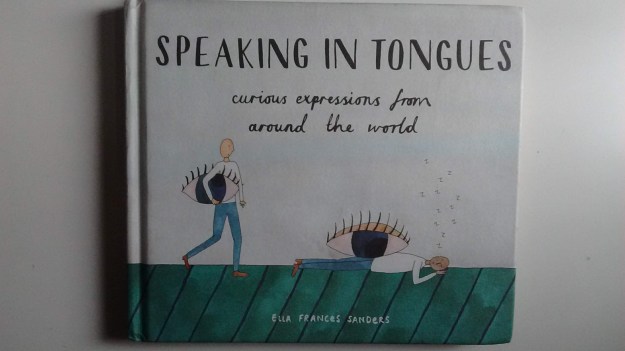
This is one of the many sayings in a delightful book titled Speaking in Tongues: curious expressions from around the world–a compilation of proverbs, idioms and sayings from different languages of the world, put together by Ella Frances Sanders. What brings the words alive are the accompanying illustrations, also by Ella who describes herself as “a writer out of necessity and an illustrator by accident.”

IMG_20180725_181146775.jpgFrom Finnish to Igbo, Armenian to Yiddish, each double spread presents delectable sayings and drawings that blend the wit and wisdom of the ages while also placing these in their cultural context.
Cannot resist sharing some:

Even the monkeys fall from trees. This well-known Japanese saying reminds that even the best and the cleverest can still make mistakes, and cautioning to keep overconfidence in check!  Perhaps the recent World Cup surprises where the superheroes fell from grace is an apt analogy!

You are my orange half. A Spanish term of endearment that means that someone is your soulmate or love of your life. Not quite sure what is so endearing about an orange, but reminded of the Amul chocolate ads that urged us to “Share it with someone you love!”

Horse horse Tiger tiger. To describe something that is so-so, or neither here nor there. This is a Mandarin expression; its origin lies in a story about a painter who painted a half tiger half horse but nobody bought it as it was neither one nor the other.

To pull someone out of their watermelons. A Romanian idiom that means to drive someone crazy! Not much light on why being in or out of watermelons can be harmful to mental health!

Stop ironing my head. An Armenian way of saying “Stop bugging me!” Popularly used when someone keeps asking irritating questions and won’t leave you alone. In many Indian languages we have our own equivalents in the form of “Don’t eat my head.”

To give a green answer to a blue question. A Tibetan reference to when the answer is completely unrelated to the question asked. Something that people in politics are adept at!

This is just a sampler of the 52 proverbs, expressions and idioms that have been passed on from one generation to another in diverse cultures. Interestingly, they reflect not just diversity, but also the sameness as it were. As I read I immediately thought of similar ones in Hindi and Gujarati, as will surely be the case in all languages. Remember how we had to memorise proverbs in our language subjects in school and what a pain it was? Maybe it is time to revisit these!

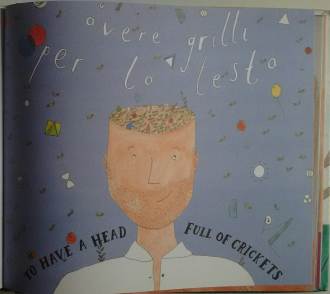
A perfect one to end with. To have a head full of crickets. 

IMG_20180725_181247.jpg

How the Spanish describe a mind buzzing with crazy, wonderful ideas, whims, and flights of fantasy…(what some would call nonsense!)

Nicely sums up how I often feel!

–Mamata

129 Pages Open Up a World

‘The Buddha in the Attic’. What an innocuous book title. And such a pretty cover.

But the world it opened for me was neither innocuous or pretty.

b5ddb7a1-198f-4968-9302-fdc498cf6c7d.jpeg

A confession first. I am pretty ill-informed of historical migration to the US. I knew about Italians and Irish going. And other Europeans—like the Polish. But I never thought of Asian migration as significant. Hence the very moorings of the book were an education. ‘Oh, Japanese migrate to the US in numbers in the 1880s?’ was the question that struck me. I had to do some little surfing and reading to give myself a context.

Just a quick wiki-glimpse of the highlights of this for those of my readers who may not be familiar with the issue:


Coming back to the book, it traces the stories of ‘picture brides’ who came to the US from Japan. And therein lies the brilliance. It is not the story of one woman or family. The technique that Julie Otsuka uses is such that through a tiny 129-page book, I begin to understand the history of the whole Japanese community in the US in the pre-WWII period, and get powerful insights into what might have happened to a whole set of picture brides.

Read it to understand history from the perspective of immigrants; read it to understand history from the perspective of women; read it to understand xenophobia is not new and that history does repeat itself; to learn that the stories of some women are the stories of all women; to learn that the stories of one diaspora are the stories of all diaspora; to learn how so much can be conveyed with so few words.

Bottom line, READ IT!

–Meena

P.S: Feel really ill-informed. I never knew about this book or Julie Otsuka till recently.

Word Play

I am a logophile. Before you leap to dangerous conclusions, let me explain! I am a lover of words! Words fascinate me, excite me, and intrigue me—the sound of words, the use of words, and the play with words. While I run scared from attempting a Sudoku puzzle (I guess that makes me Numerophobic or Arithmophobic!) I cannot resist any kind of word game or puzzle. Scrabble is the only board game I enjoy. I feel insecure without the presence of my faithful dictionaries on my table, even when I can Google up a word with a single click.  I enjoy the act of turning the pages to find the word I am looking for and, in the process, discover at least a few new ones while browsing.

Perhaps the first word that got me hooked was supercalifragilisticexpialidocious from the film Mary Poppins. It sounded as wonderful as it meant. It took many hours to learn how to say this, and much longer to even dare to spell it out! Though an invented word, it later found its legitimacy in the Oxford English Dictionary. But it could not lay claim to being the longest word in the English language, the title of which is claimed by—take a deep breath—pneumonoultramicroscopicsilicovolcanokoniosis! (a lung disease caused by inhaling very fine ash and sand dust.)

logphile.jpg

Source: Google

Over the years I have been noting down interesting words and word-related things.

Sharing some fun and games with words!

Palindrome

These are words or phrases that read the same in both directions. According to language experts palindromes are the most difficult kind of phrase to create.

The best known example: Madam I’m Adam.

An interesting one: A Man, A Plan, A Canal, Panama.

And a very clever one!

Doc, note, I dissent. A fast never prevents a fatness. I diet on cod.

Lipogram

This is a literary work in which one or more letters of the alphabet are excluded. The term lipogram comes from the ancient Greek leipográmmatos, which means ‘leaving out a letter of the alphabet’.

As far back as the 3rd century BC, Greek poet Tryphiodorus wrote an epic of 24 books, each one omitting one letter of the alphabet.

One of the most famous lipograms of more recent times (1939) is a 50,000 word novel called Gadsby. The author Ernest Vincent Wright makes no use of the most frequently used letter of the English alphabet—E.

A tiny extract illustrates how: ‘Upon this basis I am going to show you how a bunch of bright young folks did find a champion: a man with boys and girls of his own; a man so dominating and happy as individuality that youth is drawn to him as is a fly to a sugar bowl.’

From selective exclusion to all-inclusion—that is the Pangram!  This is a short sentence containing all 26 letters of the English alphabet. All the worthies who learnt touch typing on a manual typewriter will be glad to learn that the one sentence they pounded out, in endless practice, is the most famous Pangram: The quick brown fox jumps over the lazy dog.

Cheers to all fellow logophiliacs, wordaholics, word fanatics, word nuts, logolepts, verbivores and, the even nobler, epeolatrists (worshipper of words).

May our tribe increase!

–Mamata


The Sounds of Silence

When we were children and started becoming overly excited or noisy, our aunt would say “OK time for Shantini Ramat!”(the game of silence). All we had to do was to close our eyes and stay still and silent. This was not in the form of a “fingers on lips” punishment, but rather always had the most calming effect. Even as young children it made us aware of the many sounds that even silence was made up of, and sensitized us to the power of Quiet.

Many years later, as environmental educators, one of the exercises we often did in our workshops, with teachers or children, was to ask everyone to close their eyes and sit silently for just 5 minutes. After that we would ask them what sounds they heard / how they felt. It was interesting to note that they found this hard to describe or pinpoint. They were so unused to distinguishing individual sounds—even if they were obvious and strident like the honking of horns, the rumble traffic, the hum of the fan; or less obvious like the chirping of birds or squirrels.

We all live in a continual clutter of noise. Most often our ears are so tuned out of the subtle sounds around us, we can hear only the loudest, glaringly harshest and strident noises. We no longer know what silence sounds like. In fact we are almost afraid of the Quiet. Yet there is much to hear in silence. Even amidst the clamour of urban life, there are sounds that we can hear if we really listen—the early morning call of the lone bird, the rustling of leaves in the breeze, the buzz of the bee, the plop plop of the first raindrops and the steady gush of a downpour.

There is magic in silence, in being quiet. There is great power, beauty and creativity in silence.

This is beautifully captured in The Book of Quiet, a wonderfully sensitive children’s book by Deborah Underwood. Each page, lovingly illustrated by Renata Liwska, is dedicated to a different Quiet moment, beginning with “first one awake Quiet” and ending with “sound asleep Quiet.”

Some excerpts

ALL KINDS OF QUIETITUDES

Best friends don’t need to talk Quiet (Comfortable)

Trying not to hiccup Quiet (Embarrassed)

Last one to get picked from school Quiet (Nervous)

Sleeping sister Quiet (Tender)

First look at new hairstyle Quiet (Shocked)

“Silence is itself the stuff of substance; the moments it fills are not the in-betweenery of life but life itself — rich and nuanced and irrepressibly, if quietly, alive.” (Maria Popova)

–Mamata


Ministry of T

It is finding the known in the unknown, and the unknown in the known.

It is mental exhilaration and physical exhaustion.

It is anticipation and satisfaction.

It is memories of things seen and the curiosity to see new things.

8A2CDD6B-77AA-46E4-AEAA-6E2D88B21634

It is re-living old memories and storing up new ones.

It is sinking in comfort, it is roughing it out.

It is pleasant surprises and unpleasant shocks.

It is a camera lost, it is a vision captured in memory.

It is being with the family, it is getting away from the family.

It is being duped by touts, it is being helped by strangers.

It is tasting exotic food, it is finding the familiar dhabha.

It is being a bit bored, it is having a lot of fun.

It is being away from home, it is finding new homes.

It is being out of touch, it is finding new connections.

It is cockroaches in the bathroom, it is squeaky clean sheets.

It is upset stomachs, it is healthy carrot juice.

It is swearing never to travel again, it is booking tickets for the next trip.

Is this just me, or do most people think of travel like this?


–Meena


Ode to Libraries

As is probably, by now, evident, the Millennial Matriarchs are bookworms. We grew up with books, and we need books just as much, or more, as we grow older.

The enervating summer afternoons bring back so many memories of the joy of discovering, devouring, savouring, hoarding, exchanging, borrowing, and drowning in books, and more books. And, libraries were the dream destination of summer holidays.

Sharing some eloquent words that describe the power (and perils!) of libraries.

 Don’t Go Into The Library

The library is dangerous–

Don’t go in. If you do

You know what will happen.

It’s like a pet store or a bakery—

Every single time you will come out of there

Holding something in your arms.

Those novels with their big eyes.

And those no-nonsense, all muscle

Greyhounds and Dobermans,

All non-fiction and business,

Cuddly when they are young,

But then the first page is turned.

The doughnut scent of it all, knowledge,

The aroma of coffee being made

In all those books, something for everyone,

The deli offering of civilisation itself.

The library is the book of books,

Its concrete and glass and wood covers

Keeping within them the very big,

Very long story of everything.

The library is dangerous, full

Of answers, if you go inside,

You may not come out

The same person who went in.

Alberto Rios       Contemporary American Chicano poet

–Mamata


Of Libraries and Books

We lived in a government colony in Delhi. A library van used to visit every week. Come Friday, without a doubt, the van would be at the end of our street. We would queue up, return our book, get into the van, choose another book, have it stamped and come out. A lot of strategic planning was involved. Like ‘You take this book, I’ll take that one. You finish by Tuesday and we will exchange.’ Or hiding a book you wanted (next-most after the book you took) behind a pile of other books in an obscure stack, in the hope that it would remain hidden till the next week when the van returned.

These vans were run by the Delhi Public Library system. I marvel today at this amazing service. I am not aware of any such today, that too run by any government system.

A second mainstay of our reading was our school library. We had a library period every week, and it was compulsory to borrow a book. Occasional book report requirements were put in to ensure we did read them, though for at least half the class, this wasn’t necessary.  As I recall, the borrowable collection was mainly fiction. (For some reason, our school was paranoid about our bringing ‘non-authorized’ books into the premises. There would be random surprise checks and any such book would be confiscated! Considering how innocent we were and how little access we had to unsavoury reading material, this seems rather excessively zealous. But those were different times!)

And last but not the least, the neighbourhood ‘lending library’. This we were allowed to visit only during the long breaks (summer and winter holidays). And were given a limited budget, which usually stretched to one book and one comic a day. Going to the library also involved a daily outing and a walk of 20 minutes either way. But while this was good exercise for the body, regrettably, it was not great exercise for the mind, as we raced through upwards of 50 M&Bs and 50 Archie comics during a typical summer break—with an occasional Alistair Maclean, Nevil Shute or latest bestseller thrown in. But well, it helped improved our reading speed (because we used to try to finish a book overnight and swap, and try to finish another one a friend had borrowed before it was time to walk to the library).

As we grew older and more independently mobile, it was of course the BCL and the USIS. These were usually fortnightly outings in small groups from college.

How many children or adults are members of libraries today? I know a lot of people read. But it seems everyone just buys each and every book they want to read. But the excitement of reading is also partly in looking for and stumbling upon books in a library; it is yearning to lay your hands on a book, and conniving and strategizing—from reserving it in a library to striking complex deals with friends.

20180518_135152_resized

I don’t want to buy every book I want to read. I have no space. I don’t want to spend that much. And I do want to stumble upon books. Not in a bookshop setting, where books are not arranged as I like them, but in a library-like situation.

As of the last few years, ‘Just Books’ has been my library. I have to admit, since I am a ‘deliver to’ member, I don’t have the pleasure of browsing. But I do browse through their huge online catalogue and put books on the waitlist. There is a little thrill in not knowing which two books will land up at my door in a particular week, out of the 50-60 on the waitlist. It is a low-risk option—I put likely looking books on the list, and if I don’t like it, I just abandon it after the first 30-40 pages. And my shelves are not heaving with the addition of more and more books.

If you don’t know about Just Books, do check it outback (www.justbooks.in). It is a network of about 700 neigbourhood libraries, with a holding over about a million books, in English and most Indian languages. And it has an option of home delivery of books.

Happy reading!

–Meena

A Soft Pause

I like the comma! It is perhaps my favourite among the punctuation marks! Many years ago when I started out as an editor, it was a comfort and joy to work with Kiran, my “commarade”, who an equally ardent follower of the comma! Over the many years of copy editing since then, I am finding that the comma is increasingly dispensed with (as are most punctuation marks, as emoticons take over). Most people see no use or value in it, or maybe they haven’t ever paused to think about it!

Ah commas, these often overlooked tiny squiggles that lend order, and often sense, to a sentence. While a full stop ends a sentence, a comma indicates a smaller break–as a soft pause that separates words, clauses, or ideas within a sentence.

Indeed that is what it was always meant to be. The word comma itself comes from Greek word koptein, which means “to cut off.” The comma, as we know it, was introduced by a 15th century Italian printer Aldo Manuzio as a way to separate things.

While word lovers like us value the comma, it takes a master word-crafter like Pico Iyer to eloquently express these sentiments.

“The gods, they say, give breath, and they take it away. But the same could be said — could it not? — of the humble comma. Add it to the present clause, and, of a sudden, the mind is, quite literally, given pause to think; take it out if you wish or forget it and the mind is deprived of a resting place. Yet still the comma gets no respect. It seems just a slip of a thing, a pedant’s tick, a blip on the edge of our consciousness, a kind of printer’s smudge almost. Small, we claim, is beautiful (especially in the age of the microchip). Yet what is so often used, and so rarely recalled, as the comma — unless it be breath itself?

(In Praise of the Humble Comma. Essay in Time Magazine 24 June 2001)

So there is the humble comma, and then, as I discovered, there is the Oxford comma! The Oxford or ‘serial’ comma is an optional comma before the word ‘and’ at the end of a list: We sell milk, cheese, and icecream. It is known as the Oxford comma because it was traditionally used by printers, readers, and editors at Oxford University Press.

While this may seem not so important to worry about, this little squiggle before an ‘and’ can create hilarity, or confusion. For example if you write ‘I love my parents, Amitabh Bachchan, and Mary Kom’ without that little squiggle before the ‘and’, you may end up, unwittingly,  being the offspring of AB and MK!  

A comma, then, is a matter of care. Care for words, yes, but also, and more important, for what the words imply!

–Mamata