Another Word For…

Every writer knows well the sudden point in the flow of words where you struggle to find another/better/appropriate word. And where a dictionary will not serve the purpose. That is the time to turn to the trusted Thesaurus with its rich listing of synonyms.

The word thesaurus itself came to the English language in the late 16th century, via Latin, from the Greek word thēsauros meaning ‘storehouse or treasure’. It was used in the early 19th century by archaeologists to denote an ancient treasury, such as that of a temple. Soon after that, the word was metaphorically used to describe a book containing a “treasury” of words or information about a particular field.

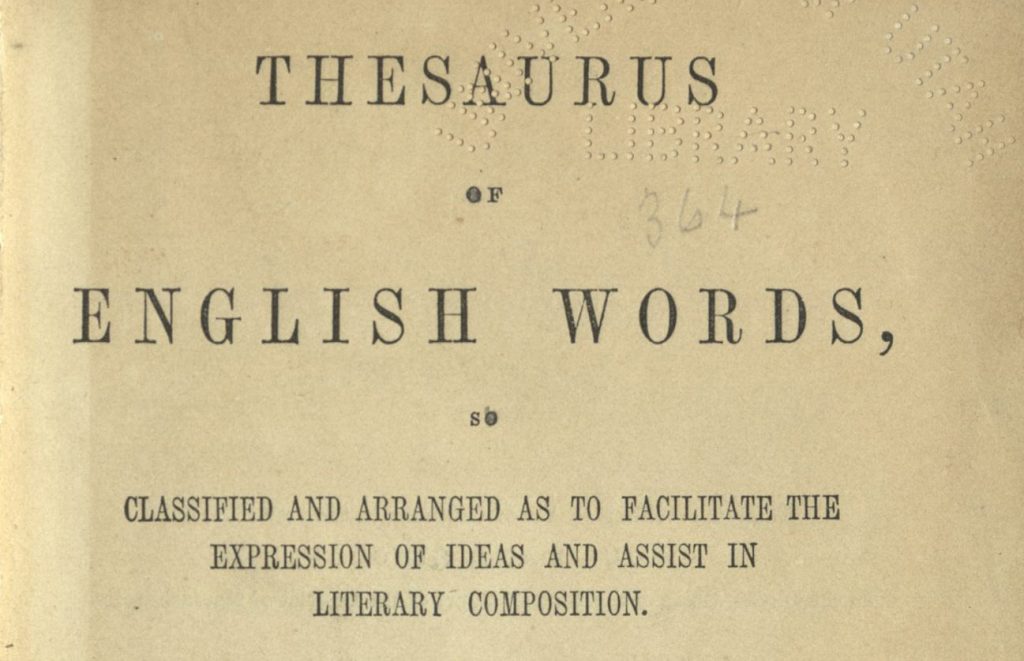
In 1852, the English scholar Peter Mark Roget published a book in which he compiled lists of related words which were organised according to specific categories. The book was titled  Thesaurus of English Words, Classified and Arranged as to Facilitate the Expression of Ideas and Assist in Literary Composition. This led to the common acceptance of the term “thesaurus” to describe a book of words and their synonyms. In the years to come the word Roget itself became a synonym for Thesaurus.

One would have imagined that the Thesaurus was the magnum opus of its author Peter Roget who spent his life as a wordsmith. In fact, Roget was a multi-faceted individual who wore many hats in his lifetime.

Peter Mark Roget was born on 18 January 1779 in London. His father was a clergyman of Swiss origin, and his mother was the sister of a notable law reformer Sir Samuel Romilly. After the death of his father when Peter was only four years old, the family moved to Edinburgh. The young Peter was a brilliant student, graduating from medical school in Edinburgh at the age of 19. His ardent curiosity led him to research and experiment in numerous fields of knowledge. As a young doctor he published works on tuberculosis, and on the effects of nitrous oxide, known as ‘laughing gas’, then used as an anaesthetic. He then moved on to Bristol and Manchester where he worked as a private physician and also as a tutor.

In 1808 he moved to London, where he continued to pursue his diverse interests in medicine and science. He was made a Fellow of the Royal Society, Britain’s national academy of science, and served as its secretary for 21 years. The government asked him to explore London’s water system.  He sought to improve sanitation and food preservation, even discussing the concept of a ‘frigidarium’. He helped to found Manchester Medical School and the University of London. He wrote numerous entries for various encyclopaedias. He invented a pocket chessboard, and a new type of slide rule. He was also interested in optics and wrote a paper on how the kaleidoscope could be improved.

While his professional life was marked by prodigious achievements, Peter Roget’s personal life was traumatic and tragic. He hardly knew his father who died when he was very young; his mother suffered from paranoia, and his sister experienced mental breakdowns. His wife died of cancer when she was only 36. And Sir Samuel, his favourite uncle and surrogate father slit his own throat, even as Roget tried to pull the blade from his hand.

Roget himself was afflicted with depression, and developed such a repugnance of dirt and disorder, that would today be diagnosed as OCD. Perhaps as a reaction to all this turmoil, he also became obsessed with numbers and lists. The obsession also worked as therapy.

From the time that he was a young boy, Peter made lists. The process of sorting and classifying provided a sense of order and logic. As early as 1805 when he was 26 years old, he had compiled, for his own personal use, a small indexed catalogue of words which he used to help his prolific writing. He continued with this exercise of classifying and cataloguing words even as he continued his distinguished career in medicine and science.

It is only when he retired from medical practice age the age of 60 that Roget devoted all his time and energy on the project that would, in later years, eclipse all his former achievements.  For four years he worked on the task of arranging ideas, meanings and concepts. The contents were not arranged alphabetically but put in an order where a given idea fitted into his own classification, within six classes: Abstract Relations, Space, Matter, Intellect, Volition, and Affections.

Whereas a conventional dictionary starts with words and provides their meanings, pronunciations, and etymology, Roget’s Thesaurus was the converse, namely, an idea was given alongside the word or words by which that idea could most aptly be expressed. Although philosophically orientated, the Thesaurus was a compendium of thematically arranged concepts, a classification of words by their meaning.

Roget’s Thesaurus was finally published in 1853, when Peter Roget was 74 years old. It had a print run of 1,000 copies. The 15,000 words it contained were arranged conceptually rather than alphabetically, incorporating 1002 concepts. But shortly before publication, he inserted an alphabetical index as an appendix, thus enabling its easier use.

The first American edition of the Thesaurus was published in 1854. In the introduction to this, Roget explained: “The present work is intended to supply, with respect to the English language, a desideratum hitherto unsupplied in any language; namely, a collection of the words it contains and of the idiomatic combinations peculiar to it, arranged, not in alphabetical order as they are in a dictionary, but according to the ideas which they express.” The Thesaurus initially did not do as well in America. It only became popular in the 1920s when the crossword craze swept the United States.

Roget continued to make changes until his death at the age of ninety, by which time there had been twenty-eight editions. His son, John Lewis Roget continued its revision. Roget’s Thesaurus has never been out of print and by its 150th anniversary in 2002 had sold thirty-two million copies. From his original six classes, by the time of the eighth edition in 2019 it included 1,075 word categories.

Today while the word Roget immediately brings to mind the word Thesaurus, its author’s illustrious career in medicine and science is not as well known. His birthday week is a good time to remember the many other words to describe Peter Roget: Physician, physiology expert, mathematician, inventor, investigator, writer, editor and chess whiz.

–Mamata

Across and Down

1 Across: Word that describes the author of this piece (14 letters).

Answer: Cruciverbalist

Yes, that’s what I am. A crossword lover! My day does not end until I have tackled my three daily crossword puzzles. Over the years while this has become a habit, in recent years I have been not just trying to crack the clues and fill in the blank squares with the right answers, but equally looking more closely at how the clues are framed. And every day, I applaud not so much myself for having got the answers, but even more the creator for the clever wording of the clues.

And as with most things that interest me, I am curious to know what goes on behind the scenes. That led me to the history of the crossword puzzle.

The earliest form may have been simple word games that were published in children’s books in the 19th century in England.  These were called Word Squares where children had to fill in the words to fit the squares so that the words read the same across and down.

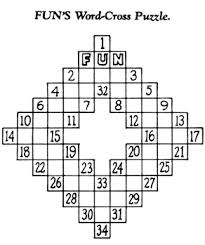
Arthur Wynne a young English boy in Liverpool was one of the children who had been taught by his grandfather to solve these puzzles. When he was 19, Arthur, emigrated to America. He went on to work with the newspaper New York World where he managed the jokes and puzzles supplement called Fun. One December day, as Arthur was working on the Christmas Edition of Fun he felt that the readers needed something new and challenging. He remembered the word games he used to play as a child. Drawing upon that memory Wynne designed a numbered, diamond-shape grid with an empty centre. As the first top Across entry, he inserted the word FUN. He fitted in words in the rest of the squares, for which he devised clues. He called this puzzle Word-Cross. An illustrator later accidentally changed Word-Cross to Cross-Word, and Arthur was fine with it, so the name stuck. Later Wynne played around with a variety of shapes and finally settled on the rectangle.

Arthur Wynne’s first Fun word Cross was published in his paper New York World on Sunday 21 December, 1913. The Word-Cross was well received and became a regular feature of the Fun page. Soon after that, World War 1 started. As the war progressed and the newspapers were full of depressing headlines and dire news reports, the crossword became a much needed refuge where readers could temporarily apply their minds to something challenging as well as satisfying. Crosswords became a comforting anchor through the uncertainty of wartime. By the time the war ended crosswords had become immensely popular.

During the early 1920’s other newspapers picked up the newly discovered pastime, and within a decade crossword puzzles were featured in almost all American newspapers. It was in this period crosswords began to assume their familiar form.

Crosswords were now being published in almost all newspapers—except in the New York Times. A 1924 editorial in the Times called crosswords “a primitive sort of mental exercise.” Interestingly, it took another World War for the New York Times to introduce the crossword—two decades after the rest of the newspapers in the USA did. Through the 20s and 30s the New York Times brushed it off as a passing fad, and deemed carrying a crossword on its pages as too low brow. They felt that the paper should hold the reader’s interest without needing to rely on a puzzle. But with the war, they realised the therapeutic value of the crossword. The first New York Times crossword ran on Sunday, February 15, 1942. Today the New York Times crosswords are among the trickiest and cleverest, and ones that solvers most aspire to crack.

After a decade of popularity in America, the crossword crossed the Atlantic. The first crossword to be published in Britain appeared in Pearson’s Magazine in February 1922, and it became very popular. The Times of London, as had the New York Times, initially scoffed at what it called “a menace because it (crossword) is making devastating inroads on the working hours of every rank of society. Everywhere, at every hour of the day, people can be seen quite shamelessly poring over the checker-board diagrams, cudgelling their brains for a four-letter word meaning ‘molten rock’ …”  The Times resisted the popular wave until February 1 1930 when it published its first crossword.

The British crosswords quickly developed their own style. While the American crosswords usually had clues for which the answers were direct, based on general knowledge or word definitions, the British ones were more complex and the clues cleverly worded so as to have double or hidden meanings. And so emerged what became known as Cryptic crosswords. One of the creators of this kind of puzzle was a school master Derrick Somerset Macnutt. He compiled his puzzles under the pseudonym Ximenes, to avoid the wrath of frustrated cruciverbalists who could not crack his cryptic clues!

Simple or cryptic, the crossword was here to stay and developed its own band of followers, who went on to become addicts.

When the world was once again in the throes of World War II, the crossword played a similar role as it did in the first War–providing a respite from the gloom and doom stories on the news pages, and something to do in the blackout hours.  

The crossword had its own intriguing WW II moments. In England, Intelligence Officers found that some of the answers in the The Daily Telegraph’s puzzles were code names for secret undercover war missions. They were worried that crosswords were being used to communicate secret messages. They traced the puzzles back to a mild-mannered headmaster Leonard Dawe. But they could not find anything to incriminate him. The mystery remained unsolved until 1984, when one of Dawe’s former students came forward and said that along with some other students he had helped Dawe fill in his puzzles. The boys had used words that they had heard being used by soldiers in a military camp next to their school. Neither they nor their headmaster had the faintest idea that they had been accidental traitors!

By the time the war ended in 1945, for crossword solvers in Britain and America, it had transitioned from providing solace to becoming a ritual. And the faithful following of cruciverbalists has grown across the world. Today, the internet has brought changes in the form of the crossword, and many today get their daily fix on their computers and smart phones. But its function remains the same—to engage the mind in bringing order out of seeming chaos, and the very personal sense of achievement when the blanks begin to be populated with letters.

1 Down: Crossword lover American President (7 letters)        Answer: Clinton

Cheers to the Cruciverbalists! We have nothing to use but our brains!

–Mamata

Reading ‘Judgmentally’

India has its fair share of Book Fests and Lit Fests. Some generic, some specific to a genre or a language. A well-known one among these is the Bangalore BizLitFest—as the name suggests, an event devoted to the Business Literature genre.

The 6th edition of this Fest, held online (of course) this year, concluded this weekend. While I have attended this Fest over the years, this time I had a special role—as one of the panel of judges to pick the best Business Book of the Year. This award was instituted in 2017, by the family of the universally-known academic Prof CK Prahalad (of ‘Bottom of Pyramid’ fame). The CK Prahalad Best Business Book Award is given to ‘the most original, impactful and thought-provoking business book written by an Indian author’.

It never ceases to amaze me how many contenders there are every year!  The competition process is a multistage one. Out of the business books published in the previous calendar year, a longlist of the top 25 is made based on ratings and reviews. Of these, the five which get the top ratings and number of reviews on Amazon, Goodreads and Flipkart in the first six months of the current  year are shortlisted. And a jury selects from among these, using two major criteria: Originality of theme, and second, Potential of the book as a game-changer, inspiration and influencer.

I was in the distinguished company of Prof Rishikesha Krishna (IIM-B), Manish Sabarwal (Teamlease), Narayan Ramachandran (formerly Morgan Stanley, writer, social entrepreneur) in the Jury Panel.

The five shortlisted books were:

Saying No to Jugaad: TN Hari, MS Subramanian

Bridgital Nation: N Chandrasekaran with Roopa Purushottaman

How I Almost Blew It: Sidharth Rao

The CEO Factory: Sudhir Sitapathy

Big Billion Startup: Mihir Dalal.

The unanimous winner was Mihir Dalal’s Big Billion Startup, the story of Flipkart.

For me, there were two levels of learning through the process:

Each book was a fascinating journey and provided enormous learning! Four of them were the story or stories of specific enterprises or entrepreneurs told so as to offer lessons to any manager or entrepreneur. Bridgital Nation was different in that it provided a broader framework of using IT to solve the nation’s problems.

At the second level, I realized that reading as a judge was a different ballgame from just reading. One has to read much more consciously, comparing and contrasting, articulating what works and what does not work. One has to be aware of content and style. Whether the ‘lessons’ are coming out clearly. And whether it will work for the audience it is meant for. While I have graded student essays and evaluated children’s fiction, judging business books was a new experience of reading ‘judgmentally’!

One comment I have on the books is that most mention dozens of names. While completely necessary to acknowledge and bring out the contribution (or otherwise) of all concerned in the making of the company, it is quite confusing for the reader who does not know any of these people. At times, I found myself going back and forth to figure out who a person was, more than even in a Russian novel!

All in all, a very interesting experience, and I thank BBLF for it.

Look forward to the next edition in Sept/Oct 2021!

–Meena

The Madness in the Method

A recent piece by one of my favourite columnists bemoaned the fact that there is increasingly reduced use of physical dictionaries because of instant and easy access to online dictionaries.

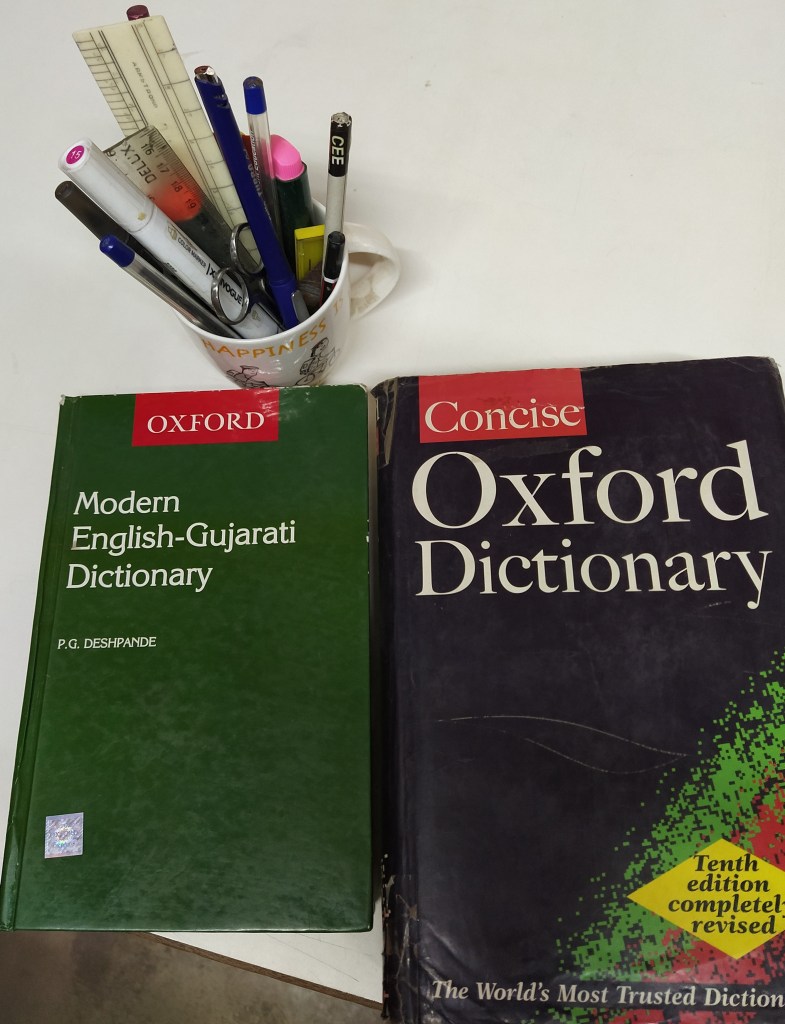
It made me feel a bit guilty as I have begun to succumb to the same short cut, but I still keep my trusty Concise Oxford Dictionary and my bilingual dictionary within hand’s reach on my table, and yes, I do look up words from these tomes. As my erstwhile colleagues may recall, the COD was a permanent fixture on my desk at work. This old friend continues to give me a sense of familiar comfort, as well as continuity in my work and play with words.

While COD is the friendly go-to dictionary, it is the Oxford English Dictionary or OED, which is widely regarded as the accepted authority on the English language. The OED today, is an unsurpassed guide to the meaning, history, and pronunciation of 600,000 words, past and present, from across the English-speaking world. It contains not only not only present-day meanings, but also the history of individual words from over 1000 years of the English language, traced through 3 million quotations from a wide range of sources, from classic literature to cookery books.

What is equally fascinating is the history of the early development of the OED.

Until the 19th century, the English language did not have a complete dictionary. In 1857 the members of the Philological Society of London decided that it was time for a complete re-examination of the language, and embarked on an ambitious project to compile a comprehensive compendium of the English language.

The new dictionary was planned as a four-volume, 6,400-page work that would include all English language vocabulary from the Early Middle English period (1150 AD) onward, plus some earlier words if they had continued to be used into Middle English. It was estimated that the project would be finished in approximately ten years. However, no one realized the full extent of the work, or how long it would take to achieve the final result. After the first grand announcement, the project took a while to take off. And five years after it was launched the editors had only reached as far as the word ‘ant’.

Then in 1879 James Murray a little known school teacher and philologist was given the editorship of this challenging project. His first task was to advertise in all the leading newspapers of the day that the project was looking for ‘volunteers’ in the English-speaking world to send him quotations which would show how the meanings of words had changed over time.

This early experiment in crowdsourcing attracted many volunteers. The most prolific and systematic contributor was a man called Dr William Chester Minor. He regularly sent in meticulously detailed slips tracing the etymology of words, accompanied by relevant examples and quotations. The return address on his letters read simply: Broadmoor, Crowthorne, Berkshire.

For almost a decade, Murray assumed that his favourite volunteer was a reclusive doctor of literary tastes with a good deal of leisure. Then, by chance, Murray discovered that Minor was a murderer who had been committed to the Broadmoor Criminal Lunatic Asylum, which was less than 40 miles from Oxford where Murray was based. In 1891, ten years after they had started corresponding, Murray visited Broadmoor and met Minor. This was the start of a close friendship between the two men that continued for the next twenty years. And one that enriched the OED immeasurably.

Minor’s own story was tragic, as well as inspiring. Born in America, he qualified as a surgeon and joined the Union Army just before the Battle of Gettysburg in 1863. After being released from the Army, Minor left for London in 1871 with his books and paints in the hopes of starting a new and more peaceful life. However the war experiences left deep scars on the sensitive and clever young man. He became delusional and paranoid. In one such moment he unintentionally shot a man and killed him.

Minor’s ‘insanity’ plea helped him to avoid going to prison. But he was incarcerated in the Broadmoor mental asylum in 1872. He was a well-behaved, quiet, scholarly inmate. With the approval of the asylum authorities, and using his US army pension he managed to accumulate and build a library of rare and antique books in his cell. It was this collection that provided the useful information about nearly 10,000 words, and examples of their usage, which he shared with Murray. The subsequent close friendship between the two which was marked by a common love for words and their history, scholarship, mutual respect and drive, was crucial in the compilation of the OED–the last word on words for over a century.

Murray acknowledged Minor’s invaluable contribution when in 1899 he said “we could easily illustrate the last four centuries from his quotations alone.” Murray also petitioned tirelessly for the release of his friend arguing that a mental asylum was no place for a man of his intellectual calibre. Sadly, Minor’s mental condition deteriorated. Finally he was released, and died in obscurity at his home in 1920.

The two men who gave half their lives to a project of unprecedented historical and cultural importance, did not live to see the publication of their magnum opus. It took roughly forty years for the first edition of the Oxford English Dictionary to be completed.

So it was, the story that made the words, rather than the words that made the story!

–Mamata

Wash ‘Em Clean

One of our favourite childhood books was a delightfully illustrated Russian book called Wash ‘Em Clean. It was a funny poem about a little boy who would not wash and bathe, and how he was converted to cleanliness.

Instilling the habit of proper hand hygiene has been one of the great challenges through the ages.

On 15 October, in 2008, over 120 million children in more than 70 countries around the world washed their hands with soap. This marked the first Global Handwashing Day, founded by the Global Handwashing Partnership as a way to raise awareness about the importance of washing hands. Since then, this day is celebrated annually to reiterate the simplicity and value of clean hands. The theme for this year is Hand Hygiene For All.

Ironically, in just over a decade since then, a single Handwashing Day is not enough. Handwashing is making daily headlines across the world as, possibly, the most effective protection from Covid 19.

Interestingly this was the very message that was sought to be promoted as far back as 1847 by Dr. Ignaz Semmelweis, a German-Hungarian physician and scientist. Armed with a doctorate from the University of Vienna and a Master’s degree in midwifery, Semmelweis joined as Director of the maternity clinic at the Vienna General Hospital in Austria.  At that time a mysterious infection known as ‘childbed fever’ was leading to high mortality rates in new mothers in maternity wards across Europe. Semmelweis was determined to understand what caused this rampant infection, and he began to closely observe the practices of the doctors on duty.

Until the late 1800s surgeons did not scrub up before and after surgery, or even wash their hands between patients; causing infections to be transferred from one patient to another. In fact, even after dissecting corpses, doctors and medical students went straight to the maternity wards to examine women who had recently delivered, without first washing their hands. Semmelwies deduced that it was the doctors who were transmitting infections to the patients. In maternity wards these infections led to the new mothers dying from puerperal fever or ‘childbed’ fever as it was called.

This was in the era before antibiotics (and before the recognition that germs are the agents of infectious disease).

Dr Semmelweis immediately instituted a strict regimen wherein all medical staff had to wash their hands between patient examinations. This seemingly simple step was the most difficult to implement. His peers were very sceptical, some were openly hostile; how could he dare to claim that the doctors were killing their patients? His own staff rose against him. He was labelled a madman because of his fanatic insistence on hand washing.

But the results of his ‘lunacy’ spoke for themselves–before hand washing was instituted in May 1847, his clinic’s mortality rate was 18.3%. By July, the rate had dropped to 1.2%, and it was zero the next year. But despite the clear link between cause and effect, most doctors did not change their practices.

Instead, in the face of opposition from a large part of the medical fraternity, the doctor  was dismissed from his post, and he moved to Budapest. At the age of 47 he was committed to a mental asylum, and died there only 14 days later.

Semmelweis never published an explanation of the logic behind his theory.  His experiments with hygienic practices were only validated some years later when Louis Pasteur expanded on the germ theory of disease. This was taken further by Joseph Lister a British surgeon. Based on his observations as a surgeon, Lister also deduced that a high number of post-operative deaths, which were attributed to ‘ward fever,’ were caused not by the surgery but by infections spread by germs from unwashed bed linen and surgical instruments, as well as lack of hand hygiene among doctors. Lister saw this as the cause, as well as the solution, to the problem. He started using carbolic acid to wash hands and to sterilize instruments, as well as to dress wounds. He experimented successfully with these techniques, and, unlike Semmelweis, went on to publish everything he discovered in a medical journal The Lancet in 1867. He became known as the father of antiseptic surgery.

That was a hundred and fifty years ago; but how much have things changed even now?

Here are some shocking facts.

Most patients and their families believe that a hospital is the safest place in terms of hygiene. But the Centers for Disease Control (CDCs) in America estimate that 1 in 25 patients pick up an infection while hospitalized. In 2011 there were more than 700,000 health care-related infections at intensive-care hospitals, and about 10 per cent of the infected patients died during their hospitalization. One of the major contributors to the spread was low hand-washing compliance among the attending doctors and nurses.

The well-known author and surgeon Dr Atul Gawande wrote an eye-opening essay in 2004. Titled On Washing Hands the essay endorsed that hand washing non-compliance was a major factor in spread of infection. But it also explained why this seemingly simple measure is, in practice, very complicated due to the sheer volume of interactions between a medical caregiver and a patient. For example, in a regular 12 hour shift a nurse would have up to 100 occasions on which hand washing is required. Given the tremendous pressure of time and patients, he accepts that the kind of hand washing that would be effective would mean that one-third of the medical staff’s time would be spent on washing.  While this is not realistic, he urges that even a small increase in compliance would mean saving at least a few more lives that are lost to infection.  

From Semmelweis to Gawande, the crusaders for hand washing have been spreading the message for almost 200 years. In this year of the Corona, never before has hand washing been more critical and more imperative. Handwashing is not just for doctors. Every one of us can save lives—especially our own, by becoming fanatical about hand washing.

Let’s put our hands together to applaud the super power of soap and water.

–Mamata

Gandhi the Vegetarian

In September 1888 a young Gujarati man named Mohandas Karamchand Gandhi set sail for England where he would pursue studies in law. Before he left he made a vow to his mother that while he was abroad he would not touch wine, women and meat. Easier said than done!

The challenge began as soon as he boarded the ship–managing to find something to eat, which both his religious belief and palate could support. A fellow passenger, an Englishman, assured him that it was so cold in England that one could not possibly survive without eating meat. The young man managed to subsist on what he could, until he reached England. It did not get any easier when he tried a couple of different lodgings. The English landladies were kind, but at a loss about what to feed their boarder. He ate oatmeal for breakfast, but barely subsisted on bland spinach, a few slices of bread and jam for lunch and dinner. The young man was almost always hungry, but was adamant to keep his vow.

As time passed, he began to find his feet in his new environs. He began to walk around the neighbourhood. He also began to look for vegetarian restaurants; walking sometimes ten or twelve miles in his search. Then one day, as he described in his autobiography: During these wanderings I once hit on a vegetarian restaurant in Farringdon Street. The sight of it filled me with the same joy that a child feels on getting a thing after his own heart. Before I entered I noticed books for sale exhibited under a glass window near the door. I saw among them Salt’s ‘A Plea for Vegetarianism’. This I purchased for a shilling and went straight to the dining room. This was my first hearty meal since my arrival in England. God had come to my aid.

Henry Salt’s book opened up a new perspective for Gandhi, and it whetted his appetite for dietetic studies. As he recalled over 40 years later when he shared the dais with Henry Salt at a meeting organised by the London Vegetarian Society on 20 November 1931: I received the invitation to be present at this meeting, I need not tell you how pleased I was because it revived old memories and recollections of pleasant friendships formed with vegetarians. I feel especially honoured to find on my right, Mr. Henry Salt. It was Mr. Salt’s book ‘ A Plea for Vegetarianism’, which showed me why apart from a hereditary habit, and apart from my adherence to a vow administered to me by my mother, it was right to be a vegetarian.

Till then Gandhi was a vegetarian by religion and tradition, but from the moment he read Salt he became ‘a vegetarian by choice’ and the spread of vegetarianism became his mission. He read whatever he could find on the subject. He found that there was a Vegetarian Society in London; he subscribed to its weekly journal, and then began to attend its meetings. In his new zeal, he even formed a branch of the Society in the locality where he then lived. Through the meetings he made friends with like-minded people. One of these friends was a man named Josiah Oldfield who was an active member of the London Vegetarian Society and editor of its journal. Sometime later, the two friends also shared accommodation, and dietetic experiments. In September 1890 Gandhi was elected to the Executive Committee of the Vegetarian Society as Secretary.

Badge of the Vegetarian Society as designed by Gandhi

Interestingly the start of Gandhi’s life-long prolific writing was a series of six essays that he wrote for the Society’s journal The Vegetarian. These were published from February to June 1891 under the heading Indian Vegetarians. In one of the essays Gandhi explained how Asian vegetarianism differed from its European counterpart. Unlike the English, the Indians do not take each dish separately, but they mix many things together. …Each dish is elaborately prepared. In fact, they don’t believe in plain boiled vegetables, but must have them flavoured with plenty of condiments, e.g., pepper, salt, cloves, turmeric, mustard seed, and various other things for which it would be difficult to find English names unless they be those used in medicine.’ He explained how the Indian diet was richer and more varied, except in one respect—the fruit, yes, the all-important fruit, is sadly conspicuous by its absence in the above-mentioned specimen dishes.

Gandhi’s essays took apart some common myths and misconceptions. They also  helped him to articulate his early thoughts on what was to remain a life-long passion and preoccupation. His experiments in dietetics continued during his time in South Africa, and throughout out his life in India. As he experimented, Gandhi also continued to write about diet and health. In 1906 while in South Africa, he wrote some articles under the heading Guide to Health. He further consolidated and expanded his ideas while he was confined to the Aga Khan Palace in Poona in 1942. These were published under the title Key to Health. This booklet concisely but comprehensively covers a wide spectrum of topics related to all aspects of health.

Today, across the world there is a proliferation of gyan on healthy foods and lifestyle. Movements like veganism are trending; as are the paeans to fruit, nuts and seeds; eliminating refined sugar and salt, and adopting non-dairy milks such as almond and soya milk. Whole grains and raw food, and even fasting are being promoted as the newly-discovered pillars of healthy life.  

1 October is celebrated as World Vegetarian Day, and 2 October marks the birth anniversary of Mohandas Karamchand Gandhi. An appropriate time to remind ourselves that well over a hundred years ago, MKG had already “been there, done that.”

–Mamata

Between the Headlines

This image has an empty alt attribute; its file name is newspaper-reading-lady.jpg

I am a newspaper person. My day does not begin until I have perused my three morning papers. Even during the first Covid Lockdown when newspaper vendors stopped home-delivering newspapers, and after a week of serious withdrawal symptoms, my husband and I found an enterprising footpath vendor who braved the police to provide newspapers to addicts like us.  

In the last couple of weeks a lovely poem by Gulzar is doing the rounds, which beautifully captures this addiction. Called Newspaper Mornings, it opens with the line Bina akhbar ke, chai subah ki adhoori lagti hai (the morning tea feels incomplete without the newspaper).

 An article related to this succinctly sums up the charm of the printed newspaper vis-à-vis the blizzard of 24/7 TV channels and Social Media that relentlessly batters our senses and our lives. The newspaper does not try to recruit you to its agenda, it puts you in control. …The important thing is that you get to choose. You comment on a headline, smile at a cartoon, match wits with the crossword, eyeball a celebrity, pore over the sports statistics. …And then there is the pleasure of serendipity. You discover what you didn’t know before, you learn new things at random.

Exactly how I relate to newspapers! I often miss the headlines, but I very much enjoy reading the little items tucked away among the big news. From the mundane to the bizarre, these tidbits add the spice to my chai!

Here is a random taste from the last one month’s newspapers.

Uplifting News: People attending a kite festival in Taiwan were left looking on in horror after a three-year-old girl was lifted high into the air by powerful winds after she got entangled in the strings of a gigantic kite. The child hovered above throngs of spectators and was zipped around by strong winds for a heart-stopping 30 seconds amid inflatable pandas and astronauts as screams erupted from spectators. The girl, who was identified only by her last name Lin, landed mostly unscathed, except for abrasions around her neck and face. 

Lip-smacking News: Waking up to a town coated in chocolate powder sounds like a childhood fantasy, but for some residents in Olten, Switzerland, it was a reality on Friday morning, when it started snowing particles of cocoa powder. Popular chocolate company Lindt & Sprüngli has confirmed local reports that there was a defect in the cooling ventilation for a line of roasted cocoa nibs in its factory; as a result of which the fine chocolate dust escaped. Combined with strong winds the powder spread across the town, leaving a fine cocoa dusting on everything.

Missing News: At least 513 animals have been reported as having gone “missing” from Marghazar Zoo in Islamabad, a report said on Sunday. In July 2019 there were a total of out of 917 animals in the zoo. But by July 2020 the number came down to 404. The animals are suspected to have been stolen.

Chilling News: Austrian athlete Josef Koeberl broke the world record for longest time spent submerged in ice. He lasted more than two hours in the box, wearing nothing but a swimsuit. Koeberl took on the challenge in front of Vienna’s main train station, fully submerged up to his shoulders in a clear box filled with ice cubes. Over the course of the two hours, his temperature was monitored, and afterward, his health was checked by medical officials in an on-site ambulance. Josef Koeberl beat the previous record for full-body contact, which he set himself last year, by over 25 minutes.

Searing News: A couple’s plan to reveal the gender of their baby-to-be-born went up not in blue or pink smoke but in flames when the device that they used sparked a wildfire that burned thousands of acres and forced people to leave from a city east of Los Angeles in California. The couple went into a field and fired a device which was to let out the coloured smoke, but an errant spark quickly ignited the tall grass there, leading to the disaster. This was as part of a trend where confetti, coloured smoke, and balloons are used to announce the coming baby’s gender.

Educational News: Surat, Gujarat’s Diamond City is creating a new benchmark in green learning with its innovative approach to promote cycling among young children. To pedal up its efforts the local civic body has designed a course ‘Cyclology’. The subject will be a ten-hour course for which books have already been printed. Students will be taught history of bicycle, traffic rules, along with environmental, health, social and financial benefits in the course.  “If we teach them early kids will develop a habit for life.”

(NB No mention of whether kids will actually have to learn cycling!)

DIY for Dummies News: Whether you have hundreds of gigabytes or boxes of decades-old albums here are some simple ways to catalogue and organise your images. Cathi Nelson founder of a global community of photo organisers uses a prioritisation system she calls ABCS. Album (photos worthy of a physical or online album), Box or Backup (photos you want to keep in some form but don’t need access to), Can (as in trash can) and Stories (photos that conjure up a great memory and are thus worth holding on to). She further advises “Don’t get too lost—you only want to look at each photo for two or three seconds, max.”

Vocal for Local News: The red-purple dragon fruit that has helped Kutchi farmers make a killing may soon get a new name—kamalam (lotus). Officials and farmers say that the shape and external appearance of the fruit has a striking resemblance to a lotus. Kutch farmers have already started branding the fruit as ‘kamalam’ in the local markets.  

Breaking News: In a daring loot near Surat, burglars stole an entire ATM weighing at least 500 kg, and took it to an isolated spot in a farm about 150 feet away. They used cutters to break open the cash tray, and took away nearly Rs 8 lakh from it, in the early hours of Wednesday. They escaped leaving the damaged machine behind.

News That You Can Use: All of the above. I just did!

–Mamata

Home and Homeland

Despite having been a student as well a teacher of Political Science, I have never been able to grasp the complexities of the politics of the Middle East or West Asia. The convoluted conflict between Israel and Palestine has been going on for almost 75 years now, making headlines when there is an escalation or an extreme event, and smouldering in the background when another geo-political volcano erupts.

In the last two weeks two news related to this region made headlines. First was the horrific blast in Beirut that decimated a large part of the city and rendered tens of thousands homeless. The other was the announcement of an intention of a historic rapprochement between Israel and the UAE as a part of which Israel would give up its plan to annex the West Bank, the main territory of a state that the Palestinians want.

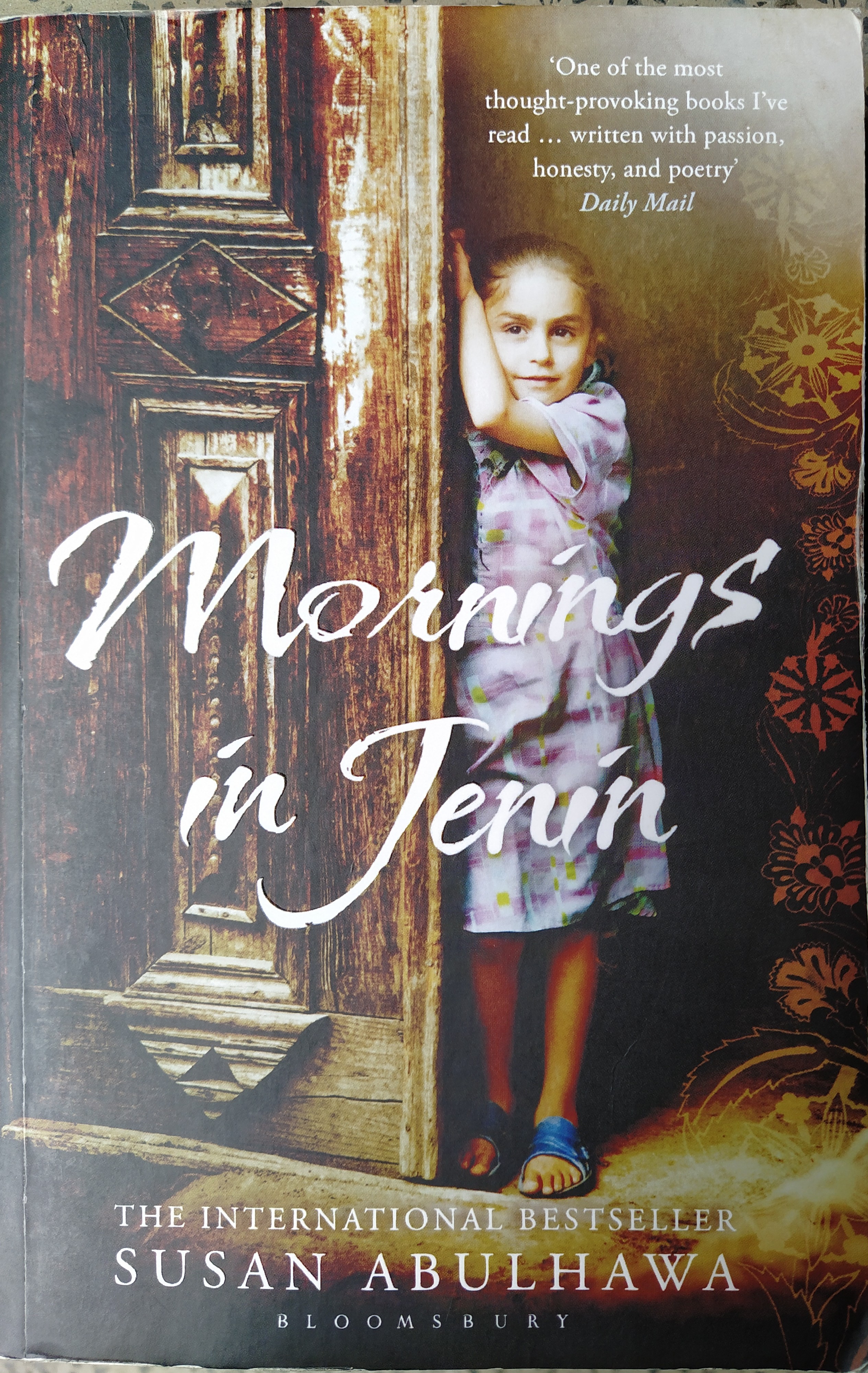
In other circumstances I would have noted, but not fully registered these two news items. However, quite coincidentally I have, in this same period, been reading a novel which is set in this region, and suddenly the context and the history took on a different dimension.IMG_20200819_105523

Mornings in Jenin is a poignant story of four generations of one family’s struggle and survival over sixty years of the Israel-Palestine conflict. The story which traverses from Jerusalem to Lebanon to America is told by Amal, a girl born to Arab parents in a refugee camp in Jenin; it traces the lives of her grandparents, herself, and her daughter.

As World War II raged in Europe in 1941, Amal’s  grandparents were living on their ancestral olive farm in the village of Ein Hod, not far from Bethlehem, in what was then Palestine. Their oldest son, Hasan, was best friends with a refugee Jewish boy, and the two were welcomed in each other’s homes. In May 1948, the Jewish state of Israel was proclaimed, and all the original inhabitants of the area were moved to the Jenin refugee camp. And this is where three subsequent generations lived, married, were born, and died.

The story follows Amal’s family as they live through a half century of violent history. It is not a political treatise, but the many interwoven stories, stretching backwards and forward in time, reveal what politics can do to ordinary people. It is a tale of hatred and fear, loss and pain, faith and hope. Above all is a saga of waiting—waiting to return to a lost home and homeland. Amidst the indignities and sufferings of these uprooted lives, there is also a tender celebration of family ties, the intensity of a mother’s love, sibling bonding, and enduring friendship.

It is also the story of Palestine from the time when it was a productive land of olive groves and proud self-sufficient inhabitants, through the 1948 War, the Occupation by Jews and conversion into the land of Israel, and the many Arab-Israeli wars from 1967, up to 2002.

Today we are so heavily bombarded with news (printed and audio visual) about conflict and displacement, all clubbed under the umbrella of ‘international humanitarian crises’ that we are either becoming inured, or choose to pretend that this does not concern us directly. For those of us who are fortunate and secure in our home and homeland we cannot imagine what it must be to be without a home nor homeland. As Amal describes “He [my brother] was denied, imprisoned, tortured, humiliated and exiled for the wish to possess himself and inherit the heritage bequeathed to him by history.” 

The novel is tagged as fiction, but the refugee camp of Jenin is real. The northernmost camp in the West Bank, it was set up in 1953 to house the displaced persons from the first Israeli takeover of territories in Jerusalem in 1948.  Over the years it was attacked several times by Israeli forces, and as lately as in 2002, it was the site of a terrible massacre. Even today Jenin camp has a population of about 14,000 residents cramped together in an area of 0.42 sq km.

Mornings in Jenin is written by Susan Abulhawa who was born in Kuwait to Palestinian refugees of the Six-Day-War of1967 war. She now lives in the USA. She is a human rights activist and founder of Playgrounds for Palestine, an NGO that advocates for Palestinian children’s right to play by building playgrounds in refugee camps in Lebanon. In 2002 she visited the refugee camp of Jenin and the book reflects real events.

While this book is “The story of one family, in an obscure village, visited one day by history that was not its own, and forever trapped by longing between roots and soil” it is a moving reminder that the faceless “humanitarian crisis” is made up of myriad individual human beings, each with their own personal life story, and common yearning for home and homeland.

–Mamata


.


War and Peace

6 August 2020 marks 75 years since one of the most devastating events in the history of warfare took place. On this day, in 1945, an American bomber plane called Enola Gay dropped a 4000+ kilo uranium bomb named ‘Little Boy’ on the Japanese city of Hiroshima.

It was as if the city was struck by a blinding flash; the bomb exploded, and a giant mushroom-shaped cloud rose to the sky. The blast flattened the city and killed nearly 100,000 people; tens of thousands were injured. Three days later, on 9 August, the Americans dropped another nuclear bomb on the Japanese city of Nagasaki. On 15 August 1945 World War II ended.

But for the survivors of the nuclear blasts the battles had just begun. Within a month of Little Boy hitting Hiroshima, radiation exposure is thought to have caused the deaths of at least 6,000 people who survived the blast. And the long-term effects of radiation exposure, physical and psychological, continued to reveal themselves for the next decades. There was a documented rise in cancer, especially, in leukaemia cases. In the years following the attacks, the survivors became known as the hibakusha (the explosion-affected people) and were subjected to widespread discrimination as it was believed that they were carriers of a contagious disease. And for years the ugly spectre of the after-effects kept raising itself.

Amidst all this, there were still some stories of hope and resilience. One of the classic stories that beautifully captures this is that of Sadako and the Thousand Paper Cranes by Eleanor Coerr. This is based on the life of a real little girl named Sadako who lived in Hiroshima from 1943 to 1955. Sadako Sasaki was a baby when the bomb devastated Hiroshima. Her grandmother died in the explosion. The story opens ten years later when Sadako is a lively girl who dreams of becoming a runner. One of the annual outings of Sadako and her family is on 6 August to what was called the Peace Park to commemorate those who lost their lives on that fateful day in 1945, and to pray for peace and good luck.

Sadako loves her family, her friends and her school. One day as she is practicing for a big race, she feels dizzy. Quickly, and without any obvious causes, the dizziness and weakness continue to worsen. After some tests at the Red Cross Hospital, the doctors’ worst fears are confirmed: Sadako has leukemia, the dreaded “atom bomb disease”. The cheerful little girl’s world is turned upside down.

Sadako needs to stay on in hospital. One day, Sadako’s best friend Chizuko comes to visit her in hospital. Chizuko has brought with her some golden paper, and she folds this to make a crane. She tells Sadako: Don’t you remember that old story about the crane? It’s supposed to live for a thousand years. If a sick person folds one thousand paper cranes, the gods will grant her wish and make her healthy again. She handed the crane to Sadako. “Here’s your first one”.

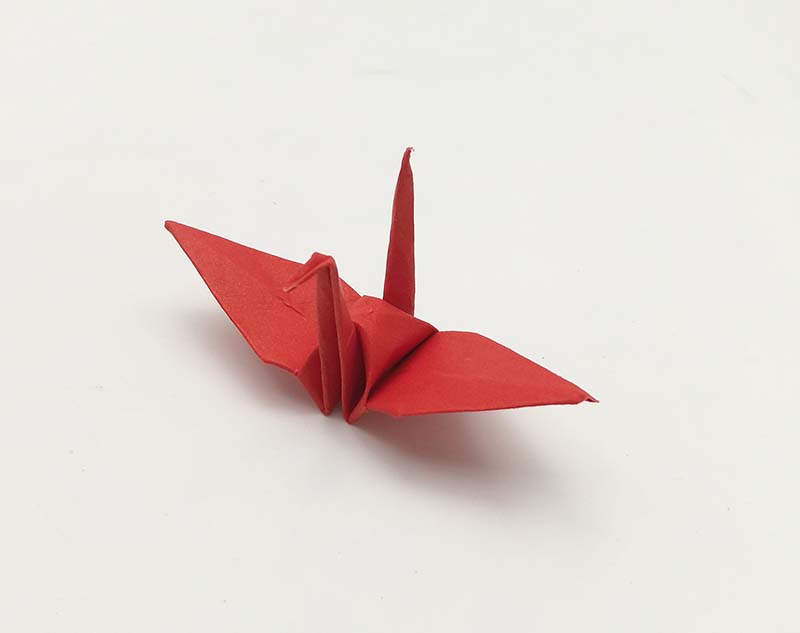
This gives Sadako hope and cheer. She spends the next few weeks folding as many orizuru or paper cranes as she can, even as she is getting weaker and sicker. Soon everyone becomes a part of the project. 

Everyone saved paper for Sadako’s good luck cranes. Chizuko brought colored paper from the bamboo class. Father saved every scrap from the barbershop. Even Nurse Yasunaga gave Sadako the wrappings from packages of medicine. And Masahiro hung every one of the birds, as he had promised. Sometimes he strung many on one thread. The biggest cranes flew alone. 

Sadako channels all her fast depleting energy into painstakingly folding paper crane after paper crane, making a wish with the completion of each one, and determined to reach the magic number of 1000 paper cranes.   

She never complained about the shots and almost constant pain. A bigger pain was growing deep inside of her. It was the fear of dying. She had to fight it as well as the disease. The golden crane helped. It reminded Sadako that there was always hope.

 Against all odds, Sadako manages to complete 644 cranes before she slowly sinks into a peaceful death.

She looked at her flock hanging from the ceiling. As she watched, a light autumn breeze made the birds rustle and sway. They seemed to be alive and flying out through the open window. How beautiful and free they were! Sadako sighed and closed her eyes. She never woke up.  

Sadako died on October 25, 1955. Her classmates folded the remaining 356 cranes, and all 1000 paper cranes were buried with her. Her classmates also collected her letters and journal and published them in a book. The book reached young people across Japan, and they all came to know the story of the courageous Sadako and her cranes.

Sadako’s classmates resolved to honour the memory of their friend in as many ways as possible. Their efforts sparked a children’s peace movement that swept through Japan, and then the world. This transformed the origami paper crane into an international symbol of peace. Their fundraising campaign led to the establishment of the Children’s Peace Monument in the centre of Hiroshima’s Peace Memorial Park. Here stands a statue of Sadako holding aloft a golden crane.

Today millions of paper cranes, reach here from all corners of the globe, symbolizing the universal value of peace and the preciousness of life. In Japan a popular tradition is to fold 1000 cranes and string these together, usually 25 strings of 40 cranes each, which are given as gifts called senbazuru which literally means, ‘one-thousand cranes’.

On 6 August every year, people still place folded paper cranes at Sadako’s statue, and reiterate the same wish that is engraved at the base of the statue:origami crane.jpg

This is our cry,

this is our prayer;

peace in the world. 

Today the long and complex history of the World War II is just that—history. But more than ever before, the unleashed peril of a nuclear explosion continues to keep the entire world on tenterhooks. Hiroshima is a reminder of the horrific legacy of nuclear warfare, but the Peace Memorial is a reminder that there can be another legacy—one of peace.

–Mamata


Tiger Tales

July 29 is celebrated as International Tiger Day as a way to

DSCN6148.JPG
Photo credit: Seema Bhatt 

raise awareness about the magnificent but endangered tiger. The day was founded in 2010 at the Saint Petersburg Tiger Summit, when the 13 tiger range countries came together to create Tx2—the goal to double the number of tigers in the wild by the year 2022. While this deadline is only two years away, it is reported that the current number still far from the goal. It is estimated that the total number of tigers in the wild in the world is 3900.

India is one country which has been showing a significant rise in its tiger population. Last year on International Tiger Day, the results of the Tiger Census 2018 were announced to reveal that the total population of the Royal Bengal Tiger in India is 2967, which is more than double that of 2006. India is also now officially one of the biggest and safest habitats of the Tiger.

As someone who is more comfortable with stories rather than statistics, all the tiger talk took me to the story of Jim Corbett—a teller of many a tiger tale.

James Edward Corbett was born on 25 July 1875 into a family of English ancestry in Nainital, in what is now Uttarakhand; he was one of twelve children. His father who was the postmaster of Nainital died when James was only four years old, leaving his widow to raise the large family on a meagre pension. The young James, or Jim as he was called, had to start earning at an early age to help out the family.

Jim was a wanderer from the time he could walk, and he spent his childhood exploring every nook and corner of the nearby forest, observing the plants, animals and birds. In those days, hunting was a part of everybody’s life. When he was just 5 years old Jim was taken by his brother on a hunting expedition. He was handed a gun and asked to report if he sighted a bear. Much later Jim wrote in one of his books, Jungle Lore, that that was the most frightening experience of his life. But this experience also laid the foundation of Jim’s life-long link with forests.

The fear of the jungle combined with the desire to know more about it led Jim to be observant but also careful. He learned to be silent, which places to avoid, and which to explore further. By the age of 7 he began to be totally absorbed in the natural world around him, appreciating it, trying to understand it, and even attempting to classify animals he saw by the functions they performed. For example, different kinds of birds. He wrote in his diary:

Bird’s that beautify nature’s garden: In this group I put minivets, orioles and sunbirds.

Birds that warn of danger: drongos, red jungle fowl and babblers.

Birds that perform the duty of scavengers: vultures, kites and crows.

Having sorted the jungle birds and animals according to his own classification, Corbett began to study them in detail, tracking them, understanding their calls and pugmarks, and learning to mimic their many sounds. In one of his books he shares this mystery and magic thus: “There is no universal language in the jungles; each species has its own language, and though the vocabulary of some is limited, as in the case of porcupines and vultures, the language of each species is understood by all the jungle-folk.”

Honing all his senses to recognise the signs and movements of wildlife, the observant and fleet-footed young Jim soon became a shikari in the true sense–a person who is one with the environment in which he hunts, and with the hunted. Shooting his first leopard at age eight, Corbett went on to become an excellent hunter, and gained fame for killing several dreaded man-eating tigers. But history has it that he has never killed any big cat without confirming that it had harmed a human.

Over the years, Jim’s love for animals translated into wildlife photography. Inspired by his friend, Frederick Walter Champion, he started to record tigers on film. In the mid 1920’s, when he was in his fifties, Corbett completely gave up shooting with a gun and turned to shooting with a camera. He felt that “far more pleasure was got from pressing the button of a camera than is ever got from pressing the trigger of a gun.”

Jim Corbett spent his remaining years in writing about his hunting adventures and jungle experiences, and promoting the cause of conservation. In November 1947, Corbett and his sister left for Kenya, where he lived till his death in 1955. Jim Corbett’s entire life was a testimony to his close connection to nature, and the joy it gave him. As he wrote: “The book of nature has no beginning, as it has no end. Open this book where you will, and at any period of your life, and if you have the desire to acquire knowledge you will find it of intense interest, and no matter how long or how intently you study the pages, your interest will not flag, for in nature there is no finality.”
But what makes Corbett so special is that he became one of the first champions of the conservation movement in India. Using his influence over then Provincial Government, Corbett played a key role in the establishment, in 1939, of Hailey National Park, India’s first national reserve for the endangered Bengal tiger. In 1957, the park was renamed Jim Corbett National Park in his honour. In 1968, one of the five remaining sub-species of tigers was named after him as Panthera Tigris Corbetti, or Corbett’s Tiger.

For us in India, tiger tales and Jim Corbett are closely linked. And today, his words are as true as they were when he wrote them in 1944:

“The tiger is a large-hearted gentleman with boundless courage and that when he is exterminated–as exterminated he will be unless public opinion rallies to his support–India will be the poorer, having lost the finest of her fauna.”

–Mamata