War and Peace

What can one say about the year that is winding to a close? Sadly, despite many stories of achievements and accomplishments across the world, and even into space, perhaps the images that will haunt us the most will be those of the ravages of war. A frightening reminder of human’s inhumanity to humans. While the voices of the war-mongers are louder and more strident, there are, in every time and generation a few who gently, but passionately, fight the non-violent battles for peace.

One among these was Daisaku Ikeda, the Buddhist philosopher, educator, author, poet, and above all, peace-builder. Ikeda was born in Tokyo, Japan, on January 2, 1928, the fifth of eight children, to a family of seaweed farmers. He grew up in a period when Japan was in an authoritarian and militaristic phase of expansion, and heading towards World War II. As a teenager Ikeda was witness to the devastation and suffering of the war, including the death of his elder brother in action. The young Ikeda was deeply disturbed by the seemingly meaningless human conflict.

At the age of 19, Ikeda met Josei Tado, an educator, pacifist and leader of the Soka Gakka, a Japanese Buddhist religious movement based on the teachings of the 13th-century Japanese priest Nichiren. Toda had been imprisoned during the war together with his mentor Tsunesaburo Makiguchi. Both had held firm to their religious convictions in the face of oppression by the military authorities who had imposed the Shinto ideology as a means of sanctifying their war of aggression. Makiguchi had died in prison, and Toda had resolved to stand up to the militarist regime. This greatly impressed Ikeda who was drawn to the Buddhist philosophy of peace and non-violence. The seeds of Ikeda’s passion for peace were firmly sown.

Toda was engaged in the process of rebuilding the Soka Gakkai which had been all but destroyed as a result of wartime persecution. The young Ikeda shared Toda’s conviction that the philosophy of Nichiren Buddhism, with its focus on the limitless potential of the individual, cultivated through an inner-directed revolution, could help revive society in the devastation of post-war Japan.

Ikeda accepted Toda as his mentor, and the next ten years became as he described, ‘the defining experience of his life and the source of everything he later did and became.’ Toda died in 1958, and in May 1960, Ikeda succeeded him as president of the Soka Gakkai. He was 32 years old. In 1975, Ikeda became the founding president of Soka Gakkai International (SGI), which grew into a global network that brings people of goodwill and conscience together. Under his leadership, the movement began an era of innovation and expansion, becoming actively engaged in initiatives promoting peace, culture, human rights, sustainability and education worldwide. He established the Soka (value-creation) schools system, a non-denominational educational system based on an ideal of fostering each student’s unique creative potential and cultivating an ethos of peace, social contribution and global citizenship.

Ikeda’s philosophy is grounded in Buddhist humanism; the central value being the fundamental dignity of life, which is the key to lasting peace and human happiness. In his view, global peace relies ultimately on a self-directed transformation within the life of the individual, rather than on societal or structural reforms alone.

From a healed, peaceful heart, humility is born; from humility, a willingness to listen to others is born; from a willingness to listen to others, mutual understanding is born; and from mutual understanding, a peaceful society will be born. Nonviolence is the highest form of humility; it is supreme courage.

Ikeda also firmly believed that the foundation of peace lay in dialogue. Dialogue and education for peace can help free our hearts from the impulse toward intolerance and the rejection of others. People need to be made conscious of a very simple reality: we have no choice but to share this planet, this small blue sphere floating in the vast reaches of space, with all of our fellow “passengers.”

Dialogue and the promotion of cultural exchange became the basis of his efforts to build trust and foster friendship in contexts of historical division and conflict. In order to discover common ground and identify ways of tackling the complex problems facing humanity, Ikeda pursued dialogue with individuals from diverse backgrounds—prominent figures from around the world in the humanities, politics, faith traditions, culture, education and various academic fields. Over 80 of these dialogues have been published in book form. Through his writings and actions Ikeda became a pioneering practitioner of the concept of ‘a culture of peace’.

Ikeda also founded a number of independent, non-profit research institutes to promote peace through cross-cultural, interdisciplinary collaboration: the Boston Research Center for the 21st Century (renamed Ikeda Center for Peace, Learning, and Dialogue in 2009), the Toda Institute for Global Peace and Policy Research (renamed Toda Peace Institute in 2017) and the Institute of Oriental Philosophy. The Min-On Concert Association and the Tokyo Fuji Art Museum promote mutual understanding and friendship between different cultures through the arts.

Ikeda was a multi-faceted personality—philosopher, educator, writer and peace-builder. But all his endeavours were rooted in his strong faith in the positive potential inherent in the life of every person. Ikeda was convinced that peace is ultimately inseparable from enabling the flourishing of each person’s individuality. A great inner revolution in just a single individual will help achieve a change in the destiny of a nation and, further, will enable a change in the destiny of all humankind.

For Ikeda, peace was far more than the mere absence of war. He saw this as a set of conditions in which cultural differences are embraced and appreciated and in which dialogue is firmly established as the means of choice for resolving conflict. In the end, peace will not be realized by politicians signing treaties. True and lasting peace will only be realized by forging life-to-life bonds of trust and friendship among the world’s people. Human solidarity is built by opening our hearts to each other. This is the power of dialogue.

Daisaku Ikeda passed away on 18 November 2023, at the age of 95 years. As another war rages on, the world is in dire need of the wisdom of men such as him, to remind us again and again of the futility of violence. Peace is not simply the absence of war; it is a state in which people come together in mutual trust and live with joy, energy and hope. This is the polar opposite of war―where people live plagued by hatred and the fear of death.

With hope and a prayer that the year ahead may lead humanity from war to peace.

Peace is not found somewhere far away. Peace is found where there is caring. Peace is found when you bring joy to your mother instead of suffering. Peace is found when you reach out and make an effort to understand and embrace someone who is different from you. Daisaku Ikeda

–Mamata

Teacher? Teacher!

In the run up to Teacher’s Day which is celebrated in India on 5 September every year, there will be numerous pieces about outstanding teachers, teachers who have changed the lives of students, and other inspiring stories.

Sadly, even as we felicitate and celebrate teachers such as these, there are also disturbing reports about teachers who, perhaps, could leave life-long scars on the children that they have the opportunity to mould and nurture. These belong to the mass of average teachers who are “teachers” in name but not in deed. What do they make of their job, which is really speaking a means of livelihood, and even that, which is insecure?

Take this piece, titled Confessions of a Teacher.  

I am a teacher. I saw an article entitled ‘Teacher’s Confessions’ and thought, why not pen down my own confessions?

I have been in teaching for years now. As a requirement to becoming a teacher, I had at that time, to study the science and principles of education. I have not learnt much more, since then.

I go to public libraries but rarely touch teaching related journals. A glance at the librarian’s issue book will show several books against my name, but none related to education.

I am certainly in the habit of reading. In the early years I was busy studying the textbooks and related material. But the textbooks don’t change often. I now need only to glance at the books. My reading list now includes dailies and monthlies and some assorted fiction.

After school hours I rarely discuss education-related topics. My discussion includes topics such as someone’s dismissal or promotion, forms and examinations, higher authorities or fellow teachers, booksellers, and so on.

During recess time, my colleagues gather for a cup of tea. We talk of many things. But never do we talk about how to teach, teaching aids, or students.

The school timings are fixed. The curriculum is set. The school bell heralds the passage of time, and students are prepared for the examinations. The systems are in place. I go to school. Teach the lessons for the day. I carry out my tasks and keep the order – partly by force, partly by wit, partly through my image, and largely through the set disciplinary systems of the school.

I don’t get into the depths of any subject. There is no time; just enough to complete what will be part of the exams. Students will take longer, and explanations will have to be made to the authorities.

I know the students by name, or those that know their lessons, and those that do not. I do not know anything about their family, their friends, their own personalities. We are not close. I know their minds, but not their hearts.

I see who comes first, and who is last. I do not know about their physical strengths and weaknesses. Those who finish their work and bring it to me, are clever; those I like. The rest are duds; I do not like them. Between us there is no affection. How can there be trust? They are afraid of me; and I exert my authority over them.

Once I leave the school, I scarcely think of them, save perhaps, one who might have been greatly disrespectful. Each to our own homes. Perhaps, as I lie down the thought may cross my mind that as the exams near, I will have to speed up the revision, for which I’d use the recess.

I haven’t seen the home of the children. Nor have I shown them my home. I do not have such a relationship with them.

I dream that I will be promoted till some day I become headmaster. I will complete my term of service, retire and enjoy my pension. I hope to save a little before I am too old. That is why I have to take tuitions.

I wish that I am well thought of in my community, that I can educate my children so that they get good jobs, and I can marry them off before I enjoy old age.

It is for this that I wish to work. Today the profession of teaching is, for me, an activity, a job. In all this, the ideals of education, the changing principles and practices of teaching, the desire to bring new changes in the field – all this is not in one, where will they come from?

I would like to explain clearly what my position is today. My state is like this; I presume my fellow teachers are in a similar situation.

If we think that this is a familiar scenario, it may come as a surprise that this was written in 1932 (nearly a hundred years ago). The author is Gijubhai Badheka an eminent educator who helped to introduce Montessori education methods to India. Disturbed by the dark educational system of that time, he embarked on his journey into the realms of education, and left behind a rich legacy of work and writing.

More about Gijubhai and his work on www.gijubhaibadheka.in.

Several generations later, the dilemmas about what makes a ‘good teacher’ continue to engage educators.

A hundred years after Gijubhai wrote some of his seminal works on education, Sir Ken Robinson one of the eminent contemporary thinkers on education propounded a critique of the school system. His TED talk Do Schools Kill Creativity? is one of the most watched talks. He urged schools to transform teaching and learning to an experience personalized for every student involved.

His words resonate closely with Gijubhai’s angst about the state of education, and his dream for a transformative educational system

Role of the Teacher    

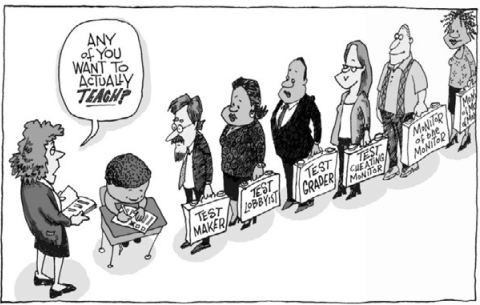
The problem is that over time, all kinds of things have gotten in the way of it – testing regimes, league tables, unions’ bargaining rights, building codes, professional identities, the concerns of various pressure groups, ideology of various political parties. It’s very easy for people to spend all day discussing education without mentioning the students at all. But all of this is a complete waste of everybody’s time if we forget that our role is to help students to learn. Therefore, the question is: what should they learn and how do we best do that?

All the great education systems and schools know that. It’s why they invest so heavily on the selection of teachers, why they insist on getting people who don’t just have good degrees, or have them at all. They want people who know their material, but they also know that teaching depends upon a whole set of pedagogical skills and a love of the process. It’s more than the transmission of direct content. It’s about having a set of skills focused on facilitating learning. (Sir Ken Robinson)

A teacher’s work is like flowing water. The fulfilment of the work of education is not in teaching one or two subjects… Real education lies in making humans aware about their own unending strengths. (Gijubhai Badheka ‘Note to Teachers’ 1920)

Some food for thought.

–Mamata

Mycologist, Artist, Author: Beatrix Potter

Several generations of children grew up with The Tale of Peter Rabbit. The author Beatrix Potter is a familiar name in children’s literature, but what is less known is that she was also a notable woman of science, in an age when this was almost unheard of.

Helen Beatrix Potter was born on July 28, 1866 in London in a family that enjoyed culture and the arts. Although Beatrix was educated at home by a governess, she and her brother spent all their free time in the woods around their home, observing the small creatures that lived there, and even bringing some, like hedgehogs and rabbits home. Beatrix was a quiet shy girl who expressed herself through paintings and drawings of wildlife, and in coded notes in a secret diary.

When an uncle who was a chemist gave her permission to use his microscope, a whole new world opened up for Beatrix who could minutely study plants, and insects and make detailed sketches. Her interest in natural history was further spurred when she used to visit the South Kensington Museum. She found herself drawn to the study of plants and fungi as well as insects.  

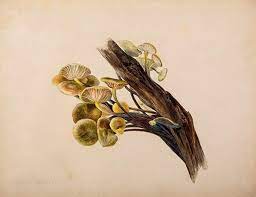
Beatrix’s interest in drawing and painting mushrooms, or fungi, began as a passion for painting beautiful specimens wherever she found them. As her biography says: She was drawn to fungi first by their ephemeral fairy qualities and then by the variety of their shape and colour and the challenge they posed to watercolour techniques.

In October 1892, on a family holiday in Scotland, Beatrix got to know Charles McIntosh, a local postman and self-educated naturalist who was also an expert on British fungi. McIntosh admired her pictures, sent her specimens to paint and advised her on scientific classification and microscope techniques. She sent him copies of her pictures in return. She would go on to produce some 350 highly accurate pictures of fungi, mosses and spores.

Beatrix also started hunting for rare varieties of mushrooms, and growing dozens of different species of fungi at home, in order to study their development. She was intrigued by their life cycle. By 1895, Beatrix Potter’s interest in fungi was becoming even more scientific. Following advice from McIntosh, she began to include cross sections of mushrooms in her illustrations to show their gills and used a microscope to draw their tiny spores. She speculated about whether these spores could germinate and the environments in which they might do so.

In May 1896 her uncle Sir Henry Roscoe, a prominent chemist, introduced her to the mycologist at Kew’s Royal Botanic Gardens. This led to a post at the Royal Botanic Gardens where she produced faithful, detailed renderings, largely of mushrooms and toadstools as seen through a microscope. In addition to her art, the scientist in her also began experimenting with germinating spores of various fungi on glass plates and measuring their growth under a microscope. Her close observations and experiments, as well as her drawings showed in great detail how lichens, a common type of fungi found on rocks and trees, were actually not one but two different organisms that lived together. Her studies showed that this was a union between an alga and a fungus. The two different organisms are able to live together, with each of them benefitting the other in some way. Beatrix thus was one of the earliest to study and hypothesize what would later become the science of symbiosis. However, the botanists she showed her work refused to discuss even discuss the drawings she made.

Beatrix prepared a paper on her findings and submitted her work to The Linnaean Society of British Scientists but was not allowed to read it herself because, at that time, only men were invited to their meetings. The all-male panel rejected her paper and refused to publish it. Potter withdrew the paper, presumably to make amendments. But it was never published; and no copy exists today. Thereafter Beatrix turned her full attention to drawing and writing.

There is today some controversy about how serious Beatrix Potter was as a mycologist. But there is no doubt about the accuracy and detailing of her drawings and paintings of fungi which remain unparalleled, and are referred to mycologists even today. As her biography says: Beatrix Potter never saw art and science as mutually exclusive activities, but recorded what she saw in nature primarily to evoke an aesthetic response.

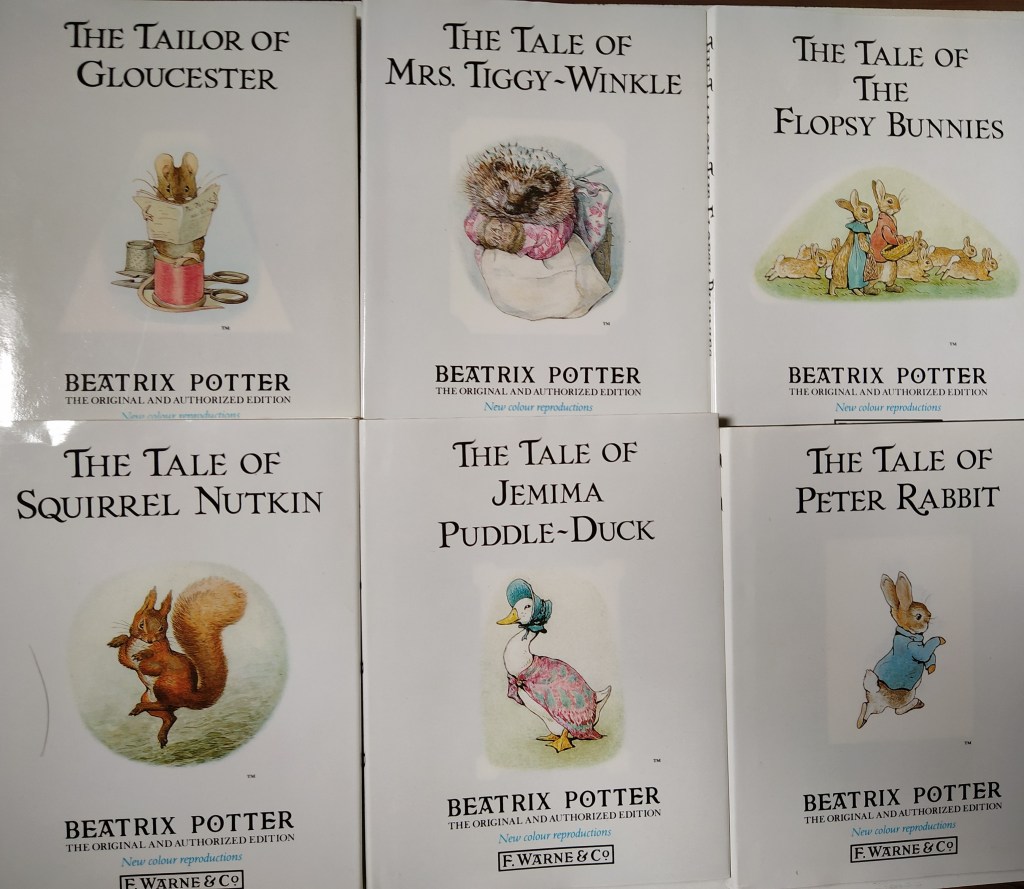
The name Beatrix Potter endures today as the author of well-loved children’s books. In 1893 she sent a letter with a picture story to a sick child of her old nanny which began with the words “I don’t know what to write to you, so I shall tell you a story about four little rabbits whose names were Flopsy, Mopsy, Cottontail and Peter.”  Beatrix went on to create the loveable characters of Peter Rabbit, Benjamin Bunny and Jemima Puddle Duck, among others that had adventures in the 26 books that she published subsequently. Over 150 million copies of her books have been sold and have been translated into 35 different languages

As her books gained popularity, she channelled all the profits towards a large property called Hill Top which she purchased in 1905. Situated in England’s Lake District, this was her first farm. She enjoyed the quiet and solitude that the thirty-four-acre property brought her and this allowed her to work more efficiently. Aside from being a farmer and landowner, Beatrix also became recognized as a sheep breeder. She never lost her love for nature and became an advocate of traditional farming and the preservation of the wild environment surrounding the area. She continued buying patch after patch of land around her farm. By doing so, Beatrix hoped to further pursue her dream to provide land for the creatures that she had loved since her childhood.

Beatrix Potter died of bronchitis in 1943, aged 77, leaving behind a legacy across different fields of study. The British Natural Trust eventually became recipient to her donation of 4,000 acres of land. The property was named a UNESCO World Heritage Site in 2017, and is now open to the public.  Beatrix Potter’s love for the land and all its creatures continues to provide a haven for all life.

–Mamata

No Regrets

What is regret? ‘A feeling of sadness, repentance, or disappointment over an occurrence or something that one has done or failed to do’, the dictionary tells us.

All of us have felt/feel/will feel regret. But few of us pause to think about it. Daniel Pink is one person who did. And came out with the book ‘The Power of Regret: How Looking Backward Moves Us Forward’ a New York Times bestseller, like four of his previous books.

Pink did a survey covering over 16,000 people from across more than 100 countries, and created a database of their top-most regrets.

And found a pattern. All regrets fell into one of four categories:

‘1. Foundation Regrets. These regrets stem from failures to be responsible, hard working, or prudent.  They are typically articulated as ‘If only I had done the work’ or ‘If only I had been a little more careful.’ Finance and health related regrets mainly fall in this category.

2. Boldness Regrets. The survey found that most people regret inaction–about double the number of people regret not taking action, rather than taking one. This is about the chances or opportunities that one missed taking. For instance, not taking that admission in a foreign university, not starting a business, not buying that dream house, or marrying a true love. These regrets sound like ‘If only I had taken that chance.’

3. Connection Regrets. These regrets happen when we don’t keep in touch or are on bad terms with people who matter to us, and make up the largest category. If the thought ‘If only I had reached out’ is on your mind, you are suffering this type of regret.

4. Moral Regrets. This category of regrets had the smallest number of responses but were probably the most painful to the person concerned. These regrets are about making the less ethical choice when faced with a decision. This is the type of regret when you agonize: ‘If only I had done the right thing.’’

I did try to think through my regrets, and can’t say I have been able to find one that is out of these four categories!

Pink also suggests some ways we can overcome these regrets, and as importantly, learn and build on them. Some of these suggestions include:

·      Apologize, try to make amends and repair the damage.

·      It is sometimes not too late, so take action now. For instance, if you regret that you did not pursue your passion for music in your youth, maybe it is not too late even now.

·      Find the silver lining, ie., try to think of how the situation may have turned out worse than the current situation.

·      Distance yourself—one has to let go of what is done and over and cannot be undone. No point in agonizing over it forever. We have to find ways to cut off.

·      Self-compassion, ie., not flogging oneself forever for something.

The most important thing however, is to consciously revisit one’s regrets and analyse them and use them as a basis when making significant decisions in the present and future. This can probably improve the quality of our decisions.

The survey of regrets is open, and one can both take the survey and visit the database. If anyone needs convincing on the commonality of the human experience, a browse through the database will do it!

And to end, a poem on regret by Robert Burns, which is profound lesson on how to live so we don’t regret the world we are passing on to the next generation:

To a Mouse, On Turning Her up in Her Nest with the Plough

I’m truly sorry man’s dominion,
Has broken nature’s social union,
An’ justifies that ill opinion,
Which makes thee startle
At me, thy poor, earth-born companion,
An’ fellow-mortal …

November 1785.

–Meena

Say Sorry!

There is an old rhyme that begins with: For the want of a nail…and ends with (through the domino effect) …a kingdom was lost. In recent days, there has been a situation where: For the want of an apology….a Parliament was adjourned. This was caused by the obdurate demand for an apology by one side in confrontation, with the equally intransigent refusal to apologize by the other. 

Saying “sorry” is probably the simplest and oldest form of an apology. An apology is defined as a regretful acknowledgement of an offence or failure. In an age where increasingly the ‘self’ rules the stage, where a sense of entitlement dominates much of human engagement, and where aggression and intimidation are a part of day-to-day life, this kind of acknowledgement is sometimes perceived as a form of cowardice or a sign of a non-confrontational (passive) person. This avoidance or denial of acknowledgement of wrong may spark off immediate confrontations that may spiral out of control, or a festering of resentment that plants the seed of future ‘revenge’. This holds true for individuals, communities and even countries.

Karina Schumann, an Associate Professor of psychology at the University of Pittsburgh has been researching and writing about factors that help people successfully manage their conflicts and respond to challenging social interactions in pro-social ways. Her work focusses on apologies as a key factor in this area. It looks at different kinds of apologies from inter-personal one-on-one apologies, to institutional apologies, to public apologies, particularly by politicians.

In the case of interpersonal conflicts Dr Schumann’s research indicates that a common response that we have when we’ve done something wrong is, ‘this does not feel good to us, we want to push away blame from ourselves’. And we can do this in a variety of ways. We blame the other person, we blame the situation, we think about all the extenuating circumstances that affect our behaviour, or we minimize the consequences of our actions for that other person.

Often apologies take the approach that “Well if you are offended, I’m sorry.” This implies somewhere that while the offender is expressing remorse or sympathy for the fact that the recipient felt bad, he or she is not really taking responsibility or accountability for the offense. This is a way of justifying our actions while morally disengaging ourselves. This kind of apology, in some ways, tries to shift the blame onto the victim. The apologies on social media during the MeToo movement are examples of this kind of apology. One key factor for this attitude is the lack of empathy with the person one has offended.

A sincere apology does not make justifications for the behaviour the person is apologizing for, and does not blame the victim. The person offering the apology does not excuse their own behaviour. An acceptance of responsibility is core to an apology.

Public apologies happen on the public stage, often delivered in some sort of official way, like a government apologizing on an official stage for a historical injustice. Sometimes corporations might put out a statement of apology to their consumers or clients. Sometimes celebrities apologize, and politicians apologize for their own misdemeanours. These are sometimes issued through an official press conference or via Twitter or YouTube. These apologies are issued in a reactive way. Research indicates that people are generally sceptical about such apologies. It is assumed that they are being offered for strategic reasons as opposed to sincere reasons, or that the public figures were pressured into it, and they have ulterior motives. To come across as meaningful, the quality of public apologies must meet a higher bar than an interpersonal apology.

Whether personal or public, to be genuinely accepted an apology must communicate empathy and concern. It is not enough to say “I am sorry”. The messages that should come across are: “I care about you. I care about our relationship. I want to make this better”. They should send a signal: “We care about this. This matters. We are committed to doing better.”

An apology can be the first step in initiating the process of forgiveness.

A beautiful passage from one of my favourite authors Alexander McCall Smith tells us how:

Forgiveness is at the heart of the way we live our lives–or should be. So when we teach our children about the things they ought to know about the world—about how not to touch fire, about how to wash their hands, or put on their shoes—all these things, we should also remember to teach them about forgiveness. We must teach them that when another person wrongs us—hurts us perhaps—we should not strike back, but should be ready to forgive. We must teach them that if we do not forgive them, then we run the risk of being eaten up with hatred inside, and that hatred is like acid, that it will grow and gnaw away. That is why forgiveness must be taught at the beginning, when we are teaching them about these first things.

Today, more than ever before, the world is in desperate need of empathy and forgiveness. The seeds need to be sown early, and nurtured with compassion.

–Mamata

I am a Book: Read Me

Many of us (from an earlier “fairy tale” generation) grew up with stories of the Ugly Duckling, The Emperor’s New Clothes, The Princess and the Pea, Thumbelina and many more. These were originally written by the famous Danish writer Hans Christian Anderson. A prolific writer of plays, travelogues, novels, and poems, he is best remembered for his literary fairy tales which have been translated into more than 125 languages.

Hans Christian Anderson was born on 2 April 1805. Two hundred years later, with the new trends in children’s literature, the author and his genre of children’s literature may not be as well known, or widely read. However his lasting contribution to children’s literature is celebrated by marking his birthday as International Children’s Book Day, to inspire a love of reading and to call attention to children’s books.

Celebrated on April 2every year, this is a day that celebrates children literature in all of its forms and acknowledges the writers which create it. It is an event that is sponsored by the International Board on Books for Young People (IBBY), a non-profit agency that was created in 1952. The organization represents an international network of people from all over the world who are committed to bringing books and children together. In 1967, this body created International Children’s Book Day to promote the six key areas deemed important by them:

To promote international understanding through children’s books; to give children everywhere the opportunity to have access to books with high literary and artistic standards; to encourage the publication and distribution of quality children’s books, especially in developing countries; to provide support and training for those involved with children and children’s literature; to stimulate research and scholarly works in the field of children’s literature, and to protect and uphold the Rights of the Child according to the UN Convention on the Rights of the Child.

Each year a different National Section of IBBY has the opportunity to be the international sponsor of ICBD. It decides upon a theme and invites a prominent author from the host country to write a message to the children of the world and a well-known illustrator to design a poster that sends a message to all the children of the world.

This year IBBY Greece is the official sponsor of the International Day of Children’s Books. The chosen theme is ‘I am a book, read me’. The theme celebrates the power of children’s books in promoting values of equality, diversity and inclusion, as well as connecting people through tolerance and understanding. Greek author Vagelis Iliopoulos and illustrator Photini Stephanidi have collaborated to create a poem and poster that remind us of these messages.

I am a book, read me

 I am a book.

You are a book.

We are all books.

My soul is the story I tell.

Every book tells its own story.

We can look quite different –

some big, some small,

some colourful, some black and white,

some with a few pages, some with many.

We may say similar or completely different things,

but that’s our beauty.

It would be boring to be all the same.

Each of us is unique.

And each of us has the right to be respected,

to be read without prejudice,

to be given space in your library.

You may have opinions about me.

You may choose to question or comment on what you read.

You can put me back in the library

or hold me close and travel with me a long way.  

 But never let someone throw me away

or send me to another shelf.       

Never ask for my destruction, nor allow anyone else to do.

And if a book ever comes from another shelf,

because someone or something drove it away,

make room.

It fits next to you.

Try to feel as it feels.

Understand it. Protect it.

You may be in its place tomorrow.

 Because you are a book too.

We all are books.

Come on, say it loud so everyone can hear you.

“I am a book, read me.”   

When a child opens a book for the first time, magic happens. Children’s books are doorways to delight, information, engagement and entertainment. Books open numerous windows to the rich diversity and different perspectives in their own unique way. Stories allow them to see through different eyes, and create empathy. Books help them understand that no matter who we are, or what our experiences may be, we are not alone in the world. They expand the child’s universe beyond time and place. They inspire new ways to think and new ideas; they spark imagination. Books give children an opportunity to experience something in their imaginations before it happens to them in real life.

As author Rebecca Solnit beautifully puts it: In some books you meet one remarkable person; in others a whole group or even a culture. Some books are medicine, bitter but clarifying. Some books are puzzles, mazes, tangles, jungles. Some long books are journeys, and at the end you are not the same person you were at the beginning.

In a time when even very young children are exposed to, and subsequently get hooked on to the seductive allure of digital media, it is all the more urgent and critical to remind ourselves of the unmatched power of physical books and storytelling.  Walt Disney said, “There is more treasure in books than in all the pirate’s loot on Treasure Island”. This Sunday, whether we are a grandparent, parent, sibling, friend or neighbour, we can all start by sharing these treasures with a child.

–Mamata

A True Gift of Love: Books

The last few weeks have seen a deluge of marketing gimmicks to remind people of the day which is meant to be a demonstration of love–Valentine’s Day. This love, as glossy advertisements remind us, is to be demonstrated by gifting loved ones with “appropriate” tokens such as red roses, chocolates, candlelight dinners, and jewelry.  Thousands of rupees are spent in this market-driven frenzy on products and experiences that soon fade, wilt, or melt away.

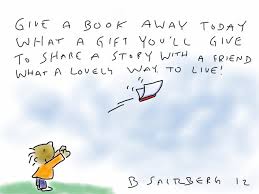
Lost in the glimmer and glitz of Valentine’s Day, was another day that is also marked on 14 February every year. This is International Book Giving Day.

This is a global, totally volunteer initiative that seeks to increase children’s access to, and enthusiasm for books. The goal of the day is to get books into the hands of as many children as possible. The day is said to be the brainchild of Amy Broadmoore, a K-5 school librarian in the United States. In 2010 Amy, then a mother of three young children started a blog called Delightful Children’s Books. As a lover of books herself she was passionate about raising her children to be curious, creative and to love books. She wanted to share this passion with others. Amy was also aware that there was a serious lack of access to books for children. Even in countries like the USA and UK large numbers of children did not have any books. In 2012 she collaborated with fellow blogger Zoe Toft to create an event that celebrated the gifting of books to children, especially to those who did not have access to books. The event held on 14 February made waves on social media. Emma Perry a UK children’s author reached out to Amy and offered to help. In 2013 Amy handed over the reins of the project to Emma. A decade later, the passion, fuelled by volunteers, has spread and the day is now celebrated in almost 45 countries across the globe.

International Book Giving Day is not just about giving books, but a symbol of the ongoing crusade to use books to foster a child’s appetite and enthusiasm for great storytelling and literary adventures.

Coincidentally, I was recently part of a stimulating discussion which posed an important question towards the same end. How to nurture children’s responses to literature? The panelists, themselves authors and educators, shared both experiences as well examples of how books can provide comfort, companionship, and entertainment. They discussed the critical role that books can play to stimulate imagination and foster creativity; create and answer questions, and expand the worlds of children.

The magic of books is beautifully evoked by American author Anne Lamott in a letter to children:

If you love to read, or learn to love reading, you will have an amazing life. Period. Life will always have hardships, pressure, and incredibly annoying people, but books will make it all worthwhile. In books, you will find your North Star, and you will find you, which is why you are here.

Books are paper ships, to all the worlds, to ancient Egypt, outer space, eternity, into the childhood of your favorite musician, and — the most precious stunning journey of all — into your own heart, your own family, your own history and future and body.

Out of these flat almost two-dimensional boxes of paper will spring mountains, lions, concerts, galaxies, heroes. You will meet people who have been all but destroyed, who have risen up and will bring you with them. Books and stories are medicine, plaster casts for broken lives and hearts, slings for weakened spirits. And in reading, you will laugh harder than you ever imagined laughing, and this will be magic, heaven, and salvation. I promise.

Which raises the primary question, of how to bring children and literature together, before they can respond to the magic.

The first step towards this would be to facilitate children’s access to books. Classrooms and libraries are perhaps the more formal spaces for such access, while homes are the cradle where exposure to books could sow the seeds of a life-long engagement with words and visuals. 

However, passive or organized access to books alone may not be enough. To nurture this initiation requires also facilitating contexts where children could express their ‘response’ to books. Which also raises the question of what do we mean by ‘response’?

Each child responds in a different and very personal way to the same book. Some children respond to the sound of words, some respond to the characters in the story, some respond to the situations, some respond to the pictures. Perhaps the last thing that children respond (or not respond to) is the “message”. But is that even really important? What the book has done for each child is unique to that child. What is common is that the child has had the opportunity to look at, touch, feel, (even smell and taste!) a book. Whichever way a child may respond, it is important that a child have the time and space to absorb and interpret the experience in its way.

While the panellists in the discussion agreed strongly about the potential of engaging with printed books, there was also the concern about the huge challenge to this posed by the overwhelming attraction, (almost addiction) to digital media. In an age of information at ones fingertips, fleeting bytes, and constant rush, these words by a Lithuanian children’s writer help us to pause and ponder, once more, the power of books.

No less frequently do we hear that we live in the age of information overload, haste and rush. But if you take a book into your hands, you immediately feel a change. It seems that books have this wonderful quality – they help us slow down. As soon as you open a book and delve into its tranquil depths, you no longer fear that things will whizz by at a maddening speed while you see nothing. All of a sudden, you come to believe you don’t have to dash off like a bat out of hell to do some urgent work of little importance. In books, things happen quietly and in a precisely arranged order. Maybe because their pages are numbered, maybe because the pages rustle gently and soothingly as you leaf through them. In books, events of the past calmly meet events that are yet to come. Books help us not to rush, books teach us to notice things, and books invite us or even make us sit down for a while.

I am sure that books are never bored when they are in your hands. Someone who enjoys reading – be it a child or adult – is much more interesting than someone who doesn’t care for books, who is always racing against the clock, who never has time to sit down, who fails to notice much of what surrounds them.

If only we could make this message heard more widely. Perhaps at an individual level each one of us can play a small role by gifting books to children in the hope that some seeds may find fertile soil to sprout and grow.

–Mamata

A House for Mr. Narayan

Generations of Indians have grown up on RK Narayan’s writings. If you have not read his novels, maybe you have seen ‘Guide’, starring Dev Anand and Waheeda Rehman? Or the charming TV series ‘Malgudi Days’? Well, suggest you visit or re-visit all of the above!

RK Narayan was one of the first Indian authors to gain international recognition. His first novel, Swami and Friends, which he wrote in 1930 did not find a publisher for many years. But sometime in 1933, his friends in Oxford to whom he had sent the manuscript, showed it to the famous author Graham Greene. The senior author liked it so much that he recommended it to his publishers and the book saw the light of day in 1935. It got good reviews across the world. RKN followed this up with The English Teacher and The Dark Room, which also won appreciation. From then, it was a steady stream of novels, short stories and articles.

Narayan created the fictional town of Malgudi as the setting for his novels. So authentic was it to his readers that many even today believe it is a real place.

But why the sudden piece on RK Narayan, one might ask.

Well, it has been triggered by a visit to his house in Mysuru. Just last week, when I was there, I was lucky to get to visit this house. RKN spent many years in Mysore (as it was spelt then)—some of his growing up years, as well as his adult life when he accepted a commission in the State of Mysore.

It was in the second stint that he built a house which I visited. Set in the quiet area of Yadavagiri, it is a beautiful house typical of the 1950s, full of light and air, with red oxide floors and a beautiful balcony.

It was indeed gratifying to see the house so well preserved. Especially after we heard the story of how it was almost demolished. The author passed away in 2001. All of his family had left Mysuru by then. The house was falling to rack and ruin, when a builder wanted to pick it up and re-develop it. It was at this time that Mysuru woke up to this legacy. Led by a journalist, the people of the city protested. Finally in 2011, the city corporation bought the house and restored it.  

And we must be thankful for this! For not only is the house in good shape, it seems to have been restored fairly faithfully. There is also an exhibition of several artifacts, including his awards, personal items etc., many photographs, as well panels of text for those who have the patience to read them.

But…

And it is a very big BUT!

When one thinks of the potential that the house has for the students, literature lovers and citizens of Mysuru, not to mention the thousands of tourists the city attracts, it is a tragedy to leave it to routine care-taking and not very imaginative management.

As we reflected on our visit, we could come up with more than 10 ideas in less than 5 minutes:

  • Have a lively permanent exhibition, along with special temporary exhibitions to explore specific themes: maybe selected books; his relationship and collaboration with his brother, the famous RK Laxman, who illustrated so many of his books; maybe the process of turning his books into movies or TV (he is said to have hated the movie Guide), RK Narayan compared to comtempory Indian writers, etc., etc.
  • Sell RKN’s books (no, unbelievably, they don’t!)
  • Make it the hub for meetings of book-clubs
  • Make it a venue for book-launches
  • Host lit fests
  • Have literary events for children
  • Have screenings and discussions of movie and TV shows based on his books
  • Have an author-in-residence programme
  • Develop an archive related to his life and work
  • Create and sell souvenirs based on Malgudi
  • Start a café in the lovely little garden space around the house, and serve his favourite dishes
  • Make it a wifi café, so young people hang out
  • And charge a small fee for entrance (the Corporation has kept entry free..generous but it would be more sustainable to charge something).

Ideas are of course easy. Execution is difficult. But do this for RK Narayan’s house we must. He is a very important part of Indian writing in English.

While India does not have a great tradition of making author’s houses into educational and enjoyable experiences, there are more than enough international experiences to learn from: Shakespeare’s birthplace; Mark Twain’s house; Emily Dickenson’s House; Jane Austen’s House; Milton’s House are among the many which are successfully keeping the legacy of these authors alive.

Maybe RK Narayan House can set the example for homes of other Indian authors?

–Meena

A Wordy Adventure

 “I’m bored!” How many little boys and girls, across the world, echo the same words. More than ever before, the last two years when the pandemic confined families within four walls, this was the refrain. But this is nothing new.

There once was a boy named Milo who didn’t know what to do with himself not just sometimes but always.

That is the opening line of The Phantom Tollbooth, first published in 1961, which went on to become a classic of children’s literature.

The Phantom Tollbooth is the story of Milo, a 10 year-old boy who is utterly bored with everything around him. One day he comes home to finds a mysterious package with a bright blue envelope which reads “For Milo. Who has plenty of time.”

When unpacked it reveals a magical toy tollbooth which he sets up in his room. Having nothing better to do, he drives his toy car through it and there begins his whacky journey through the different realms of language. He is accompanied on his travels by a “watchdog” named Tock—a large dog with an alarm clock for a body. 

Crossing Expectations and going through the Doldrums, Milo heads for Dictionopolis, ruled by King Azaz the Unabridged–Monarch of Letters, Emperor of Phrases, Sentences and Miscellaneous Figures of Speech. He is welcomed by five tall thin gentlemen who introduce themselves as The Duke of Definition, The Minister of Meaning, the Earl of Essence, the Count of Connotation, and The Undersecretary of Understanding.

We offer you the hospitality of our country, nation, state, commonwealth, realm, empire, palatinate, principality.

Do all those words mean the same thing? asked Milo.

Of course, certainly, precisely, exactly, yes, they replied in order. They also explain: Dictionopolis is the place where all the words in the world come from. They’re grown right here in our orchards.

Milo wanders around the marketplace of words where there are thousands of words on sale, with the vendors trying their best to sell theirs. It is here that he meets the giant Spelling Bee, that can spell any word, and who joins him on his travels.

Finally he meets the king who asks him what he can do. Milo has no answer. The King thinks:”What an ordinary little boy. Why my cabinet members can do all sorts of things. The duke here can make mountains out of molehills. The minister splits hairs. The count makes hay while sun shines. The earl leaves no stone unturned. And the undersecretary hangs by a thread.”

And thus Milo embarks on a wordy adventure where the characters indulge in a riot of word play that initially throws Milo into deep confusion, but gradually his curiosity leads him not only to learn new things, but eventually to join in the pun-fun as it were. 

From Dictionopolis to Digitapolis, from the Foothills of Confusion, and over Mountains of Ignorance; through the Valley of Sound and the Forest of Sight; the Sea of Knowledge and Island of Conclusions (he had to jump to get there!), and the Kingdom of Wisdom, Milo encounters an army of new words as he is roped in to rescue the captured princesses of Rhyme and Reason imprisoned in the Castle in the Air, while fighting the fearsome Hate and Malice.

The Phantom Tollbooth is an absolute delight for word lovers such as me. The word play is clever and stimulating, reminding one of the adventures of Alice in Wonderland. When the book was published, several reviewers wondered whether children would even understand so many new and unfamiliar words, and whether they had the ability to really enjoy the play on words. These apprehensions were vindicated when the book sold millions of copies; and continues to remain a favourite even 60 years after it was first published in 1961.

Years later the author Norton Juster explained his approach: My feeling was that there is no such thing as a difficult word. There are only words you don’t know yet, the kind of liberating words that Milo encounters on his adventure. Today’s world of texting and tweeting is quite a different place, but children are still the same as they’ve always been.

The story of how the book came about is equally interesting. Norton Juster was a young architect working in New York. He had received a Ford Foundation grant for a book on cities for children, and spent months researching it. One day, in a restaurant, he overheard a boy asking the question   “What’s the biggest number there is?” That put him on a totally different path.

I started to compose what I thought would be about a child’s confrontation with numbers and words and meanings and other strange concepts that are imposed on children,” he wrote. “I loved the opportunity to turns things upside down and inside out and indulge in all the bad jokes and puns and wordplay that my father had introduced me to when I was growing up.

The grant never fructified into the intended book, but there began the story of The Phantom Tollbooth. Norton recalled: When I wrote the book I really didn’t write it with any sense of mission. I wrote it for my own enjoyment. The book in no way was written to any sense of what it was that children needed or liked.

However, under all the word play is just what children need–a feeling that navigating the world can be an exciting adventure in itself. As Norton puts it: And I think what kids do — it’s a fairly universal kind of thing – I think the general sense of the book – the feeling of it is something most kids experience one way or another. They’re at times disconnected, or they don’t know what to do with themselves. They don’t know why anything is happening. All the things that they’re learning don’t connect to other things. One of the things that happens in your life is you start out learning a million facts and none of them connect to any other facts. As you get older you gradually realize that something you learned over here connects to something you experienced over there. And you start drawing sort of mental lines, and after a while, like when you get to my age, there’s almost nothing that you learned that doesn’t connect with 80,000 other things. So it all has some kind of a meaning and context to it, and I think kids slowly begin to feel that too.

In an age when children have so many distractions, and yet are always “bored” this book encourages them to look anew at the world around them. You have to constantly look at things as if you’ve never seen them before. Or look at them in a way that nobody has ever seen them before. Or turn them over and look at the other side of everything. That is the magic formula.

Serendipitously, at the time Norton was writing the book, his illustrator friend Jules Feiffer, who was also his upstairs neighbour, read some of it and spontaneously produced a bunch of perfectly-suited drawings that brought the characters to life. And The Phantom Tollbooth continues to be loved by children even six decades later.  

I seem to have missed reading this book in my childhood, but I am delighted to have discovered it in the sixth decade of my life. Thank you Evan for sharing this, a favourite childhood read of yours, with me!

–Mamata

My Lockdown Book Project Starring Ladybug, Mouse and Dog

Lockdowns saw all of us sitting for hours in front of our home- computers. And when I developed some kind of cervical spondylosis, I spent a lot of those hours with a neck brace on.

My Sunday with Deedu and Daadu
Deedu, the Ladybug

It was only when Barnalee my 2.5 year old foster grand-daughter put the neck brace on her stuffed ladybug toy, fitted my specs on to it, and called it ‘Deedu’ that I realized that for her, these two items were an essential part of me!

Her imagination was the inspiration for my lockdown children’s book. I started wondering if I could do a book based on her daily routine.

But children’s books need illustrations! They depend on that. I knew few illustrators who could help me. And the ones I knew were too busy or too expensive.

That is when I remembered that my neighbor, young Harini a communications student, was a talented photographer and very skilled designer. So we decided to work on this together and make it a photograph-based book.

The ladybug would of course star as Deedu (granny). Barnalee’s  first stuffed toy, the dog Sheru, would star as Daadu (grandpa). And a stuffed mouse, which was her favourite, would star as Barnalee.

My Sunday with Deedu and Daadu
Barnalee, the Mouse

The mouse is almost 30 years old. I clearly remember buying it in a shop in Colombo, probably the equivalent of our state emporia, on my first visit to Sri Lanka, to attend a workshop on the use of Television for the Environment. It started life as a car-hanger, which was its original purpose. Then, when the string broke, it spent several years in the cupboard, till it was fished out for Barnalee to play with.

We built the story around the baby’s favorite activities, and used her toys and playthings as props. And things which were not supposed to be her playthings, but she played with anyway! We did all the shooting in and around the house and garden. Since both Harini and I were at home, we could capture the light at any time of the day or night that was needed. And we could do trial runs, pre-shoots and re-shoots to our hearts’ content. Another friend, Vidya Chandy, who is a very good photographer visited on a rare non-lockdown day and gave us valuable tips.

We thought we would be done in a few days—after all it was a book of about 20 pages, with maybe a total of 150 words! But of course these things are never so easy, are they? I would want to change one activity for another, or the flow of the activities, or to fine-tune the words and text. Harini would want to take the shot from a few more angles, want the shadows just this way or that. And together we wanted to change the fonts, the size, the page layouts. And sometimes, the baby would insist she wanted to play with just the prop we needed for the shoot, leading to postponements!

And then the final design and layout. We found we had to switch from a landscape format to a square format, as most publishers want that format. Thanks to Harini’s skill on the software, she managed to do that in a few hours. Watching her at work on the layouts opened my eyes to how easily and quickly software can accomplish what in the old days used to take us days and nights—whether it was layouts, change of fonts, re-positioning of pictures and text, changing backgrounds, etc. etc. And also brought home to me how skilled these young people are at working it.

And then we published! After a long, long time, the satisfaction of holding one’s book in one’s hand!

My Sunday with Deedu and Daadu
The Book!

So all in all, a lovely lockdown project.

‘My Sunday with Deedu and Daadu’.  Now available on Amazon, Flipkart and Kindle.

–Meena