The Call of the Mountains: Nan Shepherd

December 11 is marked as the International Mountain Day. Mountains have always fascinated human beings not only for their sheer scale and majesty, but also as a natural element that offers a challenge, as well as a test of physical and mental strength, and the thrill of scaling the peaks. There are numerous narratives of expeditions that describe these challenges and achievements, most of these by, and about men.

The Cairngorms

A different perspective, and approach towards mountains reminds us that there is more to mountains than the thrill of conquest.

This was lyrically described by Anna (who called herself Nan) Shepherd, a Scottish poet, writer and explorer of mountains. Nan was born in February 1893, close to Aberdeen on the North East coast of Scotland. When she was one month old, her family moved to nearby Cults and lived in a house with a garden overlooking the hills. Nan continued to live in the same house almost till the end of her life. As a young girl Nan was encouraged by her father, a keen hill walker, to explore the nearby hills, and this planted in her a lifelong love for nature and the mountains. Nan was an equally avid reader, and from her early teens she would fill notebooks with passages that inspired her from the wide spectrum of her reading. After completing her schooling in 1912, Nan joined the University of Aberdeen in the first decades after women were allowed to do so. She was an outstanding student, and graduated in 1915 with an MA in literature. Following this she taught English literature at Aberdeen Training Centre for Teachers, and continued to give enthralling lectures until she was well into her eighties. She was not only an inspiring teacher but also a role model for her students, as an early feminist. She wryly described her role as “the heaven-appointed task of trying to prevent a few of the students who pass through our Institution from conforming altogether to the approved pattern.”

Although she had always enjoyed walking in the hills, Nan Shepherd became deeply engaged with climbing in the period between the two World Wars. She was thirty years old when she began her explorations in the Cairngorms in 1928. This experience was the start of a passion that came to define both her life and her writing. From then on, she sought to escape into the Cairngorms whenever her job would allow. Often she would walk alone, camping out, and wading into hidden lochs. Occasionally she was accompanied by friends and fellow walkers from the local Deeside Field Club, or by students from the university.

By the 1940s Nan had scaled some of the highest peaks in the Cairngorms, among the wildest landscapes in the British Isles. However Nan’s expeditions were not about ‘reaching the top’ but rather a spiritual journey to ‘understand herself and the world’. She became fascinated by what happened to mind and matter on this journey up and down the mountain slopes.

These experiences were reflected in her literary work. The harsh landscape, as well as the people and places she knew well, provided the background to her first three books, published while she was teaching. These novels focussed on the harsh landscape which made for a harsh way of life, and within these, complexities of women struggling with maintaining traditional roles in a dawning age which was opening up new opportunities

But Nan Shepherd never wrote for recognition. She wrote only when she felt she had something worth saying. “I don’t like writing, really. In fact, I very rarely write. No. I never do short stories and articles. I only write when I feel that there’s something that simply must be written.”

For her teaching was as, if not more, important than her writing. However she continued to document her explorations of the Cairngorms, which came together around the end of the Second World War, under the title The Living Mountain. She combined her knowledge of the mountains, her observations of their rugged beauty, and her literary skills to muse on the philosophical and spiritual offerings from mountains. She wrote of the Cairngorms as “friends” that she “visits”, and with whom her imagination is fired as if “touched by another mind.”

 Nan Shepherd completed her book in the summer of 1945, and sent her manuscript to a novelist friend. He cautioned that it may be hard to find a publisher of a book of this nature. Nan put the manuscript away in a drawer where it remained for 30 years. Towards the end of her life, Nan retrieved the manuscript from her drawer and felt that it still resonated in many ways. Given her long association with Aberdeen University, she submitted it to Aberdeen University Press. The Living Mountain was finally published in 1977.

The Living Mountain threaded together, beautifully geography, geology, history and philosophy, along with everything that she herself had experienced in the mountains that she had fallen deeply in love with. For Shepherd, the mountains were living beings, and her book describes how she nurtured her relationship with them by walking. She wholeheartedly believed that only through walking and experiencing could insight be gained. “The more one learns of this intricate interplay of soil, altitude, weather, and the living tissues of plant and insect … the more the mystery deepens.”

The Living Mountain, continues to be timeless, since its publication 30 years after Nan Shephard wrote it. It provides a rare lens into a world that has been viewed mainly through the eyes of male climbers, who focus on the challenges, and the conquests. Nan Shepherd’s lens is that of a naturalist and poet, one of contemplation, reverence, and an exploration of the profound. The book suggests that the summit should not be the organizing principle of a mountain; it urges the practice of not walking “up” a mountain, but rather “into” them, so as to explore not just the physical forms but also ourselves, peering into the nooks and crannies.

Today, mountains across the world are facing their own challenges. Climate change is melting glaciers and distorting landscapes; the surge of climbers are leaving behind manmade mountains of garbage that threaten to bury the real mountains. This is a good time to remember The Living Mountain, and a mountain lover who looked beyond the ascents to the journeys within.

–Mamata Pandya

Reflecting on the Five Laws of Stupidity and praying Ma Saraswaty sheds the light of wisdom!

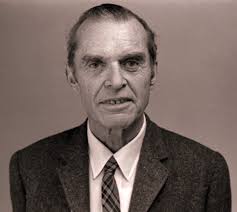
Have you ever shaken your head at someone’s actions and muttered, “How could they be so stupid?” Economist Carlo M. Cipolla, a professor at UC Berkeley, took that exasperation and turned it into a razor-sharp essay in 1976, later published as The Basic Laws of Human Stupidity. What began as tongue-in-cheek satire has, over the years, gained the weight of wisdom. His framework is quoted in boardrooms, military strategy papers, and even risk-management seminars. It is, at once, funny and sobering.

So, what are these Five Laws?

  1. InevitabilityAlways and inevitably everyone underestimates the number of stupid individuals in circulation.
    No matter how cynical you think you are, Cipolla assures us the world contains more stupidity than you can fathom. It’s a reminder not to be caught off guard when irrationality rears its head.
  2. UbiquityThe probability that a certain person is stupid is independent of any other characteristic of that person.
    Education, wealth, power or even high degree of capability in one dimension offer no immunity. History is replete with examples of brilliant scientists, decorated generals, and wealthy tycoons making catastrophic blunders. Stupidity is democratic—it spares no class or group.
  3. Damage PrincipleA stupid person is a person who causes losses to another person or to a group of persons while himself deriving no gain and even possibly incurring losses.
    This is Cipolla’s key insight: stupidity is not mere ignorance, it is destructive irrationality. Unlike the clever or the criminal, who may at least benefit themselves, the stupid spread harm without return.
  4. The Underestimation TrapNon-stupid people always underestimate the damaging power of stupid individuals.
    We often brush off foolishness as harmless. But Cipolla insists it is a potent force that can derail institutions, movements, or nations. Underestimating stupidity is, itself, stupid.
  5. The Supreme LawA stupid person is the most dangerous type of person.
    Why? Because unlike the bandit (who robs you but at least gains something), the stupid person leaves everyone worse off, including themselves. They are unpredictable, immune to logic, and capable of pulling entire systems into collapse.

From Satire to Serious Lens
Cipolla originally wrote the essay as a whimsical interlude in his career as an economic historian. Yet, his classification gained traction because it resonated with lived experience. Management theorists mapped his “laws” onto organizational behavior. Military strategists saw in it an explanation for the chaos of battle. Behavioral economists quietly nodded, recognizing parallels with cognitive biases and irrational decision-making.

Interestingly, Cipolla illustrated his framework with a simple 2×2 graph, plotting human behavior along axes of personal benefit and social impact. The quadrants neatly categorized people as helpless (hurt themselves but help others), bandits (help themselves, hurt others), intelligent (help both), and stupid (hurt both). That little diagram has since found its way into PowerPoint slides across the world.

Echoes Through History
History, as Cipolla loved to remind, is propelled not only by heroes and villains but also by the stubborn weight of stupidity. The fall of empires, disastrous wars, or economic collapses often show a pattern: decisions made against all logic, driven by pride, short-sightedness, or blind conviction. From letting in the Trojan Horse to the Maginot Line, human folly has had a starring role.

Practical Uses Today
At first glance, Cipolla’s laws feel like cocktail-party philosophy. But they’ve been pressed into real-world use:

  • Risk Management: Financial firms use “Cipolla’s Matrix” to flag policies or behaviors that could destroy value for no clear reason.
  • Leadership Training: By distinguishing between stupidity and malice, leaders are taught to manage teams with sharper judgment.
  • Public Policy: Some commentators even apply the laws when analyzing bureaucratic inertia, or social media misinformation.

A Mirror, Not a Weapon
It’s tempting to wield Cipolla’s laws as a judgmental hammer—branding others as “stupid.” But the real power of his essay lies in self-reflection. How often have we acted against our own interest, or underestimated the ripple effects of our actions? If stupidity is so pervasive, perhaps humility is the antidote.

Another thinker came out with the The Bonhoeffer Law of Stupidity describes stupidity not as a lack of intelligence but as a moral failing where individuals surrender their inner independence to power structures, groupthink, and simplistic slogans, becoming “mindless tools” incapable of critical thinking or moral judgment. It is a sociological problem, amplified by rising political power and fostering conditions where people become susceptible to propaganda and blind obedience. Bonhoeffer argued that stupidity is more dangerous than malice because it is immune to reason and force, making it a more insidious threat, especially within groups. which describes stupidity not as lack of intelligences, but as a moral failing where individuals surrender their inner independence to power structures, groupthink and simplistic slogans, becoming incapable of critical thinking or moral judgement.  It is a sociological problem, amplified by rising political power and fostering conditions where people become susceptible to propaganda and blind obedience. Bonhoeffer argued that stupidity is more dangerous than malice because it is immune to reason and force, making it a more insidious threat, especially within groups. 

On the occasion of Dusshera, let us pray to Goddess Saraswathi for to rid the world of stupidity!

–Meena

Happy Dusshera!

Image: artandhome.net/quotes-about-stupidity/

The Real James Bond

Recently there was news that a woman has been appointed as the head of the British Foreign Surveillance Agency. This is the first time in its 116 year-long history. For readers of spy fiction, and even more, fans of the popular James Bond films, this may sound as a deja-vu. After all we have such a clear image of the formidable Dame Judy Dench playing this role as M, in the fictitious MI6. In many ways the intricate workings of the MI6 and its key characters have been deeply etched in several generations of Bond followers, first through the books, and subsequently through the movies. “The name is Bond. James Bond” immediately conjures up the image of the suave but tough, risk-taking, swashbuckling, gizmo-loving hero, who has been played on screen by a series of actors starting with the inimitable Sean Connery.

James Bond: a simple name that is almost synonymous with these qualities. How did this happen? The christening of Bond is a fascinating story in itself.

The creator of this character, Ian Fleming was a British Naval Intelligence Officer during World War II.  As part of his work he interacted with several spies from different countries. After the war, Fleming left the Service and decided to devote himself to writing spy novels.

He did all his writing from his winter home in Jamaica, then a British colony. He bought several acres of land and built a house mainly based on his own design. He named the house GoldenEye, named after an intelligence mission of the same name that he had overseen during his time with the Intelligence Service. This is wherehe wrote his first book Casino Royale which introduced Secret Agent 007. He named the character James Bond. This did not spring from his imagination; it was the name of an ornithologist whose books Ian Fleming, himself a birder, used to refer to while he was in Jamaica. Fleming thought that it was a perfect name for a spy as it was ‘ordinary and unromantic, but sounded masculine’. As he explained later: I was determined that my secret agent should be as anonymous a personality as possible. Even his name should be the very reverse of the kind of “Peregrine Carruthers” whom one meets in this type of fiction.

This ‘real’ James Bond was born in America but moved with his father to England when he was 14 years old, and he was educated at Harrow and Cambridge. He then returned to the United States and tried his hand at banking upon the urging of his father. But he gave this up and joined the Academy of Natural Sciences of Philadelphia as an ornithologist (self-taught). He began to focus on the birds of the Caribbean islands, undertaking long strenuous voyages on mail ships (despite being prone to seasickness), and hopping from island to island on local banana boats and tramp steamers. This is where he found his true calling. He explored the thick foliage of the islands on foot or horseback, surviving on whatever he could find. He recorded and collected bird samples. From the 1920s through the 1960s, Bond the birdman undertook more than 100 scientific expeditions to the West Indies. He collected more than 290 of the 300 bird species known to the West Indies. He wrote more than 100 scientific papers on Caribbean birds. He complied his observations in the book Birds of the West Indies. This seminal book of Caribbean bird watching was first published in 1936 and for many years remained the definitive bird watching book of the region.

It is this book that Ian Fleming, a keen bird watcher, used as a reference while he spent the winter months at GoldenEye on the north coast of Jamaica. And it is the name of the author that he gave his fictitious character. James Bond, the spy, went on to become one of the most famous names in spy fiction.

Ironically, the real James Bond did not know about this new identity for almost a decade after that. His wife found a reference to this in a magazine interview with Ian Fleming and wrote to the author. Ian Fleming admitted that he ought to have taken permission for the use of the name. To make up for this lapse, the story goes that he wrote back to ornithologist Bond with three offers: He gave Bond “unlimited use of the name Ian Fleming for any purpose he may think fit.” He suggested that Bond discover “a horrible new species” and “christen [it in] insulting fashion” as ”a way of getting back!” And he invited the Bonds to visit Goldeneye so that they could see “the shrine where the second James Bond was born.”

In 1964 the real Bonds who were in Jamaica on a research trip paid a surprise visit to Ian Fleming at GoldenEye. Ian Fleming tested his authenticity by asking Bond to identify some birds. The two went on to become good friends, although Ian Fleming died not long after.   

The ornithologist and the spy, an unusual coming together. While the James Bond franchise continues to thrive and profit, it is fitting to remember the original James Bond whose pioneering contributions to the field of ornithology and conservation have laid the foundation for all that has come after. James Bond was prophetic when he wrote in his introduction to Birds of the West Indies: “In no other part of the world … are so many birds in danger of extinction.… It is to be hoped that the island authorities will show more concern for the welfare of their birds so there may yet be a possibility to save the rare species from being annihilated. Bird sanctuaries should be created where no hunting of any kind is permitted.”

On a more personal note James Bond, the spy, entered our family in the mid-1960s. My mother was recovering from an accident and in a lot of pain. Someone (perhaps a nephew) gave her a couple of Ian Fleming books to distract her. She was soon hooked! Thereafter James Bond was ensconced on our bookshelf, and both my parents enjoyed the books. I am not sure if they saw any of the Bond movies. But I know that they would have equally enjoyed this story about the real James Bond!

— Mamata

Casting a Spell

The Indian-American domination of a peculiarly American phenomenon—the Spell Bee—is something that intrigues me no end. Not to say Indian-Americans don’t excel in many pursuits out there, but these kids winning the national level spelling competitions year after year after year after year is quite something.

The American tradition of spelling competitions may have started with the Puritans. By the mid-18th century, spelling competitions were common across the country. In 1750, Benjamin Franklin apparently recommended their use in a proposal for a school. Spelling challenges were quite the rage with both adults and children in the 19th century. Mark Twain apparently mentions ‘spelling fights’ in Adventures of Tom Sawyer!

The use of the term ‘bee’ for these competitions started in the mid 1870s. It is an unusual usage of the word, as ‘bee’ usually refers to a community activity with a shared goal—like quilting bees or knitting bees.

English, with words from various sources and a variety of languages, probably peculiarly lends itself to this pastime. Afterall, I don’t think there can be much confusion how 99% of words are spelt in Tamil or Kannada or Oriya– languages with phonetic writing systems do not have so much confusion in spelling. Moreover, because English has borrowed words from many languages through its history, the result is a diverse vocabulary with inconsistent spelling patterns which are carried over from the mother-languages.

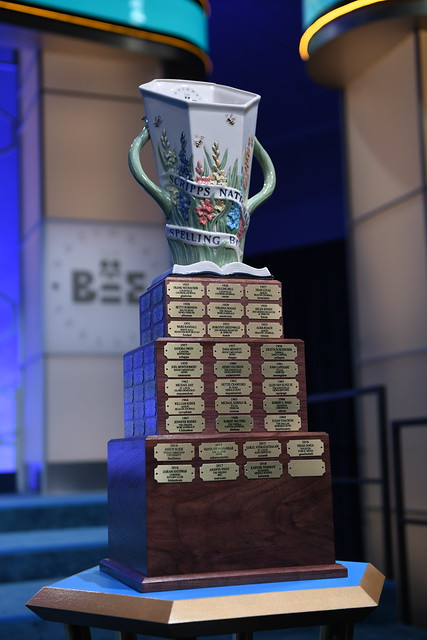
In the US, the National Spelling Bee, as we know it today, was established in 1925. The Louisville Courier-Journal was the first sponsor, who saw it as a way to foster interest in spelling and language. 

The E.W. Scripps Company acquired the rights to the National Spelling Bee in 1941. This company was started by E.W. Scripps who founded The Penny Press, a daily newspaper in Cleveland. Today, the company is involved in investigative documentaries and enterprise journalism with the purpose to ‘…advancing understanding of the world around us.’

The Spell Bee has been held annually, in late May or early June since its inception, except for a few years during World War II and in 2020 due to COVID-19.  It has evolved over time, beyond just spelling, encompassing vocabulary development and broader language knowledge. 

The first winner of the Spell Bee, in 1925, was Frank Neuhauser of Louisville, whose winning word was “gladiolus”. The next year saw a girl winning for the first time– Pauline Bell, also of Louisville, who spelt the word “cerise”. (Incidentally, girls won nine consecutive competitions from 1932 to 1940.)

Now coming to winners of Indian origin. 30 of the last 36 competitions have been won by them. Which is surely not a chance thing. Before 1999, there were only two spelling bee winners of Indian-American descent—Balu Natarajan in 1985, with the word “milieu”, and Rageshree Ramachandran in 1989 with “elegiacal”.  Nupur Lala opened the floodgates in 1999 winning with “logorrhoea,” and there has been no looking back since then! This year of course we celebrate Faizan Zaki, a 13-year-old Indian-American student from Texas, who won with the word ‘éclaircissement”

Rebecca Sealfon who won in 1997 against Prem Murthy Trivedi, has done some analysis on the subject of Spell Bee competitors, and tells us that children practice for about 500 hours in the years in which they compete; some hire ex-competitors as coaches; and they typically and unsurprisingly relax by playing word games like Scrabble or Boogle. Some try to learn every word in the dictionary. She further tells us that double ‘ll’ words are the ones which have tripped up a large number of contestants, along with the words ‘metastasize’ and ‘metonymy’.

Since I don’t know many of these words, and would certainly not be able to spell them, I can only express my wonder at these sub-14 year olds who can.

Kudos to all of you! You have cast a spell on me!

–Meena

Pic: https:spellingbee.comblogscripps-cups

Growing Older With Ruskin Bond

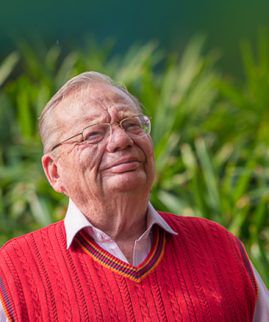
Ruskin Bond celebrated his 91st birthday on 19 May. One of India’s most well-known writers, Ruskin Bond has spent over seven decades as a prolific author, delighting readers of all ages with his simple, beautiful and ‘from the heart’ words. When many put down their tools of trade when they reach “retirement age”, Ruskin Bond celebrates every day of each advancing year with reminiscences, observations of life around him, and above all gratitude for the magic of Nature.

As he puts it: For writers, the nice thing about growing old is that it gives us more to write about—all those years of love, friendship, adventure, achievements, a changing country, a changing world, changing ways of life, history in the making. There may have been dull moments, but most of the time, something was happening—and things continue to happen today.

Many people who have been touched and inspired by Ruskin Bond’s writing have shared their memories. I feel that this is also my opportunity to pay my small tribute.

I was introduced to Ruskin Bond over three decades ago by Uncle Ken and Rusty. These were the characters in the first books that I translated. I was invited by the National Book Trust to translate two of Ruskin’s books into Gujarati. Having neither read him, nor having translated before this, but game for trying something new, I embarked on the project. I so enjoyed the madcap adventures of the eccentric Uncle Ken and the restless school boy Rusty, not just for the stories but for the simple style of writing and the lovely use of language. As a translator it was a challenge to try to retain the spirit and the form in another language.

Following this introduction I continued to follow Ruskin Bond on his wanderings and meanderings through his essays and columns. Here was someone who was not only sensitive to, and entranced by every minute detail of nature, but one who could share this evocatively through words. As an environmental educator who was trying to communicate the wonders of the world around us, and sensitize children to the intricate but fragile web of life, it was inspiring, and humbling to see how effortlessly Ruskin Bond could do just that.

Moving on, as the years went by, one could find new nuances and meaning in his words; words that also reflected the passage of time, both as it affected a human being, but also the environment of which we are all a part. With the passing years, Ruskin Bond’s prolific writing reflects his life journey.

It is the journey that fascinates him, the spirit of wandering and exploring that leads him, and the childlike joy of discovery that makes every step exciting. The adventure is not in the arriving, it’s the on-the-way experience. It is not the expected; it’s the surprise. You are not choosing what you will see in the world, but giving the world an even chance to see you.

Ruskin Bond reminds us that the journey will be much enriched when we use all our senses to the fullest. Sight, hearing, smell, taste and touch. He highlights how each one is capable of giving us joy.

The eyes are our windows to the world, the great wide beautiful world that there is for all of us to marvel at—the skies, wandering clouds, mountains, forests, rivers, the sea; the moon, the stars, the rising sun—all the wonder of creation. The eyes see it all.  

And we hear too. We hear the sounds of nature—the wind, the rain, the sound of birds. We hear the voices of our friends, our loved ones. We hear great music. There is so much to hear and enjoy.

And we smell. The fragrance of roses, of jasmine; of gardens, of wildflowers, the mountain air, the sea breeze. We smell good food—appetizing odours! We eat what smells good.

The sense of taste—we take it for granted, but life wouldn’t be much fun without it. If everything tasted the same from chocolates to fish and chips, we would take no interest in our food and would fade away due to lack of nourishment.  Our taste buds keep us going, make life worth living!

And then there’s touch. The touch of a loving hand, the feel of things, good things—your clothes, your books, your intimate belongings, your own flesh. Cold and warmth, pain and pleasure are felt by our sensitive systems. The sense of touch is felt in our brains, and it is there that all happiness resides.

Value those five senses of yours. The more you use them, the better you will be able to appreciate your life and all that the world has to offer.

Ruskin Bond reminds us to value ourselves, our time and everything from the tiniest to the largest that weaves the web of life. His words are an island of calm in turbulent seas. He does not paint the world as perfect, but urges us to look for the rays of sunshine amidst the dark clouds: The human race is destructive by nature, only too ready to go to war or to pollute and do away with seas, rivers, forests, and our natural inheritance; but now and then along comes someone who can create something beautiful, meaningful—a great painting, a piece of music, a work of literature or philosophy, something that survives the conflicts  and injustices that are the main features of human civilization, past and present. But in the darkness there is a gleam of light, and we can turn away from the ugly to appreciate the beautiful.

Simple words that have continued to offer solace, hope, and a quiet joy as I have grown older with Ruskin Bond over the decades.

Happy Birthday Ruskin Bond. As you remind us: Don’t wait for your birthday. Make today your birthday.

(Excerpts from The Golden Years: The Many Joys of Living a Good Long Life. Ruskin Bond 2023)

–Mamata

MOOMINS

Way back in the ‘60s and ‘70s growing up in Delhi, the family newspaper was The Statesman. It was considered by Tamilian families to be the closest substitute for The Hindu, which in those days used to arrive in Delhi with a delay of a day or two.

So like all good Tamilian families outside Tamil Nadu, we too took The Statesman. And through this, got introduced to the Moomins, which was the only cartoon strip that the paper carried.

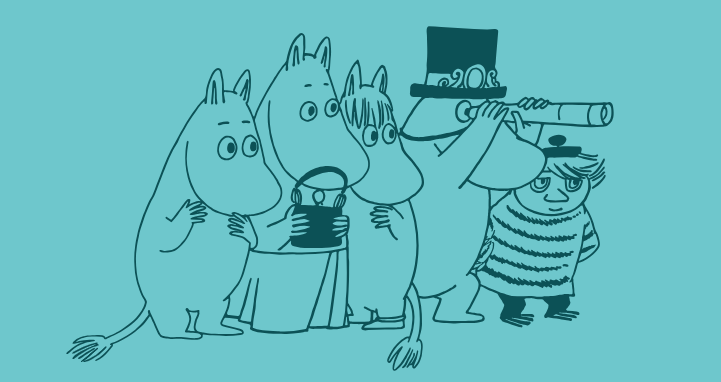
The central characters of the cartoons, which have just turned 80, are gentle-looking hippo-like creatures called the Moomins . They are white and roundish, with large snouts. The Moomin world and its characters are the creations of the Swedish-Finn illustrator and writer Tove Jansson, and the books and comic strips were originally published in Swedish in Finland.

The core family consists of the main protagonist, Moomintroll, a small and well-meaning Moomin who who is forever having adventures and often finds himself in trouble; his mother, the nurturing and loving Moominmamma; and his father, the restless Momminpappa. And besides, there are many of their friends.

The first book was written during World War II as a fairytale for Tove to comfort herself during dark times.  It is based on the situation and stories of  millions of displaced people seeking refuge. The Moomins live in a tall blue house – a joyful place where everyone is welcome, whoever they are. The motto is ‘The door is always open’. The blue-purple Moominhouse is thus a symbol of security, shelter and a sense of belonging. No wonder then that even today the Moomins represent hope for refugees, so much so that UK cities are using this as an the inspiration for a series of art installations in UK cities, in collaboration with Refugee Week. 

The Moomin stories are tales of adventure and overcoming adversities, always with a sense of inclusion and tolerance, and living together in cheer and happiness. Harmony with nature is a recurring underlying theme. The underlying message of all the Moomin stories is that it’s the simple things that are valuable in any situation, and that one’s attitude can often change a bad day into a good one.

Many in India may not be very familiar with these characters, but there are nine Moomin novels which were all successful. The cartoon strip was syndicated in 1954, to over 120 publications in 40 countries. This comic strip reached 20 million readers daily. There was a TV show too, which was originally broadcast in Poland and then sold to other countries including the UK, and aired on PBS in the US. There are even two Moomin theme parks, one in Finland and the other in Japan. Moomin stories have been adapted for the theatre, the cinema, and as an opera.

Here are some Moomin quotes, encapsulating good sense and postivity:

‘That’s most extraordinary, but I’m so used to your doing extraordinary things that nothing surprises me.’

‘Perhaps it will come – perhaps not. It’s all the same to a person who knows that everything is unnecessary.’

‘How nice to be on your own for a bit and do what you like.’

‘I like you, I don’t want to make you feel unhappy.’

‘The main thing in life is to know your own mind.’

In a conflicted world, Moomins may be the cartoon characters we need!

–Meena

Visual: From http://www.moomins.com

Freedom of Imagination Makes a Book

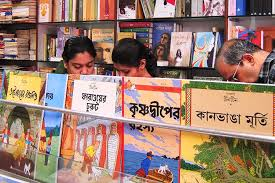
A few years ago an exhibition at a Research Centre at the University of Chicago was titled But is it a Book? The exhibition broke down the classic elements of ‘bookness’ like format, shape and binding.

The walk-through exhibition had a number of objects that through history were considered as ‘books’, ranging from a clay tablet made in the 3rd century BCE to a modern audiobook. But are either of these books? It was up to the visitor to decide. The exhibition posed a series of questions: “Does a book need to have pages? Does a book need text?” It was up to the visitors to decide. And each decision led the decider down a different path.

If some adults find the journey of exploring and discovering what makes a book, and furthermore, what makes a good book interesting, this exploration is even more adventurous when we enter the realm of children’s books. It is generally accepted that good children’s books are a blend of engaging storytelling, relatable characters, age-appropriate language, vibrant illustrations, cultural diversity, emotional depth, interactive elements, and timelessness. Each of these elements is deep and has numerous facets. And there is no magic formula; even if all these elements are present, it does not guarantee that the outcome is a ‘great’ children’s book.

Perhaps one element that is not explicitly listed, and which may be the key, is the ability of the author to think like a child; to recall how the world seemed as a child—the sense of mystery and discovery, the sense of wonder and anticipation, the sense of being insignificant and powerless in a world of adults…And to translate these complexities into a story that feels true to its young readers, wherein the spark of their imagination is ignited, to explore their imagination, and develop their creativity.

These are the guiding tenets of the International Board on Books for Young People (IBBY), an organization which represents an international network of people from all over the world who are committed to bringing books and children together. The mission of the IBBY includes the promotion of international understanding through children’s books, giving children everywhere the opportunity to have access to books with high literary and artistic standards, and encouraging the publication and distribution of quality children’s books, especially in developing countries.

The IBBY also promotes the celebration of International Children’s Book Day. This is celebrated every year on 2 April, to mark the birthday of Hans Christian Andersen, whose fairy tales have been an integral part of the childhood of many generations.

International Children’s Book Day (ICBD) emphasizes the significance of high-quality literature for children and the creativity it fosters. It highlights the love of reading that unites children worldwide. In high-quality children’s books, the reader’s imagination is kindled and developed. These books help children to explore their imagination, to develop their creativity and to see the world in a new way.

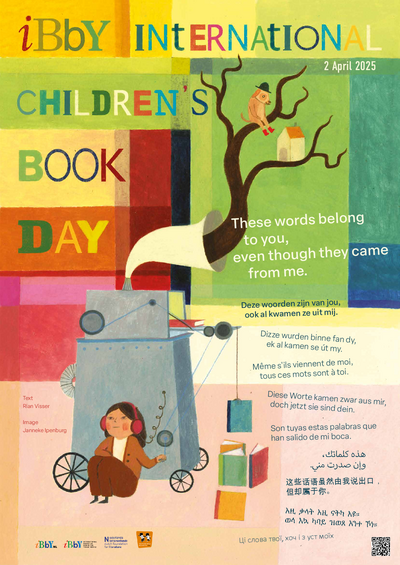
Each year a different National Section of IBBY has the opportunity to be the international sponsor of ICBD. It decides upon a theme and invites a prominent author from the host country to write a message to the children of the world and a well-known illustrator to design a poster. The host country for this year’s ICBD is the Netherlands. The theme for 2025 is The Freedom of Imagination. This derives from the belief that good books invite readers to interpret the words for themselves, making the story their own.

The poster for the theme is designed by two Dutch creators of children’s books, and the message of the theme is highlighted with the last sentence of the poem The Language of Pictures: Make pictures for my poem, and please feel free: these words belong to you even though they came from me.

Reading about this brought back memories of a wonderful project that I was involved in, many years ago, and which was sparked by the same message.

As environmental educators at the Centre for Environment Education, my team and I had diverse opportunities to develop creative teaching-learning resources for teachers and children. Perhaps the most exciting of these was a project to develop children’s books on four different themes: Pollution, Forests, Waste, and Conservation of Natural Resources. The form, format and presentation was left for us to decide. This presented an exciting blank canvas, as well as the challenge to be creative while still retaining the educational objectives for each theme. The outcome was the decision to develop books in four very different formats: a magazine format for Pollution; a collection of folk tales from the region for Forests; a quirky mystery story for Waste. But when it came to Natural Resources we were stumped! What was a manageable way of covering the wide range and scope of the theme?

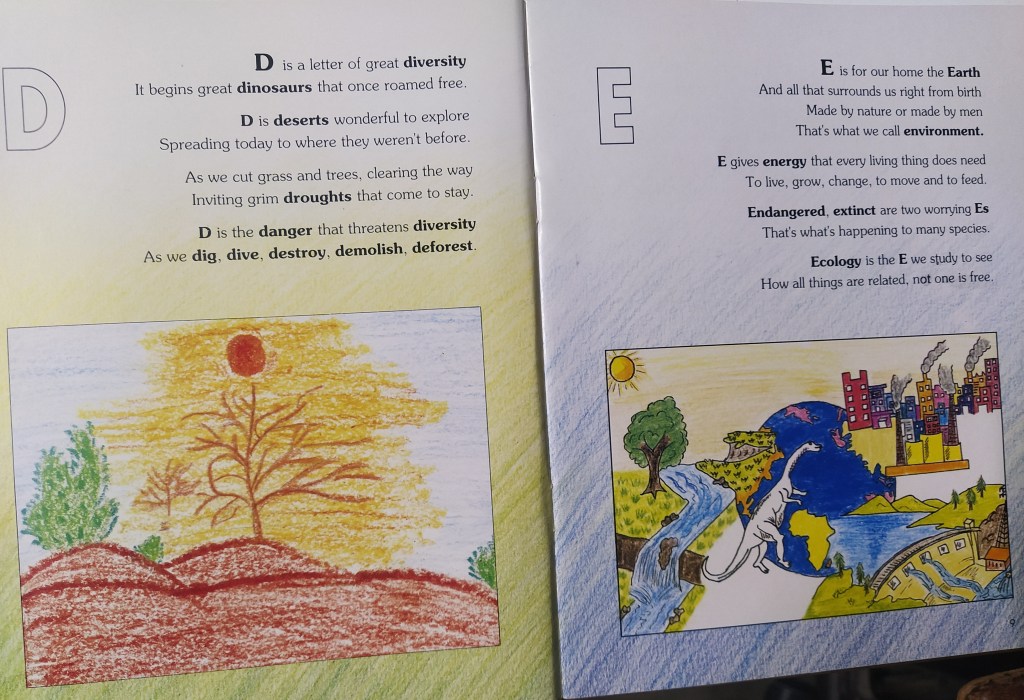
Much brainstorming later this took the form of verses through which we could take “poetic liberties” by bringing together different natural resources. To make it more fun, we decided to do this alphabetically. Hence the title ABC…Naturally. And so the R page could have a verse with the words: rivers, rainbows, reptiles, roots, rainforests, resources, recycle, reuse and reduce.    

With such a motley assortment of words in place, there arose the next challenge. How would an artist illustrate these verses? As adults we are so conditioned to ‘labels’ and fixing of labels in ‘appropriate places’; this would need a huge leap of imagination. But Eureka! Children could make these leaps effortlessly. And so, we walked into a school and handed it over to more creative minds! We simply gave different children the verses, and gave them the Freedom of Imagination to interpret the words through their pictures, as they saw fit. The result was an incredibly rich and many-layered tapestry where disparate elements seamlessly fell into place. ABC…Naturally became a shared work, with every child feeling a sense of ownership and pride at being a ‘creator’. It was a true reflection of the freedom of imagination! It was also a validation of the belief that good books invite readers to interpret the words for themselves, making the story their own.

As someone who was deeply engaged in every part of this process, I am excited that the IBBY is celebrating International Children’s Book Day this year by providing a similar opportunity to

children across the world. IBBY Netherlands has launched an International Illustration Competition to encourage children worldwide to use and express their imagination and creativity by creating works of art inspired by the theme The Freedom of Imagination and the associated motto: “Make pictures for my poem, and please feel free: these words belong to you, even though they came from me.”

Details are available on https://www.ibby.org/fileadmin/user_upload/icbd/icbd_2025/ICBD_2025_international_illustration_competition_-_regulations.pdf

https://www.ibby.org/awards-activities/activities/international-childrens-book-day/icbd-2025-sponsored-by-the-netherlands#:~:text=The%20theme%20of%20the%202025,’

–Mamata

Agatha Christie: Archaeologist

Agatha Mary Clarissa Miller was born on 15 September 1890. 135 years later she continues to be popular around the world as Agatha Christie, the Queen of Murder Mystery. Even as the very English settings of most of her stories and the lifestyle of the characters in her books have seen a century of change, what makes these stories endure is her deft portrayal of human character, with all its foibles, frailties, and hidden depths.

While much has been written about Agatha Christie’s life (including her autobiography), a lot of it describes her life as a writer. From the first short story she wrote (to stave off boredom when she was in bed with the flu) to early days of exploring the ‘murder-mystery’ genre (a detective novel written after a bet with her sister), to creating the memorable detective Hercule Poirot (while she was working as a nurse and hospital dispensary assistant during World War I).

Along the way Agatha became engaged, but then met and married someone else, and became Mrs Agatha Christie. At some point writing became a necessary means of income, rather than an exciting and creative vocation. There were periods when she wished for anonymity, and a yearning to get away from the pressure and spotlight. As her wartime marriage with Archie Christie was falling apart, Agatha began to make brief forays towards breaking free; impulsively travelling alone on the Orient Express to Baghdad 1928. As she wrote in her autobiography …one must do things by oneself, mustn’t one? …I thought ‘it’s now or never. Either I cling to everything that’s safe and that I know, or else I develop more initiative, do things on my own’. And so it was that five days later I started for Baghdad.

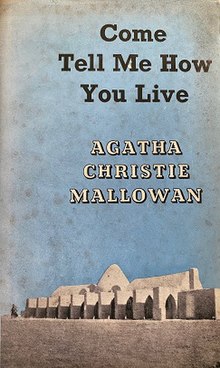
Cover of first UK edition, 1946 https://en.wikipedia.org/

From Damascus she travelled overland to Baghdad, and from there on to an archaeological excavation at the ancient site of Ur, where she met eminent archaeologist Leonard Woolley and his wife Katherine who became good friends. At their invitation, she returned to Ur in 1930 where an archaeologist-in-training Max Mallowan escorted her around the historic sites, the two often travelling ‘rough’ over difficult terrains and situations. The bond between Agatha (already a well-known author) and the much-younger Max grew, and ended in marriage in 1930. Agatha Christie Mallowan discovered the world of archaeology.

Agatha began to accompany Max on some of his excavation sites, and spend the digging season from October to March with him and his team. Here she pitched in, helping to clean, catalogue and photograph the finds. Agatha slept in a tent like the other members of the team, but there was a room set aside for her to write, when she was not engaged in archaeological tasks. This was the only time and place where she was not to be disturbed.

An archaeological dig is like a mystery novel. While the slow and painstaking process of carefully uncovering centuries of accumulated earth in the hope of discovering fragments of past history is far from being a ‘page turner’, the actual discovery of even a fragment of shard is when the mystery really begins. It is from these tiny clues that an entire jigsaw begins to be meticulously pieced together. Where did this piece come from? What was it a part of? Who used this and for what purpose? A single object may lead to the remains of a dwelling, which in turn could have been part of a settlement. And thus the ambit widens. The different clues may provide answers to the key questions of a whodunit: What, where, why, how?

So while Agatha spent much of her time helping the team discover and decipher these tiny clues, she spent some of her time also putting together a different set of clues and characters who would make up a murder mystery novel. Some of these novels were set in the region where she herself was based for part of the year.

Simultaneously she was also noting her observations about the people and their culture, the landscape and its wildlife, the architecture and the archaeological discoveries. These remained notes and memories until the Second World War when Max had been posted to Egypt and Agatha Christie was alone in London, where she worked part time as a volunteer in a hospital dispensary (as she had done in World War I).

In the years when she used to accompany Max on his excavations, Agatha had often been asked by her friends what it was like on an archaeological site. She had started writing about this before the War, but had put it aside. Now missing her husband and nostalgic about their days on the ‘digs’ she returned to those notes and began to chronicle her time there. Drawing upon these and her memories and experiences she wrote about life on an archaeological dig, the different personalities that made up the team (a combination of nationalities, temperaments and dispositions), and the everyday doings and happening that resulted from their interactions. These vignettes, recounted with humour and detail, vividly brought to life the human side of the enterprise. She put these in the context of the political situation in the Middle East in the 1930s.

Agatha Christie finished the book in June 1945, soon after she was reunited with her husband. It was published in 1946 under the title Come, Tell Me How You Live.

For the enthusiasts of detective fiction, who eagerly awaited the new exploits of Hercule Poirot and Jane Marple, the new Christie was a bit of a shock. Where was the plot, the suspense, the investigation and the unmasking of the villain? And yet, in their own way, all these elements were indeed present, this time not as fiction but as facts. The subtitle of the book An Archaeological Memoir, was the first clue to the difference.

But the best-selling author did not intend to ‘cheat’ her faithful readers. The book was published under her married name Agatha Christie Mallowan. It was her tribute to a geographical region and field of study that had given her a lot of happiness. As she wrote in the Epilogue to the book: “Writing this simple record has not been a task, but a labour of love. Not an escape to something that was, but bringing into the hard work and sorrow of today of something imperishable that one not only had, but has”.

–Mamata

Wishing you a Green and Happy World Book Day

Today is World Book Day. Oh Happy Day, Oh Happy Day!

It is a day that UNESCO, in 2001, declared for ‘a celebration to promote the enjoyment of books and reading. Each year, on 23 April, celebrations take place all over the world to recognize the scope of books – a link between the past and the future, a bridge between generations and across cultures.’

Why specifically April 23rd? Well, it seems that it is the date on which prominent authors William Shakespeare, Miguel de Cervantes and Inca Garcilaso de la Vega (Peruvian chronicler and writer) all died. A bit macabre, but well, there has to be some peg!

UNESCO and international organizations representing the three major sectors of the book industry – publishers, booksellers and libraries, select a World Book Capital each year. (New Delhi was the Book Capital in 2003, just two years after the concept came into being—looks like India had a stature and soft power even two decades ago!). The city of Strasbourg is UNESCO’s World Book Capital for 2024.

Book Days are usually marked with reading circles, events where people dress up as their favorite book characters, literary quizzes, book sales, author discussions, and various other innovative events to celebrate this most important of days.

The thought of book day prompted me to dig a little into a question that has been bothering me for a while. Are physical books more eco-friendly or e-books? Some research and calculations have been done, which say that:

‘.. one physical book has a climate impact of about 2.7kg CO2e*.’ 

‘And a Kindle e-reader has a climate impact of about 37.4kg CO2e per year.’ (Incidentally, text files are tiny, and the impact of downloading books is pretty close to negligible. The bulk of the e-book’s footprint is in the production and charging of the e-reader itself.)

‘So if you read 14 different books or more in one year, e-books have a lower footprint than physical books.

But if you only read a handful of books each year, physical books are the better option for you.’

(*CO2e: “Carbon dioxide equivalent” or “CO2e” is a term for describing different greenhouse gases in a common unit.)

As an educator, I want to children to read and read and read.  And I would much prefer that they read physical books. Since 14 is a ridiculously low number of books to read per year, we need to find ways to make physical reading greener. Here are some tips for ‘greener’ reading—for kids and adults:

Use libraries: Not for very young children, but beyond the age of 8 or so, children can get their reading dose from libraries. Thanks to the Delhi Public Mobile Library and my school library (Carmel Convent, New Delhi), supplemented by neighbourhood lending libraries during summer vacations, we got more than enough books. (In fact, we were allowed to purchase only one book a month, so that was the bonus and used as leverage in book exchanges.) Even today, I don’t buy too many books. I receive a lot of books as gifts, and am a faithful subscriber to Just Books!

Used books: Pre-loved books are a great way to go. Shops like Blossoms in Bangalore have some of the greatest selections.  And don’t hesitate to pass on books you have read to others who may find them of interest. Reach out to schools, colleges and educational institutions—they may welcome books you no longer have space for. You could also organize book-swaps.

Support green publishers: Buy books printedon 100% recycled paper, and create awareness about this aspect amonth other readers..

Happy Book Day! Happy Sustainable Reading!

–Meena

PS: The picture was taken ata library in Englands in the 1890s. The image is available at Getty’s Open Access Library.

Timeless Friendship: Pooh and Pals

The little bear and his small gang of Hundred Acre Wood friends have captivated children’s imagination for nearly a hundred years. Pooh, along with Tigger, Eeyore, Piglet, Rabbit, Kanga, Roo, Owl, and the little boy Christopher Robin were the literary creations of English writer AA Milne.

Alexander Alan Milne was born in London on 18 January 1882. He studied at Henley House School, a small independent school run by his father. One of the teachers at the school was HG Wells. After earning a degree in mathematics from Cambridge University, AA Milne moved back to London where we worked as assistant editor of the humour magazine Punch for eight years. Despite being a staunch pacifist he was drafted in World War 1 and served for the British army. He was injured in the Battle of Somme; and returned to England suffering from post-traumatic stress caused by his experience in the war. He could not take the busy life of London and moved his family to the countryside outside of East Sussex. As he slowly recovered, he spent a lot of time in the woods in the area with his only son Christopher Robin, nicknamed Billy Moon. These woods became the setting for the forthcoming adventures of the Hundred Acre gang of friends. And the woodland walks planted in AA Milne the roots of the tales of the motley group of anthropomorphic animals. 

How did the woods become populated with these characters whose charm has remained undiminished for a hundred years? Christopher Robin himself was introduced by his father in a poem titled Vespers which was published in 1923. Another poem mentions a Mr Edward Bear, which was the name of the toy bear that Milne had given his son on his first birthday. But a visit to London Zoo where Christopher saw a black bear rescued from Winnipeg in Canada, led to the renaming of Edward the toy bear as Winnie. The christening was complete when Christopher told his father about a swan that he fed every morning, and how, if the swan did not come, Christopher would say “pooh” implying ‘I don’t care!’ Thus, on Christmas Eve 1925, AA Milne’s short story The Wrong Sort of Bees formally introduced Winnie the Pooh, the teddy bear often dragged down the stairs by his owner Christopher Robin. In no time, the big-hearted but slightly slow-witted bear won the hearts of all children, and the child-at-heart. In the stories that followed, the little boy and his bear were joined in their woodland adventures by their equally quirky, but loving, furry and feathered friends.

The pencil illustrations by Milne’s friend Ernest E Shepard brought the characters to life. The association between writer and artist (his old friend who had served together with him in the war) continued through all the books. Shepard based his drawings also on some other stuffed toys that Christopher played with in his childhood. However Pooh bear was based on his own son’s teddy bear named Growler. The original stuffed toys that gave form to Tigger, Eeyore, Piglet, and Kanga are still preserved in the New York Public Library, a bit bedraggled over time, but still tugging at heartstrings. The baby kangaroo stuffed animal (named Roo) was lost in an apple orchard during the 1930s. The toys were taken to the United States in 1947, and remained with Milne’s American publisher EP Dutton until 1987 when they were donated to the New York Public Library to add to its renowned collection of children’s literature. Here they remain in the Library’s permanent exhibition, a bit bedraggled over time, but still tugging at heartstrings.

The first collection of stories Winnie the Pooh was published in October 1926. It was a huge success and helped to introduce the characters to audiences beyond England. The stories with their innate innocence, childhood joys, and idyllic countryside provided comfort in times that still echoed with the brutality of World War I. They also touched upon universal sentiments of friendship and bonding.

The unprecedented success of the books however impacted the childhood of the real Christopher Robin. He was thrust into the discomforting limelight, and grew up resenting the fallout of early fame. This led AA Milne to stop writing Pooh stories after his fourth book, The House at Pooh Corner. However the damage had been done and the relations between father and son continued to remain strained till the end.   

Milne wrote four children’s books that made up the Winnie the Pooh anthology, beginning with the poetry series When We Were Young published in 1924, and the final book The House at Pooh Corner, published in 1928. In the nearly hundred years since, the books have sold millions of copies worldwide, and the characters remain evergreen, and ubiquitous, through animated versions and merchandise which have earned billions of dollars. The exclusive media ownership of the brand was with Disney and Warner Brothers until 2022 when the 95-year copyright lapsed. Pooh and friends are now in the public domain. May they continue to charm and endear themselves for the next hundred years.

So they went off together. But wherever they 
go, and whatever happens to them on the way, in
that enchanted place on the top of the Forest a
little boy and his Bear will always be playing.

The House at Pooh Corner

–Mamata