When Feet Take Flight: A Memory and the Magic of Sepak Takraw

Some memories come back vividly when there is a trigger. Sadly, the trigger for this memory was a newspaper item reporting an accident involving a Sepak Takraw team.

But the memory itself is joyful. A trip to Burma, about fifteen years ago. It was a warm afternoon in Yangon. The tea stalls were buzzing, the pagodas gleamed in the sun, and somewhere between wandering and people-watching, I found myself drawn to a small patch of open ground near a quiet lane.

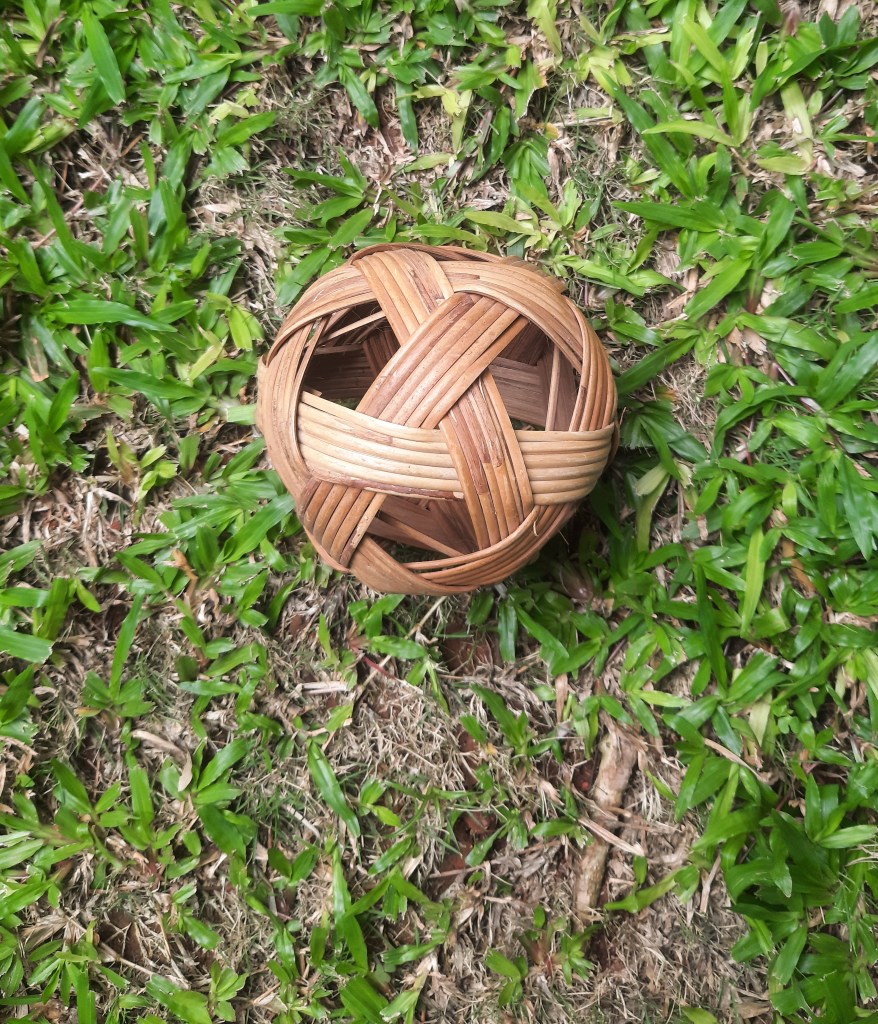
A group of young boys were playing a game I had never seen before. A boy leapt into the air, spun like a dancer mid-flight, and kicked a small rattan ball clean. I stood completely still, mesmerized. It was my first encounter with Sepak Takraw. We stood and watched for quite a while—the grace, the athleticism, the sheer joy of the players—was something amazing to watch. Fortunately on the way out, I found a Sepak Takraw at the airport and bought it.

All these years later, that moment still shines brightly in memory. Because Sepak Takraw is not a sport you easily forget.

For many of us in our generation, our playground sports were familiar—gully cricket, kho-kho, maybe a weekly volleyball session if your school had both a net and enough motivation to set it up. But Sepak Takraw feels like someone took volleyball, infused it with martial arts, added the grace of classical dance, and sprinkled it with sheer joy.

In the lanes of Myanmar, Malaysia, Thailand, and Indonesia, this sport has lived for centuries. Its early form, sepak raga, simply meant “kick the rattan ball.” Communities played in circles, keeping the woven ball aloft with feet, knees, heads—much like our own childhood attempts to keep a rubber ball bouncing on our legs, but infinitely more skillful.

Over time, the game evolved. Nets were added, rules refined, teams formed. What remained unchanged was the heart of the sport—rhythm, teamwork, and an almost balletic coordination.

What struck me in that first encounter in Burma was the joy. There was no crowd, no scoreboard, just a group of boys pushing the limits of their bodies, laughing, teasing, showing off impossible kicks.

Since then, as videos of Sepak Takraw swirl across the internet, the world has begun to share in that delight. Watching professionals play is like watching physics bend slightly. The killer kick—a full somersault that sends the ball crashing down at an angle—feels like something from a choreographed stage performance. The teamwork is intuitive, almost telepathic.

Interestingly, Sepak Takraw has been creeping into India’s sporting landscape too, especially in the Northeast. Manipur in particular has embraced it with enthusiasm, with players who train tirelessly and compete internationally. Perhaps some Indian traveller today will see a game in Imphal or Aizawl and feel the same quiet awe I felt in Yangon all those years ago.

Today the game is played at international level, and has entered the AsianGames. Efforts are on to get it into the Olympic list. 

But for me, it is the memory of that afternoon in Burma—the dusty field, the laughter of boys, the swift arc of a rattan ball against the sky. It is a reminder of how sport, in its purest form, connects us across borders and time.

–Meena

Beauty in Imperfection: Kintsugi

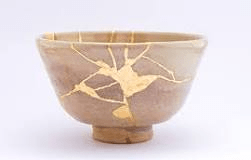
This week Meena wrote about the Japanese reverence for precision and perfection with reference to sationery. Many aspects of Japanese life, as well as products, display the concept of kirei that refers to ‘clean’, ‘beautiful’ or ‘elegant’. While the Japanese revere perfection, they equally celebrate imperfection. Nothing personifies this better than the concept of kintsugi. This word combining the Japanese words for ‘gold’ and ‘joinery’ translates roughly to mean ‘joining with gold’ and refers to a 500 year-old art in which broken pottery is repaired with a seam of lacquer and precious metal. The repair is done not with the aim of disguising the crack, but rather highlighting it to create a piece of art.  The joining is involves fine craftsmanship.

Traditionally, kintsugi is entirely based on the use of urushi lacquer. Urushi refers to the tree sap of the lacquer tree, a type of tree that can be found in Japan, China and also on the Korean peninsula. It is widely used for various crafts in Eastern Asia, such as Japanese lacquerware. Urushi is a natural material that has outstanding protective and adhesive properties. Urushi lacquer is used at all stages of the joining process from sticking the pieces together to the gold finish. While urushi lacquer has been used for thousands of years as an adhesive to create or repair objects, the use of gold and lacquer for restoration is believed to have evolved later, dating back to the Muromachi period (1336 AD to 1573 AD).Historically it is craftmen specializing in lacquerware who also did kintsugi. This was their side activity during the winter when the lacquerware business was usually slow.

There are several stories associated with how this began. In one version a Japanese shogun sent his cherished tea bowl to China for repairs after it had been broken. It was returned stapled together with metal which was the common technique then. Disappointed at the clumsy outcome, he asked Japanese artisans to restore the bowl in a way that honoured the craftsmanship of the object. The craftsmen put together the pieces by repairing the cracks with lacquer mixed with powdered gold. The effect was beautiful, restoring the aesthetics as well as functionality of the bowl.  And so, the story goes, kintsugi came to be–the technique that highlights flaws rather than disguising them, creating a new piece of art that retains the functionality of the object. As a craft and an art form, kintsugi challenges conventional expectations. This is because the technique goes further than repairing an object but actually transforms and intentionally changes its appearance.

Kintsugi is more than an art and craft form. It is inextricably linked with the Japanese philosophy of wabi-sabi. This comprises two core concepts – wabi and sabi. Though related, each has its own distinct meaning in the Japanese language. Wabi represents a rustic, understated form of elegance that avoids extravagance and embraces the authentic, the modest and humble, and avoids anything ostentatious or overdesigned. Sabi refers to reverence of the naturally aged and organically withered objects which have acquired a special character over the passage of time.

Put together the concept of wabi-sabi centres on the philosophy that nothing stays the same forever, and the acceptance of transience, imperfection, and beauty in simplicity. It urges us to celebrate the changes over the passage of time. This is a uniquely Japanese sense of imperfect, impermanent beauty in contrast to the values of perfection and permanence.

The kintsugi technique is an extension of the philosophy of wabi-sabi. The restoration of the broken pieces is a slow and painstaking process, carried out with love and respect. It is literally a labour of love, love for the fragile beauty and age of something that deserves due care and reverence. While the word refers to this specific process it is a reflection of the philosophy of a culture that values the old and imperfect, (including a population which has the highest number of centenarians!).

In an age of mass production, conformity, and “use and throw” we are quick to reject anything that does not fit the mould, and even quicker to throw away something which has outgrown its use, is even slightly chipped or dented, and perhaps not ‘in fashion’ any longer (including putting our elders in the care of others).

Going back to where I started, as an avid collector of stationery all my life, I have wonderful memories of going to a shop called Chimanlals and selecting a variety of writing paper and envelopes, and the joy of writing on these with a carefully-filled fountain pen, sealing it in an envelope, and going to the post office to attach stamps and posting the missives. The period of anticipation of the letter reaching its addressee, and the sweet impatience of awaiting the response was a treasured part of a life that moved at a slower pace. I feel sad for a generation that will not know these simple pleasures. In the ‘virtual’ exchange of communication at the speed of sound, we have lost the mindfulness and ritual that is a part of the zen of stationery. It is heartening that Japan still has a Stationery Expo. I would so love to be there!

–Mamata

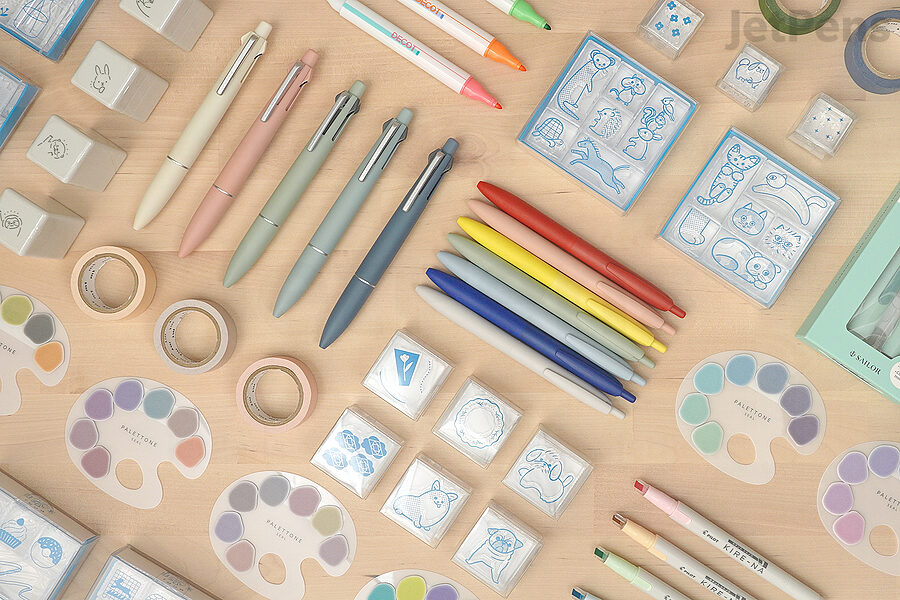
The Irresistible World of Japanese Stationery

Japanese stationery–it’s not just about paper and pens. It’s an entire universe of meticulously designed (and over-engineered, some people say)products that blend functionality with a sense of artistry. From perfectly engineered mechanical pencils to pastel-hued notebooks that feel like an experience rather than just stationery, Japan’s stationery game is on another level.

Japan’s obsession with stationery is more than just a passing trend or quirky fascination. There’s a deep cultural history and a respect for craftsmanship that informs the country’s relationship with its stationery products. It’s not about pens, paper, or notebooks—it’s about reverence for beauty, functionality, and attention to detail.

At the core of this lies the cultural reverence for precision and perfection. The concept of kirei—a Japanese word that means “clean,” “beautiful,” or “elegant”—is key to understanding the stationery obsession. In everyday life, the Japanese strive for beauty and simplicity, and this aesthetic extends deeply into the design of their stationery. Minimalism is at the heart of many stationery designs: neutral colors, sleek lines, and a focus on function over excess.When it comes to everyday tools like stationery, the emphasis is on creating items that are not only practical but also exquisitely refined.

There’s a conscious focus on making something beautiful out of the mundane or utilitarian, a concept that transcends into stationery. Pens aren’t just about writing—they’re carefully crafted to deliver the perfect writing experience. Paper isn’t just a surface for notes; it’s a tactile experience that enhances the act of writing itself. Craftsmanship plays an enormous role. Many high-end stationery items, like Uni-ball pens or Midori notebooks, are created by artisans who bring decades of expertise to their craft. Stationery is an extension of this artistry.

The Zen of Stationery: Mindfulness and Ritual

Japanese students are encouraged to use their stationery in an almost sacred way. Their school notebooks are often neatly organized with an emphasis on clean, legible handwriting. Calligraphy—known as shodo—is still a highly respected art form in Japan, and the skills learned in this practice often extend into daily life.

The slow, deliberate process of choosing a pen, selecting the right paper, and finding the perfect notebook to match your mood is an act of mindfulness. It’s about being present in the moment and honouring the process of creation.

The Japanese Stationery Expo and Awards: A Celebration of Craftsmanship and Innovation

This devotion to elevating the everyday reaches its peak each year at two marquee events which take place in June every year in Tokyo: the Japan Stationery Expo and the Japanese Stationery Store Awards. Together, they showcase the best of design, functionality, and sheer creativity.

The Japan Stationery Expo is where stationery enthusiasts, designers, and brands converge to showcase the best of what the industry has to offer. (More on this expo and another interesting one next week).

If the Japan Stationery Expo is where products are showcased, the Stationery Awards are where the best of the best are recognized. They honour the incredible craftsmanship and innovation in Japanese stationery, celebrating both traditional designs and newer, boundary-pushing concepts. It’s the Oscars of the stationery world, but without the drama and red-carpet couture. Products are judged based on various criteria, including design, function, innovation, and overall quality, with awards in several categories, from Best Stationery Product to Best New Brand, and even a category for environmental sustainability.

The 2025 Awards went to:

  • Grand Prize: Pilot Kirei-na Highlighter — engineered with a guiding plate that keeps lines neat and smudge-free.
  • Design Award: Luddite THE POST Sustainable Leather Bendy Pen Case — chic, durable, and eco-friendly,
  • Functionality Award: Uni Jetstream Single Ballpoint Pen (Lite Touch Ink) — celebrated for its smooth flow and comfort, turning everyday scribbles into a silky experience.
  • Idea Award: King Jim Hitotoki Kori Jirushi Ice Stamp — a playful yet practical reinvention of a classic tool.

35 other winners were recognized, from elegant fountain pens to ingenious pen cases, and even a “tea-time notebook”.

Some of the Most Innovative Award Winners in Recent Years

1. Pilot FriXion (2006) – Erasable Ink Pen: This was one of the first pens to use thermosensitive ink, which could be erased with friction.

2. Midori MD Paper (2011) – Premium Paper Notebooks : Known for its exceptionally smooth texture, these revolutionized notebook writing with its soft, cream-colored, bleed-resistant paper

3. Lihit Lab Teffa Bag-in-Bag (2017): A unique product that allows people to organize their small stationery, gadgets, and accessories inside a larger bag. It has pockets of various sizes to fit pens, notebooks, chargers, and other essentials.

4. Kokuyo Campus Sticky Notes (2019): This product took the classic sticky note and reimagined it with a special adhesive that works even on rougher papers.

5. Karuizawa Stationery – Plantable Paper (2020): A sustainable stationery innovation that uses plantable paper embedded with seeds. Once you’ve used the paper, you can plant it and grow flowers, herbs, or even vegetables from it.

I will be content if I can read my own handwriting after a few hours. No loftier ambitions!

–Meena

Pic: .jetpens.com/

Racing with the Oars of Tradition – Kerala’s Boat Races

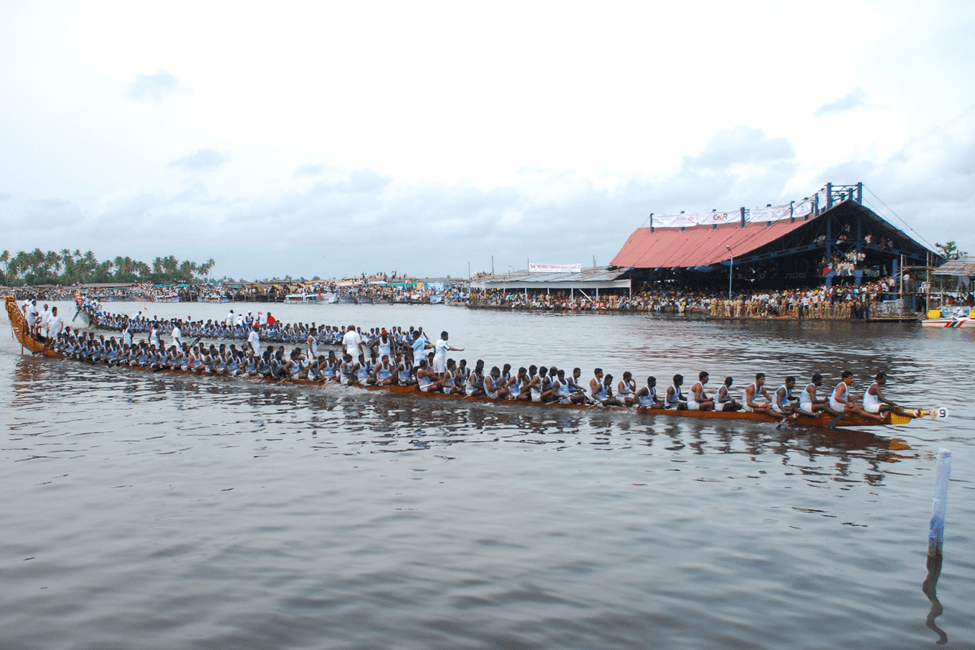
Come August, the air begins to buzz with anticipation in Kerala. The boat race season is here! Known locally as vallamkali (literally, boat play), the sight of dozens of snake boats slicing through the waters, powered by hundreds of synchronized oarsmen, is one of Kerala’s most spectacular traditions. Shiny black boats stretching almost 100 feet, with rowers swaying to the rhythm of a vanchipattu (boat song).

The most famous of the boat races is the Nehru Trophy Boat Race, inaugurated in 1952 when Jawaharlal Nehru, then Prime Minister, was so captivated by the spectacle that he donated a silver trophy. Today, the Nehru Trophy on the Punnamada Lake in Alappuzha attracts international attention and has been featured on tourism campaigns worldwide. But across the state, from Aranmula to Champakulam, local communities host their own races, each with its own traditions and lore.

Innovation on the Water

One of the most interesting aspects of the boat races today is how technology has crept in—not to diminish tradition, but to amplify it. While the boats themselves are still crafted the old way, using Anjili wood and painstaking carpentry handed down through generations, innovations have entered the training and organization.

Rowers now undergo scientific fitness regimes, with physiotherapists, nutritionists, and even sports psychologists guiding teams. GPS trackers and drone footage help coaches analyze synchronization and speed—things once left only to the naked eye and instinct. Live-streaming and 4K broadcasts take the drama of the races across the world, making it a truly global event. And traditional boat songs as well as new ones are now available on Spotify playlists.

Women at the Oars

But what about women? For long, the snake boat races were a male preserve, embodying sheer physicality. Yet, in recent years, there has been a quiet but important shift. Kerala has begun hosting all-women boat races—a recognition that strength and stamina are not male monopolies. In 2022, the first Vallamkali exclusively for women was held, with teams of fisherwomen taking to the waters.

Even in mixed-community celebrations, women’s teams are increasingly visible, particularly in the Kettu Vallam (smaller decorated boats) races. It is still early days, but the image of women rowing with fierce determination underlines how traditions evolve without losing their essence.

More than a Race

Preparing a snake boat involves dozens of families. Training the oarsmen requires food, lodging, and encouragement from entire villages. On race day, the banks are filled with people singing, cheering, and celebrating. Divisions of caste, class, and creed dissolve.

There is also a spiritual dimension. The Aranmula boat race, for instance, is tied to temple rituals, where the boats are offered as homage to Lord Parthasarathy. Here, winning or losing is less important than participation.

The Kerala boat races are not just about the boats—they’re about the teams, each carrying the pride of their village or community. In recent years, the competition has become so professional that many villages now run their own “boat clubs,” with dedicated squads training year-round. It’s a bit like football clubs elsewhere—loyalty runs deep, rivalries are fierce, and victories are celebrated across the community!  A few of the most celebrated teams are:United Boat Club (UBC), Kainakary, Police Boat Club, Kollam, Jawahar Boat Club (JBC), Kollam, St. Pius Boat Club, Alappuzha, Karichal Chundan (Alappuzha), Champakulam Chundan, Veppu Vallams of Aranmula.

Congratulations to the winner of this year’s 71st Nehru Boat race held last week, the boat Veeyapuram Chundan of Village Boat Club Kainakary. The winning team which was one among 75 competitors, touched the finishing line in 4.21.084 minutes.


And Happy Onam to all
!

–Meena

Pic: nehrutrophy.nic.in/

Casting a Spell

The Indian-American domination of a peculiarly American phenomenon—the Spell Bee—is something that intrigues me no end. Not to say Indian-Americans don’t excel in many pursuits out there, but these kids winning the national level spelling competitions year after year after year after year is quite something.

The American tradition of spelling competitions may have started with the Puritans. By the mid-18th century, spelling competitions were common across the country. In 1750, Benjamin Franklin apparently recommended their use in a proposal for a school. Spelling challenges were quite the rage with both adults and children in the 19th century. Mark Twain apparently mentions ‘spelling fights’ in Adventures of Tom Sawyer!

The use of the term ‘bee’ for these competitions started in the mid 1870s. It is an unusual usage of the word, as ‘bee’ usually refers to a community activity with a shared goal—like quilting bees or knitting bees.

English, with words from various sources and a variety of languages, probably peculiarly lends itself to this pastime. Afterall, I don’t think there can be much confusion how 99% of words are spelt in Tamil or Kannada or Oriya– languages with phonetic writing systems do not have so much confusion in spelling. Moreover, because English has borrowed words from many languages through its history, the result is a diverse vocabulary with inconsistent spelling patterns which are carried over from the mother-languages.

In the US, the National Spelling Bee, as we know it today, was established in 1925. The Louisville Courier-Journal was the first sponsor, who saw it as a way to foster interest in spelling and language. 

The E.W. Scripps Company acquired the rights to the National Spelling Bee in 1941. This company was started by E.W. Scripps who founded The Penny Press, a daily newspaper in Cleveland. Today, the company is involved in investigative documentaries and enterprise journalism with the purpose to ‘…advancing understanding of the world around us.’

The Spell Bee has been held annually, in late May or early June since its inception, except for a few years during World War II and in 2020 due to COVID-19.  It has evolved over time, beyond just spelling, encompassing vocabulary development and broader language knowledge. 

The first winner of the Spell Bee, in 1925, was Frank Neuhauser of Louisville, whose winning word was “gladiolus”. The next year saw a girl winning for the first time– Pauline Bell, also of Louisville, who spelt the word “cerise”. (Incidentally, girls won nine consecutive competitions from 1932 to 1940.)

Now coming to winners of Indian origin. 30 of the last 36 competitions have been won by them. Which is surely not a chance thing. Before 1999, there were only two spelling bee winners of Indian-American descent—Balu Natarajan in 1985, with the word “milieu”, and Rageshree Ramachandran in 1989 with “elegiacal”.  Nupur Lala opened the floodgates in 1999 winning with “logorrhoea,” and there has been no looking back since then! This year of course we celebrate Faizan Zaki, a 13-year-old Indian-American student from Texas, who won with the word ‘éclaircissement”

Rebecca Sealfon who won in 1997 against Prem Murthy Trivedi, has done some analysis on the subject of Spell Bee competitors, and tells us that children practice for about 500 hours in the years in which they compete; some hire ex-competitors as coaches; and they typically and unsurprisingly relax by playing word games like Scrabble or Boogle. Some try to learn every word in the dictionary. She further tells us that double ‘ll’ words are the ones which have tripped up a large number of contestants, along with the words ‘metastasize’ and ‘metonymy’.

Since I don’t know many of these words, and would certainly not be able to spell them, I can only express my wonder at these sub-14 year olds who can.

Kudos to all of you! You have cast a spell on me!

–Meena

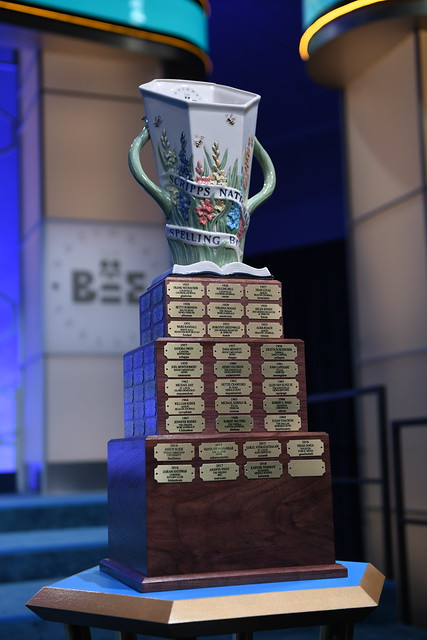
Pic: https:spellingbee.comblogscripps-cups

Singing Telegrams, Speeding Birds

Humans have poured in innovation and ingenuity into developing communication modes and media. Today of course the world revolves around ‘social media’ but some of the older modes are quirky and beautiful. Here is a look at two of them:

Singing Telegrams: Popular in the 1930s in the US, these were telegrams sung out to the recipient. It began in 1933 when a fan sent a birthday greeting to Rudy Vallee, a popular singing star of the times. George Oslin, the Public Relations Officer of Western Union–the company which handled telegrams–was a man who thought differently. He had long been concerned with the ‘gloom and doom’ image of telegrams, which usually arrived to announce a disaster (those old enough will recall churning stomachs when a telegram arrived—usually to announce a seriously ill relative or the demise of a loved one). He took the occasion of this birthday greeting to add a fun element to telegrams and try to change their image. So he got a lady-operator to sing the telegram out on the telephone. And so a new medium of communication was born!

But those were days when few homes even in the US had telephones. So the postal department used to actually sent someone to ring the bell of the addressee and sing out the words! Of course, this was not something that went ‘viral’ but people did use if for a lark. It continued on till 1974 when the company suspended this service. Now, in the US and even in India it seems, there are some private companies which will perform this service. They come dressed in fancy clothes to fit the occasion, and put up a full-fleged performance at the doorstep of the addresee.

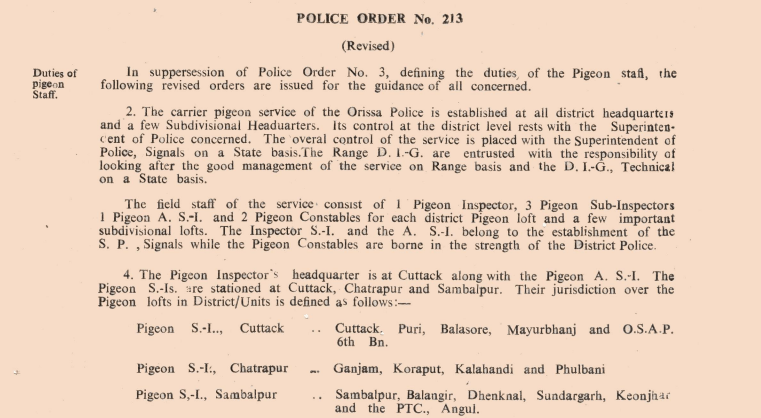
Speeding Birds: Pigeons as carriers of messages have been the mainstay of armies, spies, princesses imprisoned in towers and everyone else that the romantic imagination can conjure up. But the interesting thing is that the Odisha Police had a functional pigeon messenger system till as recently as 2008!  They were used in times of disasters or during military or police action when all other means of communication like wireless, telegraph, telephone and despatch riders were disrupted or failed. The pigeons were also used for inter police station communications. Flying at a speed of about 55 kmph, carrying messages written on light-weight onion paper which were inserted into a metal capsule and tied to the bird’s leg, this mode of communication was considered no-fail. These Belgian Homer pigeons were highly trained, and considered very intelligent by their handlers!

There is a very interesting story about Orissa Police Pigeon messengers. Apparently, in 1948, when Pandit Nehru, the then-PM visited the state soon after Independence, he first went to Sambalpur. The same day, he was to address a public meeting in Cuttack, which is about 260 km away. He wanted to send an urgent message to the police in Cuttack to ensure that the arrangements were such that they did not create too much of a barrier between the public and the dais. When he asked how the message would reach Cuttack in time, the police officials there showed him the carrier-pigeon which would be doing the needful. Nehru was sceptical. But the pigeon departed Sambalpur at 6 am and was in Cuttack by 11.20 am. And when the PM reached, his instructions had been carried out! He was amazed.

Even today, though not in regular use, Orissa Police still maintains a carrier pigeon service of about 150 birds, utilizing them for communication during disasters and for ceremonial purposes.

–Meena

Visual from: https://odishapolice.gov.in/sites/default/files/PDF/PO-213_0.pdf

MOOMINS

Way back in the ‘60s and ‘70s growing up in Delhi, the family newspaper was The Statesman. It was considered by Tamilian families to be the closest substitute for The Hindu, which in those days used to arrive in Delhi with a delay of a day or two.

So like all good Tamilian families outside Tamil Nadu, we too took The Statesman. And through this, got introduced to the Moomins, which was the only cartoon strip that the paper carried.

The central characters of the cartoons, which have just turned 80, are gentle-looking hippo-like creatures called the Moomins . They are white and roundish, with large snouts. The Moomin world and its characters are the creations of the Swedish-Finn illustrator and writer Tove Jansson, and the books and comic strips were originally published in Swedish in Finland.

The core family consists of the main protagonist, Moomintroll, a small and well-meaning Moomin who who is forever having adventures and often finds himself in trouble; his mother, the nurturing and loving Moominmamma; and his father, the restless Momminpappa. And besides, there are many of their friends.

The first book was written during World War II as a fairytale for Tove to comfort herself during dark times.  It is based on the situation and stories of  millions of displaced people seeking refuge. The Moomins live in a tall blue house – a joyful place where everyone is welcome, whoever they are. The motto is ‘The door is always open’. The blue-purple Moominhouse is thus a symbol of security, shelter and a sense of belonging. No wonder then that even today the Moomins represent hope for refugees, so much so that UK cities are using this as an the inspiration for a series of art installations in UK cities, in collaboration with Refugee Week. 

The Moomin stories are tales of adventure and overcoming adversities, always with a sense of inclusion and tolerance, and living together in cheer and happiness. Harmony with nature is a recurring underlying theme. The underlying message of all the Moomin stories is that it’s the simple things that are valuable in any situation, and that one’s attitude can often change a bad day into a good one.

Many in India may not be very familiar with these characters, but there are nine Moomin novels which were all successful. The cartoon strip was syndicated in 1954, to over 120 publications in 40 countries. This comic strip reached 20 million readers daily. There was a TV show too, which was originally broadcast in Poland and then sold to other countries including the UK, and aired on PBS in the US. There are even two Moomin theme parks, one in Finland and the other in Japan. Moomin stories have been adapted for the theatre, the cinema, and as an opera.

Here are some Moomin quotes, encapsulating good sense and postivity:

‘That’s most extraordinary, but I’m so used to your doing extraordinary things that nothing surprises me.’

‘Perhaps it will come – perhaps not. It’s all the same to a person who knows that everything is unnecessary.’

‘How nice to be on your own for a bit and do what you like.’

‘I like you, I don’t want to make you feel unhappy.’

‘The main thing in life is to know your own mind.’

In a conflicted world, Moomins may be the cartoon characters we need!

–Meena

Visual: From http://www.moomins.com

A Maharaja and his Art come to Town

Like many of my fellow citizens, I am not a great fan of rajas, maharajas and their ilk. Nevertheless I love one Maharaja. The Air India Maharaja of course!

And the Maharaja has come to my neck of the woods (Bangalore), bringing with him a part of his famed art collection. Yes, the National Gallery of Modern Art (NGMA) here is hosting close to 200 pieces from the Air India art collection for six months.

Air India’s was one of the largest corporate art collections in India, estimated to have been worth over Rs. 350 crores about eight years ago. The collection has been built over almost seven decades and comprises close to 4000 works. It spans across modern and contemporary paintings, folk art and miniatures, as well as sculptures, textiles, photographs and antique clocks.

The collection started in the 1940s, propelled by JRD Tata, who wanted all of Air India’s booking offices across the world to represent India. Bobby Kooka and Jal Cawasji were mainly responsible for selecting and buying the art pieces. They would not only buy paintings from established artists, they would also visit student exhibitions and pick up paintings. Many of these would be used to make calendars, post cards etc. There was another interesting way of acquiring paintings—the transportation service contract. In exchange for the works of artists, Air India would give them international air tickets! Many an artist, including MF Hussain found this offer irresistible!

There were specially commissioned art works too. For instance, in the days when smoking in the air was quite normal, the airline commissioned Salvador Dali to design a special ashtray to be given to first class passengers. This was in 1967. 500 limited edition pieces were made of an ashtray comprising a shell-shaped centre with a serpent twined around its perimeter, supported by two surrealist elephant-heads and a swan.  Dali asked for a baby elephant as payment, and got it too!

When the Tatas controlled Air India, the art works were carefully documented, displayed, stored and issued out from the Mumbai office to various domestic and international offices. After the merger with Indian Airlines in 2007 however, things went awry. The collection was moved to Delhi and there was no real ownership. There were scandals with one of Jatin Das’ works allegedly disappearing. Moreover, the works were not properly stored or cared for.

When Air India was re-privatized a few years ago, it was decided that the collection would go to the NGMA, where it could be taken care of professionally. A further decision was taken that the collection would not just stay in one location, but would travel across the country and to other countries as well.

It is as part of this that the collection has now come to Bangalore, where it is being displayed at the NGMA building which itself is a sight. Called the Manickyavelu Mansion, it belonged to Manickyavelu Mudaliar, a mining baron, who himself bought it from the Wadiyars of Mysore.  Mudaliar who came from a poor family made it big thanks to his forays into manganese and chrome mining. But the fortune did not last long and the mansion was taken over by the City Improvement Trust Board.  In 2000, it was leased out to the Ministry of Culture. So today the imposing mansion with grand rooms and a scale quite fitting to a national museum, set in serene green grounds with century old trees, is the Southern Headquarters of the NGMA.

So if you are in Bangalore, ensure you drop into the gallery to see the Air India exhibition. You will see works by Anjolie Ela Menon, B. Prabha, Arpana Caur, MF Hussain, Jatin Das and Raza, among others.

And one room is devoted to the Braille versions of these works. The paintings and the information about them are done in Braille and hopefully will be enjoyed by many.

A special exhibition indeed!

–Meena

Famous Women on the Wall: Happy Women’s Day

This week we celebrate International Women’s Day.

It was in 1911 that IWD started being marked. A couple of decades after that was when something called the ‘Famous Women Dinner Set’ was commissioned. This was a set of 50 dinner plates depicting famous women down history.

Kenneth Clark (Baron Clark), the art-historian and museum director, commissioned these. (Those of an older vintage may remember the BBC serial ‘Civilization’ which discussed Western art, architecture and philopsophy. Though made in 1969, it was broadcast in India in the late ‘70s or early ‘80s, and was one of the most popular art-history programmes in the world.)

Coming back to the dinner-plates, the artists given the commission were Vanessa Bell and Duncan Grant, of the famous Bloomsbury Group. This was the name given to a group of English writers, philosophers and artists who met between 1907 and 1930 in the Bloomsbury  district of London, the area around the British Museum , and discussed matters of art and philosophy.

It is said that Kenneth Clark got the idea of commissioning a special dinner service when he was dining off a historic blue-and-gold Sèvres service, originally made for Catherine the Great.

Kenneth and his wife did not interfere in any aspect of the creative work—what form or shape it would take, what pieces it would consist of, or even what it should portray.

In 1933 the work was completed, and after showing it to the Baroness, the artists presented the set of 50 plates to Kenneth Clark, who was probably quite surprised to see the result if his commission, because he thought he would be getting’…a wide ranging set of decorative crockery that included everything from soup tureens to mustard pots’

Picture from https://www.charleston.org.uk/event/famous-women-dinner-service

Vanessa and Duncan had selected 50 famous women down history—twelve each from four categories: Women of Letters (e.g George Eliot, Charlotte Brontë, 10th-century Japanese poet Murasaki. Virginia Woolf and Elizabeth Barrett Browning); Queens (including Catherine the Great, the Queen of Sheba, Elizabeth I, and Victoria); Beauties (among whom were Pocahontas and Helen of Troy); , and Dancers and Actresses (including Sarah Bernhardt, Ellen Terry and Greta Garbo). That made 48 women. The last two plates portrayed the artists Vanessa Bell and Duncan Grant. The artists had hand painted beautiful portraits of their subjects on Wedgewood plates.

Though he was initially a bit confused with the dinner service, it seems that Baron Clark quite grew to like his plates. It is said that he used to select specific plates from the service for use for particular guests, depending on their interests, or to poke fun at their sensitivities.

The dinner set, after being sold and re-sold disappeared from view for some decades, but later re-surfaced. They are now housed in the Charleston Museum in the UK—the original home of Vanessa Bell.

Another major work of art involving women and dinner is ‘The Dinner Party’, a 1979 installation by Judy Chicago. This is a dinner table arranged with place settings for 39 mythical and historical women. They are seated around a triangular table. Though controversial, this is considered a classic of feminist art.

In India we do have portraits (paintings and photographs) of women. But they are outnumbered by artistic works down the ages which put females at the centre—the oldest probably being the Harappan Girl, going back to 1750 BC or thereabouts. From there, to all the art in temples, to Raja Ravi Verma and his goddesses and mythical women, to the controversial portrayals of MF Hussain, to women painted by Amrita Shergill, Anjolie Ela Menon, Arpana Caur, Bharathi Kher and others, which are all classics today.

May many more artists immortalize real women in their art. It is an apt tribute.

Happy Women’s Day!

–Meena

And thanks to all our readers on this, the anniversary of our blog! And all those whose encouragement and support keeps it going!

Updating Anthems

In this week of Republic Day, the tune of our national anthem and other patriotic songs are all around us. Without them, the mood cannot be built. Singing the national anthem together with neighbours, community, colleagues, fellow-students—there is nothing more symbolic of our oneness.

Anthems in general are rallying cries, rousing or uplifting songs identified with a country, section, cause etc. A national anthem is a solemn patriotic song officially adopted by a country as an expression of national identity.

These songs are our identity. But just as in so much else, should they change as contexts and realities change?

Well, five countries have taken the bold step of changing their anthems in recent years.

Australia: On Jan 1, 2021, Australia’s national anthem, “Advance Australia Fair,” underwent a significant change. The phrase “For we are young and free” in the second line was changed to “For we are one and free.”  This is an effort to respect the Aboriginal and Torres Strait Islander peoples, recognizing that Australia’s history precedes European settlers tens of thousands of years. It is a symbol of Australia’s commitment to unity and reconciliation with Indigenous population.

Austria: Austria’s national anthem is “Land der Berge, Land am Strome” (Land of Mountains, Land by the River). The language was reviewed and modified to promote gender inclusivity in 2021 . The original lyrics which referred to “great sons,” was changed to “great daughters and sons.”

Canada: In 2018, Canada made a significant and widely-welcomed change to its national anthem “O Canada” in 2018. The line “in all thy sons command” was changed to “in all of us command.” was changed to “in all of us command”, again an effort for gender-inclusivity.  

South Africa: Like the nation itself, South Africa’s national anthem is unique. It combines lines from several different languages and songs, including the hymn “Nkosi Sikelel’ iAfrika” and the former anthem “Die Stem van Suid-Afrika.” In recent times, small changes have been made to the anthem with the purpose to ensure proper pronunciation and inclusion of all languages and honour the linguistic heritage of all its people.

New Zealand: In 1977, the Government announced that New Zealand would have two national anthems — the traditional anthem ‘God Save The Queen’ and the poem ‘God Defend New Zealand’. Since then, both the anthems have had equal status. Following the accession of King Charles III to the throne in 2022, the words of the first anthem changed to ‘God Save the King’.

The latest change in a national anthem is not for a change of words but of the tune. In January 2025, Saudi Arabia has asked Hans Zimmer (Oscar-winning composer of the Lion King, Dune etc.) to create a new version of its national anthem, Aash Al Malik (Long live the King)!

Our anthem Jana Gana Mana (‘[Ruler of] the minds of the people’) was  composed as “Bharato Bhagya Bidhata” in Bengali by  Rabindranath Tagore on 11 December 1911. The first stanza of the song  was adopted by the Constituent Assembly of India as the National Anthem on 24 January 1950, the same day as the Indian Constitution was signed. (Mamata has dwelt on this at length in post last week).

There have been a few proposals to change/add/delete words and phrases. For instance, to add the name ‘Kamrup’ to make the anthem inclusive of the Northeast; or remove the name ‘Sind’ because it is no longer in India. The word “Adhinayak” has also been controversial,  because it was used to praise King George V in 1911. In 2019, there was a bill moved in the Rajya Sabha, to modify the third line to ‘Punjab Sindh Uttarpurv Gujarat Maratha’, to bring in the Northeast. However,  the Supreme Court has struck down all of these.

While tampering with sacred traditions is always fraught, there does seem to be sense in these suggestions, and maybe we need a debate on this. After all, the essence of democracy is debate, and this seems a worthwhile one!

Happy Republic Day!

–Meena

Thanks: http://www.vanguardngr.com