Symbolizing the Olympics

Continuing in the spirit of the Olympics—after all, they will come back only after four years—today I thought we could take a random walk through things other than the mascot which symbolize the Games.

The Olympic Rings of course are the most widely recognizable symbol of the Games. The five interlaced rings are of equal size, and are in five colours–from left to right: blue, yellow, black, green and red. The five rings stand for the five continents. One or more of the five colours is present in the flag of every country. The Olympic rings appeared for the first time as a graphic symbol for the Olympic Games in Antwerp 1920.
As per the Olympic Charter, The Olympic symbol expresses the activity of the Olympic Movement and represents the union of the five continents and the meeting of athletes from throughout the world at the Olympic Games.
Each edition of the Games has its own emblem, which integrates the five rings. These usually combine an edition-specific characteristic symbol, lettering naming the event location and year, and of course the Olympic rings.
Another strong identity of the Games is the motto or slogan. The original motto Citius, Altius, Fortius (Faster-Higher-Stronger) was modified in 2021 to Citius, Altius, Fortius–Communiter (Faster, Higher, Stronger—Together). The Games’ motto or slogan is an integrating part of the emblem and is to be used only in the in the context of the Games. The motto is to be displayed, as far as possible, together with the Games emblem. Apart from this, individual Games may have their own taglines—the one for Paris being Games Wide Open.
Apart from these, each Olympics has a ‘Look’. This is the visual identity of that edition of the Games, and tries to capture the zeitgeist of the Games, differentiating one edition from another.  It is designed to promote the culture of the host country and celebrates the spirit of its people. The Look is displayed on sporting and non-sporting facilities, the city, uniforms, tickets, credentials, products, shops, medals, etc., giving a unique identity to wherever the Games are happening. The Look of the Paris Games has been designed to celebrate sport and the festive atmosphere of the Games. It has French sense of style and elegance. The major colours are blue, red, green and purple.
Olympic Pictograms or icons are stylised, non-verbal representations or instructions that help people to find their way and provide information, even if those people cannot read the language. Since athletes come from all corners of the world, there is need for commonly understood signs. Olympic sport pictograms help with their simple, unambiguous representation of athletes, typical poses and/or sports equipment, and have been a key element of all Olympic Games.  The Paris Olympics have 62 pictograms for the various events in the Olympics and Paralympics, which ‘symbolise not only the different sports, but also pride, values, and a large and diverse family’. 
 The Games also have an anthem. A Greek anthem was created for the 1896 Games but was not, at that stage, adopted as the official all-time anthem. For several editions of the Games, there were different anthems. However, in 1960, the original Olympic anthem with lyrics by Palamas and music by Samaras was adopted as the Olympics anthem. Appropriately, it speaks of achievement and of beauty, of greatness and of truth. Again, there is a theme song for the different Games, with the one for Paris being Parade, composed by Vector le Manse.
 The Paris Olympics have seen plenty of controversies, mess-ups and disappointments, as well as moments of joy, splendour, camaraderie and achievement.
2028 will see Los Angles hosting the Games.
Well, what to say but “Faster, Higher, Stronger–Together”!
–Meena

The Little Red Caps: Olympic Phryges

We are well into the Olympics—complete with controversies, exhilarating triumphs and heart-breaking failures. And we will see more super-human achievements in the weeks to come.

Overseeing all the fun, festivities and sports are the Olympic mascots of Paris 2024, the Phryges. The phryges are little red hats. This is somewhat unusual, because the mascots are often, but not always, characters—often indigenous animals or birds, or human forms representing the cultural heritage of the host country.  Generically, mascots are ‘a person or thing that is supposed to bring good luck, especially one linked to a particular organization or event; a person, animal, or object adopted by a group as a symbolic figure especially to bring them good luck’

Why is a red hat the mascot for the Paris Olympics? Well, the phryge holds a lot of significance for the French, and is a deep part of their cultural heritage. The phryge is a soft hat, generally red, which was first worn by freed slaves in Phrygia, an ancient Greek kingdom (in present-day Turkey). The storming of the Bastille prison in July 1789 marked the beginning of the French Revolution. Revolutionaries who were involved in the storming wore phryges. And slowly the hats came to symbolize the Revolution itself, and since then have since been known as a symbol of liberty and the revolution. Even today, protesters don them as they march. Marianne, the personification of France, is often shown wearing a Phrygian cap.
The Paris Olympics have two Phrygres: one for the summer Olympics, and one for the Paralympics. The Paralympics mascot  which ‘has a visible disability also sends a strong message: to promote inclusion.’

Both the Phryges are blue, white and red — the colors of the French flag.  They sport a gold “Paris 2024” logo on their chests. Their eyes are made out of a “cockade of France” –a knot of ribbons that is the French national ornament.  Each Phryge has its own personality. The Olympic Phryge is ‘the smart one” with a “methodical mind and alluring charm.’ The Paralympic Phryge is ‘a party animal, spontaneous and a bit hot-headed.’ 
Olympic mascots have been around  since 1968. They symbolize the Olympic spirit; spread the values highlighted at each edition of the Games; promote the history and culture of the host city; and give the event a festive atmosphere. They bring a personality to the Games, capturing the styles, traditions and cultures of the host country. The mascots are especially meant to connect with youth.

The very first Olympic Mascot was‘Shuss’, a little man on skis in the skiing position to which his name alludes.  He wears a two-coloured head, resting on a zig-zag flash-shaped foot with the Olympic rings featuring on his head. He symbolized the winter Olympics that took place in Grenoble, also in France. Waldi was the first Summer Olympics mascot. This dachshund, a very popular animal in Bavaria known for its endurance, tenacity and agility, was the symbol of the Olympics held in Munich in 1972.

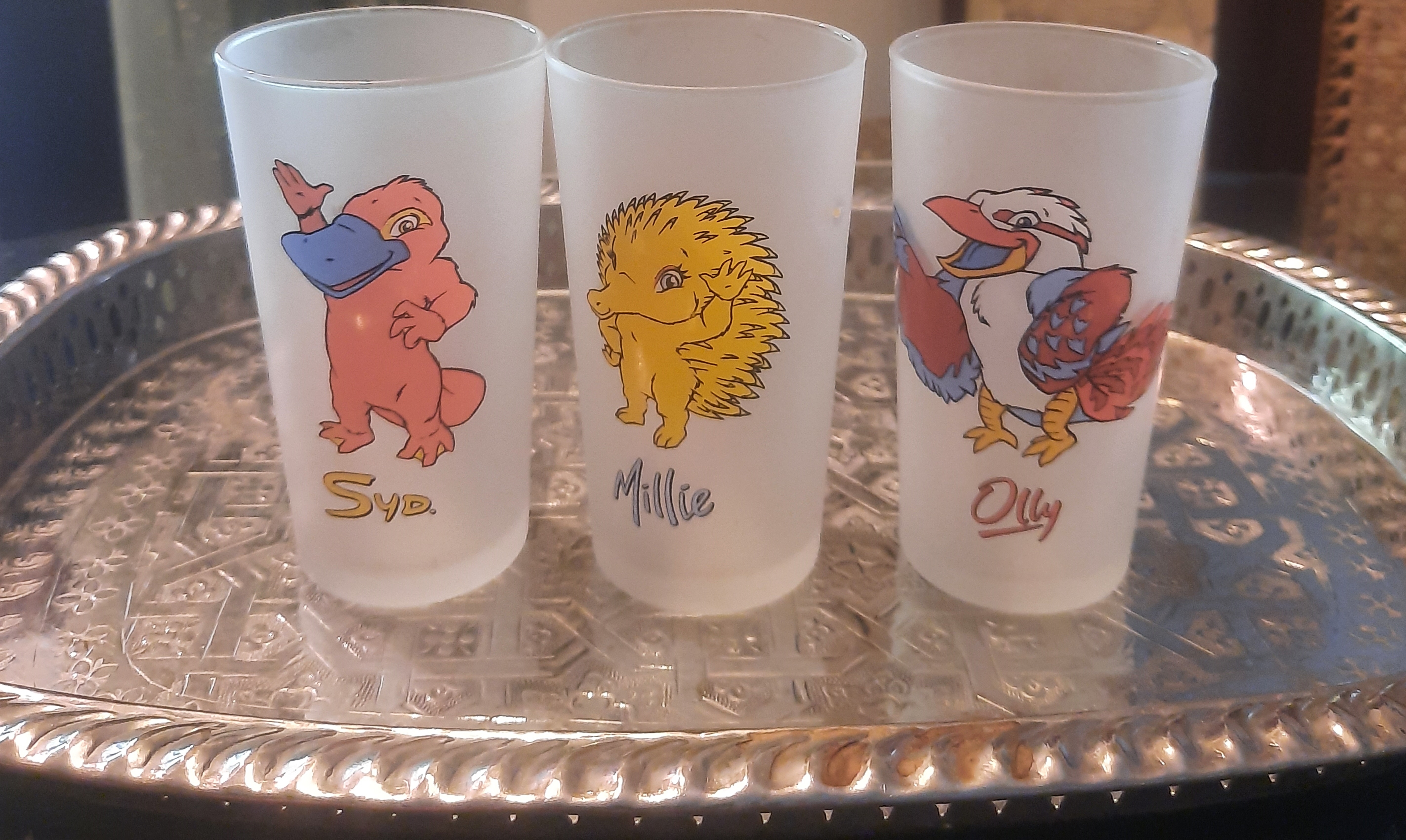
Sydney Olympics Sovernirs
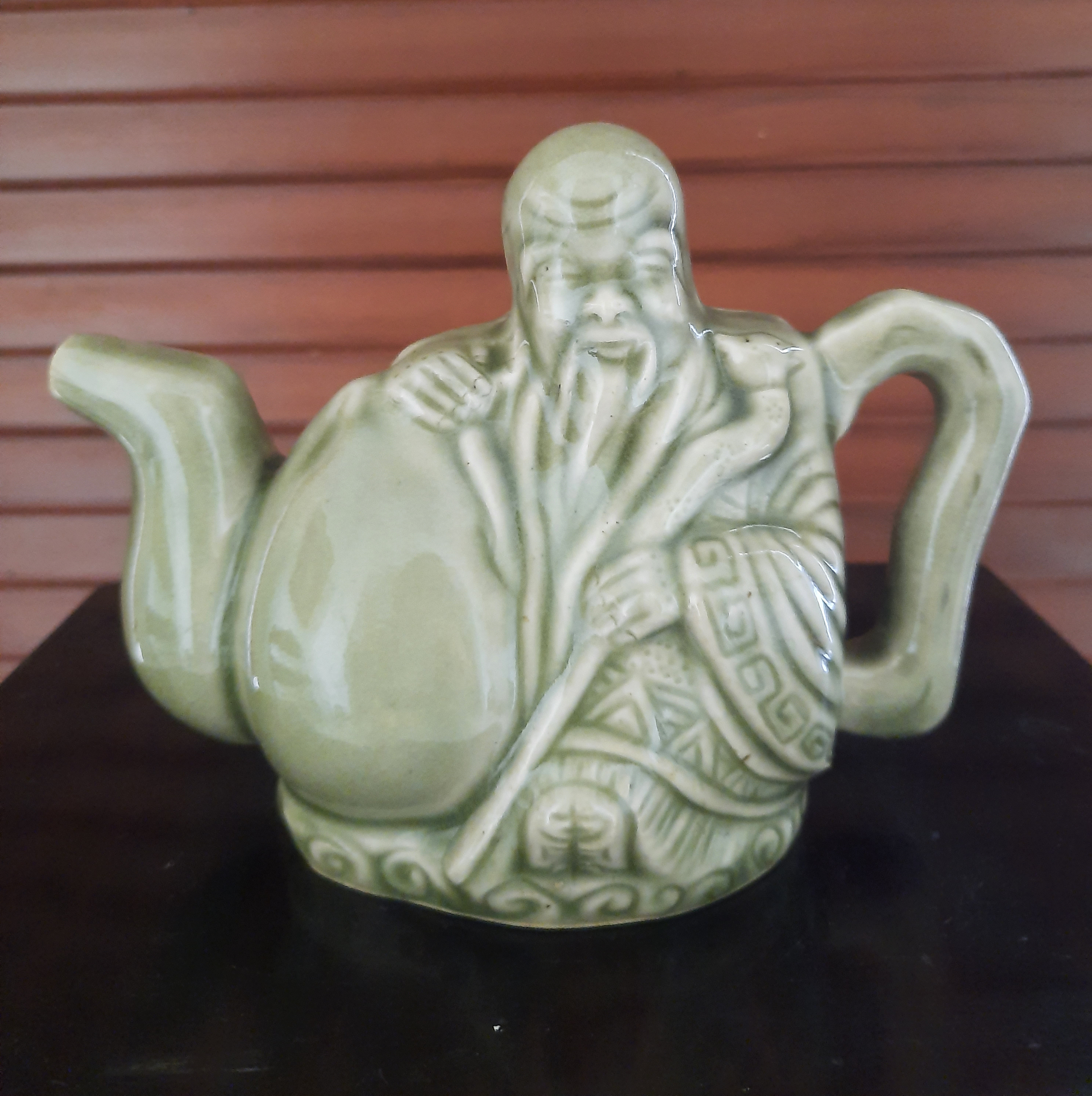
Sovenirs from Sydney Olympics Year!

Since then, the Olympics have featured various animals, birds and objects. Unusual objects have included Schneemandl’  a snowman wearing a red Tyrolean hat (Innsbruck winter Olympics); Magique, a little imp in the shape of a star and a cube (Albertsville); Neve a snowball; Gliz an ice cube (Turin) etc. There are some mascots which are not an animal, nor a human figure, nor an object. One of the most unusual was Wenlock (London 2012) made from one of the last drops of steel used to build the Olympic Stadium in London. The light on his head was similar to those found on London’s famous black cabs. The shape of his forehead resembled the Olympic Stadium roof. His eye was the lens of a camera. He wore five bracelets in the colours of the Olympic rings.

India has not yet hosted the Olympics, but the 1982 Asian Games mascot Appu the Elephant, and the 2010 Commonwealth Games Shera the Tiger, were much beloved. The Phryges follow in this beloved tradition.

So here is to the spirit of the Phryges which aim to show that sport and its values can do great things, and that sports are about fraternity, solidarity and can help society grow.

–Meena


Here Come the Clean-Green Olympics!

This Friday, 26 July, will see the start of the 33rd Summer Olympics. Over the next few weeks, till 11th August, Paris—the main host city, and 16 other cities around France as well as Tahiti, a French overseas island, will see 800 sporting events. With this, Paris becomes only the second city in the world (apart from London) to host the Olympics for the third time. But it is a good long time since the last time it held the Games—a century to be exact!

 The arrangements for the games are aimed at setting new benchmarks for quality, convenience, security and aesthetics. The 4-hour opening event will set the tone. The Paris 2024 opening ceremony will be unique in that it will not take place in a stadium. Instead, nearly a hundred boats will be deployed, which will carry thousands of competitors and other guests on a 6 km scenic route on the River Seine. The boats will be organized by country. Along the way, they will sail by the newly-repaired Notre-Dame Church, several bridges and other Paris landmarks, and will arrive at the Eiffel Tower. The banks of the river will be alive with music, dances and performances woven together into a 12-part show. The speeches and other formalities will all be a part of the overall presentation-experience, as the Games are declared open by French President Emmanuel Macron.  The show will end around 9.30 pm when the sun sets.

Paris Olympics

About 10,500 athletes will participate in the ceremony, which will be attended by about 100 heads of state. There will be over 3 lakh spectators on the banks. 80 giant screens will be put up along the way.

Other unique aspects of the 2024 Olympics:

  • This will be the first Olympics in history to achieve numerical gender parity, with an equal number of female and male athletes– 5250 men and 5250 women.
  • Break-dancing: For the first time break-dancing will be introduced as a competitive event. There will be two events, one for men and the other for women.
  • For the first time in history, the public will be part of Olympic experience! They will be allowed to run the same course of the Olympic marathon on the same day as the Olympians.
  • The marathon swimming event and the swimming leg of the triathlon will be held in the River Seine, as they were in 1900. From 1923 until recently, swimming had been banned in the Seine due to water-quality issues, but the authorities have put in their utmost to clean up the river, and have assured that it is safe.

Most significantly, the organizers have vowed to make these the ‘greenest Olympics’, with efforts to make to make it carbon-neutral, and to cut the carbon footprint of the Olympics in half compared to previous editions. They will try to offset more emissions than the Games create. Some of the steps the organizers are taking include:

  • The Olympics will run on 100% green energy generated from new sources of wind and solar energy, like windmills on the Normandy coast as well as solar panels on the roofs of venues in Paris.
  • The Games will mainly use only existing venues and temporary structures, thereby avoiding the carbon footprint of building new ones. Only two new venues will be built–for aquatics and basketball.
  • There will be no air conditioning in the athletes’ rooms. Instead, buildings in the athletes’ village have been designed with a cooling system drawing water from underground. Moreover, facades have been designed so they get little direct sun.
  • The Village will use 94 per cent recycled materials and a special construction process that emits half as much carbon.
  • After the games are over, the Athletes’ Village will allocate the houses for permanent residences.
  • Athletes’ mattresses will be made from recycled fishing nets, and the base of the beds will be made from reinforced cardboard.
  • Local farms will provide 80 per cent of the 13 million meals served during the Games, thereby lowering emissions.
  • Most Olympic venues will be accessible by public transport, and 1000 km of new cycling lanes have been created. 3000 pay-and-use bikes will be deployed.
  • About 2 lakh new trees have been planted.

Sounds like these Olympics are going to set new benchmarks! Appropriately so, for the motto “Citius, Altius, Fortius – Communiter” or “Faster, Higher, Stronger – Together” is not just about the sports events themselves, but every aspect of the Games!

Here is to the spirit of the Games!

–Meena

From the Botany Textbook to my Backyard

Our biology teacher tried her hardest to fill our brains with all kinds of information about plants, flowers, and creatures big and small. I am not sure how much of it stuck. But Rafflesia arnoldi  was one of the plants that we studied about that all of the students were fascinated with, and I can still recall many details about it.

For after all, a parasitic plant is fascinating isn’t it? Especially when its blooms are the single largest individual flower in the world, and which emit an aroma similar to rotten meat? It is a parasitic plant that grows on vines of the genus Tetrastigma. It has no green photosynthetic tissues, leaves, stems or roots. It essentiallylives inside the Tetrastigma vines as a mass of strands which absorb water and nutrients from the host. It grows out of the host plant’s bark as brown, cabbage-like buds which bloom over several days. The flowers have five lobes, are reddish-brown with white spots, and grow up to 1 m across and may weigh up to 11 kg. The smell of rotten meat they emit attracts insects such as flies and beetles, and this helps in the pollination cycle.

We all dreamt of the day that we would travel to the wilds of Indonesia to see this plant.

Another parasitic plant, which we didn’t realize was parasitic, was the mistletoe. The books we read were generally by British authors, and the tradition of hanging up mistletoe during Christmas and kissing under it drew many a schoolgirl snigger. Readers of Asterix comics would recall Druid Getafix forever up on top of a tree cutting some plants with a golden sickle. This would be the mistletoe which was believed to have medicinal and magical powers. There are many species of mistletoe, which are parasites on a variety of hosts. Some species even parasitize other mistletoes, which in turn are parasitic on a host! Unlike Rafflesia, mistletoes are hemiparasites—they have chlorophyll and can make some of their own food. 

Thanks to all these references, another ambition was to see miseltoe.

I have definitely not seen Rafflesia.

But I have had recent encounters of a mistletoe type in my own backyard.

The parijaat or coral-jasmine tree is the pride of my garden. Come July, the lawn is carpeted with the delicate, fragrant white blossoms with orange stalks. A few months ago, I saw another type of leaf among the parijaat leaves. I took it for a climber, though I could not see where it had originated from. I didn’t pay too much attention. Then I saw a different kind of flower on the tree, and was kind of happy, because these were rather pretty too, and I thought I had two beautiful flowers for the price of one.

But as l looked more closely, I became more and more perplexed. The climber was simply not rooted anywhere! I clumsily clambered up a stool to check out where the branches with the different leaves were originating from. And to my dismay I found that there were knots at various places on the parijaat branches, and each of them sprouted thin branches with these different leaves.

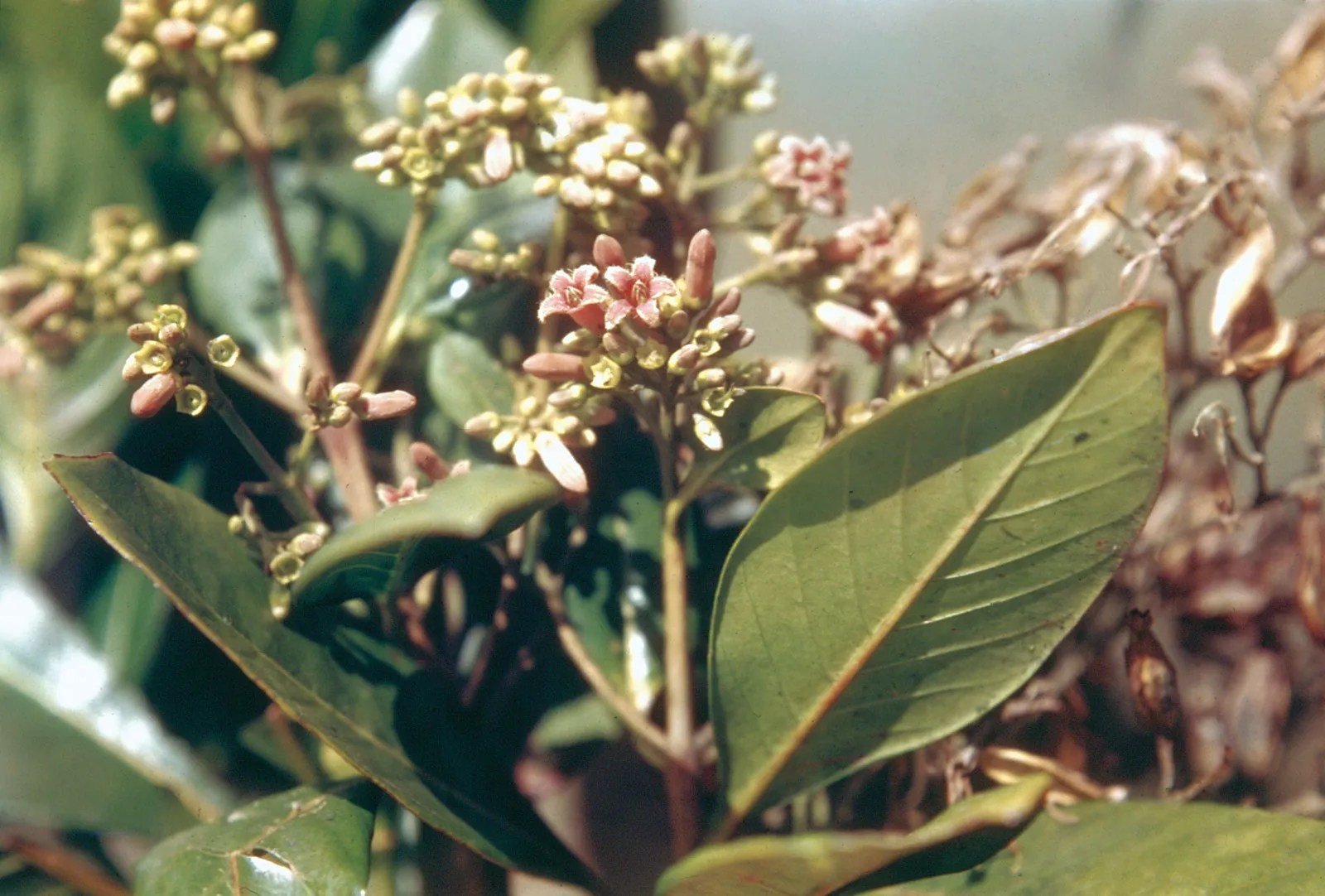
LeLeaves of Night-flowering Jasmine and Loranthus
Leaves of Night-flowering Jasmine and Loranthus

Consultations with experts has finally resulted in the conclusion that my poor parijaat is infested with the parasitic Loranthus. It belongs to Loranthaceae, the showy mistletoe family. So the ambition to see mistletoe has come true, though I am not happy about it!

Some species of Loranthus are parasites on cultivated trees, for example, on mango s, chiku and poplar trees. Though the books don’t say so, they obviously infect parijaat, and are also seen on my neighbour’s anar.

Loranthus grows on the branches and stems of other trees and obtains water and nutrients from the vascular tissues of the host plant.  Birds like sunbirds and flowerpeckers spread the seeds after eating the berries, either by excreting them or wiping off the seeds from their bills, to the branches of neighbouring plants. Seeds germinate and sink parasitic haustorium (an attachment mechanism) into the branches of their host. Secondary haustoria are formed from the same parasitic plant wherever there is a contact with the host.

A parasite takes up the host tree’s water and mineral content and harms the host while the parasite gets benefitted.  While most of these parasites don’t draw enough to kill the tree unless there is a serious drought or other drastic conditions, the host does weaken.

I have had all the branches with Loranthus knobs pruned. Apparently, the huastoria spread quite deep, so fairly drastic surgery had to be performed on some branches.

I think my paarijaat is looking happier!

–Meena

Maze-Amaze

Last week, I was in a shopping area near my house, and got myself lost. Having no sense of direction, any set of streets can turn into a maze for me, and I can get lost hopelessly anywhere!

That is when I started thinking about real mazes. What would I ever do if I got into one? Probably panic and die!

But apparently that wouldn’t happen in a labyrinth. Because though most of us don’t really stop to think about the difference, they are very different! Labyrinths have a single continuous path which leads to the centre, and as long as you keep going forward, you will get to the centre eventually. So given enough time, it is close to impossible for anyone, even me, to get lost in a labyrinth.Mazes on the other hand, have multiple paths which branch off and will not necessarily lead to the centre or to the exit.

Mazes probably evolved from labyrinths, and over time took on elaborate forms including multiple branching paths, dead ends, etc.

The first recorded labyrinth is a 5th century BC one from Egypt. Labyrinths are found in many cultures, and generally seem to have an underlying spiritual meaning.  Some represent spiritual journeys which guide visitors towards a single path, which may be full of twists and turns, but there is no doubt of reaching the goal as long as one is walking on the right path. In some cases, entering the labyrinth signified death and exiting it signified re-birth. They were also fertility symbols. Labyrinths were also thought to represent protection or fortification. Often in temples, forts etc., one can find carvings or paintings of labyrinths on the floor or walls, to represent one of these symbolisms.

Some temples are like labyrinths themselves, and their orientation, form and geometry have symbolic as well as spatial importance. The process of moving through the pathways is supposed to unwind the Kundalini or stored energy, releasing, magnifying, and ultimately harnessing its flow. 

Chakravyuha labyrinth

Many military formations adopted in ancient Indian warfare were labyrinths. The famous Chakravyūha (wheel formation, also called Padmavyūha—lotus formation) of the Mahabharata was one such. It was a very special formation and knowledge of how to penetrate it was limited to only Abhimanyu, Arjuna, Krishna and Padyumna on the Pandavas’ side. The Kauravas strategically diverted the senior warriors to different parts of the battlefield, and then went into the Chakravyuha formation, and succeeded in decimating the Pandava warriors. 16-year old Abhimanyu was there and bravely plunged into the wheel, killing many seasoned Kaurava warriors. Alas, he did not know how to get out of the formation, and at the sixth level, was slaughtered by a horde of Kauravas.   

The Bara Imambara of Lucknow houses a famous Indian maze. Said to be the world’s largest structure that is unsupported by beams, the Imambara is considered a marvel of engineering. The fourth Nawab, Asaf-Ud-Dowhala, commissioned this building during the drought of 1784 to help people in the city earn a livelihood. He invited bids and it was won by Hafiz Kifayatullah, an architect from Shahjahanabad who was already well-known by then. Work on the building started in the 1784 and finished fourteen years later.

The Bhul Bhulaiya or Maze located on the upper floor of the Bara Imambara was Kifayatullah’s masterpiece. It is said that there are 1024 ways of getting inside the maze but only two ways of coming out! Once you enter the maze, you might end up going round and round and up and down staircases without being able to come back. It is even difficult to figure out which level you are at—you could think you have climbed down to the lower floor, but may still be on an upper one!

Interestingly, about 10 years ago, archaeologists uncovered a 2,000-year-old labyrinth that is the second-largest ever found in the country. This is in Gedimedu in Tamilnadu, along an ancient trade route on the east coast of India. It measures 56 feet by 56 feet, with passages ranging from 2.6 feet to 3.6 feet. It follows a pattern similar to Greek mazes found on clay tablets from 1200 BC. Archeologists are still studying the maze.

I am not sure I want to ever go into a maze or labyrinth. I don’t want to be loster than I am!

–Meena

.

Slugs and Snails

Snails: UGGGGG!

Slugs: UGGGGGGGGGGG!

Yes, that indeed is the normal reaction.  Both of these creatures are gastropods, a type of mollusk. They are both soft-bodied creatures which are covered with mucus—and it is this which usually makes people go ‘UGGGG’. But they need the mucous to stop them from drying out.

Gardeners hate them too, because some species of slugs and snails (S&S) feed on live plant material. These species are particularly fond of eating soft fleshy leaves and seedlings. Some slugs which stay underground tunnel holes in potatoes and other tubers. Snails and slugs are sporadic pests in those places where damp conditions prevail.

And yes, there are worrisome trends too. Some species of exotic snails and slugs can destroy native biodiversity and multiply madly. They have no natural predators when they travel out of their native lands, and so thrive.

In India, 1500 species of land snails have been reported, but the number of species of slugs is limited. Of these, nine species of snails and 12 species of slugs are pests, including the Giant African Snail, which is a serious problem with regards to fruits, vegetables and ornamental plants specially in the east, northeast and south; the common snail, Helix spp. ;  the  common garden snail; and the black slug.  

These gastropod-pests are a worldwide problem. For instance, the Giant African Snail is native to East Africa. But it has spread to many, many parts of the world, either by stowing away on ships, or being deliberately brought to other countries for experiments, as pets etc. And wherever it has travelled, it is creating problems– over 500 plant species may be targeted by the giant African snail, including most vegetables, legumes, ornamental plants, banana, citrus, etc.


But wait! Before we condemn them outright, we must understand that slugs and snails are generally beneficent to the environment and have a key role to play in the ecosystems, as they are recyclers, feeding on dead leaves, dung and sometimes even on dead animals. They play a useful role in composting.  And as important, they are an important food source for birds, beetles and reptiles.

Snails and slugs

And in recent years, the fashion world has taken to these gastropods in a big way. Snail mucin and slug slime have become popular in the world of beauty. Gastropod slime has been shown to have many beneficial properties–antibacterial, anti-inflammatory and antioxidant, anti-tumoral, anti-aging, tissue regeneration, wound healing etc. Snail mucin contains antioxidants that may help reduce signs of aging like wrinkles, uneven skin tone and sagging. Studies indicate that snail mucin helps with skin regeneration and protects against damaging free radicals.

And let us also recognize that the seriously devastating snails and slugs are often introduced exotic species. There is never anything fundamentally ‘wrong’ about any species. They fit and have a role in the ecosystem where they have evolved. But a species can be in the ‘wrong place’, and then they can cause devastation.

So yes, it is up to us humans to ensure S&S stay where they belong, and don’t travel.

But there is no doubt people, especially gardeners don’t like them. And this is why a wildlife NGO in the UK, The Herts and Middlesex Wildlife Trust and Royal Horticultural Society (RHS) want to challenge negative perceptions. The  organisers want to create a positive image for snails and slugs by showing people how they contribute to ecosystems. Campaign organisers hope that by learning to “appreciate and co-exist” with snails and slugs, gardeners can adopt a more environmentally friendly approach. The trust, with the RHS, has produced a guide with tips to “live harmoniously alongside slugs and snails”.

And here is some S&S Trivia

Slugging is a slang term for a skin care technique that involves applying an occlusive moisturizer to one’s face, typically before sleep, primarily as a way to prevent moisture loss.

Slugging-it-out is to fight, argue, or compete with someone until one person wins.

Sluggish isbeing lazy and slow.

Sluggish in the computer world is when you use human-readable terms in a URL instead of a database number or some other form. It supposedly originated when programmers became too “lazy” to look up a proper code or ID for a website, and began naming them using words. Those “lazy URLs” became slugs.

And FYI: Snails move at a pace of 0.029 miles per hour, or 153 ft per hour. If we convert that to human speed, that’s the equivalent of walking almost 3.2 km per hour. Not too bad! So in this too, it seems snails are getting unnecessary flak!

S&S are nice fellows. Let’s not blame our problems on them!

-Meena

See also:

https://wordpress.com/post/millennialmatriarchs.com/3209

https://wordpress.com/post/millennialmatriarchs.com/2617

PIC: https://www.medicaldaily.com/snail-slime-touted-latest-miracle-beauty-product-243080

Crabby, Crabby…

At the moment–June 22 to July 22—we are in the zodiac sign of Cancer. The sign is called Cancer from the Greek word for crab. Cancer constellation represents the giant crab that attacked Hercules during the second of his twelve labours. It was sent by the goddess Hera to distract Hercules as he battled the water serpent Hydra. Hercules ended up killing the giant crab with his club. In the skies, the crab constellation is a medium-sized one which has ten suns with their own planets.

Down on earth, crabs are members of the animal group called crustaceans—creatures which mostly live in water, have a hard shell, a segmented body, and jointed appendages. Lobsters, shrimps, barnacles are also members of this group. Crabs have five pairs of legs. The first pair has large pinching claws that help with feeding and defence. Three pairs help the crab walk, and last pair may be broad and flattened to serve as paddles for crabs that swim. Though crabs can walk forwards, they generally walk sideways. This is because they have stiff, jointed legs, and find it easier and faster to walk sideways.

There are at least 7,000 species of crab, and they can be found in all oceans and in fresh water. Some crabs even live on land, often several miles from water. They come in a great range of sizes from tiny pea crabs measuring about 2.5 centimeters across, to the giant crab of Japan which may span over 30 centimeters across and measure 4 meters from tip to tip of its stretched out legs.

Some types, including the blue crab, the Dungeness crab, and the king crab, are often eaten by humans. But apart from their nutritional value to humans, and economic value as a major industry, they play a key role in the ecosystem. They are vital food sources for sea animals. The smaller ones recycle nutrients as filter feeders, and the larger ones serve as food for large aquatic mammals. Terrestrial crustaceans are important because they are decomposers of dead organisms. Small crustaceans eat substantial amounts of algae keeping the plant in check, which helps keep the water clear and ensures that sea-grass beds can access to light and oxygen.

crab
Ghatiana dvivarna

India has about 125 species of crabs. The Western Ghats alone, a biodiversity hotspot, is home to 75 species. A new species was discovered here as recently as 2022.

Belonging to Ghatiana genus of fresh water crabs, the new species is called ‘Ghatiana dvivarna’, the name being a combination of the Sanskrit words dvi (two) and varna (colour). The crab is a beautiful white and red-violet.

All this information is very important. But surely there could be more interesting ways to present it?

That is what the Crab Museum in Margate UK tries to do! This museum’s objective is ‘to roll science, humour and philosophy into a unique and satisfyingly baffling day out’! The founders of the museum believe that ‘“’everyone learns better when they’re laughing’”’, and take a goofy approach to their displays. And it seems to be working! The Museum saw over 80,000 visitors last year, and parents report that their children are more engaged here than in many other conventional institutions.

The dioramas, exhibits, text-labels are all planned with humour in mind, even as they are informing the viewers about crab anatomy, mating habits and the importance of these creatures to marine ecosystems. But the Museum goes further—it uses crabs as an entry point to discussing bigger issues, including environmental issues, climate change, capitalism and colonialism.

Other museums are taking note of these unconventional approaches. As reported in the New York Times, ‘Chris Stringer, of the Natural History Museum in London, said in an email that the museum’s silly approach leads to learning “by stealth.” It “teaches more in a small space and short time than many others with far larger budgets.’

We may not be able to visit the Crab Museum at Margate but crab-lovers can participate in their annual Crab Joke Competition. Last year, there were 700 entries, so the competition is quite stiff. One of the top shortlists was:

Why did the crab get bad grades? Because it was below C level!


Jokes apart, we must be aware that various environmental dangers beset crabs. Research says about one-sixth of all freshwater crab species have an elevated risk of extinction, and there are any number of ‘threats to marine species, including illegal and unsustainable fishing, pollution, climate change and disease’. 

So in this month of Cancer, let’s spare a thought for crabs and their well-being.

–Meena

Pic acknowledgement: TOI

Juneteenth

That is not a word that we in India are very familiar with. Not surprising. Though the ‘Day’ is about a historical event that took place over 150 years back, it officially became a federal holiday in the US only in 2021.

It goes back to the American Civil War. After the Union won, President Abraham Lincoln issued the Emancipation Proclamation which declared the over three million enslaved people living in the Confederate states to be free. However, those were not the days of instant communication. It took over two years before the news reached the people of Texas! It was when Union soldiers arrived in Galveston, Texas, on June 19, 1865, that the state’s residents finally learned that slavery had been abolished. The formerly enslaved African-American community immediately started celebrations with prayer, feasting song, and dance. Over time, the name ‘Juneteenth’ a portmanteau of the words “June” and “nineteenth” started being used for this day.

Since then, the day has been celebrated in Texas, with the first official Juneteenth celebrations held on June 19, 1866, marked by prayer meetings and the singing of spirituals. People wore new clothes as a way of marking their newfound freedom. Over the next few years, African-Americans in other states started celebrating the day as well, making it an annual tradition. Celebrations continued to spread across the United States and typically include prayer and religious services, speeches, educational events, family gatherings and picnics, and festivals with music, food, and dancing. Juneteenth became a state holiday in Texas in 1980, and a number of other states subsequently followed suit.

It still took a long time for it to be recognized at the national level. It was only in 2021 that Juneteenth was made a federal holiday. Activist Opal Lee played a huge part in making this happen. Born in 1926 in Texas, Opal Lee was a teacher. One of the formative events of her life was when her house was burnt down in 1939. The house was in a predominantly white area, and obviously, the fact that a black family had bought a house there was uncomfortable for some people. On June 19, 1939, 500 white rioters vandalized and burned down the home. Opal realized that 19 June had been chosen for a reason and was very symbolic.

Opal was always at the forefront of organizing the community, and played a lead role in Juneteenth celebrations. This gathered momentum when she retired, and she became a relentless campaigner for having Juneteenth declared a federal holiday. For many years, she organized a march of 2.5 miles, to represent the 2.5 years it took for the news of their emancipation to reach the African-Americans in Texas. She promoted a petition for a Juneteenth federal holiday at Change.org, and the petition received 1.6 million signatures. In 2021, when Opal was 94, her dream came true and President Biden finally signed the Bill. Opal was an honoured guest at the function. Slowly, over time, the day started being celebrated outside the United States too, to recognize the end of slavery and to honor the culture and achievements of African Americans.

Here is something that Lincoln wrote about slavery, which is worth pondering:

If A. can prove, however conclusively, that he may, of right, enslave B. — why may not B. snatch the same argument, and prove equally, that he may enslave A?–

You say A. is white, and B. is black. It is color, then; the lighter, having the right to enslave the darker? Take care. By this rule, you are to be slave to the first man you meet, with a fairer skin than your own.

You do not mean color exactly?–You mean the whites are intellectually the superiors of the blacks, and, therefore have the right to enslave them? Take care again. By this rule, you are to be slave to the first man you meet, with an intellect superior to your own.

But, say you, it is a question of interest; and, if you can make it your interest, you have the right to enslave another. Very well. And if he can make it his interest, he has the right to enslave you.’

And to see how he relates it to democracy:

‘As I would not be a slave, so I would not be a master. This expresses my idea of democracy. Whatever differs from this, to the extent of the difference, is no democracy.’

Wise men know how to capture universal truth in a few words!

–Meena

AJT Johnsingh: The Highest Standards of Wildlife Research

A few days ago came the sad news of Dr. AJT Johnsingh’s passing. And for once, mainstream media covered this event—from AIR to Times of India to Hindu to several other national and regional papers. 

For media to so widely cover the passing of a wildlife researcher is sure indication that there was something special about him. And indeed there was.  He was one of India’s best and most respected field researchers. And even more, he put all that knowledge into practice in conservation.  He strongly believed that knowledge should not lie in books, but be used to develop better policies and practices to support conservation on the ground.

Born to teachers who were both nature-lovers and outdoor people, he grew up in a small town called Nanguneri in Tirunelveli district of Tamil Nadu. His parents encouraged him to be outdoors, and family outings generally meant picnics in the wilderness areas of the Western Ghats. They were early and important influences in his love for nature. Another source of inspiration was Jim Corbett, whom he read avidly when young, and whose approach to conservation he admired—it was an approach that was unsentimental, and doing what needed to be done, extending to killing maneaters when there was no other way out.

JC Daniel of BNHS whom he first met when trekking up in the Kalakad hills in 1971, and who mentored him at various stages in his career, was a great influence.  George Schaller,  American mammalogistbiologistconservationist and author recognized by many as the world’s preeminent field biologist, studying wildlife throughout Africa, Asia and South America, was a role model for Johnsingh.

AJT went to St. Xavier’s College, Palayankottai, and then Madras Christian College, Tambaram. He started his career as a professor at Ayya Nadar Janaki Ammal CollegeSivakasi, He worked as a postdoctoral fellow at the Smithsonian Institution in Washington, D.C. He returned to India in 1981 to work with the Bombay Natural History Society. In 1985, he joined the faculty of newly-established Wildlife Institute of IndiaDehradun, and helped shape this premier institute which has developed the cadre of India’s current wildlife professionals. He retired as the Dean WII in 2005. In this period WII trained over 300 managers and several M.Sc Wildlife and PHD students.

He was the first Indian to carry out field research on free-ranging large wild mammals. He focussed particularly on the dhole (wild dog) in Indian forests. His research in the early years focused on the ecology and prey-predator relationships of dhole, other carnivores and ungulates in Bandipur National Park. His interest and research covered several large mammals, and his knowledge of many species saw him on the IUCN Asian Elephant Specialist Group, as well as the Cat, Canid, Bear, and Caprinae Specialist Groups. He also researched the Mahseer fish.

Tigers also fascinated him. He is credited with having taken the first good photo of a tiger in Bandipur. Talking about this photo in an interview to Sanctuary, he said: ‘ For years, no one had been able to take a clear picture of a tiger in Bandipur. Because my dhole study area was littered with tiger spoor, I always carried a camera around ‘just in case’. On May 23, 1978, around 7 a.m., I was sitting eight metres up on a mango tree in the Ministerguthi nullah, which was frequented by tigers whose pugmarks could easily be seen and whose spray markings, I could smell. I sat for around 45 minutes, barely breathing when a movement in the tall grass caught my eye. The tiger walked towards a clearing right in front of me and when it reached a patch of sunlight, I whistled and with a perplexed look on its face, it froze staring straight at me. But the moment it heard my camera shutter, it vanished. Interestingly, I cannot stop smiling whenever I see this picture.’

He authored several research papers, but what got him know widely across the general public where his three popular books: ‘Field Days: A Naturalist’s Journey through South and Southeast Asia’ (2005), ‘Walking the Western Ghats’ (2015) and ‘On Jim Corbett’s Trail and Other Tales From the Jungle’ (2018). He also edited two volumes of The Mammals of South Asia which in total has 69 chapters.

AJT was decorated with many honours including the Distinguished Service Award by the Society for Conservation Biology, the Carl Zeiss Wildlife Conservation Award, the ABN AMRO Sanctuary Lifetime Wildlife Service Award, ‘Kirloskar Vasundhara Sanman’ and Salim Ali Conservation Award.

The government also respected and valued his expertise. He was on the Standing Committee on the National Board for Wildlife, Government of India, and served for three years as a member of the National Tiger Conservation Authority. He was also a Padma Shri awardee. His voice, opinion and work contributed to the creation of wildlife areas including the Kalakkad-Mundanthurai Tiger Reserve.

We at CEE had the opportunity to interact with Dr. Johnsingh on different occasions when we sought his expertise on various projects. Two in which I was personally involved where he was on the Advisory Committee were the Snow Leopard Education project, and the ‘School Education to Support Asian Elephant Conservation’ project. In the days prior to Zoom and video calls, we could not get into discussions with him, but sent him drafts on which he gave his insightful comments.

The conservation world and India have lost a unique researcher and spokesperson who had the knowledge and courage to speak out, and the stature to be listened to. As a message from his family puts it: ‘The Green Warrior has landed safely in his Valhalla, after a war well fought, to save mother nature, for all mankind.’

And to end with a quote from him which underlines the spirit behind his research: “I used to ask questions about wildlife that no one could answer. So I began to search for answers myself by observing animals. Curiosity is the greatest trigger for good science.

RIP, Dr. AJT Johnsingh.  Your passing is personal loss to your family and friends, and as great a loss to the wildlife and environment you worked so hard to protect.

–Meena

.

Shady Environment-Talk

June 5: Marked as Environment Day across the world since 1973.

The world has come a long way since the time in 1972 when such a day was mooted. Not only in terms of becoming more aware about the environment and taking action, but also in terms of the planetary boundaries being pushed to the brink through not taking enough action!

With the environment being such a widely talked-about issue, every actor—governments, businesses, civil society– have taken these issues on board.

Which is very good.

Till it is not.

The ‘till it is not’ includes corporates and other entities passing themselves off as environmentally or socially friendly when they are not. How do they do this? Here are a few terms that are used in the context of the many, many shades of these tricks:

  • Green Washing is undertaking misleading promotion of products or policies as environmentally friendly when in reality, they are not—often exaggerating the benefits while hiding the true or non-existent environmental impact. Common and insidious, such examples may range from misleading ads, to misleading recycling claims, to unverifiable carbon footprint claims, and every PR stunt in the book.
  • Blue Washing, indulged in by some of the largest corporations across the world, is the practice of businesses to sign up for the UN Global Compact and use their association with the United Nations to enhance their image and shift attention from their controversial business practices.
  • Carbon Washing is when companies make misleading or unsubstantiated claims about their carbon impacts or initiatives.
  • Social washing is similar to green washing, but in the context of being socially conscious–corporations wrongfully trying to market themselves as socially responsible.
  • Purple Washing is when a state or organization appeals to women’s rights and feminism in order to deflect attention from its doing nothing, or in fact actually harming these rights. 
  • Pink Washing is when companies try to create a false impression of being LGBTQ friendly while doing nothing to make life for their LGBTQ employees easier.
  • Rainbow Washing is similar to the above, when corporations use the rainbow symbol or colours, while being involved in activities that are damaging to LGBTQIA+ community 
  • Vegan Washing is when companies promote their products through appeals to compassion for animals, while actually causing animal suffering

Of recent times, the vocabulary of Green Washing has got even more nuanced! Here are some subtle variations:

  • Green Shifting: This is a subtle move, wherein companies highlight consumer choices, thus transferring responsibility to them, rather than highlighting their sustainability efforts.
  • Green Lighting: This trend is about corporations highlighting a particularly environmentally friendly aspect of their operations, in an effort to divert attention from less sustainable practices elsewhere in the company.
  • Green Rinsing: This involves businesses frequently changing ESG targets without genuine accomplishment, thereby making it hard for stakeholders to track their progress.

The UN warns about the seriousness of the harm that Green Washing (and allied colour-washes) can cause. In the context of climate change, the UN points out that: ‘Greenwashing presents a significant obstacle to tackling climate change. By misleading the public to believe that a company or other entity is doing more to protect the environment than it is, greenwashing promotes false solutions to the climate crisis that distract from and delay concrete and credible action.’

They identify many tactics of green washing including:

  • :‘Claiming to be on track to reduce a company’s polluting emissions when no credible plan is actually in place.
  • Being purposely vague or non-specific about a company’s operations or materials used.
  • Applying intentionally misleading labels such as “green” or “eco-friendly,” which do not have standard definitions and can be easily misinterpreted.
  • Implying that a minor improvement has a major impact or promoting a product that meets the minimum regulatory requirements as if it is significantly better than the standard.
  • Emphasizing a single environmental attribute while ignoring other impacts.
  • Claiming to avoid illegal or non-standard practices that are irrelevant to a product.
  • Communicating the sustainability attributes of a product in isolation of brand activities (and vice versa) – e.g. a garment made from recycled materials that is produced in a high-emitting factory that pollutes the air and nearby waterways.’

The UN urges us all to be more responsible by:

  • Learning more about green washing techniques so that we are more discerning
  • Make better consumer choices by buying only from companies whose green claims have been substantiated
  • Taking into account a product’s lifecycle and its environmental impact through every stage of making, use and disposal.

This Environment Day, let’s become better watch-dogs for the environment by getting more savvy about this colour palatte!

–Meena