Updating Anthems

In this week of Republic Day, the tune of our national anthem and other patriotic songs are all around us. Without them, the mood cannot be built. Singing the national anthem together with neighbours, community, colleagues, fellow-students—there is nothing more symbolic of our oneness.

Anthems in general are rallying cries, rousing or uplifting songs identified with a country, section, cause etc. A national anthem is a solemn patriotic song officially adopted by a country as an expression of national identity.

These songs are our identity. But just as in so much else, should they change as contexts and realities change?

Well, five countries have taken the bold step of changing their anthems in recent years.

Australia: On Jan 1, 2021, Australia’s national anthem, “Advance Australia Fair,” underwent a significant change. The phrase “For we are young and free” in the second line was changed to “For we are one and free.”  This is an effort to respect the Aboriginal and Torres Strait Islander peoples, recognizing that Australia’s history precedes European settlers tens of thousands of years. It is a symbol of Australia’s commitment to unity and reconciliation with Indigenous population.

Austria: Austria’s national anthem is “Land der Berge, Land am Strome” (Land of Mountains, Land by the River). The language was reviewed and modified to promote gender inclusivity in 2021 . The original lyrics which referred to “great sons,” was changed to “great daughters and sons.”

Canada: In 2018, Canada made a significant and widely-welcomed change to its national anthem “O Canada” in 2018. The line “in all thy sons command” was changed to “in all of us command.” was changed to “in all of us command”, again an effort for gender-inclusivity.  

South Africa: Like the nation itself, South Africa’s national anthem is unique. It combines lines from several different languages and songs, including the hymn “Nkosi Sikelel’ iAfrika” and the former anthem “Die Stem van Suid-Afrika.” In recent times, small changes have been made to the anthem with the purpose to ensure proper pronunciation and inclusion of all languages and honour the linguistic heritage of all its people.

New Zealand: In 1977, the Government announced that New Zealand would have two national anthems — the traditional anthem ‘God Save The Queen’ and the poem ‘God Defend New Zealand’. Since then, both the anthems have had equal status. Following the accession of King Charles III to the throne in 2022, the words of the first anthem changed to ‘God Save the King’.

The latest change in a national anthem is not for a change of words but of the tune. In January 2025, Saudi Arabia has asked Hans Zimmer (Oscar-winning composer of the Lion King, Dune etc.) to create a new version of its national anthem, Aash Al Malik (Long live the King)!

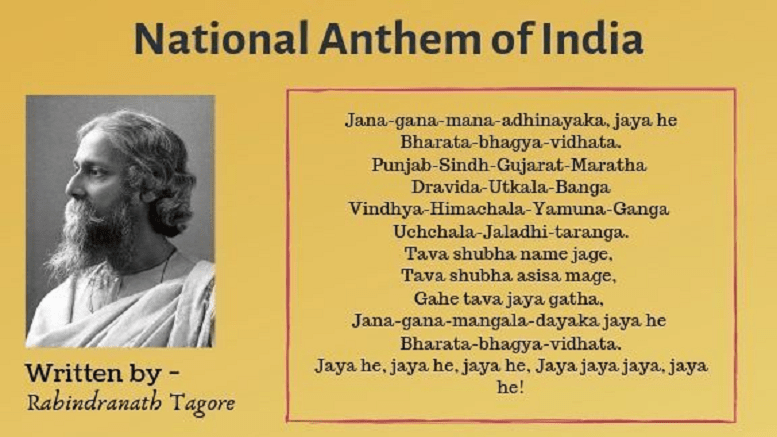
Our anthem Jana Gana Mana (‘[Ruler of] the minds of the people’) was  composed as “Bharato Bhagya Bidhata” in Bengali by  Rabindranath Tagore on 11 December 1911. The first stanza of the song  was adopted by the Constituent Assembly of India as the National Anthem on 24 January 1950, the same day as the Indian Constitution was signed. (Mamata has dwelt on this at length in post last week).

There have been a few proposals to change/add/delete words and phrases. For instance, to add the name ‘Kamrup’ to make the anthem inclusive of the Northeast; or remove the name ‘Sind’ because it is no longer in India. The word “Adhinayak” has also been controversial,  because it was used to praise King George V in 1911. In 2019, there was a bill moved in the Rajya Sabha, to modify the third line to ‘Punjab Sindh Uttarpurv Gujarat Maratha’, to bring in the Northeast. However,  the Supreme Court has struck down all of these.

While tampering with sacred traditions is always fraught, there does seem to be sense in these suggestions, and maybe we need a debate on this. After all, the essence of democracy is debate, and this seems a worthwhile one!

Happy Republic Day!

–Meena

Thanks: http://www.vanguardngr.com

Hussain-Doshi Gufa

I was recently on a nostalgia trip to Ahmedabad, visiting/re-visiting haunts of yore. One of these was Ambadvad ni Gufa (Hussain-Doshi Gufa for old-timers like me). This is an underground art gallery where both the structure and ‘contents’ are works of art

Born of a collaboration between the renowned architect Balkrishna Doshi and MF Hussain, it exhibits works of MF (Maqbool Fida) Husain, in a unique structure designed by Doshi. It is and unusual juxtaposition of architecture and art—a situation where a work of art contains works of art.

Hussain and Doshi both belonged to and loved Gujarat, and hence the decision to create a permanent structure in Ahmedabad which could showcase both their work.

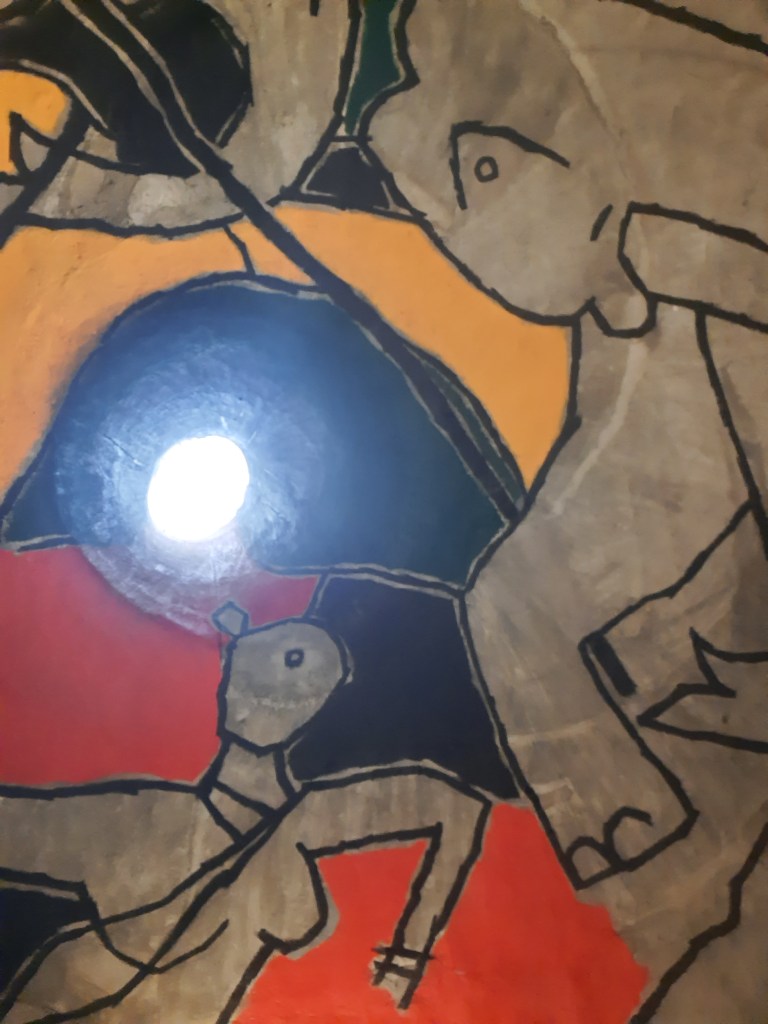
The underground gufa (cave) has a roof made of multiple interconnected domes which are covered with a mosaic of tiles. As one descends a not-so-obvious staircase, the inside opens up. It has irregular and inclined tree-like columns supporting the domes. The roof and walls are painted by Hussain. Light enters the cave though snouts, creating spots of light on the floor. The lighting is thus very different at different times of the day, and creates a mystique of its own. The cave spans across 1000 square metres.

The inside walls serve as a canvas, on which Hussain painted with bold strokes and in bright colours. There are depictions of human figures and animals, including of course, his iconic horses. The idea was to recreate ancient cave-type paintings in a modern environment. A few metal sculptures of human figures are also placed in the niches between the columns.

However, the largest artwork is on the mosaic outside surface of the gufa. This is a depiction of the Sheshnag (divine serpent), winding across the surface over a length of 100 feet, and is visible at eye-level as one walks past the structure.

The Gufa is considered a milestone in collaborations across disciplines. When Hussain visited Ahmedadab once, he asked Doshi, who was a close friend, to design a permanent art gallery for his works. Doshi said he would design something unique but Hussain would need to rise to his structure in his artwork! The planning was a process of interplay of ideas.

The objective was to develop something contemporary, but based on ancient design ideas, and in sync with the natural environment.

Given Ahmedabad’s high temperatures, it was designed as an underground structure. The white porcelain mosaic tiles covering the outside reflect sunlight and reducing the heat reaching the inside of the structure. The Buddhist caves of Ajanta and Ellora inspired Doshi to design the interior in the form of circles and ellipses. The domes are inspired by tortoise shells (kurma avatar) . The mosaic tiles on the roof are similar to those on the roofs of Jain temples at Girnar. Hussain’s wall paintings are inspired by Palaeolithic cave art, and serpent by the Seshnag of Hindu mythology.  The interior columns resemble columns at Stonehenge.

The Gufa has been attacked and vandalized several times—ironic for something designed as a syncretic work. In the very first attack on October 11, 1996, Bajrang Dal activists damaged 23 tapestry items and 28 paintings which were on display. The excuse for the attack was Hussain’s depiction of Hindu goddesses.

What is nice today is that there is a lively café around it, and young people throng the place. The Gufa is a part of a cherished hangout. They look on to the mosaic domes and the Sheshnag as they munch on their snacks and sip on their iced tea. And hopefully, through the process, imbibe an appreciation of the art so close to them, and moved to cherish both the art and the spirit behind the work.

–Meena


High in the Sky, Celebrating the Sun

Today is Makar Sankaranthi. It marks the day the Sun starts moving from the South to the North, and coincides with its transition from the zodiac of Sagittarius (dhanu) to Capricorn (makara). Dedicated to the Sun, the day is observed across India in many different ways, but all signifying thanks-giving and a new beginning.

Kite-flying marks the day, especially in Gujarat. The sky is full of colour, with myriad shapes and sizes of kites, and fierce battles to bring down opponents’ kites.

Since media is full of reports of kites, kite-festivals and other sundry related topics, I thought I would mark Sankaranthi by writing about another flying object which is used to denote joy and celebration—balloons!

Definitionally, a balloon is a flexible membrane bag. It is inflated using a gas. At the most basic level, it is about filling it with as much air as our lung-power allows.  But otherwise, a range of gases is used– helium, hydrogen, nitrous oxide, oxygen etc. Balloons can also be filled with smoke, liquid water, small solids like sand, flour or rice.

Though in everyday life, we go out to buy balloons for birthdays, parties and events, the rubber balloon was invented for scientific experiments by the great scientist Michael Faraday in 1824. He came out with these for use in the lab for experiments with various gases.

Even today, apart from their use in fun and games and as decoration, more serious uses include meteorology, medical treatment, military defence, or transportation. The fact that a balloon is low cost and has a low density, makes it useful in several situations.

The use of balloons for decoration has extended into balloon modelling or balloon twisting where special balloons are twisted into various shapes, often animals, by artists called twisters, balloon benders or balloon artists. 

Balloon or Inflatable Art museums and exhibitions too dot the world. Artists who work with this medium are fascinated with the concept of how the air element can fill various shapes. They translate this fascination into installations, inflatable sculptures, interactive and digital artworks.

Prime among these is Balloon Museum– a curatorial team that designs contemporary art exhibitions with specific works in which ‘air’ is a distinctive element. Their ‘The Pop Air Tour’, with the tagline ‘Art is Inflatable’ has been travelling across Europe. It has several immersive exhibits: ‘A Quiet Strom’ in which infinite white spheres fall to the ground, as tiny soap bubbles caress the audience. ‘Aria’, a ‘digital interpretation of inflatable art in which the visitor finds himself enveloped, in a tight space, surrounded by a multitude of balloons lost in the sky, involving visitors in the journey through the metaphysical experience of suspension. This exhibit like many others has immersive sound design ‘intended to bring back in sound the sensations created around the visitors with the same intensity and depth of a breath taken miles high with the unique intention of experiencing a space without limits.’ Apart from these serious exhibits, there are also fun ones like  the independent inflatable maze, and The Goof — an entourage of inflatable Monsters that are taking over the world, but how they got here and what their motives are is unknown! 

The US has its share of Balloon Museums, including the Anderson Abruzzo International Balloon Museum Foundation with a ‘mission to uplift’!

So this Sankaranthi, let us be uplifted along with the kites (or balloons), pay homage to the Sun, and wish for a healthy, happy, prosperous year for all!

–Meena

Contested Hedges

Contested borders are in the news every day. You can’t miss the claims and counter-claims between neighbouring countires—in our case, mainly China.

But it seems that disputes between neighbours on humble garden hedges are as serious. In the UK, disputes between neighbours on this issue have even resulted in deaths, with one Mr. Wilson of Lincolnshire, dying from gunshot wounds sustained during an argument over hedges, and a Mr. Reid dying of a heart attack after a heated dispute with his neighbour on the same subject. While not so drastic, many people have been levied stiff fines on the charge of trespass for cutting their neighbours’ encroaching hedges. In all, there were 1,00,000 hedge disputes in the UK prior in 2003.

Why do these disputes arise? A major reason is that the hedge blocks too much light to a neighbour’s house or garden; or that the hedge blocks a view. Or a neighbor’s overgrown hedge may encroach on your property. Also, branches or roots may cross into your property from a neighbor’s property or a public road.

This serious situation led to the passing of laws to manage the situation. In 2003, UK passed laws to manage disputes related to hedges. The UK Law essentially is about ‘high hedges’ defined as those over 2 meters in height. Transgressions of hedge-related law come under the definition of Anti-Social Behavior, since 2003!

The situation is understandable, given the extent of hedges in the UK. Laser scanning has shown that the UK has 390,000 km of hedges and hedgerows (1-6 metres tall) on field boundaries– enough to go round the world almost 10 times.

A step back. What is a hedge? A hedge is a line of shrubs (and occasionally trees), planted closely (3 feet or closer) which form a barrier or mark the boundary of an area, such as between neighbouring properties. Hedgerows on the other hand are hedges used to separate a road from adjoining fields, or one field from another, and which may incorporate larger trees. Apart from demarcating boundaries, hedges and hedgerows may serve as windbreaks to improve conditions for crops, as. A hedge is also called a “live fence”.

Under the UK Law, these disputes don’t go to court. Neighbours are encouraged to reach negotiated settlements. If this does not work, a written complaint may be given to the local Council, which will look into both sides of the argument and give a decision. Either the Council will reject the complaint, or they will give an order to cut the hedge to the mandated height. The cutting has to be done keeping in mind The Wildlife and Countryside Act 1981 which makes it an offence to destroy any bird’s nest that is either in use or being built!

Few other countries have such elaborate laws on the subject. However, some local authorities in the US do regulate the height or placement of hedges. For example, a resident of Palo Alto was arrested for allowing her xylosma hedge to grow too tall.

So go ahead. Do grow your Photinia, Duranta, Golden Cypress, Nerium, Hibiscus, Copper Leaf, Ixora, Tecoma, Vilayati Mehendi or whatever else takes your fancy. But make sure they don’t inconvenience your neighbours and get your behaviour labelled as anti-social—at least under the UK laws!

If everyone could plant hedges and learn to maintain them with discipline, maybe we will also learn to manage other boundary disputes without resorting to violence.  It could make for a world where boundary disputes become a thing of the past!

–Meena

Doomsday Book

No, not a book with dire predictions for 2025 aka Nostradamus, Baba Yaga etc.

The Domesday (or Doomsday) book is the 1200+ year survey record! Covering most of England and parts of Wales, it was commissioned by William the Conqueror. The survey started on Christmas of 1085 (exactly 939 years ago!) and was completed in1086. It is the oldest government record held in The National Archives of the UK.

It is an amazing piece of work, in that it surveyed almost every property in England and Wales. Using a fixed format, the survey tried to elicit who owned which property, who lived there, the livestock, how much the land was worth etc. It traced the history of the property—who had owned it before the time of William the Conqueror and who owned it now.

The whole purpose was to ensure that the King had a record of how much land was owned by whom, and therefore how much tax could be charged! It provides definitive proof of land rights and tax obligations, making it a crucial legal document even today. It covered over 13,000 places. Not only was it a foundational document for land rights, it also the socio-economic landscape of 11th-century England.

But why on earth was it called the Doomsday Book? This evolved from its association with the Last Judgment (or Doomsday). The book was the last word–once recorded, its contents could not be contested! It was the source of evidence of land titles, and hence served as a legal reference for resolving disputes over land ownership. It was the final arbiter!

Data collection for the Book was monumental for its time. Royal Commissioners travelled across the kingdom, collecting information from local juries composed of nobility and citizens convened for the purpose. These people swore in court to give correct and accurate information to the Commissioners.  They answered several questions including:

  • Who owned the land.
    • How much land there was.
    • The value of the land.
    • The number of tenants and their obligations.
    • Livestock counts.
    • How many plough teams.
    • How much wood, meadow and pasture.
    • How many mills and fisheries.

The responses gathered by the juries were meticulously recorded in Latin by one set of scribes, and checked by a second set. The data was probably cross-verified with other records and follow-up inquiries.

The information was recorded in two books—The Great Domesday, and the Little Domesday (covering different geographies). Each is arranged by county, and within each county, by landholder. Each landholder is given a number, which is written in red in roman numerals as the heading of their entry. There is a table of contents at the beginning of each county, which lists the landholders with their numbers.

The Doomsday Book is not a census of the population, but has influenced surveys and censuses down history. The Indian census is considered a model for gathering reliable data across a large country (not of course land ownership—that is a problem yet to be cracked).  The Doomsday Book has probably also influenced our census indirectly.  Hopefully, we will have our long-delayed census in the coming year—aided by smart phones, tabs and the like. Let us hope the information collected is as authentic as the Doomsday Book managed.

In 1789 Benjamin Franklin said, ” In this world, nothing can be said to be certain, except death and taxes.” The Doomsday Book was indeed proof of that!

So here is to a Happy 2025, even though we will still have to pay our taxes!

–Meena

nationalarchives.gov.uk

Pic: Historic UK

Merry Christmas with Amigurumi

Tis the season of good cheer and brotherhood.

Of celebrations and togetherness.

Of Christmas trees and ornaments.

And this last is what we are talking about today.

Photocredit: amigurumi.com

The tradition of decorating trees with ornaments is thought to have originated in Germany in the 1800s.  An enterprising gentleman by the name Hans Greiner began making glass ornaments called baubles for hanging on trees. These were the first mass-produced Christmas ornaments and were a huge commercial success.  Woolworths was the first company to import these types of decorations into the United States in 1890, from where  the custom spread to other parts of the world.

Common ornaments include globe ornaments, angels, egg ornaments, figurines, snowflakes, icicles and stars. They are made from a variety of materials, including glass, plastic, porcelain, metal, wood, and expanded polystyrene

A trend that has been popular in recent years is amigurumi Xmas ornaments. If like me, you haven’t a clue what this is, amigurumi is the art of creating crocheted or knitted stuffed creatures and objects, which has its roots in Japanese culture.

While the exact origins are not clear, it is believed to have developed from multiple influences over time. Japan has a long history of hand-made dolls and toys, such as “temari” (decorative balls made from thread) and “daruma” dolls. Amigurumi probably grew from these traditions. During the Meiji period (1868-1912), European knitting and crochet techniques were introduced to Japan and became popular. Japanese crafters combined these techniques with their traditional doll-making skills to create amigurumi,which comes from the Japanese words “ami” meaning crocheted or knitted, and “nuigurumi” meaning stuffed doll.  

Amigurumi grew more popular in Japan in the post-World War II era. As the country’s economy grew stronger, it led to increased income and leisure time, and a resurgence in crafting hobbies. It was during this time amigurumi gained recognition as a distinct art form.

A major impetus to the growth of this craft was the rise of “kawaii” culture. This Japanese aesthetic emphasizes cuteness and adorableness—think Hello Kitty.  Amigurumi lends itself to the creation of cute, whimsical, and anthropomorphic designs and hence appealed to the kawaii aesthetic.

Internet and social media brought amigurumi international attention and today, amigurumi enjoys a global following including in its use as Xmas ornaments. Amigurumi angles, cherubs, stars, elves and reindeers decorate trees across the world. Many people take pride in crocheting or knitting figures either on their own or with the help of popular amigurumi kits which include patterns, instructions, wools and needles.

A popular Xmas tree ornaments also rendered in crochet, which we are not very familiar with in India, is the Christmas Pickle. This is an American tradition. A decoration in the shape of a pickle is hidden on a Christmas tree, with the finder receiving an extra gift. It is also thought that he or she will enjoy good fortune for the next year. (While for us Indians, a pickle brings thoughts of mangoes and limes, in the West, it is often a cucumber, and that is what Christmas Pickle ornaments represent).  

The origin of the Pickle ornament is not known. Americans think it came from Germany, but Germans have no clue about this tradition. But here is one story: During the American Civil War, Bavarian-born Private John C. Lower had enlisted in the Pennsylvania Infantry. He was captured in 1864 and taken to the prison camp. On Christmas Eve he begged a guard for a pickle because he was starving. The guard provided the pickle, which Lower later credited for saving his life. After returning to his family in Bavaria, he began a tradition of hiding a pickle on their Christmas tree each year.

Even if it is not true, it is surely a story that captures the Christmas spirit!

Christmas wishes, Peace and Goodwill among all!

–Meena

The Ultimate Flower-Clock

Wouldn’t it be beyond-beautiful if we had a clock which did not tell time by mundane numbers and needles, but by a particular flower blooming? Imagine if you peeped out of the window and you could look at this clock, and tell if it was 12 noon, or 1 pm or 2 pm by the flower that was blooming!

This was the kind of clock that Carl Linnaeus dreamed of.  Linnaeus’s flower clock or Horologica Floræ is a garden-plan thought up by Linnaeus that would take advantage of plants that open or close their flowers at particular times of the day, to accurately indicate the time.

As most of us would remember from school-biology, Linnaeus was the Swedish naturalist who laid down the principles for defining genera and species of organisms, and created a uniform system for naming them (the binomial nomenclature). His book, Systema Naturae (The System of Nature) consisted of only 11 pages but laid the foundations of taxonomy. It presented a hierarchical classification or taxonomy, of the three kingdoms of nature: stones, plants, and animals. Each kingdom was subdivided into classes, orders, genera, species, and varieties. All modern classification systems in biology have their roots in the Linnaean classification system which is based on similarities—for instance, Linnaeus grouped together organisms that shared obvious physical traits, such as number of legs or shape of leaves.

The Linnaean system of classification consists of a hierarchy of groupings, called taxa (singular, taxon). Taxa range from the kingdom to the species. The kingdom is the largest and most inclusive grouping. It consists of organisms that share just a few basic similarities. Examples are the plant and animal kingdoms. Then come the phylum, then the class, order, family, genus, and finally the species–the smallest and most exclusive grouping. It consists of organisms that are similar enough to produce fertile offspring together.

Linnaeus greatest contribution to science was his method of naming species. This method, called binomial nomenclature, gives each species a unique, two-word Latin name consisting of the genus name and the species name. An example is Homo sapiens, the two-word Latin name for humans, literally meaning “wise human.”

But if Linnaeus saw order in the natural world around him, he saw beauty too. In around 1748 he started thinking about the flower-clock. It builds on the fact that there are species of plants that open or close their flowers at set times of day. In his publication Philosophia Botanica, he gives 46 examples of flowering plants that are open during particular parts of the day. He brought together 43 of these under the heading Horologium Florae, or Floral Clock, arranging them in a time sequence from 3 am to 8 pm. The time at which each flower opens and closes is given in whole and half hours.

To give you a glimpse, here are a few rows from Linnaeus’ table:

Botanical nameCommon nameOpening timeClosing time
    
Tragopogon pratensisGoat’s-Beard3 a.m.
Cichorium intybus L.Chicory4–5 a.m.
Reichardia tingitana (L.) RothFalse Sow thistleby 6 a.m.10 a.m.
Taraxacum officinale WeberDandelion5 a.m.8–9 a.m.
Crepis alpina L.Hawk’s beard5 a.m.11 a.m.
Hieracium umbellatum L.Hawkweed6 a.m.5 p.m.

Though Linnaeus worked for years on this, the observations and hence selection and organization of flowers were not complete.  Linnaueus’ son Carl the Younger was given the task for completing the table so that the clock could be built. Unfortunately, Linnaeus the Younger’s floral clock was never completed, and his observations on the opening and closing of flower have not been found among his surviving papers.

Alas, no one has actually built such a clock, and it is not even clear that it is possible.  There are many practical issues to overcome. For instance, it would only function for part of the year since plants don’t flower through the year; the time shown would be indicative at best since blooming times are in a range and would vary with specifics like weather and other atmospheric conditions; many of the plants that Linnaeus observed and selected were wildflowers from Sweden and may not be found in other places, or would behave differently in other places. And then, the clock may not work at all in some seasons, if there are not enough flowers which bloom then.

Well, in this digital age, there are some ingenious people who have created an app based on the idea. They have selected 24 flowers, one for each hour that would normally flower at that time of the day or night. Floræ – Linnaeus’ flower clock app is free on appstore for Apple and iPhone.

So maybe we have make do with that, till some genious actually builds the Horologica Floræ to blow our minds!

–Meena

https://www.countrylife.co.uk/nature/curious-questions-what-is-linnaeuss-flower-clock-259032

Wikipedia

Wikimeida Commons (Picutre)

Word of the Year

Come the end of the year, and we see various lists, rankings, selections ,’ Best of..’,  ‘..of the Year’, and what have you. For me, the most interesting of these is the Word of the Year, or WOTY.

Word of the Year is what is considered the most important word(s) or expression(s) in the public sphere during a specific year. It is supposed to capture the zeitgeist of the year gone by. There is no THE Word of the Year. There are several Words of the Year, assessed and declared by several bodies—dictionaries, learned societies, etc.

The tradition started in German when the first Wort des Jahres was selected in 1971. The word was aufmüpfig, meaning rebellious or insubordinate.

The first English WOTY was declared by the American Dialect Society’s in 1990, and was bushlips, meaning insincere political rhetoric (from Bush’s ‘read my lips’ comment). The American Dialect Society (ADS) is a learned society, not connected to any commercial interest, and their WOTY is picked by vote of independent linguists, though anyone can nominate a word at any time of the year. As appropirate for a seriously academic institution, ADS really gets into the issue, defining several categories apart from overall WOTY, including: Most useful/Most Likely to Succeed WOTY; Political WOTY; Digital WOTY; Informal WOTY; Acronym/Initialism of the Year; AI-related WOTY; Most Creative WOTY; and Euphemism of the Year. While all other organizations declare WOTYs at the end of the given year, ADS comes out with it’s in the beginning of the next year.

As we have seen from the newspapers, several other organizations also pick their own WOTYs, using different methodologies. Here is a look at some of the popular ones and how they are selected:

Oxford WOTY

‘The candidates for the Word of the Year are drawn from evidence gathered by our extensive language research program, including the Oxford Corpus, which gathers around 150 million words of current English from web-based publications each month. Sophisticated software allows our expert lexicographers to identify new and emerging words and examine the shifts in how more established words are being used.

Dictionary editors also flag notable words for consideration throughout the year and use other sources of data to identify contenders.

We regularly take into account the many suggestions sent to us via social media.

The final Word of the Year selection is made by the Oxford Languages team on the basis of all the information available to us.’ (https://corp.oup.com/word-of-the-year/)

Cambridge WOTY

‘The candidates for the Word of the Year are drawn from evidence gathered by our extensive language research program, including the Oxford Corpus, which gathers around 150 million words of current English from web-based publications each month. Sophisticated software allows our expert lexicographers to identify new and emerging words and examine the shifts in how more established words are being used.

Dictionary editors also flag notable words for consideration throughout the year and use other sources of data to identify contenders.

We regularly take into account the many suggestions sent to us via social media.

 The final Word of the Year selection is made by the Oxford Languages team on the basis of all the information available to us.’ (https://dictionary.cambridge.org/editorial/word-of-the-year)

Dictionary.com

‘Dictionary.com’s Word of the Year and short-listed nominees capture pivotal moments in language and culture. These words serve as a linguistic time capsule, reflecting social trends and global events that defined the year. The Word of the Year isn’t just about popular usage; it reveals the stories we tell about ourselves and how we’ve changed over the year. And for these reasons, Dictionary.com’s 2024 Word of the Year is demure.’ (https://www.dictionary.com/e/word-of-the-year)

Merriam-Webster WOTY

‘When the Word of the Year was started in 2003, Merriam-Webster determined which words would appear on the list by analyzing page hits and popular searches to its website. For example, the 2003 and 2004 lists were determined by online hits to the Merriam-Webster Online Dictionary and Online Thesaurus and to Merriam-WebsterCollegiate.com.

In 2006 and 2007, Merriam-Webster changed this practice, and the list was determined by an online poll among words that were suggested by visitors to the site. Visitors were requested to vote for one entry out of a list of twenty words and phrases. The list consisted of the words and phrases that were frequently looked up on the site and those that were submitted by many readers.

From 2008 onwards, however, user submissions have not been a deciding factor, and the list has been composed only of the words which were looked up most frequently that year. Merriam-Webster said that the reason for the change was that otherwise ordinary words were receiving so many hits that their significance could not be ignored.’ (https://www.merriam-webster.com/wordplay/word-of-the-year)

The Oxford WOTY 2024 is brain rot, which is ‘any Internet content deemed to be of low quality or value, or the supposed negative psychological and cognitive effects caused by it’.

The Cambridge WOTY for the year is manifest, meaning ‘to speak your dreams into existence. It’s also associated with the practice of visualizing goals to achieve them’.

And stop press! Merriam-Webster has just declared polarization as its WOTY. While polarization means division into two sharply contrasting group, Merriam-Webster’s editor at large clarified further that in the context of their choice. “Polarization means that we are tending toward the extremes rather than toward the center.”

If only we could ‘manifest’ ‘brain rot’ and ‘polarization’ away, wouldn’t that make for a great 2025!

–Meena

Walking Stick: Symbol of Status, Symbol of Renunciation

The walking stick may be one of the most ancient tools ever invented (or should we say ‘discovered’??!!). I can imagine my ancient-ancestress in Africa, 300,000 years ago, stopping to cut a branch and smoothen it, to help her trek and clamber over hills and rocks.

Walking sticks obviously began as mobility aids, in that they help with balance and mobility issues; reduce the risk of falling; help those recovering from injuries and those who experience pain in their hips or knees. But of course, they were also used for self-defence. Having a two-in-one is always great–my ancient grandmother would have used hers to shoo away wolves or hyenas.

What began as a very functional item would soon have become a thing of beauty and pride– my ancestress-grandmother may have spent the evenings chipping at her stick and carving wonderful designs on it.

Down the ages, these sticks became a symbol of power, authority and status. Ancient images show kings, religious leaders and authority figures holding them.

But walking sticks really came into their own in the 17th and 18th centuries, when they became an essential part of the wardrobe of fashionable men in Europe. The cult is thought to have started with Louis XIV. This royal king was conscious of his height—he was 5’4”, and so used heels (red and high). And to help him balance, he used a walking stick. Heels and walking sticks became the rage in the French court, and then spread to the rest of Europe and to England. They became prized possessions  and an oft-exchanged gift between kings and courts.

And of course, befitting the importance given to these objects, they began to be made of precious material and extravagantly decorated. The knobs or handles were carved individually, made of gold, silver, ivory, tortoise shell, or painted porcelain, and studded with precious stones or inlaid with mother of pearl. Shapes ranged from lions to dogs to rams to fantastical creatures. Louis XIV had a stick whose eagle knob was set with twenty-four diamonds!

And no one who could afford it was content to have just one.   Voltaire, the French philosopher-writer owned eighty sticks, though he considered himself a man who did not follow fashion.  Count Brühl of Dresden, owned three hundred canes to match his three hundred suits, and had a snuff-box to match each cane! Queen Victoria had a room full of canes, gifted to her from across the world, though she used only one–one of great historic value which had been presented to King Charles II. The head was made of “An idol which graced the temple of an ill-fated Indian prince… an exquisitely wrought affair in ivory… The eyes and forehead are jewelled and on the tongue is the rarest of rubies.”

But if walking sticks were a symbol of worldly power, they were also the symbol of spirituality. They were among the few possessions of monks–Hindu, Jain and Buddhist.  A staff is part of our image of Swami Vivekananda. And of course Gandhiji! It was with the help of his lathi that Gandhi strode across the country, and walked 241 miles in 24 days to protest the British monopoly on salt in India.

There is a very interesting story about Gandhiji and his lathi. In the 1920s and 30s, Ghorghat village in Bihar made and supplied lathis all across north India, and these were essentially used by the British forces on protesting unarmed Indians. When Gandhiji visited Ghorghat in 1934, the villagers wanted to gift him a lathi. He agreed but put a condition—that they would not sell them to the British anymore. It is a symbol of those times and of Gandhiji’s influence that the villagers readily agreed to give up a means of their livelihood. Gandhi accepted their gift. Ever since, the village celebrates ‘lathi mahotsav’ to commemorate the gifting of a lathi to the Mahatma.

Walking sticks started losing their image as a fashion-accessory around the middle of the last century, but great are the advancements of walking sticks as mobility aids. So now it is about function and not art!

Well, we, especially men, may have lost a fashion accessory. But with better and more functional walking sticks on the market, senior-life is surely better!

–Meena

Grammarly yours…

A title itself which will be grist to the mill for the “Grammar police”, a term for people who feel compelled to correct other people’s grammar, often in public. Of course, I would rather be pulled up by the grammar police than the “Grammar nazi”—a term which originated in the 1990s to describe someone who is overly critical of others’ grammar, spelling, typos, and other writing or speech errors.  Grammar nazis are obsessed with formal grammar rules. 

The world of grammar is a contentious one, with some debate or the other making the headlines. The latest is Germany’s outrage about the increasing influence of English on their grammar. The kerfuffle is about what is called the ‘idiot’s apostrophe’ (a translation from the German Deppenapostroph).

What is this intriguing thing? Well it stems from a basic difference between the grammar of the two languages. Unlike English, German does not traditionally use apostrophes to indicate the genitive case or possession. So in German, the correct form for a shop named after its owner, say Kareena or Paul, is ‘Kareenas Kirana’ or ‘Pauls Dry-cleaning’. And this is how it has been for centuries.

However in English, as we know, the correct form is ‘Kareena’s Kirana’ or Paul’s Dry-cleaning’. And for the last several years, thanks to the influence of English, slowly the general usage in Germany has shifted from ‘Kareenas Kirana’ to ‘Kareena’s Kirana’. Which was OK with the general public.

But now the new edition of the Council for German Orthography’s style guide—the official set of rules for the use of grammar has endorsed this shift, saying ‘Kareena’s Kirana’ is perfectly acceptable. Which has set the pedants and scholars up in arms, as they see it as a dilution of the rules of their language due the pernicious influence of a foreign tongue. The controversy continues to rage there!

We in India are rather free in our misuse of apostrophes, though not quite in this way. What we often see is what is called the English greengrocer’s apostrophe, when an apostrophe before an ‘s’ is mistakenly used to form the plural of a noun (e.g., “a kilo of potato’s”). Look closely at emails you receive, menus, or local ads, and you will find plenty of examples.

It is not just the apostrophe which is at the root of grammar-controversies. The Oxford comma is a case in point. The last comma in a list of three or more things is called the Oxford comma (or the serial comma). For example, in She bought peanuts, soap, and candles, there is a comma between each item listed. The comma before and is the Oxford comma. Not everyone agrees on whether to use the Oxford comma. In this case, the comma can be deleted without changing the sense of the sentence. But there are cases when things may get confusing without it. For example, in the sentence I love my dogs, chikko, and cheese, the Oxford comma makes it clear that all three items are separate. This one could be confusing if the Oxford comma were left out: I love my dogs, chikko and cheese, might mean that the speaker’s dogs are named Chikko and Cheese. Which would also of course imply that the writer is not strong with capitalization! But there is a point there, and doing away completely with Oxford commas does not seem a good idea.

Some people have proposed that we should have Grammar Czars–benevolent dictators who would hand down rulings on ambiguous grammatical rules. The GC’s decisions would be final. All would abide by the GC’s decisions, upon penalty of death (or being banned from social media for periods ranging from a month to a year!).

In the meantime, let us enjoy the creativity of grammatical mistakes, mis-spellings and confusions arising from misunderstanding of words.  I love my neighbourhood ‘Karim Puncher Shop’. But surely an ad for a new housing society which I saw some years ago in Hyderabad, which proudly called for subscribers for ‘Mildew Apartments’,  takes the cake!

–Meena