Starry, Starry Village

Last week, I was in interior Andhra Pradesh. We were felicitating high-performing Std. 10 students from government schools of villages in our project area.

All was routine, till they announced one of the winners as Keerthi Chawla. I wasn’t sure I had heard right. It was too North-Indian a name for a village in AP. So I asked again what the child’s name was, and she reiterated that it was Keerthi Chawla. And she was speaking Telugu. I asked her if she belonged to those parts or her family had moved there. She told me she was very much from Dosari village. And also told me her full name, which was Vangapudi Keerthi Chawla.

I couldn’t wait for the function to finish to catch hold of my colleagues to ask what this was about. They told me that the trend in Dosari village was to name children after film stars. That is not an unusual trend—we all know that many a Rajesh or Dilip or Aishwarya were named about the eponymous stars. What was unusual of course was the adoption of the name—lock, stock and surname!

We thought we should get a little more into it. A very quick count in the primary school and Bala Badi in the village threw up 81 children who were named after stars: from Trishas to Tamannas to Anushas (these ladies don’t use surnames, I think). From among those who do use surnames, we found apart from Keerthi Chawla, also a Vidya Balan. Among the boys there were Nageswar Raos, Ram Charans and Prabhas.

(I have met many a Jhansi, Jhansi Rani and Jhansi Lakshmi from AP/Telangana. Not sure why these names are so popular here.)

I thought mine was my Keerthi Chawla was the most exciting find. But I was deflated when my colleague told me that in her previous job, where they used to provide education support for children from Tamilnadu slums, they had one child called David Beckham (Muthu David Beckham).

With what dreams do parents name their children?

How we look up to the stars!

Do they know?

–Meena
Sights That Make Me Smile As I Walk By

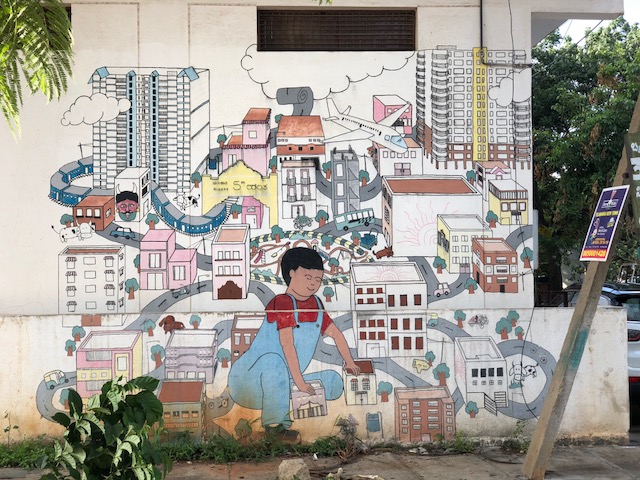
Our Indian cities don’t have much by way of street art. And what there is, looks typically municipality-commissioned.

Which is why i thought i should share a few examples of street art that ticks all the boxes of what this should be–creative, imaginative, quirky and brilliantly executed.

So I am going to let the pics speak for themselves!

A brilliant 2-level piece, partly on the compound wall, and partly on the building wall. (Note the line across the boy’s shoulder. Below that, is the the portion on the compound wall, and above on the building wall). Yelahanka, Bangalore.

2E61621F-9F75-4954-9F46-955590FBF2F7

Compound wall of a house. Yelahanka, Bangalore.

bd744ad6-bc93-4e87-9255-21e9fbc1be89.jpeg

Discarded dish antenna. GMR Institute of Technology. Rajam, Andhra Pradesh.

04AD7BC1-8698-4AE9-8D94-4A94F29005E2

–Meena

My Crores vs. Your Millions

India gave the world Zero. So should we not be a bit more assertive in the matter of numbers?

I have grown up with lakhs and crores. And I have not heard that India has officially moved to millions and billions.

2018-06-15 17.29.16_resizedWhy then does my newspaper headline inform me that 55 million Indians are pushed into poverty every year due to health spending? Isn’t it a sad enough fact for me to take in, without having to contend with doing mental callisthenics?

And an Indian research journal in which I hope to publish a paper also says that figures must be in millions and billions, not in good old familiar lakhs and crores.

Well, in the case of the research study, maybe it has been done in collaboration with American researchers? And in the second, maybe it is that the journal hopes for an international audience?

Whatever the reasons, when communicating to Indians, would it not make more sense to use familiar number-names? Is 55 million a lot? Or not so much? What proportion of the population is it? I can’t do these calculations early in the morning.

And writing numbers too! I write and relate to 10,00,000. Not 1,000,000. But will Excel allow me to? NO!

India, we hear has a lot of soft power (as well as software power). Can we not prevail upon companies making programs to have an ‘Indian number variation’, like there are options for UK and US spellings?

And even more important, can we in India—the media, academia et.al., use lakhs and crores? The Americans have proved that a country can get by in the comity of nations without switching to the metric system. Mine is a relatively small ask!

–Meena


Living Magic!

How can you not be cured by a medicine called Living Magic! That is what ‘Zinda Tilismat’, translates to! With a name like that, can you wonder that it claims to cure everything from colds to upset stomachs to toothaches, to ‘new’ ailments like swine flu and bird flu? (But no, I haven’t heard of its use in Nipah, I have to admit!)

The ‘wonder drug’ was formulated by Hakim Mohammed Moizuddin Farooqui, way back in 1920, and has been manufactured in the Zinda Tilismath Karkhana in Hyderabad since then. This Unani medicine is basically made from aromatic herbals—mainly eucalyptus, and also some camphor, menthol, thymol, etc. Amazingly, you can apply it externally or ingest it.

The pack seems to have been unchanged for all these 100 years too. It carries a picture of a spear-toting African. The reason, it seems, is that the founder was so impressed by the Siddhi guards of the Nizam that he thought that such a picture on his medicine would give it an association with strength and well-being.

1428BDE4-BC2D-494A-9D66-81395EF8673B

I have no idea if there have been clinical trials on this medicine to substantiate any or all the claims. But can you argue with a sale of 1 crore vials every year?

And the romance of the name! I am ready to be cured of anything with this. And, to its credit, the ingredients cannot do me harm!

As a Hyderabadi for some years, I obviously knew of this magic potion. But as we do with things which are local, I didn’t bother to buy it or try it. Now that I have left Hyderabad and someone reminded me of ZT, I became obsessed with it! So I made some friends buy and send me some. Now I am waiting for some (minor) illness to strike me, so that I may be magically cured.

So I suppose my message is, everything is in a name! An invaluable lesson to product managers (I began my life as one), innovators, company founders, et.al.

–Meena

Matchmaker, Matchmaker….

Shared memories are probably what define a community or nation or any grouping.

And one indelible memory shared by millions of Indians is seeing miles and miles of walls painted with:

‘Rishtey hi rishtey

Prof. Arora

Mil to lein’.

Prof. Arora rocked social media before social media was invented!

But this piece is not so much about the ‘world-famous in India’ professor, as about how matches were and are made.

Detail from ‘Matchmaker’: A painting by Nilofer Suleman

1FC2B36C-B161-48B1-8E85-4B144E33018D


When we were young (and for centuries before that, I would imagine), it was about

Pushy pishis

Mission-mode mamas

Chatty chachis

Anxious ammammas

Each activating their network of relatives, friends, acquaintances; chatting up people chance-met at weddings or house warmings or whatever; reaching out to guests of their neighbours, sisters in law of their cousins, whoever. But the fundamental strategy was ‘pass the word, pass the word’.

And boy, did it work! Everyone (except the resolutely resistant), did end up getting married.

‘Matchmaker’: Nilofer Suleman

1EBC476B-FA84-4731-AD93-0D1C690EB499


And then came a generation where it was considered OK to put up a matrimonial ad in TOI or Hindu or whatever the local dominant newspaper was. This seemed to work fairly OK too.

Today, with so-called efficient networks and all manner of specialized networking sites, that doesn’t seem to be the case anymore. I meet so many 30+ people who are not married. It could be that they don’t want to get married. But I know at least half of them do want to. But they never seem to find the right person. The trick seems to be to find a soulmate in school or college. It seems to get increasingly difficult afterwards.

Then parents come into the picture. And they are pretty clueless!

Which makes me think that we have to find some other means to fix matches. Have no idea what, but maybe go back to real-live human beings as intermediaries, rather than just bits and bytes of information floating in the ether?

—Meena

Two BHIMS I am Fan Of

The first is the hero of Randamoozham, or The Second Turn, the masterly Malayalam novel by M.T. Vasudevan Nair, based on the Mahabharata. It is told from the perspective of Bhima who never got his due, though he took the brunt of every battle, was the bravest, kept every promise, and made his share of sacrifices. The novel makes one question stereotypes and assumptions. For instance, after reading the book, you will never quite respect Yudhisthra, who comes across as self-righteous and pompous, or admire Arjun, whom we now see as egoistical and pretty focussed on himself.

bhim

It was my friend Ann, knowing of my interest in such take-offs on the epics, who told me about Randamoozham, which she said was the best book she had ever read. After a huge build-up, when I asked her to get me an English translation on her next visit to Kerala, she said she thought there wasn’t one! Anyway she said, she would check –she mentioned that there was a bookseller who sold books on the train, who was very knowledgeable, and he would be the best person to ask. And faithfully, she asked him on her next train trip from Bangalore to Kerala. And oh boy! Did she get an earful! The bookseller took a break from business and lectured her for five whole minutes about the younger generation who did not care to know enough of their mother tongue to read in it; how did they expect to get the real essence of a book written in Malayalam when they read it in English; how could she insult the writing of a master like Vasudevan Nair by even dreaming of reading his masterpiece in English. etc. etc.

Subsequently, several English translations of the book have come out. But the one I love is BHIMSEN by Prem Panicker, shared with me by my friend Unni. It has none of the hiccups and awkwardness that translations from Indian languages to English often suffer.  It is surely a work of love. I am not even sure it is published formally—what I recall is that it was published chapter by chapter on Mr. Panicker’s blog. Prem Panicker, is incidentally a cricket journalist.

(You can access the book on https://prempanicker.wordpress.com/2009/10/05/bhim-complete-and-unabridged/)

The other BHIM I love is the app for money transfer. I am in general very wary of financial transactions through electronic media. And being technologically-challenged, have great difficulty operating most of them. But BHIM is one thing which works like a dream. I routinely pay salaries using BHIM. I use it in shops. Whenever my friends buy anything on my behalf, two clicks and the money is in their account.

So folks, two messages:

Download Bhim the novel, and enjoy the best read in a long time.

Download Bhim the app, and enjoy superlative convenience.

–Meena

P.S. ‘Duryodhana’ by V. Raghunathan, is the re-telling of the Mahabharata from, you guessed it, Duryodhana’s point of view.

Rain, rain…

The Monsoon is scheduled to hit Kerala today, 29th May. Traditionally, in agriculture-based societies like ours, rain is a welcome phenomenon. Down the ages, music, art, dance, poetry in every part of India have celebrated the rains and the monsoon. There is a raga to bring rain. Lovers long for the rains. Literature celebrates the monsoons.

Even young urbanities, thanks to movies like ‘Lagaan’ will appreciate that rains are the lifeline for agriculture. And let us not forget that is not only the farmers who depend on the rains. The looming food crisis and rising prices of vegetables, fruit and produce has brought home very sharply that ultimately for everyone, it all goes back the land, to those who till the land, and to the rains.
In spite of all this, we urbanites have to admit that we are not happy to see the rains, except for the fact that it brings down temperatures. That could be attributed to two major reasons—(a) lack of preparedness of civic authorities to cope with the rains, and (b) our own increasing inability to put up with even minor inconveniences.
If the rains bring flooding to my street because the storm water drains are not kept in functional order; if manholes left open become death traps for people who are wading through knee deep water; if the roads are potholed and pitted after the rains and never mended; if improperly planned road dividers and badly leveled roads lead to stagnation and chaos—no wonder then that the normal city dweller fears the rainy season. If rains mean uncleared, rotting garbage all over; if rains mean frequent electricity cuts; if rains mean the threat of minor epidemics due to unsanitary conditions—no wonder then that we dislike the rains.
Is there anything unexpected about the rains? They come every year, on a fairly predictable date. The volume of rain is also forecasted—if not accurately, at least better than election results! Then why can our cities not prepare better? Should not every city and town worth its name have a regular plan of action to prepare for the rains? Civic authorities may say they have such plans, but isn’t the proof of the pudding in the eating?
Apart from civic authorities, we as individuals also love our comfort so much, that we cannot stand clothes drying inside the house; we cannot put up with rains disturbing our plans for an open air party; we don’t want the driver or maid to come in half-an-hour late because of the rain.
Rains bring joy; rains bring life to the land; rains are what make the world go round. Let’s bring back the joy of monsoon to our lives.
–Meena

Ministry of T

It is finding the known in the unknown, and the unknown in the known.

It is mental exhilaration and physical exhaustion.

It is anticipation and satisfaction.

It is memories of things seen and the curiosity to see new things.

8A2CDD6B-77AA-46E4-AEAA-6E2D88B21634

It is re-living old memories and storing up new ones.

It is sinking in comfort, it is roughing it out.

It is pleasant surprises and unpleasant shocks.

It is a camera lost, it is a vision captured in memory.

It is being with the family, it is getting away from the family.

It is being duped by touts, it is being helped by strangers.

It is tasting exotic food, it is finding the familiar dhabha.

It is being a bit bored, it is having a lot of fun.

It is being away from home, it is finding new homes.

It is being out of touch, it is finding new connections.

It is cockroaches in the bathroom, it is squeaky clean sheets.

It is upset stomachs, it is healthy carrot juice.

It is swearing never to travel again, it is booking tickets for the next trip.

Is this just me, or do most people think of travel like this?


–Meena


Of Libraries and Books

We lived in a government colony in Delhi. A library van used to visit every week. Come Friday, without a doubt, the van would be at the end of our street. We would queue up, return our book, get into the van, choose another book, have it stamped and come out. A lot of strategic planning was involved. Like ‘You take this book, I’ll take that one. You finish by Tuesday and we will exchange.’ Or hiding a book you wanted (next-most after the book you took) behind a pile of other books in an obscure stack, in the hope that it would remain hidden till the next week when the van returned.

These vans were run by the Delhi Public Library system. I marvel today at this amazing service. I am not aware of any such today, that too run by any government system.

A second mainstay of our reading was our school library. We had a library period every week, and it was compulsory to borrow a book. Occasional book report requirements were put in to ensure we did read them, though for at least half the class, this wasn’t necessary.  As I recall, the borrowable collection was mainly fiction. (For some reason, our school was paranoid about our bringing ‘non-authorized’ books into the premises. There would be random surprise checks and any such book would be confiscated! Considering how innocent we were and how little access we had to unsavoury reading material, this seems rather excessively zealous. But those were different times!)

And last but not the least, the neighbourhood ‘lending library’. This we were allowed to visit only during the long breaks (summer and winter holidays). And were given a limited budget, which usually stretched to one book and one comic a day. Going to the library also involved a daily outing and a walk of 20 minutes either way. But while this was good exercise for the body, regrettably, it was not great exercise for the mind, as we raced through upwards of 50 M&Bs and 50 Archie comics during a typical summer break—with an occasional Alistair Maclean, Nevil Shute or latest bestseller thrown in. But well, it helped improved our reading speed (because we used to try to finish a book overnight and swap, and try to finish another one a friend had borrowed before it was time to walk to the library).

As we grew older and more independently mobile, it was of course the BCL and the USIS. These were usually fortnightly outings in small groups from college.

How many children or adults are members of libraries today? I know a lot of people read. But it seems everyone just buys each and every book they want to read. But the excitement of reading is also partly in looking for and stumbling upon books in a library; it is yearning to lay your hands on a book, and conniving and strategizing—from reserving it in a library to striking complex deals with friends.

20180518_135152_resized

I don’t want to buy every book I want to read. I have no space. I don’t want to spend that much. And I do want to stumble upon books. Not in a bookshop setting, where books are not arranged as I like them, but in a library-like situation.

As of the last few years, ‘Just Books’ has been my library. I have to admit, since I am a ‘deliver to’ member, I don’t have the pleasure of browsing. But I do browse through their huge online catalogue and put books on the waitlist. There is a little thrill in not knowing which two books will land up at my door in a particular week, out of the 50-60 on the waitlist. It is a low-risk option—I put likely looking books on the list, and if I don’t like it, I just abandon it after the first 30-40 pages. And my shelves are not heaving with the addition of more and more books.

If you don’t know about Just Books, do check it outback (www.justbooks.in). It is a network of about 700 neigbourhood libraries, with a holding over about a million books, in English and most Indian languages. And it has an option of home delivery of books.

Happy reading!

–Meena

Lemon Tree Very Pretty, or The Recalcitrant Citrus

Those who grew up in the ‘70s would remember this song. It went something like this:

‘Lemon tree very pretty
And the lemon flowers are sweet
But the fruit of the lemon
Is impossible to eat.’

I grew up in Delhi, and in my youth had not seen a lemon tree. So I took the first few lines of the song to be true. But I always wondered about the last two lines. Sure, we didn’t eat the lemon, but we couldn’t get by a day with it! The rasam, the dal, the nimbu paani, the lemon rice, the zing needed to cover up any insipid dish. The lemon was irreplaceable.

A few years ago, we moved to Bangalore. And for some reason, the price of lemons soared that year. Considering we use about 10 a week, my veggie budget soured. Having a small plot at the back of the house, I decided to grow my own lemons.
The next day, I marched off to the nearest nursery. The nursery-wallah sold me a lemon tree (over the years, the feeling has grown that he actually sold me a lemon, but more on that!). He assured me it was a hybrid and would start flowering the very year. ‘Pluck out all the flowers this year’, he said. “Then next year, you will get a good crop.’

I looked out of the window every morning to check on the flowering so as to quickly pluck them out, lest they jeopardize the long-term fruiting. After several months, there was one bud. I plucked it out.

Along came the next year. Oh, the anticipation! I waited and waited for my tree to flower. Every time I picked up lemons from the vendor or the super market, it was with a sense of ‘Listen, I am paying your price now. But you are not going to take me for a ride for too long. Just wait till my tree starts fruiting.’
It was a case of the milkmaid and her castles in the air!

My tree did not flower that year.
Or the next.
I shared my sob story with anyone and everyone who would listen.
Then a friend told me to beat the tree with a broom, in the night! She said that it was a well-known remedy for such recalcitrant lemon trees! I got home and googled it, and sure, there were lots of people talking about this. Quite a prevalent urban myth! Many posts suggested that it was the beating with the broom that was at the core of it. The beating at night, they said, was so that the neighbours didn’t think the perpetrator was mad!
Nothing to lose, I thought, and did the needful for a week, in the dead of night. Though I have to admit, I couldn’t bring myself to beat it very hard!
A month or so after that, I went to a Krishi Mela. Lots of agri-related people and enterprises had stalls. I picked a couple of likely looking ones and shared my woes. The first listened, asked me a few questions, and declared that there was no hope. I just needed to pull out the tree and plant another one. The next stall guy told me the problem was completely solvable, and sold me a few soil tonics and leaf sprays, which he assured me would fix it.
I followed the instructions. And also beat the tree once in a while for good measure.
And lo and behold! The tree flowered. Rather generously. At last, I thought! Whether the beating or the tonics, one or both seem to have worked. I didn’t care which!
The flowers turned to fruit. But my days of waiting are not over. The fruits haven’t grown bigger than a large marble, in two months. My neighbour’s tree in the meanwhile is full of large, yellow fruit.

Believe me, the lemons look much bigger in the pic than on the tree!

66099837-DC6B-4FD7-B4EA-5C32F9AF7F64
I look out of the window every morning and think: ‘The lemon tree is not a particularly pretty tree. Nice enough but nothing spectacular. The flowers are nice too—small and white. But again, the anar next to it has prettier flowers. But the fruit of the lemon is what I want, but will I get it?’
Will I be  a sour loser this year too? Well, at least I will try not to be a sore one!
–Meena