How Pleasant to Know Mr. Lear*

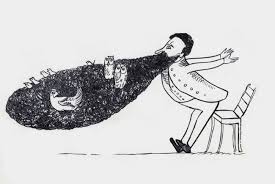
There was an Old Man with a beard,
Who said, ‘It is just as I feared!

Two Owls and a Hen
Four Larks and a Wren,
Have all built their nests in my beard.
old man.jpg
Original illustration by Edward Lear Source: Google


No this is not 2020 Corona humour, although it pithily describes one of the fallouts of the lockdown! The verse was written by Edward Lear nearly 200 years ago. Lear is popularly associated with the Limerick, and best known for his
A Book of Nonsense, which he also illustrated, that was published 1846.

Limerick is a form of nonsense verse in which the first, second and final lines end with rhyming words, while the third and fourth shorter lines have their own rhyme. In Lear’s limericks the first and last lines usually end with the same word rather than rhyming. For the most part they are truly nonsensical and devoid of any punch line or point.

Interestingly, while he is best remembered for his absurd wit, Edward Lear was a popular and respected painter of his time. Born in London on 12 May 1812, one of 21 children, Lear was forced to start earning a living when he was just 15. This he did by selling his art and by teaching drawing. In 1832 he was employed by the London Zoological Society to illustrate birds, and later went on to work for the Earl of Derby who had a private menagerie on his estate. Lear stayed there until 1836.

Around this time Lear decided to devote himself exclusively to landscape painting (although he continued to write his nonsense verse.)  Between 1837 and 1847 he travelled extensively throughout Europe and Asia. After his return to England, Lear’s travel journals were published in several volumes as The Illustrated Travels of a Landscape Painter. Lear eventually settled, with his cat Foss, in Sanremo on the Mediterranean coast at a villa he named Villa Tennyson after Lord Tennyson whom he admired. He continued to paint seriously till the end of his life in 1888.

Edward Lear had a sickly childhood, and also suffered from epilepsy and depression. But in his verses he poked fun at everything, including himself. His irreverent humour, love for the ridiculous, and cooked-up nonsense words were like cocking a snook at the prissiness and orderliness of the Victorian society that he lived in.  Also different from the expected upright behaviour which was the norm of the period, the characters in his verses often indulge in absurd and outrageous antics.

His love for silly word play “a perpendicular, spicular, orbicular, quadrangular, circular depth of soft mud”;  his weird and wonderful creatures like Moppsikon Floppsikon bear and  “diaphanous doorscraper” (stuffed rhino); the characters with names like Quangle-Wangles, Pobbles, and Jumblies remind me of another favourite—Roald Dahl.

I have always loved the nonsense verse of Edward Lear. I remember memorising and reciting The Owl and the Pussycat, perhaps his most famous poem, when I was in school. The words seemed to frisk and gambol just like the characters.

They dined on mince, and slices of quince,
Which they ate with a runcible spoon;
And hand in hand, on the edge of the sand,
They danced by the light of the moon,
The moon,
The moon,
They danced by the light of the moon.

We all need a bit of silliness in our lives, especially in these strange days of uncertainty. Today as we celebrate Lear’s birthday as Limerick Day, also marked as Owl and Pussycat Day, here is my humble offering to the memory of Mr Lear!

There was a wicked virus from Wuhan

Who said its time to cause some mayhem

I’ll travel the world for a lark

And make sure they close every park

That villainous virus from Wuhan.

*How pleasant to know Mr. Lear is the title of Lear’s self-portrait in verse.

–Mamata

.
Tuk Tuk

Tonk tonk tonk…it starts before dawn has broken. Even before the crows start their warm-up caw-caws, and the magpie robin tunes up to launch into its melodious repertoire. 

IMG_20200430_111905.jpg
Spot Tuk Tuk! 

A steady metronomic metallic sound—like the hammer of a coppersmith softly hitting the metal.  The Coppersmith of the avian world is awake and ready for another call-marathon.

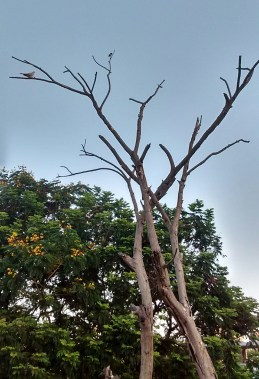
Last week when it first began calling, I rushed out to look for the source of the sound. It seemed to be all around—almost like sound-surround! But I know where look for it–the remains of the big rain tree that once overlooked my kitchen wash area. The tree died naturally last year, but its skeletal remains continue to invite so much other life–to perch, to play, and to pause awhile. This is the Coppersmith’s favourite post. And sure enough there it was—on the highest point of the tallest bare branch—a speck against the blue sky. Almost invisible, but certainly not inaudible. It puffed up its chest, and raising and bobbing its head from side to side (perhaps the secret of the sound surround!) called out like a muezzin from the minaret.

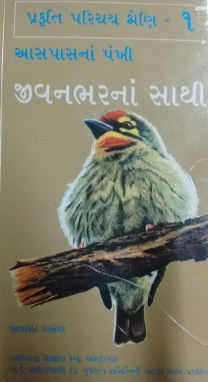
The Crimsonbreasted Barbet, as it is ornithologically called,

IMG_20200430_110942.jpg
Cover bird of my favourite bird book!

is a small bird with a loud call. It  is just a little bigger, but chunkier, than a sparrow, but certainly not as drab. It dons a striking combination of brilliant colours—grass-green top feathers and green-streaked yellowish underparts; a crimson forehead and patch on its breast; vibrant yellow throat, and concentric eye rings of red and yellow. It has distinctive whisker-like feathers around its stout black beak, and a short truncated tail.

My bird book tells me that this bird is mainly a fruit eater, and is commonly found wherever there are fruiting trees, especially fig or banyan. The closest trees around my house are Gulmohar and Copper pod, which are also in full bloom, but not with the fruits and berries that this bird likes so much. Perhaps it finds these in the park next door. Although it baffles me, given the very short breaks between the continuous metronomes, how it manages to partake of sufficient nourishment to sustain its energy to call non-stop.

As the sun climbs higher, other birds fall silent as they seek refuge from the heat in the foliage of trees and hedges. But not our relentless caller. Under the blazing sun, on a high bare treetop, it goes on and on. Funnily, nowhere could I find out why it calls—is it to attract a mate? Difficult to know as both male and female look alike! Is it to warn of predators and danger? But then, why call continuously? Or is it for the sheer joy of being alive and and sharing its song each day? I rather like to think of it this way!

Last evening during a lull, I scanned the tree and spotted it perched woodpecker-like, using its strong beak to excavate a hole in the dry branch. I discovered that it nests and roosts in these small holes.  I am glad though that it has chosen to make its look-out point, and perhaps its home, on our tree. It is nice to have a Tuk Tuk for a neighbour!

Tuk Tuk is one of the common Gujarati names for the Coppersmith.

–Mamata


Earth Spring

22 April 1970 saw what, at the time, was perhaps the planet’s largest civic event. Millions of American citizens took to the streets, college campuses and hundreds of cities to protest environmental ignorance and demand a new way forward for our planet.
“Earth Day” as this event was dubbed, was a unified response to the numerous environmental crises that engulfed the world in the 1960s—oil spills, smog, polluted rivers, and newly exposed dangers of pesticides.

2020 marks 50 years since what was considered to be the trigger that launched the modern environmental movement. In the five decades since, much has transpired and much has changed for, and on, planet earth. Despite all the noble intentions, movements and efforts (which I have also been a part of for three decades), the planet seems to have been damaged beyond limits, plummeting in recent times into an uncontrollable downward spiral. Poisoned waters, toxic air, melting ice, disappearing forests and vanishing wildlife have become so much a part of the daily news that we have become inured. Worst still, we continue to pretend that all will be well—after all man is the master of technology, and we will find the answers.

It has taken 50 years for Earth to have gotten a respite from human interference. Ironically, this has been given by an invisible, seemingly indestructible microbe.

Almost a hundred years ago, pioneering environmental philosopher John Muir wrote “The universe would be incomplete without man; but it would also be incomplete without the smallest transmicroscopic creature that dwells beyond our conceitful eyes and knowledge…”

In the three months since this ‘creature’ has sent us scurrying for shelter, and changed the world as we know it, the earth is changing too. It is coming back to life.

The theme for this year’s Earth Day was Climate Action and events were planned to draw attention to the critical need to take action to combat climate change. Ironically, what a hundred conferences did not do for climate change, is happening today simply without human activity.

When I read about the revised suggested activities for a house-bound Earth Day it made me wonder though! All the activities were digital– webinars, online learning, nature videos, teach-ins and make-ins, and more. Everything that called for virtual interaction through digital media. What a paradox! What a missed opportunity to open windows and minds to the world outside. Some thoughts on this.

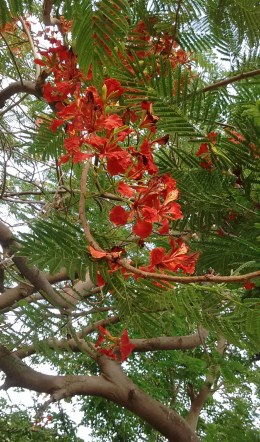
A lot is being written and shared about windows and balconies. WIMG_20200306_071238550 (1).jpghile these are great to reach out to other humans, they are also a wonderful opportunity to be inside looking out, at nature. One does not have to be in the countryside to see Nature. Even in the midst of the urban jungle, look from the same balcony or window, and you will discover—a bird, a butterfly a bumblebee, a spider. A patch of sky and a puff of cloud. The branches of a tree with fresh green leaves, a bird call, a shaft of sunlight on a wall, or the stars on a clear night.
One doesn’t have to be outdoors to do one’s bit for Earth day. Just making time to stop and stare is as much a contribution as a ‘run for earth marathon’.

And why make Earth Day just a one-day celebration? Even in 1970, the entire month was marked by events and it came to be called Earth Spring.

In these unusual times, let us be grateful for Nature which is never in ‘shutdown’! Come let us celebrate every moment, every day of our Earth Spring.

–Mamata


What an Irony!

…Or contradictions in the time of Corona.

Confession. I belong to the age of dinosaurs! Not so old as to reminisce about the freedom struggle, and World War 2 (which my parents did), but old enough to remember one short war, night curfews and blackouts, and shortages. Old enough to remember a time when gymming, pubbing, clubbing, beauty and retail therapy were not considered to be critical to one’s physical and mental health. When staying indoors as a family was not unheard of, and what to do with one’s time was never a stress-inducing problem.

It is in the last month, as they say, “the world as we know it had changed.” Coronatimes newspapers, and especially the Lifestyle and Leisure supplements reveal that yes, the world has changed, but in different ways for different people. I cannot help but think back, and chuckle a bit at the contradictions!

Then and Now…

‘Staycations’ were the trendy way to spend your holidays; but now staying at home for free becomes ‘confinement’.

People went to expensive health spas for detox stints; now have DTs at home without their sustaining substances.

School vacations were a time of simple self-devised ‘time-pass’ activities (or lack of activities); not a time of huge stress for parents as to how to keep the children “engaged”.

Summer holidays were marked by hours spent playing cards, ludo and carom with relatives of all ages; now newspapers feature pictures of this as a wonderful sign of how indoor games lead to ‘family bonding’.

‘Social distancing’ was a cause for concern and counselling, as people addicted to virtual reality could not relate to real people; now when it becomes mandated, people want to break it.

Page 3 celebrities fill pages with pictures of “doing the dishes” or “playing with baby”; while numerous stories of unseen unsung heroes who are risk their own life to save others are inconspicuous among the headliners.

People have to be taught how to cover their faces when outdoors, something the two-wheeler female riders of Ahmedabad have been adept at for years.

Now Kitchen Hacks on innovative ways to make provisions last longer, and replacements for quinoa and parsley; when generations of homemakers have learnt and practised ‘living within their means’ with some saved for a rainy day.

While some eagerly await the resumption of Swiggy and home delivery from restaurants, many middle-class housewives wake up early every day to join the voluntary cooking efforts to feed the homeless and hungry.

Glossy pictures of designers displaying their designer masks; news items of hundreds of ordinary women sewing for hours to make and distribute masks made from old clothes.

Once people had to wear masks when the sky was grey and smoggy; now everyone has to wear masks when the sky is clear and blue.

Then, health and well-being pundits urged and cajoled people to get off the couches and walk; now people are risking fines and arrests to go out for a walk.

Now we need Life Coaches to tell us how to spend our day from the time we open our eyes to shut-eye time; then people did not have time nor leisure to need such coaching, but a lot of basic common sense to guide in how to live, and thrive.

Then we scoffed at mothers and grandmothers who judiciously planned, saved and put away things that “you never know when these may help”; now we remember with nostalgia and regret (or gratitude) that ‘old ladies’, old fashioned’ advice.

SARS CoV-2 did to CO2 levels what 25 Climate Change COPs could not do!

The virus of fake news spreads much faster than the Covid-19.


With gratitude and humility for those of us who are lucky to have the wherewithal to lead the life we do.

–Mamata


Hail, Nightingales!

Two news items last week took me to my cache of ‘saved for a rainy (read lockdown) day’ books.

The first was that the tagline for this year’s World Health Day is ‘Support Nurses and Midwives’. April 7 is celebrated as World Health Day as it marks the anniversary of the World Health Organization which was founded in 1948.

The second news was that on April 3 Britain’s first emergency field hospital exclusively for coronavirus patients was inaugurated in the East End or docklands of London. More remarkable, that a large exhibition space, usually used for large events such concerts and conferences, was transformed into this 4000 bed hospital in just nine days. The hospital is fittingly called NHS Nightingale Hospital. Similar Nightingale hospitals are planned to be set up in different cities of UK, as emergency sites to treat coronavirus patients.

Calling these facilities Nightingale hospitals, is an apt and timely reminder of Florence Nightingale, who almost 200 years ago changed the face of nursing from a mostly untrained profession to a highly skilled and well-respected medical profession with very important responsibilities.

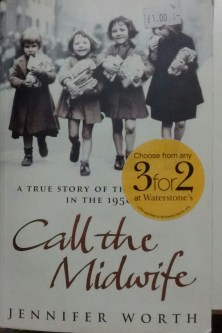
These stories took me to the book titled Called the Midwife by Jennifer Worth. The book is the memoir of the years that Jenny, this young nurse anIMG_20200407_111221.jpgd midwife spent in the poor slums of the East End of London. 23 years old and newly qualified she lived and trained as a midwife with a dedicated group of nuns St Raymond Nonnatus.

Though set in the 1950s, the conditions of the area, and the people who lived in these docklands were appalling in terms of health, hygiene and sanitation. The book recounts anecdotes that paint vignettes of the people, and the experiences as a midwife, delivering babies at home amidst challenging and often overwhelming circumstances. But where the narration could have been dark and depressing, Jenny’s description of her patients and their families brings out the touching humanity, and tough spirit that rises above the squalor. Whether it is the pen portraits of the nuns, each with a unique personality; the fellow trainees; and the soon-to-be or new mothers (from the first baby of a 14 year-old girl, to the 25th baby of a 45 year-old woman!), the book captures the power and spirit of the vocation. Rushing on their bicycles through the freezing smoggy streets with their simple delivery bags to attend a calling the middle of the night (almost 100 deliveries a month), to the daily routine of morning and evening home visits for pre and post-delivery check-ups, one cannot help but applaud the total dedication and role of the midwives.

Interestingly in India generations of children had been born at home under the hand of the local midwife or dai. Around the time when Jennifer Worth was a midwife in England, hospital deliveries started becoming more common in India. In the last fifty years, with advances in the world of medicine, and advancing technology, the traditional art and craft of midwifery was replaced with the science of sonography and Csections. Interestingly, in the last ten years or so, there seems to be a return to the traditional ways of childbirth. While at the one end of the spectrum, there are boutique clinics offering 5-star deliveries, other young women are opting to ’call the midwife’. And there is a new generation of Jennys who are undergoing the rigorous training of midwifery to qualify and practice as midwives.

It is fitting indeed that WHO has designated 2020 as the Year of the Nurse and Midwife, in honour of the 200th birth anniversary of Florence Nightingale who fought, against all odds, in the frontlines of the Crimean war. And once again, more than ever before, it is time to salute these brave and tireless soldiers who are at the frontline of the Corona war. Hail, to all these Nightingales! year of the nurse.jpg

–Mamata

Friends in Need

“They are friends waiting for us any time we want them, and they will always speak honestly to us about what really matters. They are the perfect cure for loneliness. They can be our very closest friends.” They are books, wrote Swiss-born British philosopher and essayist Alain de Botton, in a letter to children.

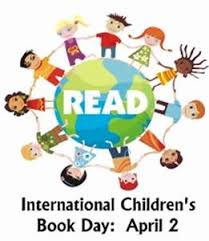
Today is the day to celebrate this timeless friendship. April 2 is International Children’s Book Day, a worldwide celebration to highlight children’s literature and encourage the love of reading among children. This date marks the birthdICBD.jpgay of Hans Christian Anderson one of the best known children’s writer who was born on 2 April 1805 in Denmark.

The celebration of this day began in 1967, initiated by the International Board on Books for Young People, or IBBY. Each year a different National Section of IBBY has the opportunity to be the international sponsor of ICBD. The hosting country picks the theme for the year and invites a prominent author from that country to write a message to the children of the world and a well-known illustrator to design a poster.

This year, IBBY Slovenia is hosting this day, and the theme is “A Hunger for Words.” Slovenian writer Peter Svetina has written the message for this theme. Sharing a few lines: “Words in poetry and in stories are food. Not food for the body, not food that can fill up your stomach. But food for the spirit and food for the soul.”

In the days of lockdowns when parents around the world are despairing, and desperate to “keep children occupied” why not open up a menu of books, to explore and discover, to taste and savour, and to assuage the hunger of a restless mind. This will plant the seeds of the magic of stories that will grow with them as friends, and sustain their spirit through the many unknowns that lie ahead.

Equally relevant, and perhaps one that presaged the year to come, was the theme for 2019 which was Books Help Slow Us Down. Lithuania was the host, and Kęstutis Kasparavičius the Lithuanian writer wrote this inspiring message.

“It seems that books have this wonderful quality – they help us slow down. As soon as you open a book and delve into its tranquil depths, you no longer fear that things will whizz by at a maddening speed while you see nothing. All of a sudden, you come to believe you don’t have to dash off like a bat out of hell to do some urgent work of little importance. In books, things happen quietly and in a precisely arranged order. Maybe because their pages are numbered, maybe because the pages rustle gently and soothingly as you leaf through them. In books, events of the past calmly meet events that are yet to come. …Someone who enjoys reading – be it a child or adult – is much more interesting than someone who doesn’t care for books, who is always racing against the clock, who never has time to sit down, who fails to notice much of what surrounds them. …Books help us not to rush, books teach us to notice things, and books invite us or even make us sit down for a while.”

Around the world, for perhaps the first time, we have been forced to slow down, to sit down for a while (and wonder what to do with ourselves). What better time to use this opportunity to revisit our old friends—books– that were part of our young and innocent days. And what could be more joyful than rediscovering these in the company of children? A beautiful way to celebrate this special day!

–Mamata

Ides to Ideas

Beware the Ides of March! Perhaps never in the living memory of humankind, has this dire and gloomy prophecy proved so true. It is in this month that the world has been brought to its knees by an invisible force that seems to have united all of humanity in facing a common enemy.

The world, and way of life as we know, have overnight, changed beyond our wildest imagination, and no soothsayer can foretell what lies ahead, in the near and distant future. From now on, the month of March will be marked as the month that changed the world.

But before all this began, March had been designated as the International Ideas Month.

Ideas–our brain is churning out ideas all the time; even though we may not consciously register these. From small ideas about routine matters, ideas.jpgto Eureka moments, ideas keep our little grey cells ticking away. Sometimes we let these slip away because we are preoccupied with what we feel are more serious or important matters, and sometimes because we feel that the ideas is too inane to pursue.
International Ideas Month is meant to celebrate the value of ideas. And an encouragement to get one’s ideas rolling—no matter how silly, or profound they may seem.

Ideas spring from imagination, and imagination is the single most useful tool mankind possesses. And yet in these times when even creativity is measured by its market price, or ideas that help make large profits; imagination is seen as the indulgence of children and dreamers, writers and painters.

In the words of American author Ursula K. Le Guin “Imagination is not a means of making money. It has no place in the vocabulary of profit-making. It is not a weapon, though all weapons originate from it, and their use, or non-use, depends on it, as with all tools and their uses. The imagination is an essential tool of the mind, a fundamental way of thinking, an indispensable means of becoming and remaining human. …Like any tool, the imagination requires that we first learn how to use it or, rather, that we unlearn how to squander it. Children have imagination to start with, but as we grow, we tend to put aside imagination as an indulgence. All human beings need exercises in imagination as they need exercise in all the basic skills of life, bodily and mental: for growth, for health, for competence, for joy. This need continues as long as the mind is alive.”

One way to nurture imagination is to give the time and space that ideas need to take root and grow. This garden cannot be meticulously planned, pruned and scheduled. Ideas turn up anytime, anywhere—on a morning walk, at the kitchen sink, in the shower, and in the middle of the night.

Because Ideas do not have a fixed time and place to appear, it is important not to let them slip away. Grab them, capture them on paper, take your time and mull over them, incubate them, or put them into practice right away!

The right time and space is now–when we are in a physical lockdown. While we cannot physically wander far and wide, when we seem to suddenly have time on our hands–What better time to unlock and unleash all those ideas that have been hibernating or aestivating in our minds.

Turn the Ides of March into the Ideas of March.

–Mamata


Once Upon a Time…

These four words open up windows to entire universes—unexplored, or familiar. This is how many a story begins. Stories are a life force that have imbued human life with that something extra, since the dawn of civilization. Stories are a way to convey history, culture, language, spirituality, and identity. One way to keep stories alive is storytelling. Storytelling is one of the oldest forms of communication.

20 March is celebrated as World Storytelling Day–a day to remember and remind ourselves of the magic and power of stories. What began in Sweden, on this date in 1991, as All Storytellers Day has now become a global celebration of the art of oral storytelling. On World Storytelling Day, as many people as possible tell and listen to stories in as many languages and at as many places as possible, during the same day and night.

On this day I celebrate a storyteller who collected, recreated, and created a timeless repertoire of stories. Generations of children have grown up with these tales, told and retold by parents and grandparents over the last one hundred years. This was my grandfather Gijubhai Badeka, one of Gujarat’s foremost educationists and storytellers.

In Gujarati, as in most Indian languages, the child reader had remained somewhat neglected till the middle of the nineteenth century. There was hardly any specific literature for children; only stories retold from classical Indian literature, or heroic stories from Western literature, in not very satisfactory translations. Gijubhai pioneered the creation of special literature for children that also contributed to preserving the oral tradition of literature through exploring and compiling the rich legacy of folk literature. His search for folk tales crossed the boundaries of language and country. This journey of exploration he described thus, in his seminal work titled Vaarta nu Shastra (The Art and Craft of Stories) published in 1925. “So many stories have travelled in foreign lands, so many stories have changed their religion and form; it is an adventure to trace their journeys. If we become wandering travellers with the stories, we will discover that we find one story in Tibet and will see the same story in Africa; we will discover the same story wrapped in snow at the North Pole, and yet if we wander in the Arabian desert, there it will be, but uncovered and bare…but still we recognise the story. Some stories adapt to their land, taking on the form and language of their adopted home, while others retain their origins wherever they may settle. Some stories follow the creed of universal brotherhood, they see the world as their home and go wherever they get a chance to serve and please. Some settle firmly in different countries and come to be recognised as belonging to that place. They are then only translated to reach other countries.”

Many of Gijubhai’s stories are members of this travelling band. Gijubjai transformed and localised these stories, so that they are steeped in the sounds and colours of Gujarat, and have today become not only Gujarati, but uniquely ‘Gijubhai’s’ stories. They are simply told tales characterised by a mixture of prose and rhyme. The repetition of rhymes makes for lively storytelling which listeners join in. Gijubhai retold delightful tales of ordinary people, and familiar birds and animals. With equal panache he churned out stories of common folk with common trades—tailors, potters, barbers, shopkeepers, but also kings, queens and princesses. The characters reflect basic human traits—greed, envy, fear, desire for one-upmanship. Animal tales reflect a close and symbiotic relationship between animals and people. Many open with “once upon a time”… and end “happily ever after.” A hundred years after they were written these stories still touch a cord in the child, and also the child in each of us.

Stories are older than us, they are smarter than us, they keep going, and they are a part of us even though we do not realise this. But stories need human beings to reproduce, much as we need food… we need things to keep ourselves alive.

Hungarian-born American polymath Thomas Sebeok said “…what we can do, I think, is try and create stories that are interesting enough and important enough that our grandchildren might want to tell those stories to their grandchildren — because that’s the purpose of stories, that’s what they’re for: They make live worth living and, sometimes, they keep us alive.

In my own small way, I try to carry forward the legacy of my grandfather by translating and retelling these timeless tales.

–Mamata

Forth and Back

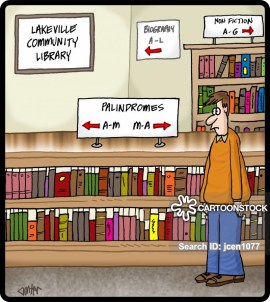
“Madam I’m Adam”. When I was young I was amused by this clever phrase because one could read it the same way from left to right and right to left. As my interest in words and love for word play grew along with me, I was always looking for such words or phrases. Somewhere along the way I discovered that a word, sentence, verse, or even number, that reads the same backward or forward was called a Palindrome. The English word Palindrome was created in the early 1600s based on Greek roots that literally mean “running back on itself” (palin meaning ‘again’ or ‘back’, and dromos meaning ‘running’.)

I began to collect examples of these, and was excited whenever I found one; one highlight being ‘A man, a plan, a canal-Panama’. Until I discovered that there were more avid collectors, and loads of such examples. Here is sharing some, from the daily use ones (that we do not even register as being palindromes) to the funny, clever ones.

Family–sweet and simple in any form: Mum, mom, amma, pop, dad, sis.

Moving on to mechanics–rotor, level, racecar, radar, refer, reviver, rotator, and repaper… (graduating to the next level as ‘Won’t I repaper? Repaper it now!’

Some simple (and sometimes silly) ones:

palindrome.jpg
Source: Google

Dennis sinned.

Don’t nod.

Never odd or even.

No lemons, no melon.

We panic in a pew.

Won’t lovers revolt now?

Sir, I demand, I am a maid named Iris.

Eve, mad Adam, Eve!

Never a foot too far, even.

Nurse, I spy gypsies, run!

Delia sailed as sad Elias ailed.

Ned, I am a maiden.

Some clever ones:

A hitman for hire: Murder for a jar of red rum.

A gross creature: Oozy rat in a sanitary zoo.

Call your mother: Mum

Sane advice: Do not start at rats to nod.

Weather forecast: Too hot to hoot.

Teutonic pride: I, man, am regal; a German am I.

Philosophical musing: Do geese see God?

Old cats: Senile felines.

On ET’s menu: UFO tofu

Bad eyesight: Was it a car or a cat I saw?

A moral dilemma: Borrow or rob?

And one curious one–Murdrum (the crime of killing an unknown man).

And our own and bona fide one: Malayalam!

A wonderful one that sounds like what it means: Tattarrattat—meaning a knock on the door. It was coined by James Joyce and used in Ulysses in 1922. It is also the longest palindromic word in the Oxford English Dictionary.

And last but not the least, there is even a palindromic word for an irrational fear of palindromes—aibohphobia! WOW!

–Mamata